📋 Key Information Summary
- Vericiguat (Verquvo®) is a soluble guanylate cyclase (sGC) stimulator that enhances the NO–sGC–cGMP signalling pathway independent of nitric oxide availability.
- Indicated for worsening chronic heart failure with reduced ejection fraction (HFrEF, LVEF <45%) in patients who have had a recent decompensation event requiring IV diuretics or hospitalisation.
- The VICTORIA trial demonstrated a significant reduction in the composite of cardiovascular death or first heart failure hospitalisation (HR 0.90, 95% CI 0.82–0.98, p=0.019) versus placebo over a median 10.8 months.
- Absolute risk reduction was 4.2% (NNT ≈ 24 over ~1 year) for the composite primary endpoint.
- Starting dose is 2.5 mg orally once daily, titrated every 2 weeks to a target of 10 mg once daily.
- Common adverse effects include symptomatic hypotension (≈9%) and anaemia; vericiguat is contraindicated in pregnancy (Category X).
- Concomitant use with PDE-5 inhibitors (e.g. sildenafil, tadalafil) is contraindicated due to risk of severe hypotension.
- No clinically relevant renal or hepatic dose adjustment is required; however, caution is advised in severe hepatic impairment (Child–Pugh C).
- Vericiguat is listed on the PBS as an Authority Required item for eligible patients with worsening HFrEF.
- It should be considered as an add-on to guideline-directed medical therapy (ACEi/ARNI, BB, MRA, SGLT2i) — not as a substitute for established pillars.
- Aboriginal and Torres Strait Islander patients experience higher heart failure hospitalisation rates; equitable access to vericiguat should be prioritised through PBS authority pathways and culturally safe prescribing.
- Vericiguat is NOT indicated for acute decompensated heart failure or HFpEF; it is initiated during stabilisation after a worsening event.
Introduction & Australian Epidemiology
Vericiguat is a first-in-class soluble guanylate cyclase (sGC) stimulator approved for the treatment of worsening chronic heart failure with reduced ejection fraction (HFrEF). It represents a novel therapeutic mechanism distinct from neurohormonal blockade and SGLT2 inhibition, acting directly on the impaired NO–sGC–cGMP pathway that is downregulated in the failing myocardium and vasculature.
Heart failure affects an estimated 480,000 Australians and accounts for over 66,000 hospitalisations per year, making it one of the leading causes of unplanned readmission in Australia. In-hospital mortality for acute decompensated heart failure remains approximately 4–5%, and one-year all-cause mortality following a heart failure hospitalisation exceeds 20%. Aboriginal and Torres Strait Islander peoples experience heart failure at younger ages and with higher rates of hospitalisation and mortality compared with non-Indigenous Australians, reflecting disparities in cardiovascular risk factor burden, access to specialist care, and socioeconomic determinants of health.
Despite the expansion of guideline-directed medical therapy (GDMT) to four foundational pillars — ACE inhibitors or angiotensin receptor–neprilysin inhibitors (ARNI), beta-blockers, mineralocorticoid receptor antagonists (MRAs), and SGLT2 inhibitors — residual cardiovascular risk remains substantial in patients who experience worsening events. Vericiguat addresses this residual risk by targeting a distinct pathophysiological mechanism: endothelial dysfunction and impaired myocardial cGMP signalling.
In Australia, vericiguat (Verquvo®) was approved by the Therapeutic Goods Administration (TGA) and is available on the Pharmaceutical Benefits Scheme (PBS) as an Authority Required medication for eligible patients with worsening chronic HFrEF. This guideline reviews the mechanism of action, pivotal trial evidence, indications, patient selection, dosing, and safety profile of vericiguat in the Australian clinical context.
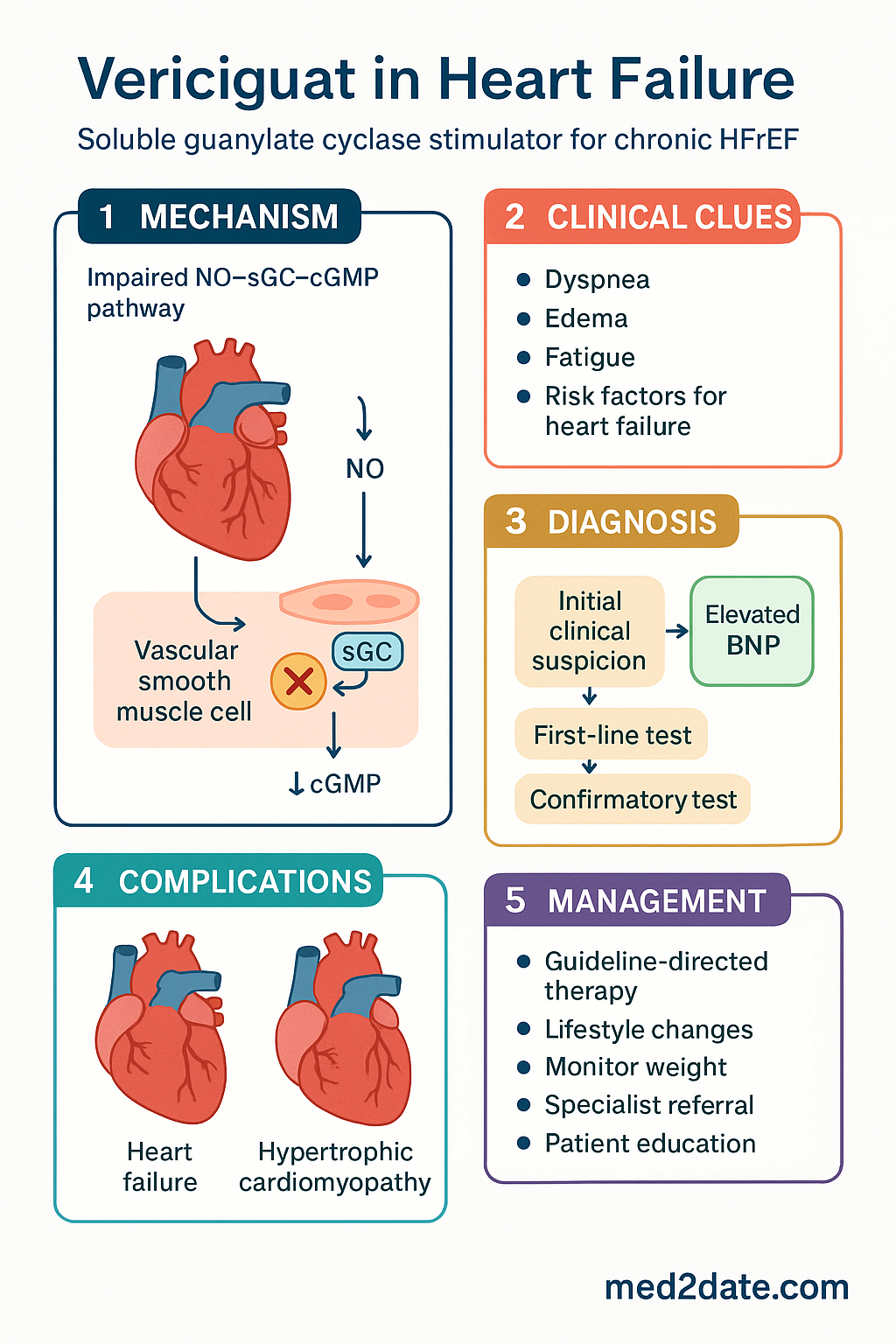
Mechanism of Action (sGC Stimulation)
Vericiguat works by directly stimulating soluble guanylate cyclase (sGC), a key intracellular enzyme in the nitric oxide (NO)–sGC–cyclic guanosine monophosphate (cGMP) signalling pathway. This pathway is critically important for cardiovascular homeostasis, regulating vascular smooth muscle tone, myocardial contractility, and cardiac remodelling.
The NO–sGC–cGMP Pathway in Heart Failure
In chronic heart failure, the NO–sGC–cGMP pathway is impaired through multiple mechanisms:
- Reduced NO synthesis: Endothelial dysfunction and oxidative stress decrease endothelial nitric oxide synthase (eNOS) activity.
- NO scavenging: Increased reactive oxygen species (ROS), particularly superoxide, react with NO to form peroxynitrite, reducing effective NO bioavailability.
- sGC oxidation and degradation: Oxidative stress converts sGC from its NO-sensitive ferrous (Fe²⁺) state to an NO-insensitive ferric (Fe³⁺) or haem-free form, which is resistant to activation by NO.
- Downstream cGMP deficiency: The net result is reduced intracellular cGMP, leading to impaired vasodilation, increased preload and afterload, adverse myocardial remodelling, and cardiac fibrosis.
Dual Mechanism of Vericiguat
Vericiguat has a unique dual mechanism:
Downstream Cardiovascular Effects of cGMP
Increased intracellular cGMP mediates several beneficial cardiovascular effects:
| Effect | Mechanism | Clinical Relevance |
|---|---|---|
| Venodilation | cGMP-dependent protein kinase (PKG) activation in vascular smooth muscle | Reduces preload and ventricular filling pressures |
| Arterial vasodilation | PKG-mediated smooth muscle relaxation | Reduces afterload and systemic vascular resistance |
| Anti-fibrotic effects | cGMP–PKG signalling inhibits cardiac fibroblast activation and collagen deposition | Attenuates adverse myocardial remodelling |
| Anti-hypertrophic effects | PKG activation opposes maladaptive cardiomyocyte hypertrophy | May slow disease progression |
| Anti-inflammatory effects | cGMP reduces NF-κB-mediated inflammatory signalling | Reduces vascular and myocardial inflammation |
Distinction from PDE-5 Inhibitors
It is important to distinguish vericiguat from phosphodiesterase-5 (PDE-5) inhibitors such as sildenafil and tadalafil. PDE-5 inhibitors prevent the degradation of cGMP, whereas vericiguat stimulates the production of cGMP. Although both increase intracellular cGMP through different mechanisms, their combination leads to excessive cGMP accumulation and a significant risk of severe hypotension. Therefore, concomitant use of vericiguat with PDE-5 inhibitors is contraindicated.
VICTORIA Trial Evidence
The pivotal evidence for vericiguat in heart failure comes from the VICTORIA (Vericiguat Global Study in Subjects with Heart Failure with Reduced Ejection Fraction) trial, a multinational, randomised, double-blind, placebo-controlled phase III trial.
Trial Design
| Parameter | Detail |
|---|---|
| Population | 5,050 patients with HFrEF (LVEF <45%), NYHA II–IV, with a worsening event within 6 months (HF hospitalisation within 6 months or IV diuretics without hospitalisation within 3 months) |
| Intervention | Vericiguat titrated to 10 mg PO once daily |
| Comparator | Placebo |
| Primary endpoint | Composite of cardiovascular death or first hospitalisation for heart failure |
| Median follow-up | 10.8 months |
| Background GDMT | 92% on ACEi/ARB/ARNI, 93% on beta-blocker, 63% on MRA |
Primary Results
Key Secondary & Subgroup Analyses
- First HF hospitalisation: HR 0.90 (95% CI 0.81–1.00) — consistent with the primary composite.
- Cardiovascular death: HR 0.93 (95% CI 0.81–1.06) — point estimate favoured vericiguat but did not reach statistical significance as an individual endpoint.
- All-cause mortality: HR 0.95 (95% CI 0.84–1.07) — not significant.
- NT-proBNP subgroup: Patients with NT-proBNP <4,000 pg/mL derived greater benefit than those with NT-proBNP >8,000 pg/mL, suggesting greater efficacy in less advanced disease.
- Benefit was consistent across age, sex, race, LVEF strata, renal function (eGFR ≥15 mL/min/1.73 m²), and background GDMT.
Safety Summary
| Adverse Effect | Vericiguat | Placebo |
|---|---|---|
| Symptomatic hypotension | 9.1% | 7.9% |
| Syncope | 4.0% | 3.5% |
| Anaemia (decrease in Hb) | 7.6% | 5.7% |
| Dizziness | 7.2% | 6.4% |
Indications & Patient Selection
Approved Indication
Vericiguat (Verquvo®) is indicated for the treatment of symptomatic chronic heart failure with reduced ejection fraction (HFrEF) in adult patients who have been stabilised following a recent worsening heart failure event requiring hospitalisation or intravenous diuretic therapy.
Inclusion Criteria (aligned with VICTORIA)
- Age ≥18 years
- LVEF <45% (most recent echocardiography within 6 months)
- NYHA functional class II, III, or IV symptoms
- Worsening heart failure within the preceding 6 months, defined as:
- Hospitalisation for heart failure (index hospitalisation), OR
- Receipt of intravenous diuretics (without hospitalisation) within the preceding 3 months
- Elevated natriuretic peptides (BNP ≥100 pg/mL or NT-proBNP ≥400 pg/mL at screening, or BNP ≥300 / NT-proBNP ≥1,000 pg/mL if atrial fibrillation)
- On stable, optimised background GDMT (ACEi/ARB/ARNI, beta-blocker, MRA as tolerated)
PBS Criteria (Authority Required — Australia)
Under the Pharmaceutical Benefits Scheme, vericiguat is available as an Authority Required (streamlined) benefit. The prescriber must confirm:
- The patient has symptomatic chronic heart failure with LVEF <45%
- The patient has had a recent worsening of heart failure requiring hospitalisation or IV diuretics
- The patient is receiving optimised background therapy as tolerated
- The patient is not receiving concomitant PDE-5 inhibitors
Prescribers should check the current PBS schedule (pbs.gov.au) for the most up-to-date listing details and authority requirements.
Exclusion Criteria
| Exclusion | Rationale |
|---|---|
| Concomitant PDE-5 inhibitor use (sildenafil, tadalafil, vardenafil, avanafil) | Contraindicated — risk of severe, potentially life-threatening hypotension due to excessive cGMP accumulation |
| Systolic BP <100 mmHg at initiation | Increased risk of symptomatic hypotension |
| Pregnancy or planning pregnancy | Teratogenic in animal studies; Category X contraindication |
| Acute decompensated heart failure | Not studied; haemodynamic instability during acute episodes |
| Severe hepatic impairment (Child–Pugh C) | Limited data; increased exposure expected |
Where Vericiguat Fits in GDMT
Vericiguat is an add-on therapy to the four established pillars of HFrEF pharmacotherapy. It does not replace or substitute for any component of GDMT. The Australian heart failure treatment algorithm should be followed:
Dosing & Side Effects
Dosing Regimen
Vericiguat requires dose titration over 4 weeks to reach the target maintenance dose. Patients must be haemodynamically stable and euvolaemic before initiation.
Available Strengths
| Tablet Strength | Colour / Marking | Use |
|---|---|---|
| 2.5 mg | White to off-white, oval | Starting dose and first titration step |
| 5 mg | White to off-white, round | Intermediate dose |
| 10 mg | White to off-white, oval | Target maintenance dose |
Adverse Effects
Contraindications & Drug Interactions
| Interaction | Effect | Management |
|---|---|---|
| PDE-5 inhibitors (sildenafil, tadalafil) | Contraindicated — excessive cGMP elevation | Do not co-prescribe. If a PDE-5 inhibitor is required, discontinue vericiguat |
| Other soluble guanylate cyclase stimulators (riociguat) | Contraindicated — similar mechanism, additive hypotension | Do not co-prescribe |
| Nitrates (GTN, isosorbide mononitrate/dinitrate) | Additive vasodilation; increased hypotension risk | Use with caution; monitor blood pressure closely |
| Strong CYP3A4 inducers (rifampicin, carbamazepine, phenytoin) | Reduce vericiguat exposure by up to 50% | Avoid combination if possible; monitor efficacy |
| Strong CYP3A4 and CYP2C9 inhibitors (fluconazole, voriconazole) | Increase vericiguat exposure | Use with caution; monitor for hypotension |
| NSAIDs | May reduce renal function and attenuate GDMT efficacy | Avoid in heart failure; not specific to vericiguat |
Practical Titration Tips
- Check blood pressure (sitting and standing) before each dose increase.
- If SBP <100 mmHg or symptomatic hypotension at any titration step, maintain current dose or reduce to the previous step.
- Optimise volume status before initiation — patients should be at dry weight.
- Reassess concurrent antihypertensives (ACEi/ARB/ARNI, nitrates, alpha-blockers) for potential dose reduction.
- Not all patients will reach the 10 mg target dose; the 5 mg dose provides clinical benefit.
- Educate patients on symptoms of hypotension and advise them to rise slowly from sitting or lying.
Monitoring
Regular monitoring is essential during vericiguat therapy, particularly during the titration phase and in patients with concurrent comorbidities.
Special Populations
Aboriginal and Torres Strait Islander Health Considerations
📚 References
- 1. Armstrong PW, Pieske B, Anstrom KJ, et al. Vericiguat in patients with heart failure and reduced ejection fraction. N Engl J Med. 2020;382(20):1883–1893.
- 2. Pieske B, Patel MJ, Lam CSP, et al. Effect of vericiguat on NT-proBNP in patients with heart failure and reduced ejection fraction: the VICTORIA biomarker study. Eur J Heart Fail. 2022;24(5):832–842.
- 3. McMurray JJV, Solomon SD, Inzucchi SE, et al. Dapagliflozin in patients with heart failure and reduced ejection fraction. N Engl J Med. 2019;381(21):1995–2008.
- 4. McMurray JJV, Packer M, Desai AS, et al. Angiotensin–neprilysin inhibition versus enalapril in heart failure. N Engl J Med. 2014;371(11):993–1004.
- 5. Atherton JJ, Sindone A, De Pasquale CG, et al. National Heart Foundation of Australia and Cardiac Society of Australia and New Zealand: Australian clinical guidelines for the management of heart failure 2018. Med J Aust. 2018;209(8):363–369.
- 6. McDonagh TA, Metra M, Adamo M, et al. 2021 ESC Guidelines for the diagnosis and treatment of acute and chronic heart failure. Eur Heart J. 2021;42(36):3599–3726.
- 7. Heidenreich PA, Bozkurt B, Aguilar D, et al. 2022 AHA/ACC/HFSA guideline for the management of heart failure. Circulation. 2022;145(18):e895–e1032.
- 8. Australian Institute of Health and Welfare (AIHW). Heart, stroke and vascular disease — Australian facts. AIHW, Canberra; 2023.
- 9. Australian Institute of Health and Welfare (AIHW). Aboriginal and Torres Strait Islander health performance framework 2023 summary report. AIHW, Canberra; 2023.
- 10. Stasch JP, Pacher P, Evgenov OV. Soluble guanylate cyclase as an emerging therapeutic target in cardiopulmonary disease. Circulation. 2011;123(20):2263–2273.
- 11. Follmann M, Griebenow N, Hahn MG, et al. The chemistry and biology of soluble guanylate cyclase stimulators and activators. Angew Chem Int Ed. 2013;52(36):9442–9462.
- 12. Therapeutic Goods Administration. Australian Public Assessment Report (AusPAR) for vericiguat. TGA, Woden; 2022.