📋 Key Information Summary
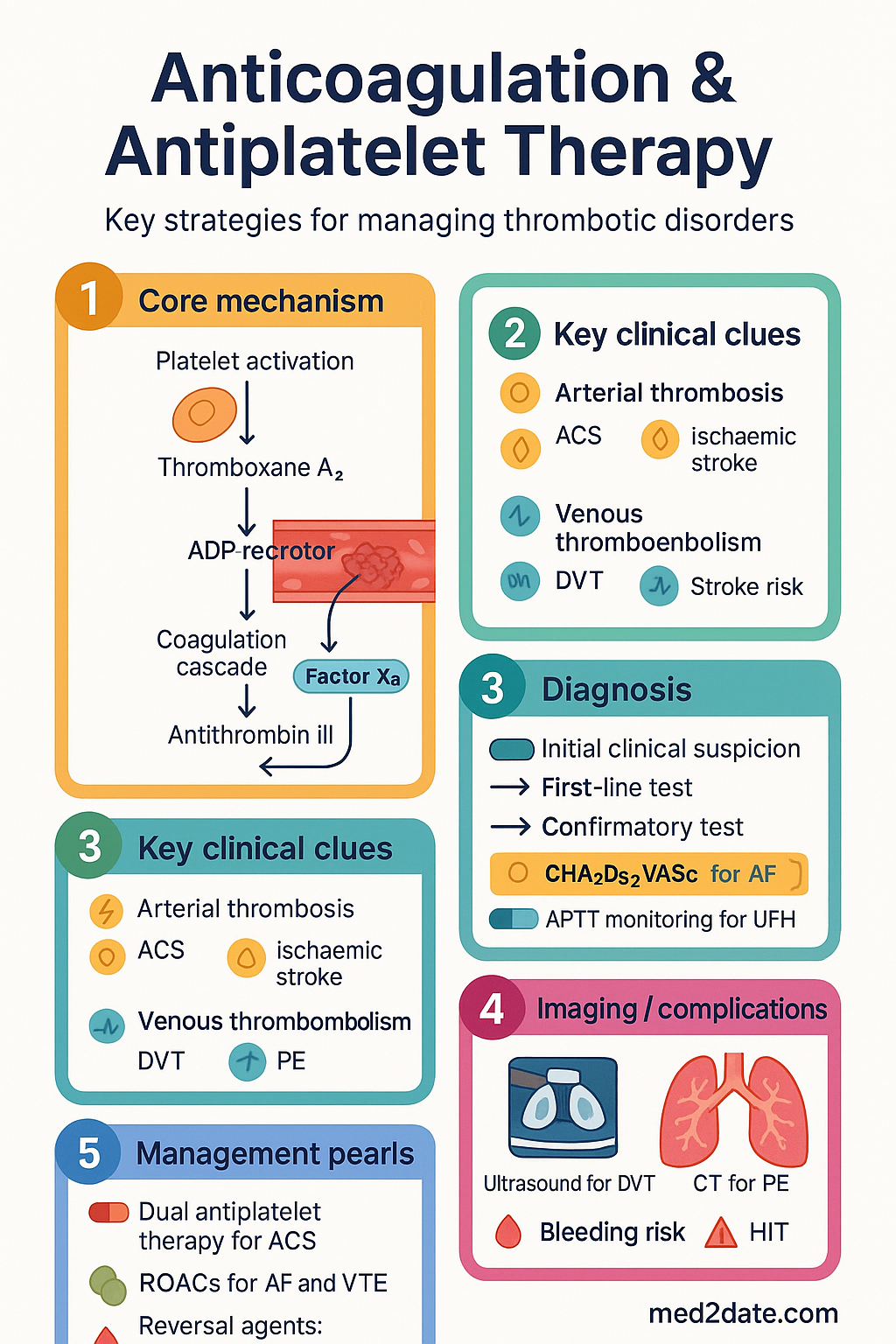
- Antiplatelet agents (aspirin, P2Y12 inhibitors) target platelet aggregation and are first-line for arterial thrombosis (e.g., ACS, ischaemic stroke).
- Anticoagulants (heparins, DOACs, warfarin) target the coagulation cascade and are used for venous thromboembolism (VTE) and atrial fibrillation (AF).
- For acute coronary syndrome (ACS), dual antiplatelet therapy (DAPT) with aspirin + a P2Y12 inhibitor is standard; choice of P2Y12 agent depends on clinical presentation and bleeding risk.
- For VTE prophylaxis in hospitalised medical patients, use LMWH (e.g., enoxaparin 40 mg SC daily) or fondaparinux 2.5 mg SC daily.
- For AF, CHA₂DS₂-VASc score guides anticoagulation need; DOACs (apixaban, rivaroxaban, dabigatran, edoxaban) are preferred over warfarin for most patients.
- DOACs require dose adjustment for renal function (eCrCl), weight, age, and interacting medications; always check product information (PI).
- UFH infusion requires APTT monitoring; target APTT 1.5–2.5× control for VTE treatment.
- LMWH (enoxaparin, dalteparin) is preferred over UFH for most indications; use UFH if eCrCl <30 mL/min or need for rapid on/off effect.
- Reversal agents: protamine for heparin, idarucizumab for dabigatran, andexanet alfa for factor Xa inhibitors (apixaban, rivaroxaban), vitamin K for warfarin.
- Periprocedural management requires balancing thrombotic vs bleeding risk; use validated protocols (e.g., BRIDGE, PAUSE).
- Major bleeding is a medical emergency; stabilise, reverse anticoagulation if possible, and consult haematology.
- Consider Aboriginal and Torres Strait Islander patients' higher burden of CVD and VTE, potential barriers to access, and need for culturally safe care.
- Medication adherence is critical; use PBS-listed agents where possible and consider dose administration aids for complex regimens.
Introduction & Australian Epidemiology
Anticoagulants and antiplatelet agents are cornerstone therapies for preventing and treating thrombotic disorders. They target distinct pathways: antiplatelet agents inhibit platelet activation and aggregation (primary haemostasis), while anticoagulants interrupt the coagulation cascade (secondary haemostasis). The choice of agent depends on the clinical indication (arterial vs venous thrombosis), patient-specific factors (renal/hepatic function, bleeding risk, age), and practical considerations (route of administration, monitoring, cost).
Cardiovascular disease (CVD) is the leading cause of death in Australia, with ischaemic heart disease accounting for approximately 10% of all deaths in 2022. Atrial fibrillation (AF) affects an estimated 2–4% of the Australian population, increasing stroke risk fivefold. Venous thromboembolism (VTE) has an annual incidence of approximately 0.8–1.6 per 1,000 adults, with significant morbidity and mortality.
This guideline provides an evidence-based, Australian-focused overview of antiplatelet and anticoagulant therapies, emphasising practical prescribing, monitoring, and safety considerations for primary care and specialist practice.
Antiplatelet Agents (Aspirin, P2Y12 Inhibitors)
Antiplatelet agents are primarily used for arterial thrombosis prevention in acute coronary syndromes (ACS), ischaemic stroke, and peripheral arterial disease (PAD).
Aspirin
Aspirin irreversibly inhibits cyclooxygenase-1 (COX-1), reducing thromboxane A2 production. It is the foundation of antiplatelet therapy.
P2Y12 Inhibitors
P2Y12 inhibitors block the ADP receptor on platelets, providing more potent platelet inhibition than aspirin alone. Used in dual antiplatelet therapy (DAPT) post-ACS or coronary stenting.
Heparins (UFH, LMWH) & Fondaparinux
Heparins are parenteral anticoagulants used for acute VTE treatment, prophylaxis, and bridging therapy.
| Agent | Mechanism | Key Features | Monitoring |
|---|---|---|---|
| Unfractionated Heparin (UFH) | Potentiates antithrombin III → inactivates IIa, Xa | Short half-life (1–2 h); reversible with protamine; use if eCrCl <30 mL/min or high bleed risk | APTT 6 h post-load, then daily; target 1.5–2.5× control |
| Enoxaparin (LMWH) | Potentiates antithrombin III → predominantly anti-Xa activity | SC administration; predictable dose-response; lower HIT risk | Anti-Xa level if renal impairment, obesity, pregnancy |
| Fondaparinux | Synthetic pentasaccharide → selective anti-Xa | Once-daily SC; no HIT risk; renal excretion | Not routinely required |
Dosing Examples
Direct Oral Anticoagulants (DOACs)
DOACs are first-line for stroke prevention in non-valvular AF and VTE treatment/prevention. They offer predictable pharmacokinetics, fixed dosing, and no routine INR monitoring.
| DOAC | Target | Standard AF Dose | Renal Adjustment (AF) | PBS Status |
|---|---|---|---|---|
| Apixaban | Factor Xa | 5 mg PO BD | 2.5 mg BD if ≥2 of: age ≥80, weight ≤60 kg, Cr ≥133 µmol/L | PBS General Benefit |
| Rivaroxaban | Factor Xa | 20 mg PO daily with food | 15 mg daily if eCrCl 15–49 mL/min; avoid if <15 | PBS General Benefit |
| Dabigatran | Factor IIa (thrombin) | 150 mg PO BD | 110 mg BD if age ≥80, concomitant verapamil, or eCrCl 30–50 mL/min | PBS General Benefit |
| Edoxaban | Factor Xa | 60 mg PO daily | 30 mg daily if eCrCl 15–50 mL/min | PBS Restricted Benefit |
- Check renal function (eCrCL using Cockcroft-Gault) at baseline and annually (more often if borderline).
- Avoid concomitant strong CYP3A4/P-gp inhibitors (e.g., ketoconazole, ritonavir) or inducers (e.g., rifampicin, carbamazepine).
- Missed dose: take if within 6 h (BD drugs) or 12 h (daily drugs) of scheduled time; otherwise skip.
Reversal Agents & Periprocedural Management
Reversal Agents
Periprocedural Management
Use standardised protocols (e.g., PAUSE for DOACs, BRIDGE for warfarin) to balance thrombotic vs bleeding risk.
Special Populations
Pregnancy
Paediatrics
Renal Impairment
Hepatic Impairment
Immunocompromised
Aboriginal and Torres Strait Islander Health Considerations
Aboriginal and Torres Strait Islander peoples experience a higher burden of cardiovascular disease and venous thromboembolism compared to non-Indigenous Australians. Anticoagulant and antiplatelet therapy must be tailored to address specific barriers and risks.
📚 References
- 1. National Heart Foundation of Australia and Cardiac Society of Australia and New Zealand. Australian Clinical Guidelines for the Management of Acute Coronary Syndromes 2023. Heart Lung Circ. 2024;33(1):e1-e91.
- 2. Australian Commission on Safety and Quality in Health Care (ACSQHC). Blood Management Standard: National Safety and Quality Health Service Standards. 2nd ed. Sydney: ACSQHC; 2021.
- 3. Tran HA, Gibbs H, Merriman E, et al. New guidelines from the Thrombosis and Haemostasis Society of Australia and New Zealand for the diagnosis and management of venous thromboembolism. Med J Aust. 2019;210(5):227-235.
- 4. Brieger D, Cullen L, Briffa T, et al. National Heart Foundation of Australia & Cardiac Society of Australia and New Zealand: Australian Clinical Guidance for the Diagnosis and Management of Atrial Fibrillation in Adults. Heart Lung Circ. 2023;32(9):e91-e115.
- 5. Lip GYH, Banerjee A, Boriani G, et al. Antithrombotic Therapy for Atrial Fibrillation: CHEST Guideline and Expert Panel Report. Chest. 2018;154(5):1121-1201.
- 6. Australian Institute of Health and Welfare (AIHW). Cardiovascular disease in Aboriginal and Torres Strait Islander people. AIHW, Canberra. 2023.
- 7. Pollack CV Jr, Reilly PA, van Ryn J, et al. Idarucizumab for Dabigatran Reversal – Full Cohort Analysis. N Engl J Med. 2017;377(5):431-441.
- 8. Connolly SJ, Crowther M, Eikelboom JW, et al. Full Study Report of Andexanet Alfa for Bleeding Associated with Factor Xa Inhibitors. N Engl J Med. 2019;380(14):1326-1335.
- 9. Douketis JD, Spyropoulos AC, Duncan J, et al. Perioperative Management of Patients With Atrial Fibrillation Receiving a Direct Oral Anticoagulant. JAMA Intern Med. 2019;179(11):1469-1478.
- 10. Monagle P, Chan AKC, Goldenberg NA, et al. Antithrombotic Therapy in Neonates and Children: Antithrombotic Therapy and Prevention of Thrombosis, 9th ed: American College of Chest Physicians Evidence-Based Clinical Practice Guidelines. Chest. 2012;141(2 Suppl):e737S-e801S.
- 11. National Aboriginal Community Controlled Health Organisation (NACCHO). Position Statement: Cardiovascular Disease. NACCHO, Canberra. 2022.
- 12. RHDAustralia (a program of Menzies School of Health Research). RHD Control and Prevention Guidelines. 4th ed. 2022.