📋 Key Information Summary
- Patent foramen ovale (PFO) is present in ~25% of the general population and is the most common right-to-left shunt; it is strongly implicated in cryptogenic stroke in patients <60 years.
- PFO closure is indicated for cryptogenic stroke aged 18–60 years after multidisciplinary discussion; meta-analyses (RESPECT, REDUCE, CLOSE, DEFENSE-PFO) demonstrate absolute risk reduction of ~3–5% over medical therapy alone.
- Atrial septal defects (ASDs) account for 10–15% of congenital heart defects; secundum ASD is most common (~75%) and often amenable to device closure.
- Small ASDs with no right-heart volume overload may be observed; closure is indicated when right ventricular dilatation (Qp:Qs ≥ 1.5:1) or paradoxical embolism occurs.
- Ventricular septal defects (VSDs) are the most common congenital heart defect at birth (~30%); 30–50% of small muscular VSDs close spontaneously by age 5.
- Large VSDs cause pulmonary overcirculation and heart failure in infancy; surgical closure is recommended if symptoms persist despite optimal medical therapy or Qp:Qs ≥ 2:1.
- Eisenmenger syndrome (irreversible pulmonary arterial hypertension with shunt reversal) is the most feared complication of unrepaired large shunts — once established, closure is contraindicated.
- All patients require endocarditis prophylaxis education; lifelong endocarditis prophylaxis is indicated only for those with prior endocarditis, prosthetic material, or cyanotic CHD.
- Echocardiography (TTE ± TOE with bubble study) is the primary diagnostic tool; cardiac MRI/catheterisation used for quantification and pre-intervention planning.
- Aboriginal and Torres Strait Islander peoples have higher prevalence of rheumatic heart disease-related valve lesions and may present later with shunt-related complications — early echocardiographic screening is essential.
Introduction & Australian Epidemiology
Atrial and ventricular septal defects are the most common congenital heart defects encountered in both paediatric and adult cardiology practice. The patent foramen ovale (PFO), atrial septal defect (ASD), and ventricular septal defect (VSD) represent a spectrum of intracardiac shunts ranging from clinically insignificant communications to haemodynamically significant lesions requiring intervention.
In Australia, congenital heart disease affects approximately 8–10 per 1 000 live births, with isolated septal defects comprising a substantial proportion. Most small ASDs and many muscular VSDs close spontaneously during early childhood; however, larger defects with significant left-to-right shunting (Qp:Qs ≥ 1.5–2.0) lead to volume overload, ventricular remodelling, pulmonary arterial hypertension, and — if unrepaired — Eisenmenger syndrome.
The recognition of PFO as a causal mechanism in cryptogenic stroke has driven a paradigm shift in secondary stroke prevention, supported by landmark randomised trials. Simultaneously, advances in transcatheter device closure have expanded treatment options for secundum ASD and selected VSDs, reducing the need for open-heart surgery in many patients.
This guideline addresses the pathophysiology, diagnosis, risk stratification, and evidence-based management of PFO, ASD, and VSD in the Australian context, including special considerations for Aboriginal and Torres Strait Islander populations, pregnancy, and the transition from paediatric to adult congenital heart services.
| Defect | Prevalence | Spontaneous Closure | Key Risk |
|---|---|---|---|
| PFO | ~25% of adults | N/A (functional valve) | Paradoxical embolism → cryptogenic stroke |
| Secundum ASD | 1–2 per 1 000 live births | Small defects may close <2 yrs | RV volume overload, AF, paradoxical embolism |
| VSD | ~3 per 1 000 live births | 30–50% of muscular VSDs by age 5 | LV failure, pulmonary hypertension, Eisenmenger |
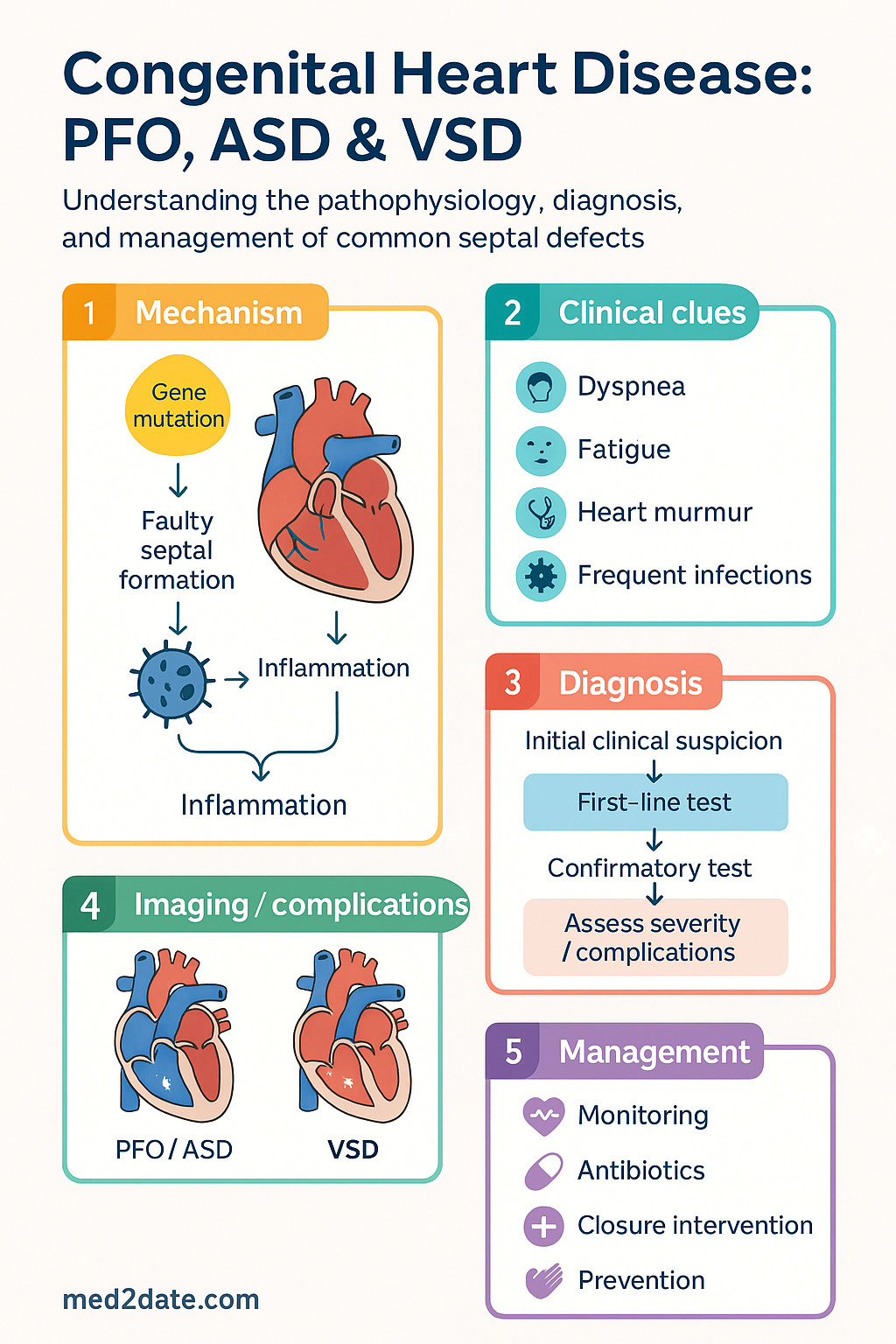
Patent Foramen Ovale (PFO) & Cryptogenic Stroke
Pathophysiology
The foramen ovale is a normal fetal structure that facilitates right-to-left shunting of blood. In approximately 25% of adults, the septum primum and secundum fail to fuse completely, leaving a flap-valve communication that opens transiently during increases in right atrial pressure (Valsalva manoeuvre, coughing, prolonged standing). This allows paradoxical embolisation of venous thrombi, fat, or air into the systemic arterial circulation.
Clinical Presentation & Diagnostic Criteria
PFO is usually asymptomatic and discovered incidentally. The clinical scenario requiring investigation is cryptogenic stroke — defined as ischaemic stroke where standard workup (including 24-hour Holter, carotid imaging, basic coagulation screen) does not reveal an aetiology. Cryptogenic stroke accounts for 25–40% of all ischaemic strokes.
Investigations
Risk Stratification — PFO-Associated Stroke
Management
Medical Therapy
Percutaneous PFO Closure
Percutaneous PFO closure is performed via right femoral vein access using a nitinol double-disc device (e.g., Amplatzer™ PFO Occluder, Gore Cardioform™). The procedure is performed under TOE or intracardiac echocardiography (ICE) guidance, typically under general anaesthesia.
Post-closure, dual antiplatelet therapy (aspirin 100 mg + clopidogrel 75 mg daily) is prescribed for 1–6 months, followed by aspirin monotherapy for at least 5 years. Device thrombosis risk is <1%. Endocarditis prophylaxis is not routinely required after isolated PFO closure.
Atrial Septal Defect (ASD): Types & Management
Types & Anatomy
| Type | % of ASDs | Location | Associated Features |
|---|---|---|---|
| Secundum | ~75% | Fossa ovalis region | Most common; amenable to device closure |
| Primum | ~15–20% | Lower atrial septum, adjacent to AV valves | Cleft mitral valve → MR; part of AVSD spectrum |
| Sinus venosus | ~5–10% | Superior (SVC junction) or inferior (IVC junction) | Partial anomalous pulmonary venous drainage (PAPVD) |
| Coronary sinus | <1% | Roof of coronary sinus | Often associated with persistent left SVC |
Pathophysiology
ASDs create a left-to-right shunt at the atrial level. The magnitude depends on defect size, ventricular compliance differences, and pulmonary vascular resistance. Chronic right ventricular volume overload leads to RV dilatation, tricuspid regurgitation, atrial arrhythmias (particularly atrial flutter and fibrillation — prevalence rises sharply after age 40), and ultimately pulmonary arterial hypertension if the shunt is large and unrepaired.
Clinical Presentation
- Children: Often asymptomatic; may present with murmur (systolic ejection murmur at left upper sternal border with wide, fixed splitting of S2), poor weight gain, or recurrent respiratory infections.
- Adults: Exertional dyspnoea, fatigue, palpitations (atrial arrhythmias), paradoxical embolism/stroke, or right heart failure symptoms.
- Elderly: Presentation with AF, heart failure, or pulmonary hypertension is common due to delayed diagnosis.
Investigations
Indications for Closure
- Right ventricular volume overload on echocardiography (RV dilatation), regardless of symptoms
- Qp:Qs ≥ 1.5:1 with evidence of RV enlargement
- Paradoxical embolism with haemodynamically significant ASD
- Symptomatic patients (exertional dyspnoea, arrhythmias) attributable to the shunt
Management
Transcatheter Device Closure (Secundum ASD)
Secundum ASDs with adequate rims (≥5 mm from mitral valve, aortic root, SVC, IVC, and right upper pulmonary vein) are suitable for percutaneous device closure using the Amplatzer™ Septal Occluder or similar nitinol double-disc device. Procedure success rate exceeds 95%. Day-case or overnight stay.
Post-closure: Aspirin 100 mg daily for 6 months. Echocardiography at 24 hours, 1 month, 6 months, and 12 months to assess device position and residual shunt. Endocarditis prophylaxis for 6 months post-device implantation only.
Surgical Closure
Indicated for primum ASD (with cleft mitral valve repair), sinus venosus ASD (with PAPVD rerouting), coronary sinus ASD, and secundum ASDs unsuitable for device closure (inadequate rims, very large defects >38 mm, or multiple defects). Performed via median sternotomy or right anterolateral minithoracotomy on cardiopulmonary bypass. Operative mortality <1% in experienced centres.
Medical Therapy (Non-closure Candidates)
Ventricular Septal Defect (VSD): Types & Management
Types & Anatomy
| Type | % of VSDs | Location | Closure Potential |
|---|---|---|---|
| Perimembranous (outlet) | ~70–80% | Membranous septum, adjacent to aortic valve | Small defects may close via tricuspid tissue apposition; device closure possible but higher risk of conduction injury |
| Muscular | ~5–20% | Muscular septum (inlet, trabecular, or outlet) | Highest spontaneous closure rate (30–50% by age 5) |
| Inlet | ~5–8% | Posterior septum near AV valves | Associated with AVSD; requires surgical repair |
| Doubly-committed subarterial | ~5–7% (higher in Asian populations) | Outlet septum beneath both semilunar valves | Spontaneous closure rare; risk of aortic valve prolapse and regurgitation |
Pathophysiology
VSDs create a left-to-right shunt at the ventricular level. Shunt volume depends on defect size relative to the aortic root and systemic vascular resistance. Small restrictive VSDs (diameter < one-third of the aortic root) generate high-velocity jets and are usually well tolerated. Large non-restrictive VSDs equalise ventricular pressures, causing pulmonary overcirculation, biventricular volume overload, and — if unrepaired — progressive pulmonary vascular obstructive disease (Eisenmenger syndrome).
Clinical Presentation
- Small VSD: Usually asymptomatic; loud pansystolic murmur at left lower sternal border (grade 3–4/6 with thrill). Often detected on neonatal or infant examination.
- Moderate VSD: Failure to thrive, tachypnoea, diaphoresis with feeds in infancy; murmur with possible S3 gallop (volume-loaded LV).
- Large VSD: Congestive heart failure from 4–6 weeks of age; tachycardia, tachypnoea, hepatomegaly, poor feeding. May progress to Eisenmenger if unrepaired — progressive cyanosis, clubbing, exercise limitation.
Investigations
Indications for Closure
- Symptomatic heart failure refractory to medical therapy in infancy (most large VSDs repaired by 3–6 months)
- Qp:Qs ≥ 2:1 regardless of symptoms
- Evidence of progressive LV volume overload or pulmonary hypertension
- Aortic valve prolapse or regurgitation associated with doubly-committed or perimembranous VSD
Management
Medical Therapy (Bridge to Surgery or Palliative)
Surgical VSD Closure
Open-heart surgical patch closure (using Dacron or pericardium) is the standard approach for most significant VSDs. Performed via median sternotomy on cardiopulmonary bypass. Operative mortality <1% in experienced paediatric cardiac centres. Risk of complete heart block is ~1% (highest with perimembranous VSDs). Post-operative endocarditis prophylaxis for 6 months only.
Transcatheter Device Closure
Percutaneous closure using the Amplatzer™ Muscular VSD Occluder is available for muscular VSDs and selected post-infarct VSDs. Perimembranous VSD device closure carries a ~3–5% risk of complete heart block and is only performed at select tertiary centres in Australia. Conduction complications may present months after the procedure — long-term follow-up is essential.
Haemodynamic Consequences (Qp:Qs)
Understanding the Pulmonary-to-Systemic Flow Ratio
The Qp:Qs ratio quantifies the magnitude of intracardiac shunting. It is calculated as the ratio of pulmonary blood flow (Qp) to systemic blood flow (Qs). A ratio of 1.0 indicates no shunt. A ratio >1.0 indicates left-to-right shunting; <1.0 indicates right-to-left shunting.
Eisenmenger Syndrome
Methods for Qp:Qs Measurement
Special Populations
Monitoring & Follow-up
Endocarditis Prophylaxis
- Prior infective endocarditis (any cause)
- Prosthetic valves or prosthetic material (including device closures — for 6 months post-implantation only)
- Cyanotic congenital heart disease (unrepaired or with palliative shunts)
- Repaired congenital heart disease with residual defect at or adjacent to prosthetic patch/device
Aboriginal and Torres Strait Islander Health Considerations
📚 References
- 1. Saver JL, Carroll JD, Thaler DE, et al. Long-term outcomes of patent foramen ovale closure or medical therapy after stroke. N Engl J Med. 2017;377(11):1022–1032. (RESPECT trial long-term follow-up)
- 2. Søndergaard L, Kasner SE, Rhodes JF, et al. Patent foramen ovale closure or antiplatelet therapy for cryptogenic stroke. N Engl J Med. 2017;377(11):1033–1042. (REDUCE trial)
- 3. Mas JL, Derumeaux G, Guillon B, et al. Patent foramen ovale closure or anticoagulation vs. antiplatelets after stroke. N Engl J Med. 2017;377(11):1011–1021. (CLOSE trial)
- 4. Lee PH, Song JK, Kim JS, et al. Cryptogenic stroke and high-risk patent foramen ovale: the DEFENSE-PFO trial. J Am Coll Cardiol. 2018;71(20):2335–2342.
- 5. Pristipino C, Sievert H, D'Ascenzo F, et al. European position paper on the management of patients with patent foramen ovale. EuroIntervention. 2019;14(14):1480–1496.
- 6. Stout KK, Daniels CJ, Aboulhosn JA, et al. 2018 AHA/ACC guideline for the management of adults with congenital heart disease. Circulation. 2019;139(14):e698–e800.
- 7. Baumgartner H, De Backer J, Babu-Narayan SV, et al. 2020 ESC guidelines for the management of adult congenital heart disease. Eur Heart J. 2021;42(6):563–645.
- 8. Australian Institute of Health and Welfare (AIHW). Congenital Heart Disease in Australia. Cat. no. CDK 6. Canberra: AIHW; 2019.
- 9. RHDAustralia (RHD Australia). The 2020 Australian guideline for prevention, diagnosis, and management of acute rheumatic fever and rheumatic heart disease. 3rd ed. Darwin: Menzies School of Health Research; 2020.
- 10. Australian Commission on Safety and Quality in Health Care (ACSQHC). National Safety and Quality Health Service Standards. 2nd ed. Sydney: ACSQHC; 2021.
- 11. Cordina R, O'Meagher S, Gould P, et al. Comparison of congenital heart disease in Indigenous and non-Indigenous Australians. Intern Med J. 2014;44(11):1113–1119.
- 12. Australian Government Department of Health. Closing the Gap: National Agreement. Canberra: Commonwealth of Australia; 2020.
- 13. Warnes CA, Williams RG, Bashore TM, et al. ACC/AHA 2008 guidelines for the management of adults with congenital heart disease. J Am Coll Cardiol. 2008;52(23):e143–e263.
- 14. Butera G, Chessa M, Carminati M. Percutaneous closure of ventricular septal defects. Cardiol Young. 2014;24(1):6–15.