📋 Key Information Summary
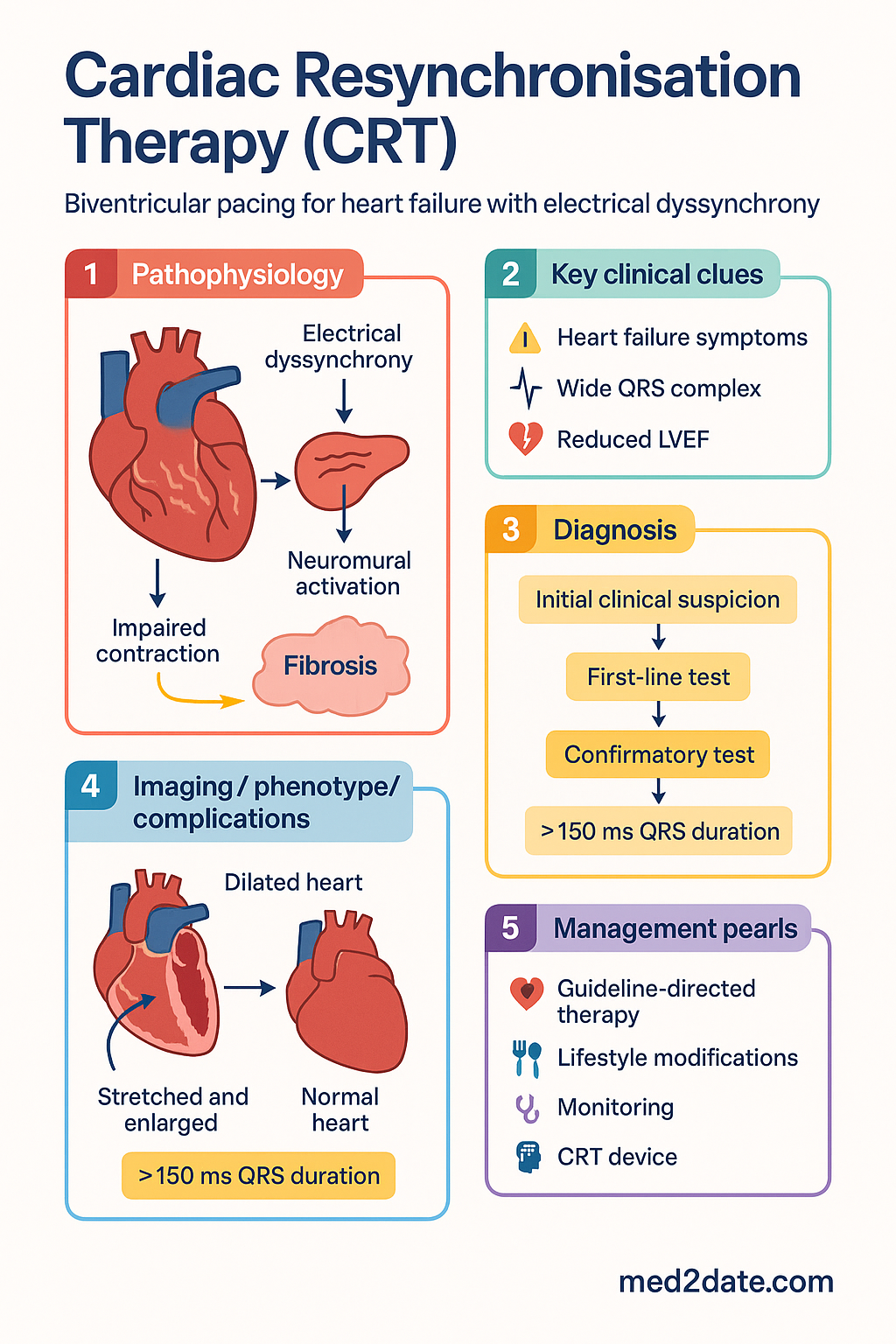
- Cardiac Resynchronisation Therapy (CRT) uses biventricular pacing to restore mechanical synchrony in heart failure patients with electrical dyssynchrony (prolonged QRS).
- Class I indication (ESC/NHFA/CSANZ): NYHA II–IVa symptoms, LVEF ≤ 35%, LBBB with QRS ≥ 150 ms on optimal medical therapy for ≥ 3 months.
- LBBB morphology is the strongest ECG predictor of CRT response; non-LBBB patterns have lower benefit.
- CRT-P (pacing only) is first-line for patients without a primary ICD indication; CRT-D (defibrillator) adds sudden cardiac death protection.
- Approximately 60–70 % of patients are clinical responders; one-third are non-responders, defined as failure to improve NYHA class or reduce LVESV by ≥ 15 %.
- Optimisation of guideline-directed medical therapy (ACEi/ARNI, beta-blocker, MRA, SGLT2i) must precede and continue after CRT implantation.
- Post-implantation AV and VV optimisation can improve haemodynamics but evidence for hard outcomes is mixed; echo-guided optimisation is common practice.
- CRT reduces heart failure hospitalisations by ~25–35 % and all-cause mortality by ~25 % in landmark RCTs (COMPANION, CARE-HF, MADIT-CRT, RAFT).
- In Australia, CRT implantation is performed in ≈ 40 centres nationally; procedural MBS item numbers 38300 (CRT-P) and 38303 (CRT-D) apply.
- Remote device monitoring (Medtronic CareLink, Abbott Merlin) is MBS-rebatable and recommended at 3–6 monthly intervals post-implantation.
- Contraindications include active infection, severe peripheral venous access issues, and lack of patient compliance with follow-up.
- First Nations Australians experience higher HF prevalence and worse outcomes — CRT access and referral equity must be actively addressed.
- Special populations (pregnancy, paediatric/congenital heart disease, dialysis patients) require individualised multi-disciplinary assessment.
Introduction & Australian Epidemiology
Cardiac Resynchronisation Therapy (CRT), also termed biventricular pacing, is an established device-based therapy for selected patients with heart failure and reduced ejection fraction (HFrEF) who demonstrate electrical dyssynchrony on the surface ECG. CRT simultaneously stimulates the left and right ventricles (or, in some systems, the left ventricle alone) to restore mechanical synchrony, improve myocardial efficiency, reverse adverse ventricular remodelling, and thereby reduce symptoms, heart failure hospitalisations, and mortality.
Heart failure affects an estimated 500,000 Australians, with a prevalence of approximately 2 % in adults and rising steeply with age. Around half of patients have HFrEF (LVEF ≤ 40 %), the population most likely to be considered for CRT. Despite advances in pharmacotherapy — including angiotensin receptor–neprilysin inhibitors (ARNIs), mineralocorticoid receptor antagonists (MRAs), and sodium-glucose cotransporter-2 inhibitors (SGLT2is) — morbidity and mortality remain substantial. CRT has been evaluated in multiple landmark randomised controlled trials involving > 4,000 patients (COMPANION, CARE-HF, MADIT-CRT, RAFT, and others) and consistently demonstrates a 20–36 % relative risk reduction in all-cause mortality and a 25–35 % reduction in heart failure hospitalisation.
In Australia, approximately 4,000–5,000 CRT devices are implanted annually. Implantation is performed in public and private tertiary cardiac electrophysiology centres across all states and territories. MBS reimbursement is available under item 38300 (CRT-pacemaker) and 38303 (CRT-defibrillator). The Cardiac Society of Australia and New Zealand (CSANZ) and the National Heart Foundation of Australia (NHFA) endorse current European and American guideline criteria adapted for the Australian context. This guideline provides a comprehensive overview of CRT mechanism, patient selection, device choice, response optimisation, and special population considerations for Australian clinicians.
Mechanism & Rationale
Electrical Dyssynchrony
In patients with HFrEF and LBBB (or other forms of intraventricular conduction delay), electrical activation of the left ventricle is markedly delayed relative to the right ventricle. The interventricular septum contracts earlier than the lateral and posterior LV free walls. This regional dyssynchrony results in wasted myocardial work, reduced diastolic filling time, functional mitral regurgitation (due to papillary muscle dyssynchrony), and diminished stroke volume.
Biventricular Pacing — How It Works
CRT delivers near-simultaneous electrical stimulation to the RV apex (or septum) and a posterolateral tributary of the coronary sinus (accessing the LV epicardium). This synchronises contraction of the septum and lateral wall, restoring coordinated ventricular shortening. Haemodynamic benefits include:
- Improved LV ejection fraction (+5–10 % absolute in responders).
- Reduced LV end-systolic volume (reverse remodelling — hallmark of response).
- Decreased mitral regurgitation via improved papillary muscle alignment.
- Enhanced diastolic filling through optimised AV timing.
- Neurohormonal modulation with reduced sympathetic drive.
Electrical vs Mechanical Dyssynchrony
While the QRS duration is a surrogate for electrical dyssynchrony, echocardiographic measures (septal-to-posterior wall motion delay, tissue Doppler longitudinal strain, speckle tracking) can detect mechanical dyssynchrony independently of QRS width. However, large-scale randomised trials (EchoCRT) demonstrated that CRT does not benefit — and may harm — patients with narrow QRS (< 120 ms) even in the presence of echo-detected mechanical dyssynchrony. Thus, the QRS criterion remains the primary selection tool in current guidelines.
Indications (NYHA, LVEF, QRS Criteria)
Class I — Strong Evidence
Class IIa — Reasonable
- LVEF ≤ 35 %, LBBB, QRS 120–149 ms, NYHA II–IVa (lower QRS threshold, less robust evidence).
- LVEF ≤ 35 %, non-LBBB pattern, QRS ≥ 150 ms, NYHA II–IVa (reduced benefit but still considered).
- Patients with HFrEF who have a conventional pacemaker indication and are expected to require > 40 % ventricular pacing (to avoid pacing-induced cardiomyopathy).
Class IIb — May Be Considered
- LVEF ≤ 35 %, non-LBBB, QRS 120–149 ms (weakest evidence).
- LVEF 36–50 % with significant dyssynchrony on imaging and QRS ≥ 150 ms (limited data; consider in expert centre).
Contraindications
- Active systemic infection or bacteraemia.
- Inadequate coronary sinus venous anatomy (unable to place LV lead).
- Life expectancy < 1 year due to non-cardiac comorbidities.
- NYHA IVb/IVc (inotrope-dependent, VAD/transplant-expected — CRT role unclear).
- Patient refusal or inability to attend device follow-up.
ECG Morphology Criteria — LBBB vs Non-LBBB
| Parameter | LBBB (Strauss Criteria) | Non-LBBB / RBBB / IVCD |
|---|---|---|
| QRS duration for benefit | ≥ 120 ms (men), ≥ 130 ms (women) — Class I if ≥ 150 ms | ≥ 150 ms (Class IIa); ≥ 120 ms (Class IIb) |
| Expected response rate | 70–80 % | 40–50 % |
| Mortality benefit | Robust (CARE-HF, MADIT-CRT) | Inconsistent; subgroup analyses variable |
| Recommendation | Strong | Individualised, discuss with HF/EP team |
CRT-P vs CRT-D
The choice between a CRT-Pacemaker (CRT-P) and a CRT-Defibrillator (CRT-D) is one of the most common clinical decisions in CRT referral. CRT-P provides biventricular pacing alone; CRT-D adds an integrated implantable cardioverter-defibrillator (ICD) capable of anti-tachycardia pacing (ATP) and high-voltage defibrillation for ventricular tachyarrhythmias.
Decision Framework
Response & Non-Response
Defining CRT Response
There is no single universally accepted definition of CRT response. Commonly used criteria include:
- Clinical response: Improvement of ≥ 1 NYHA functional class, or patient-reported improvement on Kansas City Cardiomyopathy Questionnaire (KCCQ) ≥ 5 points.
- Echocardiographic response: Reduction in LV end-systolic volume (LVESV) ≥ 15 % at 6 months — considered the most objective and prognostically meaningful marker.
- Super-response: Normalisation of LVEF to ≥ 50 % — occurs in approximately 10–15 % of CRT recipients and is associated with excellent long-term prognosis.
Predictors of Response
| Predictor | Favours Response | Predicts Non-Response |
|---|---|---|
| ECG morphology | True LBBB (Strauss criteria) | Non-LBBB, RBBB, narrow QRS |
| QRS duration | ≥ 150 ms | 120–130 ms |
| Aetiology | Non-ischaemic cardiomyopathy | Extensive scar (ischaemic, large transmural infarction) |
| LV scar location | No scar at LV lead site | Scar at posterolateral wall (lead tip) |
| Rhythm | Sinus rhythm | Permanent atrial fibrillation (inadequate biv pacing %) |
| Gender | Female (smaller heart, higher scar-free myocardium) | Male (larger LV, more ischaemic scar) |
| Biv pacing percentage | ≥ 95 % | < 95 % (frequent PVCs, AF, inappropriate programming) |
Managing Non-Response
When a patient is identified as a non-responder at the 3–6 month follow-up, a systematic approach should be undertaken:
Investigations
Pre-implantation assessment for CRT requires a structured diagnostic workup to confirm eligibility, exclude reversible causes, and plan the procedure.
Monitoring
Post-Implantation Device Follow-Up
CSANZ and the Heart Rhythm Society (HRS) recommend the following surveillance schedule:
Special Populations
Aboriginal and Torres Strait Islander Health Considerations
📚 References
- 1. McDonagh TA, Metra M, Adamo M, et al. 2021 ESC Guidelines for the diagnosis and treatment of acute and chronic heart failure. Eur Heart J. 2021;42(36):3599–3726.
- 2. Brignole M, Auricchio A, Baron-Esquivias G, et al. 2013 ESC Guidelines on cardiac pacing and cardiac resynchronisation therapy. Europace. 2013;15(8):1070–1118.
- 3. Bristow MR, Saxon LA, Boehmer J, et al. Cardiac-resynchronization therapy with or without an implantable defibrillator in advanced chronic heart failure (COMPANION). N Engl J Med. 2004;350(21):2140–2150.
- 4. Cleland JG, Daubert JC, Erdmann E, et al. The effect of cardiac resynchronisation on morbidity and mortality in heart failure (CARE-HF). N Engl J Med. 2005;352(15):1539–1549.
- 5. Moss AJ, Hall WJ, Cannom DS, et al. Cardiac-resynchronization therapy for the prevention of heart-failure events (MADIT-CRT). N Engl J Med. 2009;361(14):1329–1338.
- 6. Tang AS, Wells GA, Talajic M, et al. Cardiac-resynchronization therapy for mild-to-moderate heart failure (RAFT). N Engl J Med. 2010;363(25):2385–2395.
- 7. Gorcsan J 3rd, Oyenuga O, Habib PJ, et al. Relationship of echocardiographic dyssynchrony to long-term survival after cardiac resynchronisation therapy. Circulation. 2010;122(19):1910–1918.
- 8. Rickard J, Michtalik H, Sharma R, et al. Predictors of response to cardiac resynchronisation therapy: a systematic review. Int J Cardiol. 2016;225:345–352.
- 9. Australian Institute of Health and Welfare (AIHW). Heart, stroke and vascular disease — Australian facts. AIHW, Canberra. 2023.
- 10. Mond HG, Crozier I, Kistler PM, et al. Cardiac Society of Australia and New Zealand position statement on cardiac implantable electronic device remote monitoring. Heart Lung Circ. 2020;29(8):1138–1147.
- 11. Strauss DG, Selvester RH, Wagner GS. Defining left bundle branch block in the context of cardiac resynchronisation therapy. Heart Rhythm. 2011;8(6):885–889.
- 12. Sweeney MO, Prinzen FW. Ventricular pump function and pacing: physiological and clinical integration. Circ Arrhythm Electrophysiol. 2008;1(2):127–139.
- 13. National Heart Foundation of Australia and Cardiac Society of Australia and New Zealand. Australian clinical guidelines for the management of heart failure. Med J Aust. 2018;209(8):363–369.
- 14. RHDAustralia (RHD Australia and ARF/RHD Register). The Australian guideline for prevention, diagnosis and management of acute rheumatic fever and rheumatic heart disease. 3rd ed. Menzies School of Health Research, Darwin. 2020.