📋 Key Information Summary
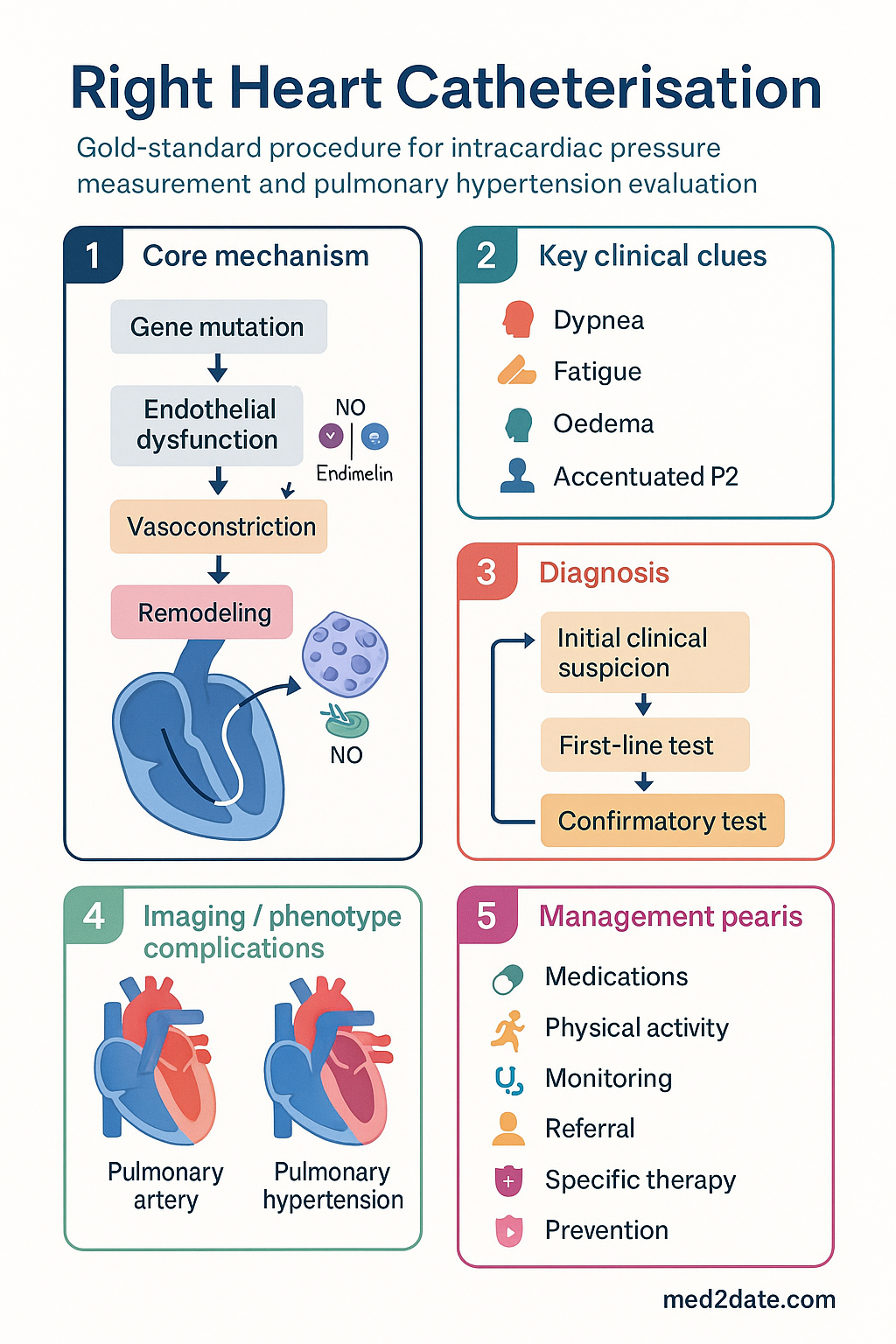
- Right heart catheterisation (RHC) is the gold-standard invasive procedure for measuring intracardiac pressures, cardiac output, and pulmonary vascular resistance (PVR).
- Primary diagnostic roles: Confirm pulmonary hypertension (PH) aetiology, assess severity in left heart disease, and evaluate for heart transplant candidacy.
- Key haemodynamic targets: Mean pulmonary artery pressure (mPAP) >20 mmHg defines PH; pulmonary artery wedge pressure (PAWP) ≤15 mmHg distinguishes pre- from post-capillary PH.
- Standard access is via the internal jugular or femoral vein using a balloon-tipped, flow-directed Swan-Ganz catheter.
- Cardiac output (CO) is measured by thermodilution (standard) or calculated via the Fick method (especially in low-flow or shunt states).
- Pulmonary vascular resistance (PVR) is calculated: PVR = (mPAP – PAWP) / CO; elevated PVR >3 Wood units is a hallmark of pulmonary arterial hypertension (PAH).
- Acute vasodilator testing with inhaled nitric oxide or IV epoprostenol identifies patients with reversible vasoreactivity for calcium channel blocker therapy.
- Major complications (tamponade, arrhythmia, pulmonary artery rupture) are rare (<1%) but potentially life-threatening; require continuous ECG and pressure monitoring.
- Procedure is PBS-listed under MBS item 11704 for right heart catheterisation with angiography, or 11700 without angiography.
- In Aboriginal and Torres Strait Islander populations, RHC access is often delayed due to remoteness; telehealth review of haemodynamic data can support earlier management.
Introduction & Australian Epidemiology
Right heart catheterisation (RHC) is an invasive haemodynamic study that provides direct measurement of pressures within the right atrium (RA), right ventricle (RV), pulmonary artery (PA), and the pulmonary artery wedge pressure (PAWP, also termed PCWP). It is the definitive diagnostic tool for evaluating pulmonary hypertension (PH), assessing severity in heart failure, and determining suitability for advanced therapies including heart transplantation and mechanical circulatory support.
In Australia, RHC is performed in major tertiary and specialised cardiology centres. The Australian and New Zealand Society of Cardiac and Thoracic Surgeons (ANZSCTS) database records over 2,000 isolated RHC procedures annually, with a significant proportion related to the assessment of pulmonary hypertension and advanced heart failure. The prevalence of pulmonary hypertension in Australia is estimated at 100–150 per million population, with Group 2 (left heart disease) and Group 3 (lung disease) being the most common aetiologies. Aboriginal and Torres Strait Islander peoples experience a higher burden of rheumatic heart disease and chronic lung disease, contributing to a disproportionate prevalence of secondary PH.
Indications & Access
Key Indications
- Diagnosis and classification of pulmonary hypertension (Groups 1–5).
- Assessment of haemodynamic severity in heart failure with reduced or preserved ejection fraction (HFrEF/HFpEF).
- Evaluation for heart transplantation or left ventricular assist device (LVAD) candidacy.
- Assessment of valvular heart disease severity (e.g., mitral stenosis, regurgitation) when non-invasive data are inconclusive.
- Diagnosis of constrictive pericarditis vs. restrictive cardiomyopathy.
- Acute vasodilator testing in patients with suspected pulmonary arterial hypertension (PAH).
Access Routes
| Site | Advantages | Considerations |
|---|---|---|
| Internal Jugular Vein (right) | Preferred for stable catheter positioning; patient can sit up; lower risk of femoral complications. | Avoid in coagulopathy; risk of carotid puncture. |
| Femoral Vein | Technically easier in obese patients; familiar access. | Requires patient supine; higher infection risk; potential for IVC catheter looping. |
| Antecubital/Basilic Vein | Alternative when neck/groin access contraindicated. | Longer catheter path; less stable. |
Pressure Waveforms & Normal Values
Interpretation of pressure waveforms is fundamental. The catheter is advanced under continuous pressure monitoring, identifying characteristic waveforms for each chamber.
| Chamber/Parameter | Normal Range (mmHg) | Waveform Characteristics |
|---|---|---|
| Right Atrium (RA) | Mean 1–7 | a-wave (atrial contraction), c-wave (tricuspid valve closure), x-descent, v-wave (atrial filling), y-descent. |
| Right Ventricle (RV) | Systolic 15–30, End-diastolic 1–7 | Sharp upstroke; systolic peak coincides with QRS; low diastolic pressure. |
| Pulmonary Artery (PA) | Systolic 15–30, Diastolic 4–12, Mean 9–18 | Dicrotic notch from pulmonic valve closure; diastolic pressure higher than RV. |
| Pulmonary Artery Wedge (PAWP) | Mean 6–15 | Attenuated a and v waves; mean PAWP approximates left atrial pressure. |
Cardiac Output (Fick & Thermodilution)
Thermodilution Method
The standard clinical method. A known volume of cold or room-temperature saline is injected into the RA port; a thermistor near the catheter tip measures the temperature change in the PA. The resulting curve is integrated to calculate CO. Requires a closed tricuspid valve and absence of significant intracardiac shunts.
- Advantages: Rapid, reproducible, does not require blood sampling.
- Limitations: Inaccurate in severe tricuspid regurgitation, low-output states (curve distortion), or intracardiac shunts.
Fick Principle
Based on the conservation of mass: O₂ consumption (VO₂) = CO × (CaO₂ – CvO₂). Rearranged: CO = VO₂ / (CaO₂ – CvO₂).
The Fick method is preferred in low cardiac output, severe tricuspid regurgitation, or irregular rhythms. Measured VO₂ via indirect calorimetry is more accurate but not universally available.
Pulmonary Vascular Resistance & Vasodilator Testing
Haemodynamic Calculations
Pulmonary vascular resistance (PVR) is a key metric for differentiating pre- and post-capillary PH.
Acute Vasodilator Testing
Indicated in patients with confirmed PAH (Group 1) to identify a subset (~10–15%) with reactive vasculature who may benefit from high-dose calcium channel blockers (CCBs).
Special Populations
Aboriginal and Torres Strait Islander Health Considerations
📚 References
- 1. McLaughlin VV, et al. ACCF/AHA 2009 Expert Consensus Document on Pulmonary Hypertension. J Am Coll Cardiol. 2009;53(17):1573-1619.
- 2. Galiè N, et al. 2015 ESC/ERS Guidelines for the diagnosis and treatment of pulmonary hypertension. Eur Heart J. 2016;37(1):67-119.
- 3. National Heart Foundation of Australia and Cardiac Society of Australia and New Zealand. Australian guideline for the diagnosis and management of acute pulmonary embolism. Heart Lung Circ. 2020.
- 4. Australian Institute of Health and Welfare (AIHW). Aboriginal and Torres Strait Islander health performance framework. 2023.
- 5. Rosenkranz S, et al. Right heart catheterisation: best practice and pitfalls in pulmonary hypertension. Eur Respir J. 2020;56(4):2001547.
- 6. Humbert M, et al. Haemodynamic definitions of pulmonary hypertension: an update. Eur Respir J. 2024;63(1):2301226.
- 7. Stout KK, et al. 2018 AHA/ACC Guideline for the Management of Adults With Congenital Heart Disease. Circulation. 2019;139(14):e698-e800.
- 8. RHDAustralia (Rheumatic Heart Disease Australia). Australian guideline for prevention, diagnosis and management of acute rheumatic fever and rheumatic heart disease. 3rd ed. 2020.
- 9. Kovacs G, et al. Pulmonary vascular reserve and the diagnosis of pulmonary hypertension. Eur Respir J. 2022;59(3):2101421.
- 10. MBS Online. Medicare Benefits Schedule. Australian Government Department of Health. Item 11700, 11704. Accessed 2024.