📋 Key Information Summary
- Heart transplantation is definitive therapy for end-stage heart failure refractory to guideline-directed medical therapy (GDMT), cardiac resynchronisation therapy (CRT), and mechanical circulatory support.
- Australia's National Heart Transplant Units — St Vincent's Hospital Sydney, Alfred Hospital Melbourne, Prince Charles Hospital Brisbane, Fiona Stanley Hospital Perth — performed ~130–140 heart transplants in 2023; median waitlist time 6–18 months.
- Median survival post-transplant is approximately 12.5 years; 1-year survival ~85%, 5-year survival ~75% (ISHLT 2023 Registry data).
- Absolute contraindications include active malignancy, irreversible pulmonary hypertension (PVR >5 Wood units unresponsive to vasodilators), active systemic infection, and severe irreversible multi-organ dysfunction.
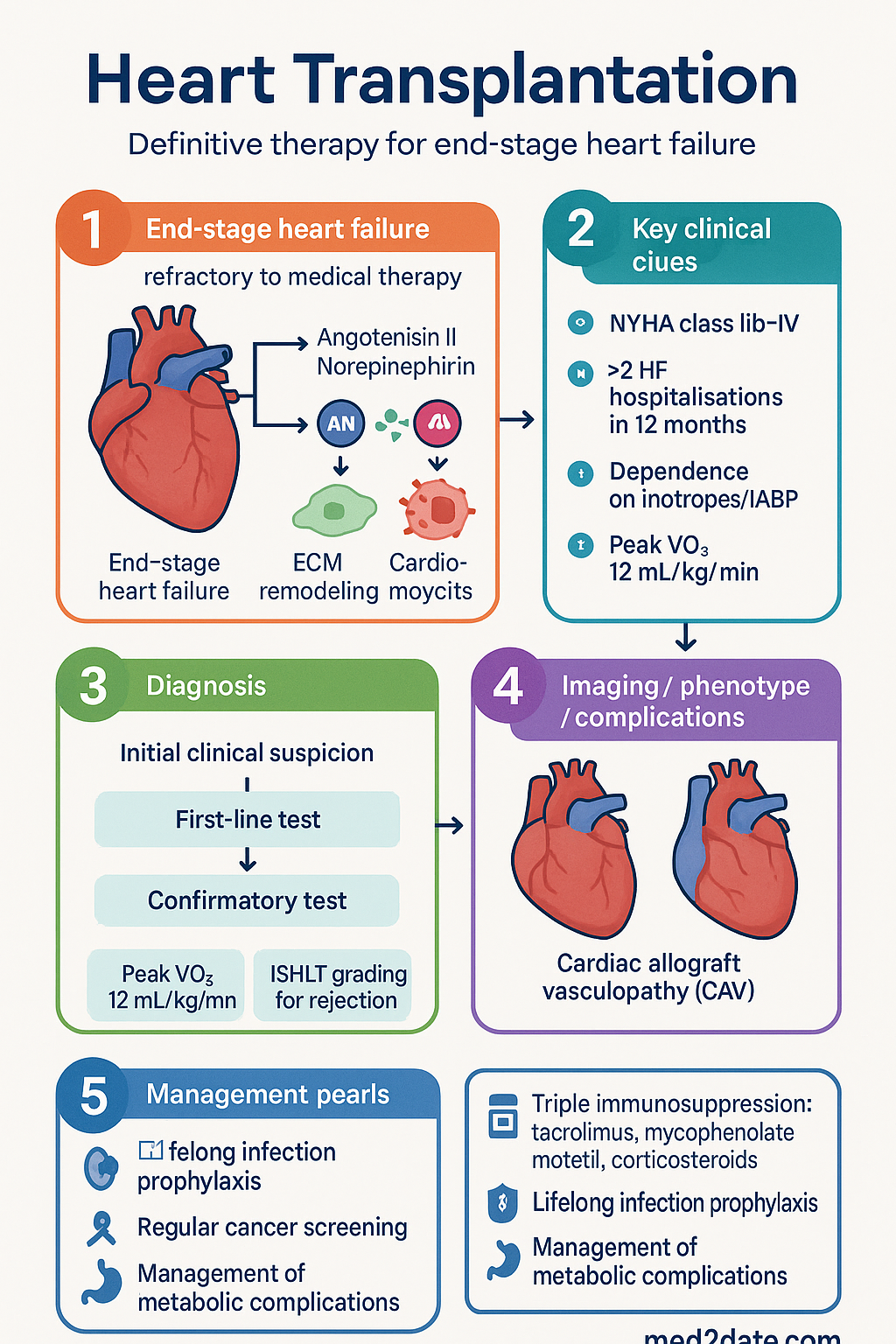
- Listing criteria require peak VO₂ <12 mL/kg/min (or <14 if intolerant of β-blockers), ≥2 HF hospitalisations in 12 months, NYHA class IIIb–IV despite maximal GDMT, or dependence on inotropes/intra-aortic balloon pump.
- Bicaval orthotopic heart transplantation is the standard surgical technique in all Australian centres.
- Triple immunosuppression — calcineurin inhibitor (tacrolimus), antiproliferative agent (mycophenolate mofetil), and corticosteroids — is the cornerstone of rejection prophylaxis.
- Acute cellular rejection (ACR) is monitored by endomyocardial biopsy (EMB) per ISHLT grading; antibody-mediated rejection (AMR) requires donor-specific antibody (DSA) surveillance.
- Cardiac allograft vasculopathy (CAV) is the leading cause of late graft loss; surveillance coronary angiography ± IVUS is performed annually from Year 1.
- Aboriginal and Torres Strait Islander Australians experience disproportionate heart failure burden but are under-represented on transplant waitlists — culturally safe referral pathways and remote monitoring are essential.
- Donor heart allocation in Australia uses a national algorithm managed by DonateLife and the transplant units, prioritising clinical urgency and geographic proximity.
- Post-transplant care requires lifelong immunosuppression, infection prophylaxis (CMV, PJP), cancer screening, and management of metabolic complications (diabetes, renal impairment, dyslipidaemia).
Introduction & Australian Epidemiology
Heart transplantation remains the gold-standard definitive therapy for selected patients with end-stage heart failure refractory to medical management, cardiac resynchronisation therapy, and mechanical circulatory support. With a median survival of approximately 12.5 years and improvements in immunosuppressive regimens, surgical technique, and post-operative care, heart transplantation offers substantial survival and quality-of-life gains in appropriately selected candidates.
In Australia, heart transplantation is coordinated through four National Heart Transplant Units: St Vincent's Hospital Sydney, The Alfred Hospital Melbourne, Prince Charles Hospital Brisbane, and Fiona Stanley Hospital Perth. Between 130 and 140 heart transplants were performed nationally in 2023. Australia's donor rate has improved following the national reform agenda, with a deceased organ donation rate of 22.2 per million population in 2023 — approaching but still below international benchmarks.
Demand continues to outstrip supply. As of mid-2024, approximately 80–100 patients are actively listed for heart transplantation at any given time across Australia, with median wait times of 6–18 months depending on blood group, body habitus, clinical urgency, and sensitisation status. The implementation of ex-vivo heart perfusion (EVHP) using the TransMedics Organ Care System in several Australian centres has expanded the donor pool by enabling use of extended-criteria and donation after circulatory death (DCD) hearts.
The Australian heart transplant population has a mean recipient age of ~52 years, with 75% male. Ischaemic cardiomyopathy and dilated cardiomyopathy account for the majority of indications. Paediatric heart transplantation (performed at The Children's Hospital at Westmead and Royal Children's Hospital Melbourne) represents ~8–10% of the national volume.
Indications & Contraindications
Indications for Heart Transplantation
Heart transplantation is indicated for patients with advanced heart failure (ACC/AHA Stage D or NYHA class IIIb–IV) who have exhausted conventional and device-based therapies and have a poor predicted survival without transplant. Common aetiologies in the Australian context include:
- Dilated cardiomyopathy (DCM) — idiopathic, familial/genetic, or myocarditis-related; the most common indication overall in Australia.
- Ischaemic cardiomyopathy — end-stage coronary artery disease with extensive myocardial scarring not amenable to revascularisation.
- Restrictive cardiomyopathy — including cardiac amyloidosis (ATTR and AL), with improved outcomes using modern chemotherapy/tafamidis before listing.
- Hypertrophic cardiomyopathy — end-stage with systolic dysfunction (EF <50%) or refractory diastolic heart failure.
- Adult congenital heart disease (ACHD) — complex congenital lesions with intractable heart failure; may require combined heart–lung or heart–liver transplantation.
- Valvular heart disease — irreparable valve disease causing end-stage cardiomyopathy.
- Cardiac tumours — unresectable primary cardiac sarcomas (rare; case-by-case consideration).
Absolute Contraindications
- Active malignancy — any current cancer or recent cancer (<5 years disease-free for most solid tumours, except non-melanoma skin cancer).
- Irreversible pulmonary hypertension — transpulmonary gradient >15 mmHg or pulmonary vascular resistance (PVR) >5 Wood units despite vasodilator challenge (e.g., IV milrinone, inhaled nitric oxide).
- Active systemic infection — including HIV with detectable viral load, active tuberculosis, or uncontrolled sepsis.
- Severe irreversible renal impairment — eGFR <30 mL/min/1.73 m² not attributable to cardiorenal syndrome or amenable to simultaneous kidney transplant.
- Irreversible hepatic dysfunction — cirrhosis with portal hypertension not eligible for combined heart–liver transplant.
- Active substance abuse — ongoing illicit drug use, alcohol dependence without documented abstinence ≥6 months.
- Severe irreversible neurological or psychiatric condition precluding compliance with post-transplant regimen.
- Highly sensitised patient — panel-reactive antibody (PRA) >80% with unacceptable donor-specific crossmatch (consider desensitisation protocols).
Relative Contraindications
- Age >70 years (individualised assessment; no absolute age cut-off in Australian guidelines).
- BMI >35 kg/m² — increased perioperative risk; weight reduction to BMI <30 recommended prior to listing.
- Peripheral vascular disease or carotid artery stenosis >70%.
- Diabetes mellitus with end-organ damage (proliferative retinopathy, neuropathy, nephropathy).
- Active peptic ulcer disease.
- Frailty (defined by Fried frailty phenotype or Short Physical Performance Battery) — may be modifiable with prehabilitation.
- Previous median sternotomy (increases surgical complexity; not an absolute barrier).
Listing Criteria & Waitlist Management
Criteria for Active Listing
Patients are listed for heart transplantation when they meet one or more of the following criteria, indicating a poor prognosis without transplant (estimated 1-year mortality >50% on medical therapy):
| Criterion | Threshold | Notes |
|---|---|---|
| Peak VO₂ | <12 mL/kg/min | Or <14 mL/kg/min if β-blocker intolerant; measured by maximal cardiopulmonary exercise testing |
| HF hospitalisation | ≥2 in 12 months | Despite optimised GDMT including ARNI/SGLT2i |
| NYHA class | IIIb–IV | Persistent despite maximal GDMT ≥3 months |
| Inotrope dependence | Continuous IV milrinone/dobutamine | Unable to wean without haemodynamic compromise |
| Mechanical circulatory support | LVAD complications | Pump thrombosis, driveline infection, right heart failure post-LVAD |
| Refractory arrhythmias | Electrical storm | Not controlled by ablation, drugs, or device therapy |
| Intra-aortic balloon pump | IABP dependent | Haemodynamic support required for ≥72 h |
Waitlist Status in Australia
Australia does not use a formal numerical urgency scoring system like the UNOS status categories in the United States. Instead, each transplant unit assesses clinical urgency and manages the waitlist collaboratively through the national organ allocation framework coordinated by the Organ and Tissue Authority (OTA). Key principles:
- Clinical urgency — patients on continuous inotropic support or temporary mechanical support (ECMO, IABP) are prioritised.
- Blood group and size matching — ABO compatibility and donor-to-recipient weight ratio (0.8–1.2×) are critical.
- Geographic proximity — ischaemic time must be minimised (<4 hours ideal; up to 6 hours with EVHP).
- Sensitisation — highly sensitised patients (PRA >10%) may have longer wait times; virtual crossmatch and desensitisation protocols (IVIg, rituximab, plasmapheresis) are employed.
Bridging Strategies While on Waitlist
- Continuous IV inotropes (milrinone 0.125–0.75 mcg/kg/min or dobutamine 2–20 mcg/kg/min) via indwelling central venous catheter — may be managed at home in selected patients through heart failure home-inotrope programmes.
- Intra-aortic balloon pump (IABP) — percutaneous insertion, typically bridging days to weeks.
- Short-term mechanical support: VA-ECMO or Impella — for cardiogenic shock or post-cardiotomy failure.
- Durable LVAD (e.g., HeartMate 3) — bridge-to-transplant strategy; increasingly common in Australia with median bridge time 12–18 months.
Surgical Procedure & Early Management
Surgical Technique
Bicaval orthotopic heart transplantation is the standard technique in all four Australian heart transplant centres, having largely replaced the biatrial technique due to superior preservation of atrial geometry, reduced mitral and tricuspid valve regurgitation, and lower incidence of atrial arrhythmias.
Immediate Post-Operative Management (ICU Days 0–7)
Early management focuses on haemoptimisation of the denervated graft, immunosuppression induction, infection prophylaxis, and monitoring for primary graft dysfunction (PGD).
| Domain | Key Management |
|---|---|
| Haemodynamics | Denervated heart: resting HR 90–110 bpm; target MAP 70–90 mmHg; CVP 8–12 mmHg. Isoprenaline infusion (1–5 mcg/min) to maintain HR >90 bpm if needed. Milrinone for RV dysfunction. |
| Induction immunosuppression | Basiliximab 20 mg IV on Day 0 and Day 4 (IL-2 receptor antagonist) — standard at most Australian centres. OR anti-thymocyte globulin (ATG) 1.5 mg/kg/day IV × 3–5 days for high-immunological-risk recipients. |
| Maintenance immunosuppression | Triple therapy initiated Day 0–1: Tacrolimus (target trough 10–15 ng/mL early phase) + Mycophenolate mofetil 1 g BD + Methylprednisolone 500 mg IV intraop → Prednisolone 1 mg/kg/day (max 60 mg), weaning to 5–10 mg/day by 3–6 months. |
| Infection prophylaxis | CMV: Valganciclovir 900 mg daily (D+/R− or R+); duration 3–6 months. PJP: TMP-SMX 480 mg daily (or 960 mg 3×/week); lifelong. Candida: Nystatin oral suspension QID × 1 month. Herpes: Valaciclovir 500 mg BD × 1 month (if not on valganciclovir). |
| Primary Graft Dysfunction | PGD affects 5–10% of recipients. Mild: inotrope support. Moderate-severe: milrinone ± adrenaline ± IABP. Refractory: VA-ECMO. Treated with high-dose methylprednisolone, inhaled nitric oxide for RV failure. |
| Venous thromboembolism | Enoxaparin 40 mg SC daily from Day 1 (if no bleeding); transition to aspirin 100 mg daily for CAV prevention. |
Drug Cards — Key Early Post-Transplant Medications
Long-Term Complications — Rejection & Vasculopathy
Acute Cellular Rejection (ACR)
ACR remains the most common form of rejection in the first 12 months post-transplant. It is mediated by T-lymphocyte infiltration of the myocardium and graded by the revised ISHLT classification on endomyocardial biopsy (EMB):
| ISHLT Grade | Histology | Management |
|---|---|---|
| 0 (Normal) | No infiltrate | Routine surveillance |
| 1R (Mild) | Perivascular/interstitial infiltrate with up to 1 focus of myocyte damage | Optimise immunosuppression; oral pulse methylprednisolone if symptomatic |
| 2R (Moderate) | Two or more foci of infiltrate with myocyte damage | IV methylprednisolone 500–1000 mg/day × 3 days → oral taper; consider ATG if steroid-resistant |
| 3R (Severe) | Diffuse infiltrate with extensive myocyte damage ± oedema ± haemorrhage ± vasculitis | IV methylprednisolone 1 g/day × 3 days + ATG (thymoglobulin) 1.5 mg/kg/day × 5–7 days; plasmapheresis if concurrent AMR; consider OKT3 if refractory |
Surveillance Biopsy Schedule
- Weeks 1, 2, 4, 8, 12 post-transplant
- Months 4, 6, 9, 12
- Annually thereafter (or more frequently if rejection history)
- Gene expression profiling (GEP; AlloMap®) may replace surveillance biopsy from 6 months in stable, low-risk patients — not yet widely funded in Australia
Antibody-Mediated Rejection (AMR)
AMR is mediated by donor-specific antibodies (DSAs) targeting HLA antigens and is associated with worse outcomes than ACR alone. The ISHLT 2013 working formulation grades AMR as pAMR 1 (histopathology or immunopathology positive), pAMR 2 (both positive), and pAMR 3 (severe with histological features of AMR).
Treatment of clinically significant AMR:
- Plasmapheresis — 3–5 sessions to remove circulating DSAs.
- IVIg — 2 g/kg over 2–5 days (immunomodulatory).
- Rituximab — 375 mg/m² IV × 1 dose (anti-CD20, depletes B cells).
- Bortezomib — 1.3 mg/m² IV × 4 doses over 2 weeks (proteasome inhibitor targeting plasma cells) — used for refractory AMR.
- Eculizumab — complement C5 inhibitor; emerging role in severe AMR; limited PBS access in Australia (Authority Required).
Cardiac Allograft Vasculopathy (CAV)
CAV is the leading cause of late graft loss and death beyond the first post-transplant year. It is a diffuse, concentric, and accelerated form of coronary artery disease affecting both epicardial and intramyocardial vessels, driven by immune-mediated endothelial injury, traditional cardiovascular risk factors, and donor-related factors.
CAV Prevention & Treatment
- Statin therapy — atorvastatin 40–80 mg or rosuvastatin 20–40 mg daily; recommended for ALL heart transplant recipients from Week 1 (independent of baseline lipid levels). PBS: General Benefit.
- mTOR inhibitor conversion — switching from mycophenolate to everolimus (target trough 3–8 ng/mL) or sirolimus has been shown to attenuate CAV progression (Everolimus vs MMF RCT, Eisen 2003; A2310 trial).
- Aspirin — 100 mg daily for all recipients (unless contraindicated).
- Strict cardiovascular risk factor control — BP <130/80 mmHg, HbA1c <7.0%, LDL <1.8 mmol/L, smoking cessation, weight management.
- Re-transplantation — the only definitive treatment for severe CAV; re-transplantation accounts for ~3–5% of Australian heart transplants.
Other Long-Term Complications
| Complication | Incidence | Key Management Points |
|---|---|---|
| Renal impairment | ~50% at 10 years (CKD stage 3+) | CNI nephrotoxicity; minimise tacrolimus trough to 5–8 ng/mL >1 year; add everolimus for CNI reduction |
| Post-transplant diabetes (PTDM) | ~20–40% | Tacrolimus + corticosteroids primary drivers; metformin first-line (if eGFR >30); SGLT2i if eGFR >25 (emerging data) |
| Post-transplant malignancy | ~30–40% at 10 years (cumulative) | Skin cancer (SCC most common in Australia): annual dermatology review, 5-FU field therapy, consider mTOR switch. PTLD: EBV-related; reduce immunosuppression + rituximab. |
| Osteoporosis | ~25–30% | Steroid-related; DEXA at 1 year; Ca²⁺/Vit D supplementation; bisphosphonate if T-score <−1.5 |
| CMV infection/disease | ~10–25% | PCR surveillance; valganciclovir prophylaxis × 3–6 months; treatment dose if viraemia >1000 copies/mL |
| Gout | ~15–20% | Colchicine 0.5 mg OD (renal-adjusted); avoid allopurinol with azathioprine (not used with MMF). Febuxostat if indicated. |
Special Populations
Aboriginal and Torres Strait Islander Health Considerations
Aboriginal and Torres Strait Islander Australians experience a disproportionate burden of cardiovascular disease, with heart failure rates 1.5–2 times higher than non-Indigenous Australians, particularly in remote and very remote communities. Rheumatic heart disease (RHD) remains a significant cause of end-stage heart failure in young Indigenous Australians, especially in Northern Territory, Far North Queensland, and Western Australia. Despite this higher burden, Indigenous Australians are significantly under-represented on heart transplant waitlists.
📚 References
- 1. Mehra MR, Canter CE, Hannan MM, et al. The 2016 International Society for Heart Lung Transplantation listing criteria for heart transplantation: a 10-year update. J Heart Lung Transplant. 2016;35(1):1–23.
- 2. Khush KK, Cherikh WS, Chambers DC, et al. The International Thoracic Organ Transplant Registry of the International Society for Heart and Lung Transplantation: Thirty-sixth adult heart transplantation report — 2019. J Heart Lung Transplant. 2019;38(10):1023–1030.
- 3. Yusuf SW, Bhatt DL, Padera RF, et al. Cardiac allograft vasculopathy. N Engl J Med. 2023;389(23):2162–2175.
- 4. Colvin M, Smith JM, Ahn YS, et al. OPTN/SRTR 2021 Annual Data Report: Heart. Am J Transplant. 2023;23(2 Suppl 1):S299–S342.
- 5. Australian Institute of Health and Welfare (AIHW). Heart, stroke and vascular disease — Australian facts. AIHW, Canberra. 2023.
- 6. Organ and Tissue Authority. Australia's national organ donation and transplantation annual report 2023. Australian Government, Canberra. 2024.
- 7. Eisen HJ, Kobashigawa J, Starling RC, et al. Everolimus versus mycophenolate mofetil in heart transplantation: a randomized, multicenter trial. Am J Transplant. 2013;13(5):1203–1216.
- 8. Costanzo MR, Dipchand A, Starling R, et al. The International Society of Heart and Lung Transplantation guidelines for the care of heart transplant recipients. J Heart Lung Transplant. 2010;29(8):914–956.
- 9. McDonald SP, Russ GR. Australian and New Zealand Dialysis and Transplant Registry — heart transplant outcomes. In: ANZDATA Registry Annual Report. Adelaide: ANZDATA; 2023.
- 10. Berry GJ, Burke MM, Andersen C, et al. The 2013 International Society for Heart and Lung Transplantation Working Formulation for the standardization of nomenclature in the pathologic diagnosis of antibody-mediated rejection in heart transplantation. J Heart Lung Transplant. 2013;32(12):1147–1162.
- 11. Pflugfelder PW, Boughner DR, Rudas L, Kostuk WJ. Enhanced detection of cardiac allograft vasculopathy with intravascular ultrasonography. Circulation. 1993;88(5 Pt 1):2180–2186.
- 12. National Heart Foundation of Australia and Cardiac Society of Australia and New Zealand. Guidelines for the prevention, detection, and management of heart failure in Australia. 2018 (updated 2023).
- 13. RHDAustralia. The 2020 Australian guideline for prevention, diagnosis, and management of acute rheumatic fever and rheumatic heart disease. 3rd ed. Darwin: Menzies School of Health Research; 2020.
- 14. Dhital KK, Iyer A, Connellan M, et al. Adult heart transplantation with distant procurement and ex-vivo preservation of donor hearts after circulatory death: a case series. Lancet. 2015;385(9987):2585–2591.