📋 Key Information Summary
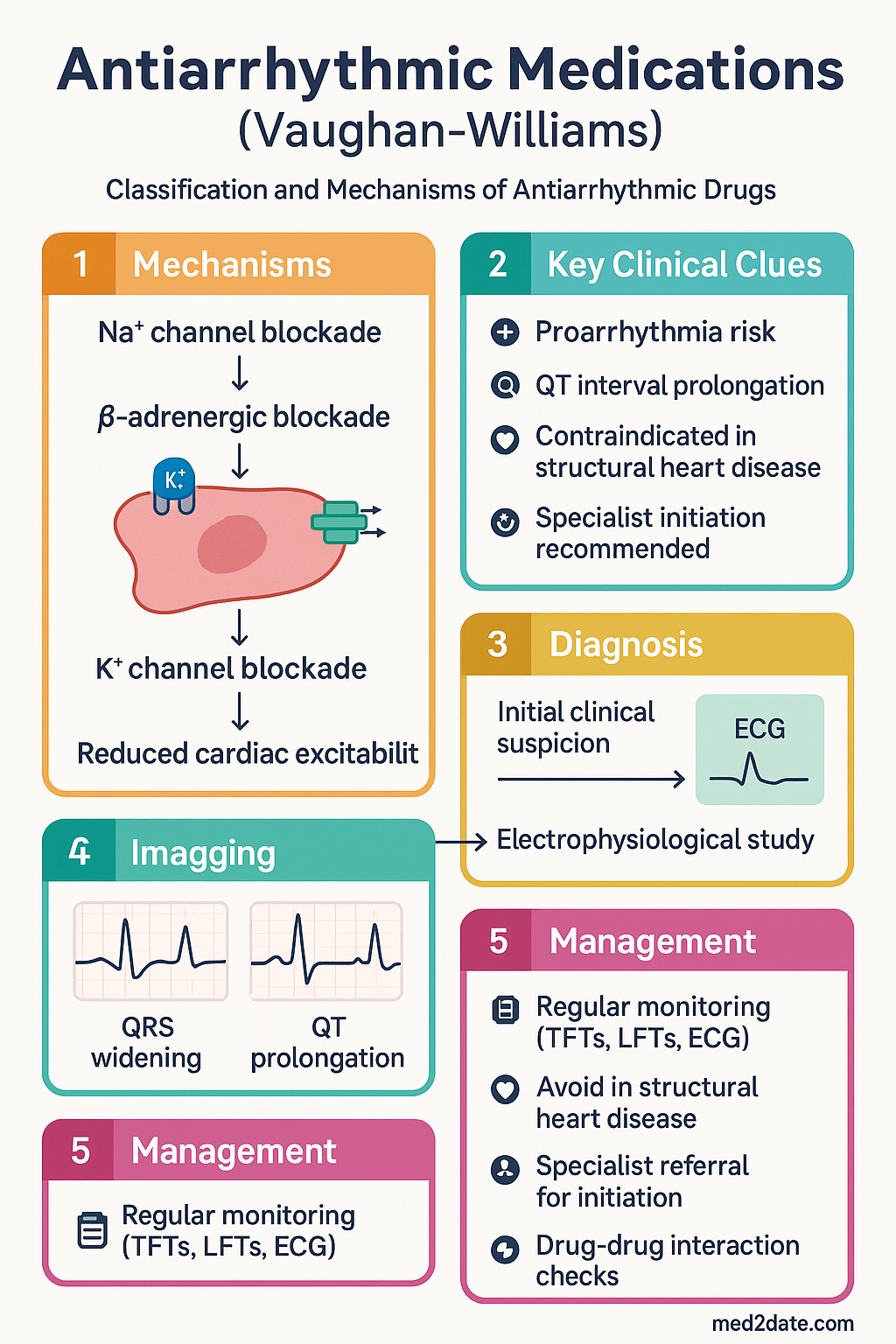
- The Vaughan-Williams classification categorises antiarrhythmic drugs into four classes (I–IV) based on their primary electrophysiological mechanism.
- Class I agents are sodium channel blockers subdivided into IA (quinidine, procainamide, disopyramide — moderate Na⁺ block, widen QRS), IB (lignocaine, mexiletine — weak/fast Na⁺ block, narrow QRS), and IC (flecainide, propafenone — potent Na⁺ block, significant QRS widening).
- Class II agents are beta-adrenergic blockers that reduce automaticity and AV conduction; first-line for SVT rate control and post-MI arrhythmia prevention.
- Class III agents are potassium channel blockers that prolong repolarisation (QT interval); amiodarone is the most widely used antiarrhythmic in Australia due to broad efficacy across SVT and VT.
- Sotalol has combined Class III and non-selective beta-blocking properties and is PBS-listed for ventricular and supraventricular arrhythmias.
- Class IV agents — verapamil and diltiazem — are non-dihydropyridine calcium channel blockers effective for SVT rate control; contraindicated in VT and heart failure with reduced ejection fraction.
- All Class I agents are proarrhythmic and are contraindicated in structural heart disease (CAST trial evidence for IC agents) and should generally be initiated under specialist supervision.
- Amiodarone requires baseline thyroid, hepatic, pulmonary function and ophthalmological assessment before initiation, with ongoing surveillance every 6–12 months.
- IV lignocaine remains a first-line agent for acute ventricular tachycardia in the context of myocardial ischaemia in Australian emergency departments.
- Dronedarone is a non-iodinated amiodarone analogue indicated for paroxysmal or persistent AF; contraindicated in NYHA III–IV heart failure and severe hepatic impairment.
- Beta-blockers are first-line for rate control in atrial fibrillation per Australian RACGP and Cardiac Society of Australia and New Zealand (CSANZ) guidelines.
- Proarrhythmia risk is highest with Class IC agents in patients with coronary artery disease or left ventricular dysfunction — specialist initiation mandatory.
- Aboriginal and Torres Strait Islander peoples experience higher rates of rheumatic heart disease and atrial fibrillation, necessitating culturally safe access to rhythm-control strategies and specialist review.
- Drug–drug interactions are a major safety concern, particularly with amiodarone (CYP3A4/2C9 inhibition) and flecainide (CYP2D6 substrate); always check interactions before prescribing.
Introduction & Australian Epidemiology
Antiarrhythmic drugs (AADs) form a cornerstone of cardiac rhythm management in Australia. The Vaughan-Williams classification, first proposed in 1970, remains the most widely used framework for organising these agents by their primary electrophysiological effect on the cardiac action potential. While pharmacological approaches are increasingly complemented by catheter ablation, antiarrhythmic medications remain essential for acute termination, prophylaxis, and rate control of arrhythmias encountered in Australian primary care and hospital settings.
Atrial fibrillation (AF) is the most common sustained arrhythmia managed in Australia, affecting approximately 2–4% of the adult population, with prevalence rising sharply after age 60. The Australian Institute of Health and Welfare (AIHW) estimates that over 400,000 Australians live with AF, with more than 40,000 new diagnoses each year. AF contributes to approximately 10% of all ischaemic strokes in Australia. Ventricular tachycardia (VT) and ventricular fibrillation (VF) remain leading causes of sudden cardiac death, with approximately 20,000 out-of-hospital cardiac arrests per year reported by the Australian Resuscitation Council.
Access to antiarrhythmic therapy in Australia is shaped by Pharmaceutical Benefits Scheme (PBS) listings, metropolitan versus rural specialist availability, and the integration of general practice, emergency medicine, and cardiology teams. This guideline provides a comprehensive overview of the Vaughan-Williams classes with Australian prescribing context, PBS status, and safety considerations.
Class I: Sodium Channel Blockers
Class I antiarrhythmics block voltage-gated sodium channels (Nav1.5) during Phase 0 of the cardiac action potential, reducing the maximum rate of depolarisation (Vmax). They are subdivided into IA, IB, and IC based on the kinetics of sodium channel binding and their effect on action potential duration (APD) and QRS width.
Class IA — Moderate Sodium Channel Blockers
Class IA agents dissociate from sodium channels at an intermediate rate. They moderately slow conduction and prolong repolarisation, widening both the QRS complex and the QT interval. They have efficacy against both atrial and ventricular arrhythmias but carry significant anticholinergic and proarrhythmic risks.
Class IB — Weak/Fast Sodium Channel Blockers
Class IB agents bind to and dissociate from sodium channels rapidly. They have minimal effect on conduction velocity in normal tissue but preferentially bind ischaemic/depressed sodium channels. They shorten APD slightly and do not widen the QRS. Their principal role in Australia is in acute ventricular arrhythmia management.
Class IC — Potent Sodium Channel Blockers
Class IC agents dissociate slowly from sodium channels and produce the greatest slowing of conduction velocity with significant QRS widening. They minimally affect repolarisation. Following the CAST trial (1989), which demonstrated increased mortality with encainide and flecainide in post-MI patients, Class IC agents are contraindicated in structural heart disease and should only be used as "pill-in-the-pocket" therapy or in structurally normal hearts under specialist guidance.
Class II: Beta-Adrenergic Blockers
Beta-blockers are the most commonly prescribed antiarrhythmic agents in Australian clinical practice. They reduce automaticity by decreasing Phase 4 diastolic depolarisation in the sinoatrial (SA) node, slow AV nodal conduction, and reduce myocardial oxygen demand. They are first-line for ventricular rate control in atrial fibrillation and flutter, and are the only AAD class with robust mortality benefit post-myocardial infarction and in heart failure with reduced ejection fraction (HFrEF).
| Agent | Selectivity | IV Dose | Oral Dose | PBS |
|---|---|---|---|---|
| Metoprolol (Lopresor®) | β₁ selective | 5 mg IV q5 min × 3 doses | 25–200 mg PO BD (tartate); 23.75–190 mg OD (succinate ER) | ✔ General |
| Atenolol (Noten®) | β₁ selective | 0.5–1 mg IV over 5 min; repeat q5 min (max 10 mg) | 25–100 mg PO OD | ✔ General |
| Bisoprolol (Bicor®) | β₁ highly selective | N/A (oral only) | 1.25–10 mg PO OD | ✔ General |
| Carvedilol (Dilatrend®) | Non-selective β + α₁ | N/A (oral only) | 3.125–50 mg PO BD (HFrEF) | ✔ General |
| Sotalol (Sotacor®) | Non-selective β + Class III | 20–120 mg IV over 10–30 min | 80–320 mg PO BD (see Class III section) | ✔ General |
| Esmolol (Brevibloc®) | β₁ ultra-short acting | 500 µg/kg bolus; 50–200 µg/kg/min infusion | IV only | ⚠ Restricted |
Prescribing Pearls — Beta-Blockers
- HFrEF (LVEF ≤40%): Bisoprolol, carvedilol, or sustained-release metoprolol succinate are the evidence-based choices (CIBIS-II, MERIT-HF, COPERNICUS trials). Start low and titrate every 2–4 weeks.
- Post-MI: Metoprolol, atenolol, or propranolol initiated within 24 hours of STEMI (if no contraindications) reduces mortality by ~20%.
- AF rate control: Metoprolol or bisoprolol first-line; add digoxin or diltiazem if rate remains >110 bpm at rest.
- Asthma/COPD: Use β₁-selective agents (bisoprolol > metoprolol > atenolol) cautiously; avoid non-selective agents. Cardiology consultation recommended.
- Diabetes: Beta-blockers may mask hypoglycaemic symptoms (tremor, tachycardia) — educate patients; glucose monitoring is essential.
Class III: Potassium Channel Blockers
Class III agents block outward potassium currents (primarily IKr — the rapid delayed rectifier) during Phase 3 repolarisation, prolonging the action potential duration and the effective refractory period. This manifests as QT interval prolongation on the surface ECG. The antiarrhythmic effect results from prolonging the refractory period, thereby preventing re-entrant circuits. However, excessive QT prolongation carries the risk of Torsades de Pointes (TdP), a polymorphic ventricular tachycardia.
Amiodarone
Amiodarone is a complex antiarrhythmic agent with actions across all four Vaughan-Williams classes: it blocks sodium channels (Class I), has non-competitive beta-blocking properties (Class II), blocks potassium channels (Class III), and blocks calcium channels (Class IV). It is the most widely used and most effective antiarrhythmic drug in Australia for both supraventricular and ventricular arrhythmias.
Dronedarone
Dronedarone is a non-iodinated benzofuran derivative structurally related to amiodarone. It lacks iodine atoms, resulting in significantly lower rates of thyroid and pulmonary toxicity. However, it is less efficacious than amiodarone and is specifically indicated for maintaining sinus rhythm in patients with paroxysmal or persistent atrial fibrillation.
Sotalol
Sotalol is a non-selective beta-blocker with additional Class III potassium channel blocking properties. It prolongs the QT interval in a dose-dependent manner and is used for both supraventricular and ventricular arrhythmias in Australia.
Class IV: Calcium Channel Blockers & Other Agents
Non-Dihydropyridine Calcium Channel Blockers
Class IV agents block L-type calcium channels in the SA and AV nodes, slowing automaticity and AV conduction. Only the non-dihydropyridine agents (verapamil and diltiazem) have significant antiarrhythmic properties. Dihydropyridines (amlodipine, nifedipine) act primarily on vascular smooth muscle and are not used as antiarrhythmics.
Other Antiarrhythmic Agents
Adenosine
While not classified under Vaughan-Williams, adenosine is an essential agent in Australian emergency departments for diagnosis and termination of SVT. It activates G-protein-coupled adenosine A₁ receptors causing transient AV block.
Investigations & Monitoring
Prior to initiating any antiarrhythmic agent, a structured assessment is essential to guide therapy selection, identify contraindications, and establish a monitoring baseline.
Baseline Investigations
Ongoing Monitoring Schedule
| Parameter | Frequency | Agents Requiring Monitoring |
|---|---|---|
| ECG (QTc, QRS, HR) | At each visit; within 1 week of dose change | All AADs; especially sotalol, amiodarone, Class I agents |
| TFTs | Every 3–6 months | Amiodarone |
| LFTs | Every 3–6 months | Amiodarone, dronedarone |
| Electrolytes (K⁺, Mg²⁺) | Each visit; after any intercurrent illness | All AADs; especially diuretic co-prescription |
| CXR | Annually | Amiodarone |
| Ophthalmology | Annually or if visual symptoms | Amiodarone |
| Digoxin level | 5–7 days after initiation/change; then 3–6 monthly | Digoxin (target 0.5–0.9 ng/mL) |
Risk Stratification for Proarrhythmia
All antiarrhythmic drugs can cause proarrhythmia — the worsening or provocation of new arrhythmias. Risk varies by drug class, patient substrate, and metabolic factors. Identifying high-risk patients before AAD initiation is critical.
Special Populations
Aboriginal and Torres Strait Islander Health Considerations
Quick Reference — Arrhythmia to AAD Selection
📚 References
- 1. Vaughan Williams EM. Classification of antiarrhythmic drugs. In: Sandøe E, Flensted-Jensen E, Olesen K, editors. Cardiac Arrhythmias. Södertälje: Astra; 1981. p. 449–472.
- 2. Cardiac Society of Australia and New Zealand (CSANZ). Guidelines for the diagnosis and management of atrial fibrillation — 2018 update. Heart Lung Circ. 2018;27(10):1209–1266.
- 3. Echt DS, Liebson PR, Mitchell LB, et al. Mortality and morbidity in patients receiving encainide, flecainide, or placebo: The Cardiac Arrhythmia Suppression Trial (CAST). N Engl J Med. 1991;324(12):781–788.
- 4. Australian Institute of Health and Welfare (AIHW). Atrial fibrillation in Australia. Cat. no. CVD 92. Canberra: AIHW; 2023.
- 5. RACGP. Red Book — Guidelines for preventive activities in general practice. 10th ed. East Melbourne: RACGP; 2023.
- 6. RHDAustralia. RHD in Australia: 2023 update. Darwin: Menzies School of Health Research; 2023.
- 7. Freemantle N, Cleland J, Young P, et al. Beta blockade after myocardial infarction: systematic review and meta regression analysis. BMJ. 1999;318(7200):1730–1737.
- 8. Hohnloser SH, Crijns HJGM, van Eickels M, et al. Effect of dronedarone on cardiovascular events in atrial fibrillation (ATHENA). N Engl J Med. 2009;360(7):668–678.
- 9. Swedberg K, Komajda M, Böhm M, et al. Ivabradine and outcomes in chronic heart failure (SHIFT): a randomised placebo-controlled trial. Lancet. 2010;376(9744):875–885.
- 10. Connolly SJ, Camm AJ, Halperin JL, et al. Dronedarone in high-risk permanent atrial fibrillation (PALLAS). N Engl J Med. 2011;365(24):2268–2276.
- 11. The Digitalis Investigation Group. The effect of digoxin on mortality and morbidity in patients with heart failure (DIG Trial). N Engl J Med. 1997;336(8):525–533.
- 12. Australian Government Department of Health. Pharmaceutical Benefits Scheme (PBS). Available at: https://www.pbs.gov.au. Accessed 2024.
- 13. Camm AJ, Kirchhof P, Lip GYH, et al. Guidelines for the management of atrial fibrillation: The Task Force for the Management of Atrial Fibrillation of the European Society of Cardiology (ESC). Eur Heart J. 2010;31(19):2369–2429.
- 14. Priori SG, Blomström-Lundqvist C, Mazzanti A, et al. 2015 ESC Guidelines for the management of patients with ventricular arrhythmias and the prevention of sudden cardiac death. Eur Heart J. 2015;36(41):2793–2867.
- 15. Brunton LL, Hilal-Dandan R, Knollmann BC, editors. Goodman & Gilman's: The Pharmacological Basis of Therapeutics. 14th ed. New York: McGraw-Hill; 2023.