Home Endocrinology Pituitary Adenoma

Pituitary Adenoma

๐Ÿ“‹ Key Information Summary

๐Ÿ“‹
  • Pituitary adenomas are benign monoclonal tumours of the anterior pituitary gland, classified by size (microadenoma <10 mm, macroadenoma โ‰ฅ10 mm) and functional status (secretory vs. non-functioning).
  • Prevalence on high-resolution MRI is approximately 10โ€“15%, but clinically significant tumours are less common, accounting for ~15% of intracranial neoplasms.
  • Mass effects from macroadenomas include bitemporal hemianopia, headache, and hypopituitarism due to stalk compression.
  • Prolactinoma is the most common secretory adenoma (40โ€“60%); first-line medical therapy is a dopamine agonist (cabergoline).
  • Acromegaly (GH excess) and Cushing's disease (ACTH excess) require multidisciplinary management, with transsphenoidal surgery as first-line for most.
  • Pituitary function testing (prolactin, IGF-1, cortisol, thyroid/sex hormones, ฮฑ-subunit) is essential for all macroadenomas and symptomatic microadenomas.
  • MRI with dedicated pituitary protocol (gadolinium-enhanced, 1โ€“1.5T minimum) is the gold-standard imaging investigation.
  • Visual field assessment (formal perimetry) is mandatory for any adenoma abutting or compressing the optic chiasm.
  • Management is stratified: prolactinomas โ†’ medical; most other adenomas โ†’ surgery (endoscopic endonasal transsphenoidal); recurrent/residual disease โ†’ radiotherapy or medical therapy.
  • Lifelong endocrine surveillance is required post-treatment for recurrence, hypopituitarism, and comorbidities (cardiovascular, metabolic).
  • Pregnancy planning is critical in fertile women with prolactinomas or Cushing's disease, requiring pre-conception medication adjustment and monitoring.
  • Aboriginal and Torres Strait Islander peoples may face delayed diagnosis and barriers to specialist care; culturally safe, accessible services are essential.

๐ŸŽง Audio Brief

How pituitary tumors change your body

A short clinical audio briefing generated from this article โ€” perfect for the commute or ward round.

Introduction & Australian Epidemiology

Pituitary adenomas are benign neoplasms arising from the anterior pituitary gland (adenohypophysis). They represent approximately 10โ€“15% of intracranial neoplasms and are the most common sellar mass. Autopsy and radiological (MRI) studies suggest a prevalence of 10โ€“15%, though the majority are incidental, non-functioning microadenomas without clinical significance.

In Australia, the incidence of clinically relevant pituitary adenomas is estimated at 3โ€“5 per 100,000 population per year. Data from the Australian Institute of Health and Welfare (AIHW) and specialist centres (e.g., Royal Melbourne Hospital, Westmead Hospital) indicate that prolactinomas account for 40โ€“60% of all secretory adenomas, followed by non-functioning adenomas (15โ€“30%), GH-secreting adenomas (acromegaly, 10โ€“15%), and ACTH-secreting adenomas (Cushing's disease, 5โ€“10%). Thyroid-stimulating hormone (TSH)-secreting adenomas are rare (<1%).

Management requires a multidisciplinary pituitary team including an endocrinologist, neurosurgeon, neuroradiologist, ophthalmologist, and radiation oncologist. Early recognition and appropriate referral are crucial to prevent irreversible complications such as hypopituitarism, visual loss, and the metabolic and cardiovascular consequences of hormonal hypersecretion.
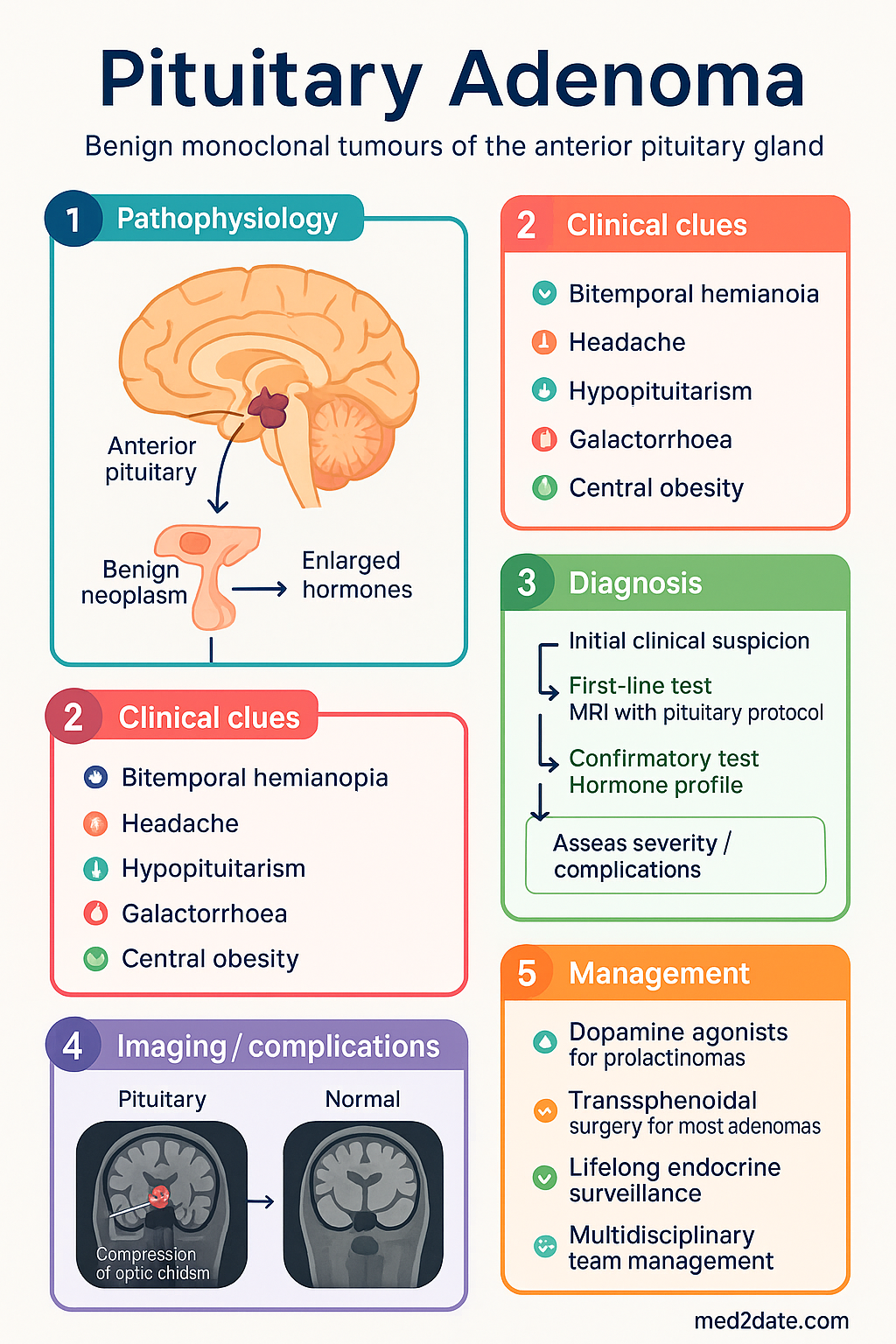
Pituitary Adenoma clinical infographic โ€” pathophysiology, clinical clues, diagnosis, imaging, and management
Tap or click image to enlarge โ€” Pituitary Adenoma: pathophysiology, clinical clues, diagnosis, imaging, and management.
Pituitary Adenoma infographic, full size

Classification & Pathophysiology

Classification by Size

  • Microadenoma: <10 mm in diameter. Typically confined to the sella turcica; rarely cause mass effects.
  • Macroadenoma: โ‰ฅ10 mm in diameter. May extend suprasellarly, laterally into cavernous sinuses, or inferiorly into sphenoid sinus. Responsible for most mass-effect symptoms.
  • Giant adenoma: >40 mm; rare but associated with higher surgical morbidity.

Classification by Function

Type Hormone Excess Proportion Key Pathophysiology
Prolactinoma Prolactin 40โ€“60% Direct dopamine inhibition by tumour; galactorrhoea, hypogonadism.
Somatotrophinoma Growth Hormone (GH) 10โ€“15% GH โ†’ hepatic IGF-1 excess; acral enlargement, metabolic dysfunction.
Corticotrophinoma ACTH 5โ€“10% ACTH drives adrenal cortisol hypersecretion; central obesity, hypertension.
Non-functioning adenoma None (or subclinical ฮฑ-subunit) 15โ€“30% Mass effect; often macroadenoma at presentation.
Thyrotrophinoma TSH <1% Inappropriate TSH secretion causing central hyperthyroidism.

Histopathological Classification (WHO 2022)

The modern WHO classification emphasises immunohistochemistry for pituitary transcription factors (PIT-1, T-PIT, SF-1) and hormone production, moving away from the term "adenoma" to "pituitary neuroendocrine tumour (PitNET)" in some contexts. Prognostic markers include mitotic count, Ki-67 proliferation index (>3% suggests potential for more aggressive behaviour), and p53 expression.

Clinical Features (Mass Effect, Hormonal)

Mass Effect Symptoms (Macroadenomas)

  • Visual field defects: Classically bitemporal hemianopia due to chiasmal compression. May progress to blindness. Formal perimetry is essential.
  • Headache: Often frontal or retro-orbital due to dural stretching. Not always correlated with tumour size.
  • Cranial nerve palsies: Diplopia from III, IV, VI nerve involvement if lateral extension into cavernous sinus.
  • Apoplexy: Sudden haemorrhage or infarction within the adenoma. Presents with acute headache, visual loss, ophthalmoplegia, and potential cardiovascular collapse (adrenal crisis). Requires emergency high-dose glucocorticoids and neurosurgical assessment.
  • Hypopituitarism: Compression of normal pituitary tissue and stalk. Sequence of loss typically: GH > FSH/LH > TSH > ACTH. Presents with fatigue, amenorrhoea, erectile dysfunction, cold intolerance.

Syndromes of Hormonal Excess

Prolactinoma
Female
Oligomenorrhoea/amenorrhoea, galactorrhoea, infertility, reduced libido. Microadenomas common.
Setting: Endocrine clinic
Prolactinoma
Male
Erectile dysfunction, reduced libido, infertility, gynaecomastia. Often presents late as macroadenoma.
Setting: Endocrine/Urology clinic
Acromegaly
GH/IGF-1 Excess
Gradual coarsening of facial features, prognathism, macroglossia, soft tissue swelling, arthralgia, carpal tunnel syndrome, sweating, sleep apnoea, diabetes, hypertension, cardiomyopathy.
Setting: Multidisciplinary pituitary clinic
Cushing's Disease
ACTH Excess
Central obesity, moon face, supraclavicular fat pads, proximal myopathy, purple striae, easy bruising, hypertension, hyperglycaemia, osteoporosis, depression, psychosis.
Setting: Specialist endocrine unit

Investigations (MRI Pituitary, Hormone Profile)

Biochemical / Hormonal Profile

Essential for all macroadenomas and symptomatic microadenomas. Perform in a specialised endocrine laboratory.

Essential
Serum Prolactin
Elevated >20 ยตg/L (women), >15 ยตg/L (men). Macroprolactinomas: often >1000 ยตg/L. Rule out "hook effect" in giant tumours.
Essential
Insulin-like Growth Factor-1 (IGF-1)
Age- and sex-adjusted. Elevated in acromegaly. First-line screen for GH excess.
Essential
Oral Glucose Tolerance Test (OGTT) for GH
Confirmatory for acromegaly: failure to suppress GH to <1 ยตg/L (or <0.4 ยตg/L with ultrasensitive assay) after 75g glucose load. MBS Item 66660.
Essential
24-hour Urinary Free Cortisol & Late-night Salivary Cortisol
Screen for Cushing's syndrome. Require at least two abnormal tests. MBS Items 66655, 66658.
Available
Low-dose Dexamethasone Suppression Test (LDDST)
Confirmatory for Cushing's: 1 mg dex overnight; serum cortisol >50 nmol/L suggests Cushing's. MBS Item 66654.
Essential
Thyroid Function Tests, Testosterone/Oestradiol, LH, FSH
Assess for hypopituitarism and hyperthyroidism (TSHoma).
Available
Dynamic Pituitary Function Testing (Insulin Tolerance Test, GnRH Stimulation)
Gold standard for GH and ACTH reserve. Perform in specialist centre with endocrine nurse supervision. MBS Item 66670.

Radiology

Essential
MRI Pituitary with Gadolinium (Dedicated Protocol)
1โ€“1.5T (3T preferred) with thin coronal and sagittal T1-weighted sequences pre- and post-gadolinium. Identifies tumour size, invasion (cavernous sinus, sphenoid), and relationship to optic chiasm. MBS Item 63000 series.
Referral
CT Scan (if MRI contraindicated)
For bony anatomy of sella, or if MRI contraindicated (e.g., pacemaker).

Ophthalmology

Essential
Formal Visual Field Perimetry (Humphrey)
Mandatory for any macroadenoma within 2 mm of optic chiasm. Baseline and post-operative monitoring.
Available
Optical Coherence Tomography (OCT)
Measures retinal nerve fibre layer thickness; objective measure of chiasmal compression.

Management (Surgery, Radiotherapy, Medical)

General Principles

Management is determined by adenoma type, size, invasiveness, and patient factors. All patients should be discussed at a multidisciplinary pituitary tumour board (neuroendocrinology, neurosurgery, neuroradiology, radiation oncology, ophthalmology).

โš ๏ธ
Pituitary Apoplexy: Medical emergency. Immediate high-dose dexamethasone (4โ€“6 mg IV 6-hourly), fluid resuscitation, and urgent neurosurgical assessment for visual deterioration or declining consciousness. Do not delay steroids for imaging.

Medical Therapy

๐Ÿ’Š
Cabergoline
Dostinexยฎ ยท Dopamine agonist (D2)
Indication First-line for prolactinomas (micro and macro). Also used in acromegaly adjunctively.
Adult dose 0.25โ€“0.5 mg PO twice weekly, titrate to normalise prolactin (max 3 mg/week).
Paediatric dose Safety and efficacy not established in paediatric prolactinoma.
Key monitoring Prolactin monthly until normal, then 6โ€“12 monthly. Cardiac echo at baseline and after 5 years (mitral valve regurgitation risk at high dose >2 mg/week).
PBS status โœ” PBS General Benefit
๐Ÿ’Š
Octreotide LAR / Lanreotide Autogel
Sandostatin LARยฎ / Somatuline Autogelยฎ ยท Somatostatin analogue (SRL)
Indication Second-line for acromegaly (if surgery not curative or not feasible). First-line for TSHomas.
Adult dose Octreotide LAR 20 mg IM monthly, titrate to 30 mg. Lanreotide 60โ€“120 mg deep SC monthly.
Key monitoring IGF-1 and GH every 3โ€“6 months. Cholelithiasis screen (ultrasound) annually. Fasting glucose.
PBS status โš  PBS Authority Required (Acromegaly, TSHoma)
๐Ÿ’Š
Pegvisomant
Somavertยฎ ยท GH receptor antagonist
Indication Third-line for acromegaly refractory to surgery and SRLs. Normalises IGF-1 in >90%.
Adult dose Loading 80 mg SC, then 10โ€“15 mg SC daily. Titrate based on IGF-1.
Key monitoring LFTs monthly for 6 months, then 6-monthly. IGF-1 every 4โ€“6 weeks until normal. Monitor tumour size (may increase).
PBS status โœ– Not PBS (Very high cost ~$50,000/year)

Surgical Therapy

Endoscopic Endonasal Transsphenoidal Surgery (EETS) is the gold-standard approach for most pituitary adenomas. Performed by a specialised skull-base neurosurgeon.

  • Indications: All non-prolactinoma secretory adenomas (first-line), non-functioning adenomas causing mass effect, prolactinomas resistant/intolerant to dopamine agonists, pituitary apoplexy with visual compromise.
  • Remission rates: Microadenomas 70โ€“90%, Macroadenomas 40โ€“70% (higher for experienced surgeons). Higher for invasive tumours.
  • Complications: CSF leak (2โ€“5%), new hypopituitarism (5โ€“15%), diabetes insipidus (transient 10โ€“20%, permanent 1โ€“2%), meningitis, vascular injury (<1%).
  • Peri-operative management: Stress-dose hydrocortisone (100 mg IV at induction) if ACTH deficient. Monitor sodium closely for DI (first 5โ€“10 days).

Radiotherapy

Used for residual or recurrent tumour not controlled by surgery/medical therapy. Goal is tumour control, not rapid hormone normalisation (may take years).

Modality Indication Key Details
Stereotactic Radiosurgery (SRS)
(Gamma Knife, CyberKnife)
Focal residual/recurrent adenoma <3 cm, โ‰ฅ3โ€“5 mm from optic chiasm. Single high-dose fraction. 5-year tumour control >90%. Hypopituitarism risk 20โ€“40% at 10 years.
Fractionated Radiotherapy (EBRT) Larger, invasive, or recurrent tumours close to optic apparatus. Typically 45โ€“50 Gy in 25 fractions. Slower biochemical response. Higher long-term hypopituitarism risk (~50โ€“80%).

Monitoring & Follow-up

Post-operative / Post-treatment

Day 1โ€“10
Inpatient: Monitor fluid balance, serum sodium (for DI). Check morning cortisol on day 2โ€“3. Formal visual field testing before discharge if pre-op deficit.
6โ€“12 weeks
First outpatient review: Full pituitary function panel (cortisol, TSH/fT4, IGF-1, prolactin, LH/FSH, testosterone/oestradiol). Repeat MRI pituitary (baseline for recurrence). Visual fields if pre-op abnormal.
3โ€“6 months
Secretory adenomas: Assess biochemical remission (normal IGF-1, UFC, prolactin). If not in remission, discuss adjuvant therapy (medical or radiotherapy).
Annually (lifelong)
All patients: Clinical assessment, pituitary hormone panel, MRI (frequency reduced after 5 years if stable). Screen for metabolic syndrome, osteoporosis, cardiovascular risk. Hypopituitarism replacement monitoring.

Special Populations

๐Ÿคฐ
Pregnancy
Prolactinoma: Microadenomas โ€“ stop cabergoline pre-conception or at positive pregnancy test (low risk of enlargement). Macroadenomas โ€“ continue cabergoline through pregnancy if high risk of expansion; monitor visual fields each trimester.
Acromegaly: Discontinue somatostatin analogues and pegvisomant pre-conception (limited safety data). Surgery if needed in 2nd trimester.
Cushing's disease: Best managed by surgery pre-conception. If diagnosed in pregnancy, medical therapy (ketoconazole, metyrapone) may be considered under specialist supervision.
๐Ÿ‘ถ
Paediatrics
Rare. Most common are prolactinomas and ACTH-secreting adenomas. Surgery is first-line for most non-prolactinoma adenomas. Dopamine agonists for prolactinomas (lower doses). Monitor growth and puberty carefully.
๐Ÿ‘ด
Elderly
Higher prevalence of non-functioning adenomas. Surgery may be higher risk due to comorbidities; consider medical management or watchful surveillance for slower-growing tumours. Careful assessment of hypopituitarism symptoms (often attributed to ageing).
๐Ÿฉบ
Renal/Hepatic Impairment
Cabergoline: Use with caution in severe hepatic impairment (Child-Pugh C); no renal dose adjustment. Octreotide: No renal adjustment; caution in cirrhosis (hepatic metabolism). Pegvisomant: No data in severe renal/hepatic impairment.
๐Ÿ›ก๏ธ
Immunocompromised
No specific pituitary adenoma considerations. Ensure vaccinations are up-to-date pre-surgery. Post-transsphenoidal surgery risk of meningitis may be slightly higher; prophylactic antibiotics per neurosurgical protocol.
Aboriginal and Torres Strait Islander Health Considerations

Aboriginal and Torres Strait Islander peoples may experience pituitary adenomas but face significant barriers to timely diagnosis and specialist care. These include geographical remoteness, reduced access to endocrinology and neurosurgery services, and culturally unsafe healthcare environments.

Diagnosis & Access
Delayed presentation is common, especially for macroadenomas causing visual loss. Local Health Districts and Aboriginal Medical Services (AMS) should facilitate urgent telehealth endocrinology consultations and funded travel to metropolitan pituitary centres.
Cultural Safety
Engagement with Indigenous Health Workers and Liaison Officers is essential. Patient information should be available in plain language and relevant community languages. Respect for family involvement in decision-making.
Chronic Disease Management
Post-treatment, long-term monitoring for hypopituitarism and metabolic comorbidities must be integrated into holistic primary care plans within the AMS. Ensure adequate follow-up for hormone replacement and tumour recurrence screening.

๐Ÿ“š References

  1. 1. Melmed S, et al. Diagnosis and Treatment of Hyperprolactinemia: An Endocrine Society Clinical Practice Guideline. J Clin Endocrinol Metab. 2011;96(2):273-88.
  2. 2. Katznelson L, et al. Acromegaly: An Endocrine Society Clinical Practice Guideline. J Clin Endocrinol Metab. 2014;99(11):3933-51.
  3. 3. Nieman LK, et al. Treatment of Cushing's Syndrome: An Endocrine Society Clinical Practice Guideline. J Clin Endocrinol Metab. 2015;100(8):2807-31.
  4. 4. Freda PU, et al. Pituitary Incidentaloma: An Endocrine Society Clinical Practice Guideline. J Clin Endocrinol Metab. 2011;96(4):894-904.
  5. 5. Australian Institute of Health and Welfare (AIHW). Brain and other central nervous system cancer. Cancer Series. 2023.
  6. 6. The Royal Australian and New Zealand College of Ophthalmologists (RANZCO). Guidelines for the management of visual field defects due to pituitary adenomas. 2020.
  7. 7. Chanson P, et al. European Society of Endocrinology (ESE) Clinical Practice Guideline on the management of aggressive pituitary tumours and carcinomas. Eur J Endocrinol. 2018;178(1):G1-G24.
  8. 8. Fleseriu M, et al. Consensus on diagnosis and management of Cushing's disease: a guideline update. Lancet Diabetes Endocrinol. 2021;9(12):847-875.
  9. 9. Australian Government Department of Health. PBS Schedule: Cabergoline, Octreotide. Accessed 2024.
  10. 10. Asa SL, et al. Overview of the 2022 WHO Classification of Pituitary Tumors. Endocr Pathol. 2022;33(1):6-26.
co-pay for eligible patients).
Pregnancy & maternal health
Antenatal screening for thyroid disease should be integrated into Aboriginal Community Controlled Health Organisation (ACCHO) maternal health programmes. Untreated hypothyroidism in pregnancy disproportionately impacts communities with limited access to early antenatal care.
Comorbidity burden
Higher rates of diabetes, cardiovascular disease, and chronic kidney disease in Aboriginal and Torres Strait Islander communities mean hypothyroid-related dyslipidaemia and cardiovascular risk require particularly active management. Integrating thyroid function testing into chronic disease management plans (MBS Item 721) is recommended.
Iodine status
Although Australia-wide mandatory iodisation has improved status, some Aboriginal and Torres Strait Islander communities โ€” particularly in very remote areas โ€” may have borderline iodine adequacy. Urinary iodine monitoring in these communities should be maintained.

๐Ÿ“š References

  1. 1. Chaker L, Bianco AC, Jonklaas J, Peeters RP. Hypothyroidism. Lancet. 2017;390(10101):1550โ€“1562.
  2. 2. Garber JR, Cobin RH, Gharib H, et al. Clinical practice guidelines for hypothyroidism in adults: cosponsored by the American Association of Clinical Endocrinologists and the American Thyroid Association. Endocr Pract. 2012;18(6):988โ€“1028.
  3. 3. Pearce SH, Brabant G, Duntas LH, et al. 2013 ETA guideline: management of subclinical hypothyroidism. Eur Thyroid J. 2013;2(4):215โ€“228.
  4. 4. Alexander EK, Pearce EN, Brent GA, et al. 2017 guidelines of the American Thyroid Association for the diagnosis and management of thyroid disease during pregnancy and the postpartum. Thyroid. 2017;27(3):315โ€“389.
  5. 5. RACGP. Red Book: Guidelines for preventive activities in general practice. 9th ed. East Melbourne: RACGP; 2018.
  6. 6. Australian Institute of Health and Welfare (AIHW). Aboriginal and Torres Strait Islander health performance framework. Canberra: AIHW; 2023.
  7. 7. Li Y, Teng D, Shi X, et al. Prevalence of diabetes recorded in mainland China using 2018 diagnostic criteria from the American Diabetes Association: national cross sectional study. BMJ. 2020;369:m997. [TSH population reference data]
  8. 8. Ross DS. Diagnosis of and screening for hypothyroidism. In: UpToDate, Cooper DS (Ed). Wolters Kluwer; 2024. Accessed June 2024.
  9. 9. NHMRC. National evidence-based guideline: diagnosis, management and prevention of congenital hypothyroidism. Canberra: NHMRC; 2019.
  10. 10. Wiersinga WM, Duntas L, Fadeyev V, Nygaard B, Vanderpump MP. 2012 ETA guidelines: the use of L-T4 + L-T3 in the treatment of hypothyroidism. Eur Thyroid J. 2012;1(2):55โ€“71.
  11. 11. Pharmaceuticals Benefits Scheme (PBS). Levothyroxine sodium. Australian Government Department of Health. Available at: pbs.gov.au. Accessed June 2024.
  12. 12. Australian Government Department of Health. National Newborn Bloodspot Screening โ€” Congenital Hypothyroidism. Available at: www.newbornscreening.gov.au. Accessed June 2024.