Home Endocrinology Congenital Adrenal Hyperplasia (CAH)

Congenital Adrenal Hyperplasia (CAH)

📋 Key Information Summary

📋
  • Congenital adrenal hyperplasia (CAH) is a group of autosomal recessive disorders affecting adrenal steroid biosynthesis, most commonly due to 21-hydroxylase deficiency (CYP21A2) — accounting for approximately 90–95% of all cases.
  • Australia includes CAH in newborn bloodspot screening (NBS) programmes across all states and territories, enabling early detection of classical salt-wasting and simple-virilising forms.
  • Classical CAH presents in the neonatal period with ambiguous genitalia (46,XX) or salt-wasting crisis (both sexes); non-classical CAH presents later with precocious puberty, acne, hirsutism, or infertility.
  • Salt-wasting crisis is a medical emergency requiring IV 0.9% sodium chloride, IV hydrocortisone bolus (50–100 mg/m² in neonates), and dextrose; delayed treatment can be fatal.
  • Lifelong glucocorticoid replacement with hydrocortisone is the cornerstone of management in children; modified-release hydrocortisone (Plenadren®) or prednisolone may be used in adults.
  • Mineralocorticoid replacement with fludrocortisone is required for salt-wasting and simple-virilising classical CAH; sodium chloride supplementation is added in neonates and infants.
  • Monitoring includes serum 17-hydroxyprogesterone (17-OHP), androstenedione, renin activity, growth velocity, and bone age in paediatric patients.
  • Antimicrobial prophylaxis is not routinely required; stress dosing of hydrocortisone (2–3× maintenance) is essential during febrile illness, surgery, or trauma.
  • Genetic counselling is recommended for all families; pre-conception carrier testing with CYP21A2 genotyping is available through Australian genetics services.
  • Surgical management of ambiguous genitalia (feminising genitoplasty) should be performed at specialised centres with multidisciplinary DSD (differences of sex development) teams; timing remains individualised.
  • Fertility is reduced in both sexes; assisted reproductive technologies and targeted ovulation induction can improve outcomes.
  • ATSI populations may face barriers to specialist follow-up and access to genetic counselling, particularly in remote communities; active outreach is essential.

🎧 Audio Brief

Managing Congenital Adrenal Hyperplasia

A short clinical audio briefing generated from this article — perfect for the commute or ward round.

Introduction & Australian Epidemiology

Congenital adrenal hyperplasia (CAH) comprises a family of autosomal recessive disorders characterised by impaired adrenal steroid biosynthesis. The condition results from deficiency of one of several enzymes required for the synthesis of cortisol, and in some cases aldosterone, from cholesterol. The most prevalent form — 21-hydroxylase deficiency due to mutations in the CYP21A2 gene — accounts for approximately 90–95% of all CAH cases worldwide and is the focus of this guideline.

The reported incidence of classical CAH (salt-wasting and simple-virilising forms) is approximately 1 in 15,000 live births globally. In Australia, newborn bloodspot screening (NBS) programmes have been operational in all states and territories since the early 2000s and reliably detect classical 21-hydroxylase deficiency. Data from the Australian Institute of Health and Welfare (AIHW) and state-based newborn screening laboratories suggest an incidence consistent with international figures, with no significant geographic variation within Australia.

Non-classical (late-onset) CAH is substantially more common, with prevalence estimates ranging from 1 in 200 to 1 in 1,000 depending on population. It is not detected by NBS and is typically diagnosed during adolescence or adulthood following investigation for hyperandrogenism, oligomenorrhoea, or infertility.

CAH management requires a multidisciplinary team including paediatric endocrinology, adult endocrinology, urology/gynaecology, clinical genetics, psychology, and nursing specialists. Early diagnosis, appropriate hormone replacement, and lifelong monitoring are critical to preventing adrenal crises, optimising growth and pubertal development, and preserving fertility.
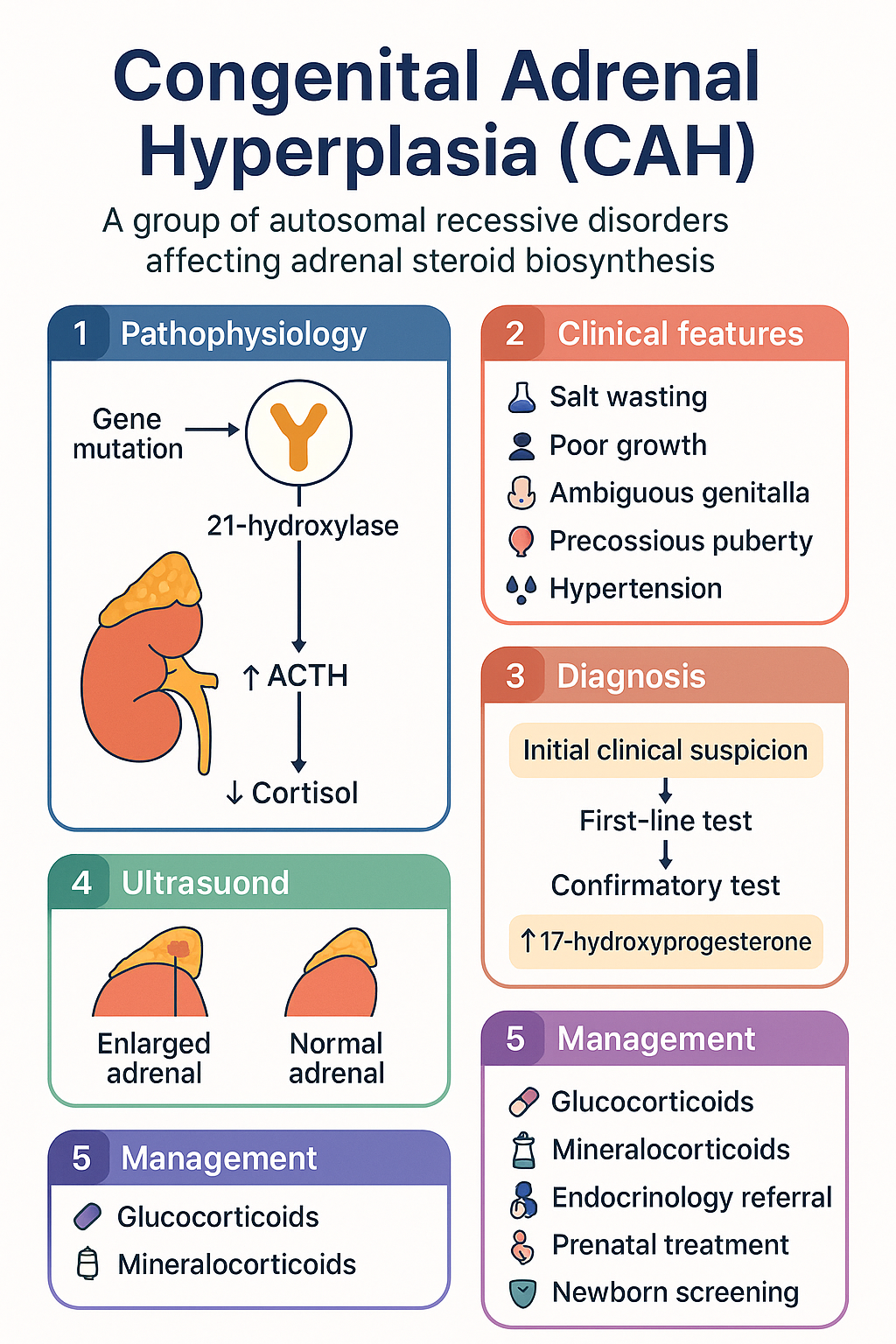
Congenital Adrenal Hyperplasia (CAH) clinical infographic — pathophysiology, clinical clues, diagnosis, imaging, and management
Tap or click image to enlarge — Congenital Adrenal Hyperplasia (CAH): pathophysiology, clinical clues, diagnosis, imaging, and management.
Congenital Adrenal Hyperplasia (CAH) infographic, full size

Pathophysiology & Enzyme Defects

Adrenal steroidogenesis converts cholesterol through a series of enzymatic steps into cortisol, aldosterone, and adrenal androgens. Deficiency of any enzyme in this pathway leads to accumulation of precursors proximal to the block and shunting of intermediates into alternative steroid pathways. The resulting hormonal imbalance — cortisol deficiency with variable aldosterone deficiency and androgen excess — drives the clinical phenotype of CAH.

21-Hydroxylase Deficiency (CYP21A2)

21-hydroxylase (P450c21) catalyses the conversion of 17-hydroxyprogesterone (17-OHP) to 11-deoxycortisol (glucocorticoid pathway) and progesterone to 11-deoxycorticosterone (mineralocorticoid pathway). Deficiency results in:

  • Impaired cortisol synthesis → loss of negative feedback → elevated ACTH → adrenal hyperplasia
  • Accumulation of 17-OHP and progesterone → shunting to androgen pathway → excess DHEA, androstenedione, testosterone
  • Impaired aldosterone synthesis (in salt-wasting form) → hyponatraemia, hyperkalaemia, dehydration
⚠️
Salt-wasting crisis: Approximately 75% of classical 21-hydroxylase deficiency is the salt-wasting form, in which aldosterone synthesis is severely impaired. Neonates may present with life-threatening hyponatraemic dehydration and hyperkalaemic metabolic acidosis within the first 2–4 weeks of life. This is a paediatric emergency.

Other Enzyme Deficiencies

Enzyme Gene Frequency Key Features
21-Hydroxylase CYP21A2 ~90–95% Virilisation, salt wasting
11β-Hydroxylase CYP11B1 ~5–8% Virilisation, hypertension (DOC excess)
3β-Hydroxysteroid dehydrogenase HSD3B2 ~1–2% Mild virilisation (XX), undervirilisation (XY)
17α-Hydroxylase / 17,20-lyase CYP17A1 <1% Hypertension, sexual infantilism, 46,XY DSD
P450 oxidoreductase POR Rare Antley–Bixler syndrome, skeletal anomalies
StAR / Cholesterol side-chain cleavage STAR / CYP11A1 Rare Lipoid CAH — severe, all steroid production impaired

CYP21A2 Genotype–Phenotype Correlation

Over 100 CYP21A2 mutations have been characterised. Genotype generally predicts phenotype severity:

  • null / large deletions: No enzyme activity → salt-wasting CAH
  • IVS2 splice mutation (intron 2 splice site): ~1–2% residual activity → salt-wasting CAH
  • I172N (exon 4): ~2–5% residual activity → simple virilising CAH
  • V281L (exon 7): ~20–50% residual activity → non-classical CAH
  • P30L (exon 1): ~30–60% residual activity → non-classical CAH

Genotyping is available through Australian clinical genetics services (e.g., Victorian Clinical Genetics Services, SA Pathology Genetics, PathWest) and is recommended for confirmation of diagnosis, carrier testing, and prenatal counselling.

Classical vs Non-Classical CAH

Classical — Salt-Wasting
Salt-Wasting CAH
Most severe form. Complete or near-complete 21-hydroxylase deficiency. Severe cortisol and aldosterone deficiency. 46,XX newborns have ambiguous genitalia (Prader III–V). Both sexes at risk of neonatal salt-wasting crisis (hyponatraemia, hyperkalaemia, dehydration, shock) typically at 1–4 weeks of life. Elevated 17-OHP (>300 nmol/L) on NBS.
Setting: Neonatal unit / PICU if crisis
Classical — Simple Virilising
Simple Virilising CAH
Severe cortisol deficiency with sufficient residual aldosterone production to prevent overt salt wasting. 46,XX newborns have ambiguous genitalia (Prader I–III). If not detected by NBS, may present with precocious puberty, accelerated growth, advanced bone age, and premature epiphyseal fusion in early childhood. 17-OHP on NBS is markedly elevated.
Setting: Outpatient endocrinology
Non-Classical
Non-Classical (Late-Onset) CAH
Mild enzyme deficiency. No genital ambiguity at birth. Not detected by NBS (17-OHP is normal or only mildly elevated). Presents in childhood with premature pubarche, or in adolescence/adulthood with hirsutism, acne, oligomenorrhoea, anovulation, or infertility. Phenotypically overlaps with polycystic ovary syndrome (PCOS). Prevalence up to 1–2% in some populations.
Setting: Outpatient endocrinology / gynaecology
ℹ️
Distinguishing non-classical CAH from PCOS: Measurement of early-morning (8–9 AM) serum 17-OHP is the key screening test. A stimulated 17-OHP level (250 µg cosyntropin/ACTH stimulation test) >45 nmol/L confirms non-classical 21-hydroxylase deficiency. Baseline 17-OHP <5 nmol/L effectively excludes the diagnosis.

Clinical Features & Newborn Screening

Neonatal Presentation

Classical CAH may present in the newborn period with:

  • Ambiguous genitalia in 46,XX neonates: Ranges from clitoromegaly (Prader I) to complete labioscrotal fusion with penile urethra (Prader V). The degree of virilisation does not correlate with the degree of salt wasting.
  • Salt-wasting crisis (both sexes): Typically onset at 1–3 weeks of life. Features include poor feeding, vomiting, lethargy, failure to thrive, dehydration, hypotension, hyponatraemia, hyperkalaemia, and metabolic acidosis. Can rapidly progress to cardiovascular collapse and death if untreated.
  • Hyperpigmentation: Excess ACTH stimulates melanocortin receptors, causing generalised skin darkening, particularly of the scrotum/labia, areolae, and skin creases.
  • 46,XY neonates with classical salt-wasting CAH appear phenotypically normal at birth and may not be diagnosed until the salt-wasting crisis.

Newborn Bloodspot Screening in Australia

All Australian states and territories include CAH (21-hydroxylase deficiency) in their newborn bloodspot screening programmes. The screening test measures immunoreactive 17-OHP from a heel-prick blood sample collected at 48–72 hours of life.

Australian NBS for CAH: Sensitivity for classical salt-wasting CAH approaches 100%. Simple virilising forms have a sensitivity of approximately 85–95% (may be missed if the screening sample is taken very early). Non-classical CAH is not reliably detected by NBS. False positives are more common in preterm, low-birthweight, or acutely unwell neonates.

Childhood & Adolescent Presentation

  • Simple virilising CAH diagnosed after the neonatal period may present with early pubic hair, body odour, clitoromegaly, penile enlargement, accelerated linear growth, and advanced bone age.
  • Untreated patients develop premature epiphyseal fusion and short adult stature despite tall childhood height.
  • Non-classical CAH in children presents with premature adrenarche (pubic/axillary hair before age 8 in girls, 9 in boys) and mild virilisation.

Adult Presentation

  • Women: hirsutism, acne, menstrual irregularity, anovulation, infertility, and clitoromegaly. Frequently misdiagnosed as PCOS.
  • Men: may be asymptomatic or have testicular adrenal rest tumours (TART), reduced spermatogenesis, and infertility.
  • Both sexes: risk of adrenal crisis during intercurrent illness, surgery, or trauma if not on adequate stress dosing.

Diagnostic Investigations

Essential
Serum 17-hydroxyprogesterone (17-OHP)
MBS Item 66759. The primary screening and diagnostic marker. Classical CAH: >300 nmol/L (basal). Non-classical: may be normal basal; requires ACTH stimulation. Confirm with early-morning sample.
Available
Serum androstenedione, testosterone, DHEA-S
MBS Items 66677, 66684. Androgen markers for monitoring disease control and diagnosis in non-classical CAH.
Available
Plasma renin activity / direct renin concentration
MBS Item 66801. Essential for monitoring mineralocorticoid replacement adequacy. Elevated renin suggests under-replacement.
Available
Serum electrolytes, sodium, potassium
MBS Item 66506. Essential in neonatal diagnosis and monitoring salt-wasting CAH.
Specialist
ACTH stimulation test (250 µg cosyntropin)
Stimulated 17-OHP >45 nmol/L confirms 21-hydroxylase deficiency. Used for diagnosis of non-classical CAH and ambiguous cases. Perform at 8–9 AM.
Specialist
CYP21A2 genotyping
Available through clinical genetics services (VCGS, SA Pathology, PathWest). Recommended for confirmation, carrier testing, and prenatal counselling. Not required for acute management.
Available
Bone age (left hand/wrist X-ray)
MBS Item 58501. Monitor growth and treatment adequacy in paediatric patients. Compare chronologic vs skeletal age.
Available
Pelvic/testicular ultrasound
Assess internal reproductive anatomy (Müllerian structures in 46,XX DSD); screen for testicular adrenal rest tumours (TART) in males.

Management: Glucocorticoids & Mineralocorticoids

Principles of Treatment

  • Replace deficient cortisol (and aldosterone where needed) to suppress excess ACTH and reduce adrenal androgen production.
  • Avoid both under-replacement (persistent hyperandrogenism, virilisation, accelerated bone age) and over-replacement (iatrogenic Cushing syndrome, growth suppression, obesity, osteoporosis).
  • Treatment is lifelong; abrupt cessation can precipitate adrenal crisis.
  • Stress dosing is essential during intercurrent illness, surgery, and trauma.

Glucocorticoid Replacement

💊
Hydrocortisone
Hydrocortisone® · Panafcortelone® · Cortef® · Glucocorticoid (cortisol)
Adult dose 10–15 mg/m²/day PO divided into 3 doses (e.g., 10 mg on waking, 5 mg at lunch, 5 mg at dinner). Total daily dose typically 15–25 mg/day.
Paediatric dose 10–15 mg/m²/day PO divided into 3 doses (equivalent weight-based: 8–12 mg/m²/day in neonates). Neonates: 2.5–5 mg PO TDS; Infants: 3–5 mg PO TDS. Crush tablets or use compounded suspension.
Route Oral (preferred for maintenance); IV/IM for acute crisis
Frequency Three times daily (mimics physiologic cortisol rhythm). Higher proportion of dose in the morning.
Renal adjustment No specific adjustment. Monitor electrolytes closely if renal impairment coexists.
Hepatic adjustment Hydrocortisone does not require hepatic activation; safe in liver disease.
PBS status ✔ PBS General Benefit
💊
Prednisolone
Solone® · Predmix® · Panafcortelone® · Intermediate-acting glucocorticoid
Adult dose 3–7 mg/day PO in divided doses (BD or TDS). Used in adults when hydrocortisone is insufficient or not tolerated. Longer half-life; less physiologic.
Paediatric dose Not recommended in children. Growth-suppressive; hydrocortisone is preferred.
Route Oral
Frequency BD or TDS
PBS status ✔ PBS General Benefit
💊
Dexamethasone
Dexamethasone® · Dexmethsone® · Long-acting glucocorticoid
Adult dose 0.25–0.75 mg/day PO at bedtime (HS). Potent suppression of ACTH; used as alternative in adults only.
Paediatric dose Not recommended in children. Highly growth-suppressive. Reserve for refractory adult cases.
Route Oral
PBS status ✔ PBS General Benefit
💊
Fludrocortisone
Florinef® · Fludrocortisone® · Mineralocorticoid
Adult dose 0.05–0.2 mg/day PO (once daily or divided BD). Titrate to normal renin, blood pressure, and electrolytes.
Paediatric dose Neonates: 0.05–0.15 mg/day PO. Infants: 0.05–0.2 mg/day. Titrate based on plasma renin, serum Na⁺/K⁺, and blood pressure.
Route Oral
Frequency Once daily or BD
Indications Required for all salt-wasting CAH and most simple-virilising classical CAH. May not be needed in non-classical CAH.
Monitoring Plasma renin activity (target: age-appropriate normal range), serum Na⁺/K⁺, blood pressure. Under-replacement → elevated renin, salt craving, poor weight gain. Over-replacement → hypertension, hypokalaemia.
PBS status ✔ PBS General Benefit
💊
Sodium chloride supplementation
Normalyte® · Sodium chloride tablets/solution · Electrolyte supplement
Dose Neonates/infants: 1–2 mmol Na⁺/kg/day (as 0.9% NaCl solution or salt added to feeds). Typically 1–2 mL of 20% NaCl solution added to each feed, or 0.5–1 g NaCl/day divided into feeds. Continue until age 1–2 years or until child takes adequate dietary salt.
Route Oral (added to feeds)
Indications All neonates and infants with salt-wasting CAH. Critical to prevent hyponatraemia in early life when renal sodium conservation is immature.
PBS status ✔ PBS General Benefit (NaCl solution)

Emergency / Stress Dosing of Hydrocortisone

🚨
Adrenal crisis protocol: Any patient with CAH who becomes acutely unwell (febrile illness >38.5°C, vomiting, diarrhoea, surgery, trauma) requires immediate stress dosing. Failure to increase glucocorticoid doses can precipitate life-threatening adrenal crisis.
Mild illness (afebrile, tolerating oral)
Double the oral hydrocortisone dose for duration of illness. Resume normal dose 24–48 hours after recovery.
Moderate–severe illness (febrile >38.5°C, vomiting, unable to tolerate oral)
Triple the oral hydrocortisone dose. If vomiting/unable to take oral: administer hydrocortisone 50 mg/m² IV/IM stat (max 100 mg in neonates/infants, 100 mg in adults), then 50 mg/m²/day IV divided Q6–8H. Give IV 0.9% NaCl bolus if dehydrated.
Major surgery / trauma
Hydrocortisone 50–100 mg/m² IV at induction (max 100 mg), then 50–100 mg/m²/day IV divided Q6–8H for 24–48 hours post-operatively. Taper to oral maintenance over 2–3 days. Maintain IV fluids with 5% dextrose + 0.9% NaCl.
Minor procedure (dental, sedation)
Double oral hydrocortisone on the day of procedure. For IV sedation or GA, use IV stress dosing as per surgery protocol above.

Monitoring Targets

Parameter Target Frequency
Serum 17-OHP 1–10 nmol/L (mid-morning, pre-dose) — slightly above normal. Over-suppressed → overtreated. Every 3–6 months (paediatric); 6–12 months (adult)
Serum androstenedione Age- and sex-appropriate normal range Every 3–6 months
Serum testosterone Age- and sex-appropriate normal range Every 3–6 months
Plasma renin activity Within age-appropriate normal range (indicates adequate fludrocortisone) Every 3–6 months
Serum Na⁺ / K⁺ Normal range Every 3–6 months (more frequent in neonates)
Growth velocity 50th–75th percentile velocity; height within genetic target range Every 3–6 months (paediatric)
Bone age (left wrist X-ray) Within 1 SD of chronologic age (not advanced >2 years) Annually in children; as needed in adults
Blood pressure Age-appropriate normal range (over-replacement of fludrocortisone → hypertension) Every visit
BMI / weight Maintain healthy BMI. Monitor for Cushingoid features (over-replacement) Every visit
Testicular ultrasound (males) Screen for testicular adrenal rest tumours (TART) Annually from puberty

Adrenal Crisis Emergency Card

⚠️
All patients with classical CAH should carry a Steroid Emergency Card (available from the Australasian Society of Clinical Immunology and Allergy — ASCIA — or via state paediatric endocrinology services). The card should detail the patient's condition, medications, emergency hydrocortisone dose, and treating team contact details. A MedicAlert® bracelet is also recommended.

Special Populations

🤰 Pregnancy
Glucocorticoids
Hydrocortisone and prednisolone are safe in pregnancy (placental 11β-HSD2 inactivates cortisol). Dexamethasone crosses the placenta and is used in prenatal treatment (experimental) to prevent virilisation of affected 46,XX foetuses — only within research protocols at specialised centres. Dose adjustments may be needed in the second and third trimesters due to increased cortisol-binding globulin.
Fludrocortisone
Safe in pregnancy. Dose may need to be increased (↑ renin in pregnancy). Monitor renin and blood pressure.
Labour & delivery
Stress-dose hydrocortisone required: 100 mg IV at onset of active labour, then 50 mg IV Q8H until delivery. Resume oral maintenance within 24–48 hours post-partum.
👶 Paediatrics
Hydrocortisone
Drug of choice in children. 10–15 mg/m²/day PO divided TDS. Crush tablets or use compounded suspension (compounding pharmacies). Avoid prednisolone and dexamethasone due to growth suppression. Growth velocity is the single most important marker of treatment adequacy in children.
Growth & puberty
Monitor height velocity, weight, and pubertal staging every 3–6 months. GnRH analogue (e.g., goserelin / leuprorelin) may be considered if central precocious puberty develops secondary to androgen exposure, but these are PBS Authority Required agents. Delaying puberty is controversial and should involve a multidisciplinary DSD team.
Transition
Structured transition from paediatric to adult endocrinology services is essential. Late adolescence is a high-risk period for treatment non-adherence and adrenal crises.
👴 Elderly
Monitoring
Increased risk of osteoporosis with long-term glucocorticoid use. Monitor DEXA bone mineral density (MBS Item 12310) every 2–3 years. Screen for cardiovascular risk factors (hypertension, dyslipidaemia, obesity). Consider reducing glucocorticoid dose if over-replacement is suspected.
🫘 Renal Impairment
Hydrocortisone
No dose adjustment required (hepatic metabolism). However, monitor electrolytes and renin more frequently as renal function declines — sodium handling and potassium excretion may be impaired.
Fludrocortisone
Use with caution. May worsen fluid retention and hypertension. Titrate carefully and monitor blood pressure closely.
🫁 Hepatic Impairment
Hydrocortisone
Hydrocortisone (cortisol) is the native hormone and does not require hepatic activation. Preferred in liver disease. Prednisolone (requires hepatic conversion from prednisone) is also acceptable. Dexamethasone: no hepatic adjustment needed.
🛡️ Immunocompromised
Stress dosing
Immunocompromised patients are at higher risk of severe intercurrent infections and therefore at higher risk of adrenal crisis. Lower threshold for IV stress dosing. Ensure patients/carers have clear written emergency plans. Vaccination schedule should follow standard guidelines; live vaccines may be given if on physiologic replacement doses.

Aboriginal and Torres Strait Islander Health Considerations

Aboriginal and Torres Strait Islander Health
Disease burden
CAH incidence in ATSI populations is likely comparable to the general Australian population given its autosomal recessive genetic basis, although robust population-specific data are limited. Newborn screening captures all births regardless of ethnicity, which is a key equity mechanism.
Remote & rural access
ATSI families in remote and very remote Australia may face significant barriers to accessing paediatric endocrinology services, which are concentrated in tertiary centres (Sydney, Melbourne, Brisbane, Perth, Adelaide). Telehealth has expanded access since 2020 and should be leveraged for specialist reviews. The Royal Flying Doctor Service (RFDS) plays a critical role in emergency retrieval for neonatal salt-wasting crises.
Medication access
Hydrocortisone, fludrocortisone, and sodium chloride are PBS-listed and generally available through community pharmacies. In very remote communities, supply may be inconsistent through Closing the Gap PBS co-payment programmes. Remote Area Aboriginal Health Services (RAAHS) and Remote Area Nurse (RAN) supply can facilitate access. Ensure families have adequate emergency supply (at least 2 weeks).
Genetic counselling
CYP21A2 genotyping and carrier testing are available through publicly funded clinical genetics services. However, geographic barriers may delay or prevent access. Telephone and video genetics counselling is available through most state genetics services. Cultural safety and language considerations are important; Aboriginal Health Workers and Liaison Officers should be involved in counselling sessions where possible.
Cultural considerations
Discussions of ambiguous genitalia and differences of sex development (DSD) require culturally sensitive communication. Engage with families respectfully and involve community Elders or cultural advisors where the family wishes. Avoid assumptions about gender identity or surgical preferences. Some communities may have specific kinship or naming practices that impact how health information is shared — liaise with Aboriginal Health Workers.
Emergency preparedness
Carer education on recognising adrenal crisis symptoms (poor feeding, vomiting, lethargy, dehydration) and administering emergency intramuscular hydrocortisone is critical, especially in remote communities where hospital access may be hours away. Written emergency action plans in plain English, with pictorial aids, should be provided to all families. Parent-held steroid emergency kits (hydrocortisone 100 mg IM injection) should be prescribed and provided.

📚 References

  1. 1. Speiser PW, Arlt W, Auchus RJ, et al. Congenital adrenal hyperplasia due to steroid 21-hydroxylase deficiency: an Endocrine Society Clinical Practice Guideline. J Clin Endocrinol Metab. 2018;103(11):4043–4088.
  2. 2. El-Maouche D, Arlt W, Merke DP. Congenital adrenal hyperplasia. Lancet. 2017;390(10108):2194–2210.
  3. 3. Joint LWPES/ESPE CAH Working Group. Consensus statement on 21-hydroxylase deficiency from the Lawson Wilkins Pediatric Endocrine Society and the European Society for Paediatric Endocrinology. J Clin Endocrinol Metab. 2002;87(9):4048–4053.
  4. 4. Royal Australasian College of Physicians (RACP). Paediatric endocrinology guidelines — Congenital adrenal hyperplasia. Sydney: RACP; 2020.
  5. 5. Australian Institute of Health and Welfare (AIHW). Newborn bloodspot screening national policy framework. Canberra: AIHW; 2018.
  6. 6. Falhammar H, Nyström HF, Ekman U, et al. Increased prevalence of cardiometabolic risk factors in women with congenital adrenal hyperplasia due to 21-hydroxylase deficiency. J Clin Endocrinol Metab. 2023;108(3):e1009–e1018.
  7. 7. Whittle E, Falhammar H. Glucocorticoid regimens in the treatment of congenital adrenal hyperplasia: a systematic review and meta-analysis. J Endocr Soc. 2022;6(1):bvac165.
  8. 8. Pharmaceutical Benefits Scheme (PBS). Schedule of pharmaceutical benefits. Australian Government Department of Health. Available at: https://www.pbs.gov.au. Accessed 2024.
  9. 9. White PC. Neonatal screening for congenital adrenal hyperplasia. Nat Rev Endocrinol. 2009;5(9):490–498.
  10. 10. Claahsen-van der Grinten HL, Speiser PW, Ahmed SF, et al. Congenital adrenal hyperplasia — current insights in pathophysiology, diagnostics, and management. Endocr Rev. 2022;43(1):91–159.
  11. 11. Australasian Paediatric Endocrine Group (APEG). Clinical practice guidelines for management of congenital adrenal hyperplasia. Sydney: APEG; 2021.
  12. 12. Aboriginal and Torres Strait Islander Health Performance Framework 2020 summary report. Australian Institute of Health and Welfare (AIHW). Canberra: AIHW; 2020.
co-pay for eligible patients).
Pregnancy & maternal health
Antenatal screening for thyroid disease should be integrated into Aboriginal Community Controlled Health Organisation (ACCHO) maternal health programmes. Untreated hypothyroidism in pregnancy disproportionately impacts communities with limited access to early antenatal care.
Comorbidity burden
Higher rates of diabetes, cardiovascular disease, and chronic kidney disease in Aboriginal and Torres Strait Islander communities mean hypothyroid-related dyslipidaemia and cardiovascular risk require particularly active management. Integrating thyroid function testing into chronic disease management plans (MBS Item 721) is recommended.
Iodine status
Although Australia-wide mandatory iodisation has improved status, some Aboriginal and Torres Strait Islander communities — particularly in very remote areas — may have borderline iodine adequacy. Urinary iodine monitoring in these communities should be maintained.

📚 References

  1. 1. Chaker L, Bianco AC, Jonklaas J, Peeters RP. Hypothyroidism. Lancet. 2017;390(10101):1550–1562.
  2. 2. Garber JR, Cobin RH, Gharib H, et al. Clinical practice guidelines for hypothyroidism in adults: cosponsored by the American Association of Clinical Endocrinologists and the American Thyroid Association. Endocr Pract. 2012;18(6):988–1028.
  3. 3. Pearce SH, Brabant G, Duntas LH, et al. 2013 ETA guideline: management of subclinical hypothyroidism. Eur Thyroid J. 2013;2(4):215–228.
  4. 4. Alexander EK, Pearce EN, Brent GA, et al. 2017 guidelines of the American Thyroid Association for the diagnosis and management of thyroid disease during pregnancy and the postpartum. Thyroid. 2017;27(3):315–389.
  5. 5. RACGP. Red Book: Guidelines for preventive activities in general practice. 9th ed. East Melbourne: RACGP; 2018.
  6. 6. Australian Institute of Health and Welfare (AIHW). Aboriginal and Torres Strait Islander health performance framework. Canberra: AIHW; 2023.
  7. 7. Li Y, Teng D, Shi X, et al. Prevalence of diabetes recorded in mainland China using 2018 diagnostic criteria from the American Diabetes Association: national cross sectional study. BMJ. 2020;369:m997. [TSH population reference data]
  8. 8. Ross DS. Diagnosis of and screening for hypothyroidism. In: UpToDate, Cooper DS (Ed). Wolters Kluwer; 2024. Accessed June 2024.
  9. 9. NHMRC. National evidence-based guideline: diagnosis, management and prevention of congenital hypothyroidism. Canberra: NHMRC; 2019.
  10. 10. Wiersinga WM, Duntas L, Fadeyev V, Nygaard B, Vanderpump MP. 2012 ETA guidelines: the use of L-T4 + L-T3 in the treatment of hypothyroidism. Eur Thyroid J. 2012;1(2):55–71.
  11. 11. Pharmaceuticals Benefits Scheme (PBS). Levothyroxine sodium. Australian Government Department of Health. Available at: pbs.gov.au. Accessed June 2024.
  12. 12. Australian Government Department of Health. National Newborn Bloodspot Screening — Congenital Hypothyroidism. Available at: www.newbornscreening.gov.au. Accessed June 2024.