Home Endocrinology Hypocalcaemia & Hypoparathyroidism

Hypocalcaemia & Hypoparathyroidism

๐Ÿ“‹ Key Information Summary

๐Ÿ“‹
  • Hypocalcaemia is defined as a serum albumin-corrected calcium <2.10 mmol/L or ionised calcium <1.10 mmol/L. It requires urgent assessment for acute symptoms and underlying cause.
  • Hypoparathyroidism is the most common cause of chronic hypocalcaemia, usually iatrogenic following anterior neck surgery. Autoimmune and genetic causes are less common.
  • Acute symptomatic hypocalcaemia is a medical emergency. Intravenous calcium gluconate is first-line to rapidly correct levels and prevent laryngospasm or seizures.
  • Classic signs include perioral/acral paraesthesia, muscle cramps, tetany, and characteristic findings like Trousseau's sign (carpopedal spasm) and Chvostek's sign (facial muscle twitching).
  • Investigations must include corrected calcium, phosphate, magnesium, PTH, 25-hydroxyvitamin D, and renal function to determine the aetiology.
  • First-line oral therapy for chronic hypoparathyroidism involves calcium carbonate/citrate supplements combined with calcitriol (active vitamin D).
  • Recombinant human parathyroid hormone (1-84) (Natparaยฎ) is available via the PBS as an adjunct for patients with refractory hypocalcaemia despite standard therapy.
  • Magnesium deficiency must be corrected concurrently, as it causes PTH resistance and impairs secretion.
  • Monitoring is essential to avoid overtreatment (hypercalcaemia, hypercalciuria) and long-term complications like nephrocalcinosis and renal impairment.
  • Aboriginal and Torres Strait Islander peoples may have higher rates of postsurgical hypoparathyroidism and require tailored, accessible chronic disease management.

๐ŸŽง Audio Brief

Managing hypoparathyroidism and the calcium tightrope

A short clinical audio briefing generated from this article โ€” perfect for the commute or ward round.

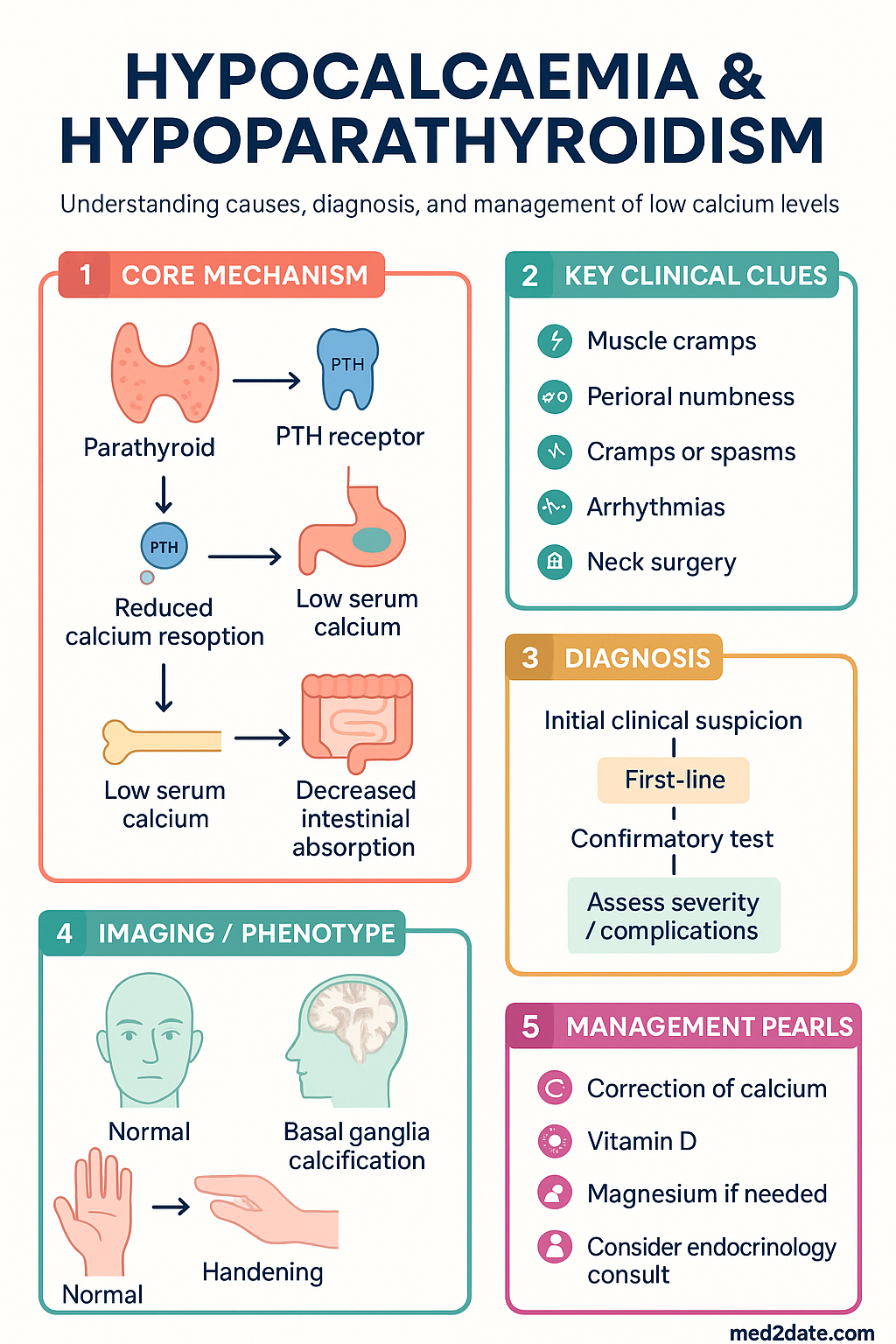
Hypocalcaemia & Hypoparathyroidism clinical infographic โ€” pathophysiology, clinical clues, diagnosis, imaging, and management
Tap or click image to enlarge โ€” Hypocalcaemia & Hypoparathyroidism: pathophysiology, clinical clues, diagnosis, imaging, and management.
Hypocalcaemia & Hypoparathyroidism infographic, full size

Introduction & Australian Epidemiology

Hypocalcaemia is a common electrolyte disturbance characterised by a low concentration of calcium in the blood. Calcium is critical for neuromuscular excitability, cardiac function, coagulation, and bone health. A reduction in serum calcium leads to increased neuronal membrane permeability to sodium ions, resulting in neuromuscular irritability.

Hypoparathyroidism, the most common cause of chronic hypocalcaemia, results from deficient or absent parathyroid hormone (PTH). PTH is the principal regulator of calcium homeostasis, acting on bone (resorption), kidneys (reabsorption and activation of vitamin D), and intestine (indirectly via vitamin D). In Australia, post-surgical hypoparathyroidism accounts for approximately 75% of cases, occurring in 1โ€“7% of patients following total thyroidectomy, parathyroidectomy, or radical neck dissection for malignancy.

Other significant causes include autoimmune hypoparathyroidism (isolated or part of autoimmune polyendocrine syndrome type 1), functional hypoparathyroidism due to severe hypomagnesaemia, and vitamin D deficiency, which remains prevalent in the Australian population. Acute hypocalcaemia can be life-threatening, necessitating rapid diagnosis and management.

Pathophysiology & Causes

Calcium homeostasis is maintained by a balance between intestinal absorption, renal reabsorption, and skeletal turnover, tightly regulated by PTH and vitamin D. Hypocalcaemia results from either increased calcium loss or inadequate calcium supply/uptake, most often due to impaired PTH action or vitamin D deficiency.

Major Causes by Mechanism

Mechanism Common Causes Key Pathophysiological Defect
PTH Deficiency/Resistance
  • Post-surgical hypoparathyroidism
  • Autoimmune hypoparathyroidism
  • Hypomagnesaemia (functional)
  • Activating mutations of the calcium-sensing receptor (CaSR)
Reduced PTH secretion or action โ†’ decreased bone resorption, renal calcium reabsorption, and 1,25-dihydroxyvitamin D production.
Vitamin D Deficiency
  • Inadequate sun exposure or dietary intake
  • Malabsorption (coeliac disease, Crohn's)
  • Chronic liver or kidney disease
Reduced intestinal calcium absorption. PTH may be elevated (secondary hyperparathyroidism) but cannot fully compensate.
Increased Calcium Loss
  • Acute pancreatitis
  • Rapid intravenous fluid administration with non-calcium-containing fluids
  • Loop diuretic therapy
Calcium sequestration by fatty acids (pancreatitis) or increased renal excretion.
โš ๏ธ
Clinical Pearl: Always check serum magnesium. Hypomagnesaemia (Mg <0.70 mmol/L) causes both impaired PTH secretion and end-organ resistance to PTH. Hypocalcaemia will not correct until magnesium is repleted.

Clinical Features (Trousseau's, Chvostek's, Tetany)

Clinical manifestations correlate with the degree and rapidity of fall in serum calcium. Chronic, mild hypocalcaemia may be asymptomatic, while acute or severe hypocalcaemia can present with life-threatening neuromuscular and cardiac complications.

Symptoms and Signs

  • Neuromuscular: Perioral numbness, tingling in fingers and toes, muscle cramps, carpopedal spasm, laryngospasm, bronchospasm, and seizures.
  • Central Nervous System: Anxiety, irritability, depression, confusion, and raised intracranial pressure (papilloedema).
  • Cardiac: Prolongation of the QTc interval on ECG, predisposing to torsades de pointes and heart failure.
  • Chronic: Dry skin, brittle nails, coarse hair, cataracts, dental enamel hypoplasia, and basal ganglia calcification.

Classic Bedside Signs

Trousseau's Sign
Carpopedal Spasm
Inflate a blood pressure cuff 20 mmHg above systolic pressure for 3 minutes. Development of spasm of the hand and wrist (main d'accoucheur) is positive.
Sensitivity: ~94% in hypocalcaemia
Chvostek's Sign
Facial Muscle Twitch
Tap the facial nerve anterior to the ear. Twitching of the ipsilateral facial muscles (nose, lip) is positive.
Less specific; can be present in normocalcaemia
Tetany
Generalised Muscle Spasm
Sustained, painful contraction of muscles, particularly hands, feet, and larynx. Represents severe, acute hypocalcaemia.
Emergency

Investigations

Investigation should confirm hypocalcaemia, determine its severity and chronicity, and identify the underlying cause. A systematic approach is essential.

First-Line Investigations

Essential
Serum Calcium (Total & Corrected) and Ionised Calcium
Corrected calcium (mmol/L) = Total calcium + 0.02 ร— (40 โ€“ serum albumin g/L). Ionised calcium is the physiologically active fraction and is not affected by albumin.
Available
Serum Phosphate, Magnesium, Creatinine/eGFR
Low phosphate and high PTH suggest vitamin D deficiency. High phosphate with low PTH suggests hypoparathyroidism. Magnesium is mandatory.
Essential
Intact Parathyroid Hormone (PTH)
Key differentiator. Inappropriately low or normal PTH in the presence of hypocalcaemia confirms hypoparathyroidism.
Available
25-Hydroxyvitamin D
Assesses vitamin D stores. Deficiency is <50 nmol/L. Insufficiency is 50โ€“75 nmol/L.
Available
24-Hour Urinary Calcium and Creatinine
Helpful in hypoparathyroidism management to monitor for hypercalciuria (target <7.5 mmol/day) and nephrolithiasis risk.

Second-Line / Aetiological Investigations

Specialist
1,25-Dihydroxyvitamin D, Autoantibodies (AIRE gene, CaSR antibodies)
Consider if autoimmune polyendocrine syndrome type 1 or familial hypoparathyroidism is suspected.
Specialist
Genetic Testing
For suspected activating CaSR mutations or other inherited disorders.
Available
ECG
Assess for prolonged QTc interval, which increases arrhythmia risk.
โ„น๏ธ
MBS Item Codes (selected): Calcium, phosphate, magnesium (item 66536); PTH (item 66812); 25-hydroxyvitamin D (item 66818). Check MBS Online for current descriptors and restrictions.

Management (Calcium, Vitamin D, PTH Analogue)

Management goals are to: 1) Acutely correct symptomatic hypocalcaemia; 2) Maintain serum calcium in the low-normal range (target 2.00โ€“2.12 mmol/L) to avoid symptoms and complications; and 3) Minimise urinary calcium excretion to protect renal function.

Acute Symptomatic Hypocalcaemia

๐Ÿ’‰
Calcium Gluconate 10%
Generic ยท IV Calcium
Adult dose 20 mL (2 ampoules = 4.6 mmol Caยฒโบ) in 100 mL 5% dextrose or 0.9% NaCl, infused IV over 10โ€“20 minutes. May repeat or start continuous infusion (100 mL in 1L over 24h).
Paediatric dose 0.5 mL/kg (max 20 mL) of 10% calcium gluconate IV over 5โ€“10 min, with cardiac monitoring.
Important Use central line or large-bore vein. Avoid calcium chloride peripherally due to extravasation risk. Continuous ECG monitoring during infusion.
PBS status โœ” PBS General Benefit

Chronic Management (Hypoparathyroidism)

First-line therapy combines oral calcium supplements with active vitamin D analogue.

๐Ÿ’Š
Calcium Carbonate
Caltrateยฎ, generic ยท Elemental Calcium
Adult dose 1โ€“3 g elemental calcium daily in divided doses (e.g., 1250 mg carbonate = 500 mg Ca). Take with meals to enhance absorption.
Renal adjustment Preferred over citrate in CKD (less aluminium absorption). Monitor for hypercalcaemia.
PBS status โœ” PBS General Benefit
๐Ÿ’Š
Calcitriol
Rocaltrolยฎ ยท Active Vitamin D
Adult dose 0.25โ€“2.0 mcg daily. Start low (0.25 mcg BD), titrate every 4โ€“7 days based on calcium.
Important Long half-life (5โ€“7 days). Hypercalcaemia may persist for days after cessation.
PBS status โœ” PBS General Benefit

Adjunctive / Refractory Therapy

๐Ÿงฌ
Parathyroid hormone (1-84)
Natparaยฎ ยท Recombinant PTH
Indication Adjunctive treatment of hypoparathyroidism in patients inadequately controlled on conventional therapy (calcium and vitamin D).
Dose Initial 50 mcg SC once daily, titrate to a maximum 100 mcg daily to reduce oral calcium and calcitriol requirements.
PBS status โš  Authority Required (RPBS)

Monitoring Plan

Acute
Serum calcium every 2โ€“4 hours. Continuous ECG monitoring.
Stabilisation
Serum calcium, phosphate, creatinine, magnesium weekly until stable.
Maintenance
Serum calcium, phosphate, creatinine every 3โ€“6 months. 24-hour urinary calcium annually (target <7.5 mmol/day). Renal ultrasound for nephrocalcinosis every 3โ€“5 years.
๐Ÿšจ
Thiazide Diuretics: Hydrochlorothiazide (12.5โ€“25 mg daily) can be used as an adjunct to reduce urinary calcium excretion and risk of renal stones. Loop diuretics are contraindicated as they increase calcium excretion.

Special Populations

๐Ÿคฐ
Pregnancy & Lactation
Calcium & Vitamin D Requirements increase. Continue supplements to maintain low-normal calcium. Calcitriol is Category B3.
Monitor closely as physiological changes can alter calcium levels. PTH analogue (Natpara) is not recommended in pregnancy.
๐Ÿ‘ถ
Paediatrics
Congenital Hypoparathyroidism: Requires genetic counselling. Management is similar but doses are weight-based. Critical for neurodevelopment.
Calcitriol dose: 0.01โ€“0.05 mcg/kg/day in neonates and infants. Requires frequent monitoring.
๐Ÿฉบ
Renal Impairment
CKD Stage 4โ€“5: Differentiate from secondary hyperparathyroidism of renal osteodystrophy. Use phosphate binders if phosphate is elevated.
Calcium supplements: Preferentially use calcium carbonate. Monitor for vascular calcification.
๐Ÿฅ
ATSI Health Considerations
Access to Care: Chronic disease management plans and Closing the Gap PBS co-payment measures improve access to medications and monitoring.
Cultural Safety: Engage Aboriginal Health Workers/Practitioners for education on injections, dietary calcium, and symptom recognition.
Aboriginal and Torres Strait Islander Health
Epidemiology
Data specific to hypoparathyroidism prevalence is limited, but higher rates of thyroid disease and associated surgery in some communities may increase risk. Vitamin D deficiency is more prevalent, contributing to hypocalcaemia.
Barriers to Management
Geographic isolation affects access to endocrinology specialists and pathology monitoring. Health literacy and language barriers can complicate complex medication regimens.
Culturally Safe Practice
Use interpreters if needed. Involve family in education. Utilise Aboriginal Community Controlled Health Organisations (ACCHOs) for holistic, continuous care.
Resources
Refer to the Australian Indigenous HealthInfoNet for evidence-based summaries. Utilise PBS co-payment and Medicare Chronic Disease Management (CDM) items.

๐Ÿ“š References

  1. 1. Shoback D. Hypocalcemia: Definition, Etiology, Pathogenesis, Diagnosis, and Management. In: Rosen CJ, ed. Primer on the Metabolic Bone Diseases and Disorders of Mineral Metabolism. 9th ed. Wiley; 2019:575-586.
  2. 2. Australian Institute of Health and Welfare (AIHW). Chronic kidney disease prevalence among Aboriginal and Torres Strait Islander people. AIHW; 2023.
  3. 3. Brandi ML, Bilezikian JP, Shoback D, et al. Management of Hypoparathyroidism: Summary Statement and Guidelines. J Clin Endocrinol Metab. 2016;101(6):2273-2283.
  4. 4. The Royal Australian College of General Practitioners (RACGP). Management of hypothyroidism in primary care. RACGP; 2023.
  5. 5. Mannstadt M, Clarke BL, Vokes T, et al. Efficacy and safety of recombinant human parathyroid hormone (1-84) in hypoparathyroidism (REPLACE): a double-blind, placebo-controlled, randomised, phase 3 study. Lancet Diabetes Endocrinol. 2013;1(4):275-283.
  6. 6. Department of Health (Australia). Pharmaceutical Benefits Schedule (PBS). Parathyroid hormone (1-84). Published 2024. Accessed [Current Date].
  7. 7. Society for Endocrinology (UK). Endocrine emergencies: hypocalcaemia. Clinical Guidance. 2021.
  8. 8. Nowak A, Loeffler J, Schacht C, et al. Calcification of cerebral arteries and basal ganglia in patients with postsurgical hypoparathyroidism. J Clin Endocrinol Metab. 2021;106(12):e5013-e5022.
  9. 9. Australian Commission on Safety and Quality in Health Care (ACSQHC). National Safety and Quality Health Service Standards. 2nd ed. ACSQHC; 2021.
  10. 10. Aboriginal and Torres Strait Islander Health Practice Board of Australia. Cultural safety framework. 2022.
co-pay for eligible patients).
Pregnancy & maternal health
Antenatal screening for thyroid disease should be integrated into Aboriginal Community Controlled Health Organisation (ACCHO) maternal health programmes. Untreated hypothyroidism in pregnancy disproportionately impacts communities with limited access to early antenatal care.
Comorbidity burden
Higher rates of diabetes, cardiovascular disease, and chronic kidney disease in Aboriginal and Torres Strait Islander communities mean hypothyroid-related dyslipidaemia and cardiovascular risk require particularly active management. Integrating thyroid function testing into chronic disease management plans (MBS Item 721) is recommended.
Iodine status
Although Australia-wide mandatory iodisation has improved status, some Aboriginal and Torres Strait Islander communities โ€” particularly in very remote areas โ€” may have borderline iodine adequacy. Urinary iodine monitoring in these communities should be maintained.

๐Ÿ“š References

  1. 1. Chaker L, Bianco AC, Jonklaas J, Peeters RP. Hypothyroidism. Lancet. 2017;390(10101):1550โ€“1562.
  2. 2. Garber JR, Cobin RH, Gharib H, et al. Clinical practice guidelines for hypothyroidism in adults: cosponsored by the American Association of Clinical Endocrinologists and the American Thyroid Association. Endocr Pract. 2012;18(6):988โ€“1028.
  3. 3. Pearce SH, Brabant G, Duntas LH, et al. 2013 ETA guideline: management of subclinical hypothyroidism. Eur Thyroid J. 2013;2(4):215โ€“228.
  4. 4. Alexander EK, Pearce EN, Brent GA, et al. 2017 guidelines of the American Thyroid Association for the diagnosis and management of thyroid disease during pregnancy and the postpartum. Thyroid. 2017;27(3):315โ€“389.
  5. 5. RACGP. Red Book: Guidelines for preventive activities in general practice. 9th ed. East Melbourne: RACGP; 2018.
  6. 6. Australian Institute of Health and Welfare (AIHW). Aboriginal and Torres Strait Islander health performance framework. Canberra: AIHW; 2023.
  7. 7. Li Y, Teng D, Shi X, et al. Prevalence of diabetes recorded in mainland China using 2018 diagnostic criteria from the American Diabetes Association: national cross sectional study. BMJ. 2020;369:m997. [TSH population reference data]
  8. 8. Ross DS. Diagnosis of and screening for hypothyroidism. In: UpToDate, Cooper DS (Ed). Wolters Kluwer; 2024. Accessed June 2024.
  9. 9. NHMRC. National evidence-based guideline: diagnosis, management and prevention of congenital hypothyroidism. Canberra: NHMRC; 2019.
  10. 10. Wiersinga WM, Duntas L, Fadeyev V, Nygaard B, Vanderpump MP. 2012 ETA guidelines: the use of L-T4 + L-T3 in the treatment of hypothyroidism. Eur Thyroid J. 2012;1(2):55โ€“71.
  11. 11. Pharmaceuticals Benefits Scheme (PBS). Levothyroxine sodium. Australian Government Department of Health. Available at: pbs.gov.au. Accessed June 2024.
  12. 12. Australian Government Department of Health. National Newborn Bloodspot Screening โ€” Congenital Hypothyroidism. Available at: www.newbornscreening.gov.au. Accessed June 2024.