📋 Key Information Summary
- Definition: Gynaecomastia is benign proliferation of glandular breast tissue in males resulting from a relative or absolute oestrogen-to-androgen imbalance at the breast tissue level.
- Prevalence: Present in up to 65% of males on physical examination; clinically significant in approximately 30–40% across the lifespan, with peaks in neonatal/pubertal and older age groups.
- Physiological gynaecomastia: Neonatal (transplacental oestrogen), pubertal (affects up to 60% of adolescent boys; 90% resolve within 2 years), and senescent (ageing-related androgen decline) — these generally require no investigation or treatment.
- Pathological causes: Always exclude hypogonadism (primary or secondary), hyperthyroidism, liver cirrhosis, chronic kidney disease, and drug-induced gynaecomastia (spironolactone, antiandrogens, oestrogens, digoxin, cimetidine, and many psychotropic medications).
- Red flags for malignancy: Unilateral, hard, irregular mass; fixed to underlying tissue; axillary lymphadenopathy; nipple retraction or skin changes — these warrant urgent mammography/ultrasound and surgical referral.
- Simon grading: Grade I (small, localised), Grade IIa (moderate, not exceeding areola), Grade IIb (extending beyond areola), Grade III (large, female-appearing) — guides management approach.
- Baseline investigations: Serum testosterone (total and free), oestradiol, LH, FSH, TSH, hCG (β-subunit), liver function tests, renal function (eGFR), prolactin, and SHBG in all non-physiological presentations.
- First-line medical therapy: Testosterone replacement for hypogonadal men; tamoxifen 20 mg daily for 3–6 months for symptomatic gynaecomastia (PBS Authority Required for this indication).
- Surgical referral: Indicated for long-standing (>12 months) gynaecomastia with fibrotic tissue, significant psychological distress, or failed medical therapy — techniques include liposuction and subcutaneous mastectomy.
- Drug review: A thorough medication history is essential; up to 25% of cases are drug-related — if a causative agent is identified, cessation or substitution is the first management step.
- Breast cancer in males: Rare (<1% of all breast cancers) but must be considered, especially in older men with unilateral firm mass and risk factors (family history, BRCA2, Klinefelter syndrome).
- Follow-up: Physiological gynaecomastia — reassurance and observation every 3–6 months; pathological — repeat hormonal profile at 3–6 months after treatment initiation; surgical — standard post-operative review.
🎧 Audio Brief
Introduction & Australian Epidemiology
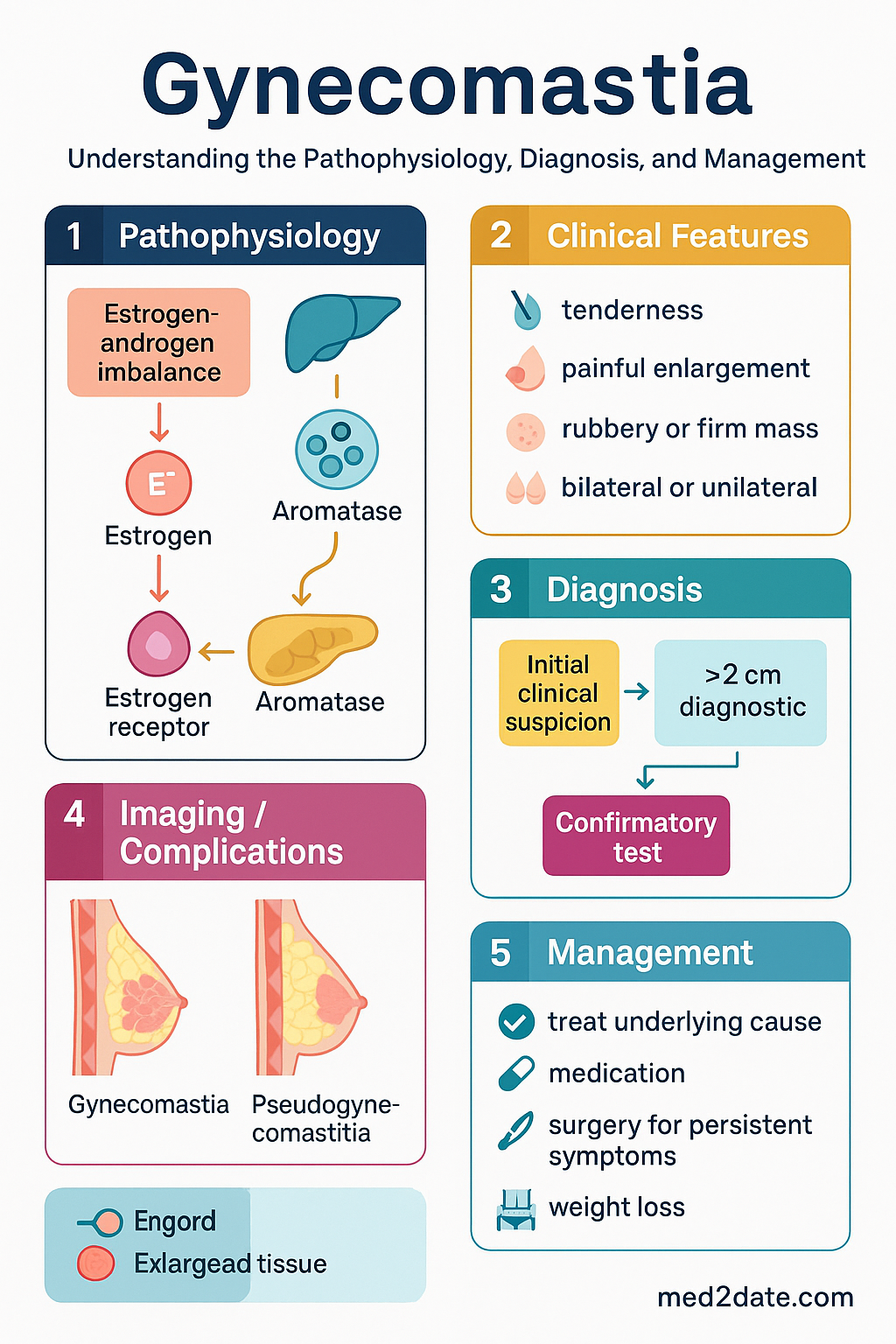
Gynaecomastia is the benign proliferation of glandular breast tissue in males, resulting from an imbalance between oestrogen and androgen activity at the level of the breast. It is the most common breast condition encountered in male patients and presents across all age groups. Although often benign and self-limiting, gynaecomastia may be the presenting feature of serious underlying endocrine, hepatic, renal, or neoplastic pathology and requires systematic evaluation.
In Australia, gynaecomastia is commonly encountered in general practice, paediatrics, and endocrinology clinics. The Royal Children's Hospital Melbourne reports that up to 60% of pubertal boys develop palpable breast tissue, with the majority resolving spontaneously within 18–24 months. Among older Australian men, cross-sectional data suggest clinically detectable gynaecomastia in approximately 35–40% of men aged 50–80 years, driven by declining testosterone levels, increased adipose tissue aromatase activity, and concurrent medication use.
Drug-induced gynaecomastia is particularly relevant in the Australian context, with spironolactone (widely prescribed for heart failure and resistant hypertension), antiandrogens for prostate cancer, and increasingly used antipsychotic medications representing major causative agents. Aboriginal and Torres Strait Islander males may face a disproportionate burden due to higher rates of chronic kidney disease, liver disease, and delayed access to specialist endocrine evaluation (AIHW, 2023).
This guideline provides an evidence-based framework for the evaluation and management of gynaecomastia in Australian clinical practice, aligned with the Endocrine Society of Australia, the RACGP Red Book, and international consensus statements.
Pathophysiology & Causes
Mechanism
Gynaecomastia results from a shift in the oestrogen-to-androgen ratio favouring oestrogenic stimulation of breast ductal tissue. Oestrogen acts via oestrogen receptors (ER-α and ER-β) on ductal epithelium, promoting ductal proliferation, periductal stromal oedema, and eventual fibrosis. Androgens (primarily testosterone and dihydrotestosterone) normally oppose this effect; their reduction or the increase in oestrogen activity tips the balance toward tissue growth.
The oestrogen excess may be:
- Absolute: Elevated serum oestradiol — from testicular or extragonadal tumours, exogenous oestrogen exposure, or increased peripheral aromatisation (obesity, liver cirrhosis, thyrotoxicosis).
- Relative: Decreased androgen levels with stable oestrogen — from primary hypogonadism (Klinefelter syndrome, orchidectomy), secondary hypogonadism (pituitary disease), or androgen receptor blockade (spironolactone, bicalutamide).
Causes by Category
| Category | Examples | Mechanism |
|---|---|---|
| Physiological | Neonatal, pubertal, senescent | Transient hormonal fluctuations; self-limiting |
| Hypogonadism | Klinefelter syndrome (47,XXY), orchitis (mumps), post-gonadectomy, Kallmann syndrome, pituitary adenoma | Decreased testosterone with preserved/gonadotrophin-stimulated oestradiol |
| Hyperoestrogenaemia | Testicular tumours (Leydig cell, Sertoli cell), hCG-secreting tumours (hepatocellular, mediastinal germ cell), adrenal tumours | Direct oestrogen or hCG-mediated oestradiol production |
| Peripheral aromatisation | Obesity, liver cirrhosis, hyperthyroidism | Increased adipose aromatase converting androgens to oestrogens |
| Drug-induced | Spironolactone, bicalutamide, flutamide, finasteride, oestrogens (topical HRT transfer), digoxin, cimetidine, ranitidine, phenothiazines, risperidone, olanzapine, SSRIs, methotrexate, isoniazid, anabolic steroids, marijuana, alcohol excess | Oestrogen activity, androgen blockade, or direct receptor effects |
| Chronic disease | Chronic kidney disease (uraemia), dialysis | Hypogonadism, altered SHBG, increased aromatisation |
Clinical Features & Grading
Presentation
Gynaecomastia typically presents with:
- Palpable, rubbery, disc-like subareolar tissue — often tender, especially in florid (early) cases
- Bilateral in 50–70% of cases; unilateral raises concern for malignancy or asymmetric disease
- May be associated with breast discomfort, nipple sensitivity, or psychological distress (body image, social avoidance)
- On examination: tissue centred under the nipple, may extend concentrically; compressible from the periphery compared to surrounding adipose tissue
Simon Classification
Duration Considerations
The duration of gynaecomastia affects tissue composition and response to medical therapy:
- Florid phase (0–6 months): Proliferating ducts, periductal oedema, and increased vascularity — most responsive to medical therapy
- Intermediate phase (6–12 months): Progressive fibrosis; decreasing oedema; moderately responsive to treatment
- Fibrous phase (>12 months): Dense fibrosis and hyalinisation of stroma; minimal response to medical therapy — surgical excision generally required
Distinguishing Gynaecomastia from Other Conditions
| Feature | Gynaecomastia | Lipomastia (Pseudogynaecomastia) | Male Breast Cancer |
|---|---|---|---|
| Palpation | Firm, rubbery, disc-like tissue under areola | Soft, diffuse adipose; no discrete disc | Hard, irregular, eccentric mass |
| Laterality | Bilateral (50–70%) | Usually bilateral, symmetrical | Usually unilateral |
| Tenderness | Common (florid phase) | Absent | Variable; may be painless |
| Skin/nipple changes | Rare | Absent | Retraction, dimpling, ulceration, discharge |
| Lymphadenopathy | Absent | Absent | May be present (axillary) |
Investigations & Differential
Investigations Pathway
Investigation should be directed by clinical assessment. Physiological gynaecomastia (neonatal, pubertal, senescent) in the absence of red flags generally requires no laboratory workup. All pathological presentations require a structured approach.
First-Line Investigations (all non-physiological cases)
Second-Line Investigations (targeted)
Differential Diagnosis
| Diagnosis | Key Differentiating Features |
|---|---|
| Pseudogynaecomastia (lipomastia) | Soft, diffuse adipose without glandular tissue; common in obesity; no subareolar disc on pinch test |
| Male breast carcinoma | Hard, irregular, eccentric mass; usually unilateral; fixed to pectoralis; skin/nipple changes; older age |
| Ductal carcinoma in situ (DCIS) | Bloody nipple discharge; often detected incidentally on imaging |
| Breast abscess | Erythema, warmth, fluctuance, fever; post-traumatic or periductal mastitis |
| Lipoma | Soft, mobile, well-circumscribed; superficial to breast tissue |
| Sebaceous cyst | Punctum visible; superficial; not centred on areola |
Management
General Principles
Management of gynaecomastia depends on the underlying aetiology, duration, severity, symptom burden, and patient preference. Treatment aims to address reversible causes, relieve symptoms, and restore normal male breast contour when cosmetically or psychologically significant.
Pharmacological Management
Surgical Management
Referral for surgical intervention is indicated in the following circumstances:
- Long-standing gynaecomastia (>12 months) with fibrotic tissue — poor response to medical therapy expected
- Simon Grade III — excess skin and tissue requiring resection
- Significant psychological distress or functional impairment
- Failure of or contraindication to medical therapy
Surgical techniques:
- Liposuction-assisted mastectomy: For mixed glandular-adipose tissue; small periareolar incision; most common approach for Grades I–IIb
- Subcutaneous mastectomy (open excision): For predominantly glandular tissue; inferior periareolar or trans-areolar incision
- Skin-reducing mastectomy: For Grade III with excess skin; may require free nipple grafting
Surgery may be funded through private health insurance or, in severe cases with documented psychological morbidity, may be considered under Medicare. Specialist plastic surgery or breast surgery referral is required.
Management of Specific Causes
| Cause | Management Approach |
|---|---|
| Spironolactone-induced | Switch to eplerenone 25–50 mg daily if gynaecomastia intolerable. If not possible, add tamoxifen; continue spironolactone if cardiovascular benefit outweighs breast symptoms. |
| Primary hypogonadism | Testosterone replacement (Primoteston 250 mg IM q2–3 wk or testosterone undecanoate 1000 mg IM q10–14 wk). May take 3–6 months for regression. |
| Klinefelter syndrome | Testosterone replacement from puberty onwards. Established gynaecomastia may require surgery. |
| Testicular tumour | Urology/oncology referral. Radical orchidectomy for confirmed malignancy; gynaecomastia regresses after successful treatment. |
| Hyperthyroidism | Treat hyperthyroidism (carbimazole, propylthiouracil, or radioiodine). Gynaecomastia typically resolves with euthyroid state. |
| Cirrhosis | Alcohol cessation, liver disease management. Testosterone replacement is generally avoided due to hepatotoxicity of oral formulations; transdermal route may be considered in specialist setting. |
Monitoring
- Repeat hormonal profile (testosterone, oestradiol, LH, FSH) at 3 months after initiating therapy
- Clinical assessment of breast tissue at 3-month intervals — measure diameter of glandular tissue
- Monitor for tamoxifen side effects: LFTs at baseline and 6 monthly; visual symptoms review
- Testosterone monitoring: trough level before next injection; target 12–25 nmol/L
- Psychological wellbeing assessment — validated body image scales where indicated
- Surgical follow-up: standard post-operative review at 1 week, 6 weeks, 6 months; monitor for haematoma, seroma, contour deformity
Special Populations
Aboriginal and Torres Strait Islander Health Considerations
📚 References
- 1. Bremner AP, Fernandes M, Nair B, et al. Gynaecomastia: a review of diagnosis and management. Australian Family Physician. 2019;48(8):556–561.
- 2. Deepinder F, Braunstein GD. Gynecomastia: incidence, causes and treatment. Expert Review of Endocrinology & Metabolism. 2011;6(2):239–257.
- 3. Narula HS, Carlson HE. Gynaecomastia — pathophysiology, diagnosis and treatment. Nature Reviews Endocrinology. 2014;10(11):684–698.
- 4. Braunstein GD. Clinical practice: gynecomastia. New England Journal of Medicine. 2007;357(12):1229–1237.
- 5. Ting ACW, Chow LWC, Leung YF. Comparison of tamoxifen with danazol in the management of idiopathic gynecomastia. American Surgeon. 2000;66(1):38–40.
- 6. Khan HN, Blauth C, McMahon MJ. Tamoxifen for gynecomastia: a randomized controlled trial. British Journal of Surgery. 2009;86(8):1056–1058.
- 7. Endocrine Society of Australia. Position statement on testosterone prescribing in adult men. Medical Journal of Australia. 2023;218(3):136–144.
- 8. Bhasin S, Brito JP, Cunningham GR, et al. Testosterone therapy in men with hypogonadism: an Endocrine Society clinical practice guideline. Journal of Clinical Endocrinology & Metabolism. 2018;103(5):1715–1744.
- 9. Australian Institute of Health and Welfare (AIHW). Aboriginal and Torres Strait Islander health performance framework 2023 summary report. Canberra: AIHW; 2023.
- 10. Lin KY, Pehlivanov BK, Walsh SJ. Gynecomastia update: a clinical review. Annals of Plastic Surgery. 2020;84(2):227–235.
- 11. Rosen H, Webb ML, DiVasta AD, et al. Adolescent gynecomastia: long-term follow-up and management outcomes. Plastic and Reconstructive Surgery. 2010;125(5):1265–1271.
- 12. Royal Children's Hospital Melbourne. Clinical practice guideline: gynaecomastia. RCH Clinical Practice Guidelines. Updated 2022. Available from: www.rch.org.au
- 13. Lincoff AM, Nicholls SJ, Riesmeyer JS, et al. Cardiovascular safety of testosterone replacement therapy (TRAVERSE trial). New England Journal of Medicine. 2023;389(2):107–117.
- 14. Pharmaceutical Benefits Scheme (PBS). Australian Government Department of Health. Available from: www.pbs.gov.au. Accessed 2024.
- 15. Bundred NJ. Male breast cancer: epidemiology, risk factors and hormone-receptor status. Surgical Oncology. 2012;21(2):101–106.