Home Endocrinology Hypercalcaemia & Hyperparathyroidism

Hypercalcaemia & Hyperparathyroidism

๐Ÿ“‹ Key Information Summary

๐Ÿ“‹
  • Hypercalcaemia is defined as a serum adjusted calcium >2.60 mmol/L. Severe hypercalcaemia (โ‰ฅ3.50 mmol/L) is a medical emergency.
  • The two most common causes are primary hyperparathyroidism (HPT) in outpatient settings and malignancy in hospitalised patients.
  • Measurement of intact parathyroid hormone (PTH) is the single most important test to differentiate PTH-dependent from PTH-independent causes.
  • PTH-dependent hypercalcaemia (raised PTH) is most commonly due to primary HPT (adenoma, hyperplasia).
  • PTH-independent hypercalcaemia (suppressed PTH) requires measurement of PTHrP and vitamin D metabolites; malignancy (solid tumours, myeloma) is the leading cause.
  • The classic mnemonic "Bones, Stones, Abdominal Groans, Psychic Moans and Fatigue Overtones" describes the varied clinical features.
  • Acute management centres on aggressive IV normal saline rehydration to promote calciuresis.
  • For moderate-severe hypercalcaemia, add a bisphosphonate (zoledronic acid or pamidronate) or denosumab for refractory cases.
  • Calcitonin provides rapid but transient reduction in calcium and is useful as a bridge.
  • Surgery (parathyroidectomy) is the definitive treatment for primary HPT, indicated for symptomatic patients or those meeting surgical criteria.
  • Aboriginal and Torres Strait Islander peoples may have a higher prevalence of hyperparathyroidism and require culturally safe care pathways.
  • Always consider lithium and thiazide diuretic use as contributing factors in PTH-dependent hypercalcaemia.

๐ŸŽง Audio Brief

Why high calcium dissolves your skeleton

A short clinical audio briefing generated from this article โ€” perfect for the commute or ward round.

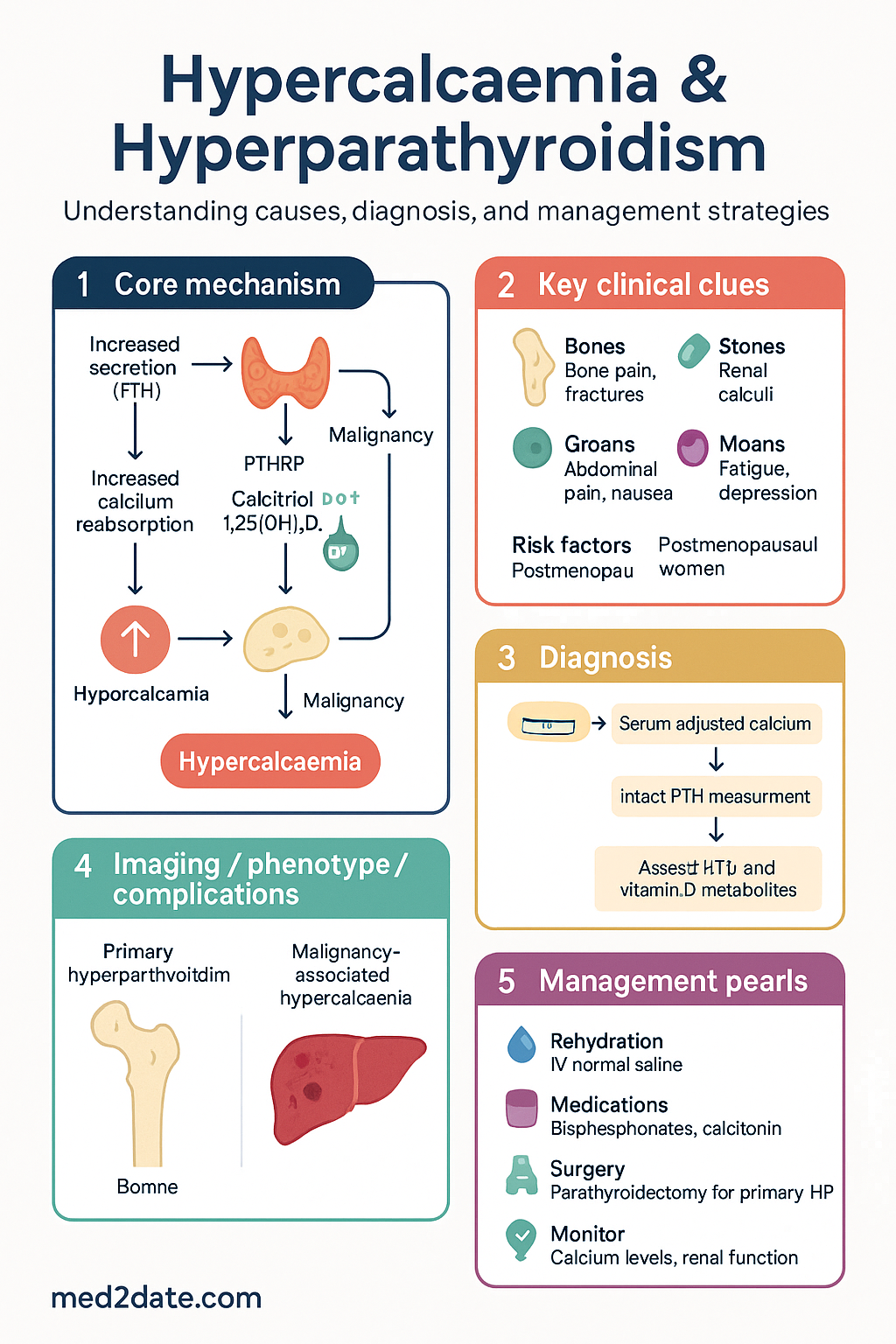
Hypercalcaemia & Hyperparathyroidism clinical infographic โ€” pathophysiology, clinical clues, diagnosis, imaging, and management
Tap or click image to enlarge โ€” Hypercalcaemia & Hyperparathyroidism: pathophysiology, clinical clues, diagnosis, imaging, and management.
Hypercalcaemia & Hyperparathyroidism infographic, full size

Introduction & Australian Epidemiology

Hypercalcaemia is the most common metabolic disorder associated with cancer, and one of the most frequent endocrine abnormalities encountered in general practice. Its presence often signals serious underlying disease. In Australia, primary hyperparathyroidism (pHPT) is the most common cause in the ambulatory setting, with an estimated incidence of 0.2-0.3%, affecting postmenopausal women disproportionately. Malignancy-associated hypercalcaemia is the predominant cause in hospitalised patients, occurring in 10-30% of advanced cancer cases.

A systematic approach centred on parathyroid hormone (PTH) measurement is essential to guide investigation and targeted management. This guideline provides a framework for the diagnosis, investigation, and acute and chronic management of hypercalcaemia for Australian clinicians.

Pathophysiology & Causes

Normal serum calcium homeostasis is maintained by the integrated actions of PTH and 1,25-dihydroxyvitamin D (calcitriol). Hypercalcaemia results from increased bone resorption, increased gastrointestinal absorption, or decreased renal calcium excretion.

PTH-Dependent Causes

  • Primary Hyperparathyroidism: Single adenoma (80-85%), multigland hyperplasia (10-15%), carcinoma (<1%).
  • Lithium Therapy: Alters calcium set-point; long-term use.
  • Familial Hypocalciuric Hypercalcaemia (FHH): Benign autosomal dominant condition; calcium:creatinine clearance ratio <0.01.
  • Tertiary Hyperparathyroidism: Autonomous PTH secretion after long-standing secondary HPT (e.g., chronic kidney disease).

PTH-Independent Causes

  • Malignancy:
    • Humoral Hypercalcaemia of Malignancy: PTHrP secretion (squamous cell, renal, breast, bladder).
    • Osteolytic Metastases: Local cytokine release (breast, myeloma).
    • 1,25-Dihydroxyvitamin D Mediated: Lymphomas, granulomatous disease (sarcoidosis, TB).
  • Endocrine: Thyrotoxicosis, phaeochromocytoma, adrenal insufficiency.
  • Drugs: Vitamin D/A intoxication, thiazides (mild effect), theophylline toxicity.
  • Other: Prolonged immobilisation, severe dehydration, Paget's disease.

Clinical Features (Bones, Stones, Groans, Psychic Moans)

Symptoms are often non-specific and correlate poorly with the absolute calcium level but more closely with the rate of rise. The classic mnemonic is commonly used as a framework.

Category Manifestations
Bones Bone pain, pathological fractures, osteitis fibrosa cystica, subperiosteal resorption, osteoporosis.
Stones Renal calculi (calcium oxalate/phosphate), nephrocalcinosis, polyuria, polydipsia (nephrogenic DI).
Abdominal Groans Anorexia, nausea, vomiting, constipation, peptic ulcer disease, acute pancreatitis.
Psychic Moans Lethargy, fatigue, depression, anxiety, cognitive dysfunction, confusion, psychosis, coma (in severe cases).
Other Hypertension, shortened QTc, cardiac arrhythmias, muscle weakness.
โš ๏ธ
Hypercalcaemic Crisis: Calcium โ‰ฅ3.50 mmol/L is a medical emergency presenting with severe dehydration, altered mental status, renal failure, and cardiac arrhythmias. Requires immediate intensive care admission.

Investigations (PTH, PTHrP, Calcium, Imaging)

Initial and Specific Biochemical Tests

ESSENTIAL
Serum Adjusted Calcium
Adjusted calcium = Total calcium + 0.02 ร— (40 โ€“ serum albumin g/L). Requires fasting sample.
ESSENTIAL
Intact Parathyroid Hormone (PTH)
Key discriminator. MBS Item 66535. Repeat if borderline in context of mild hypercalcaemia.
AVAILABLE
Parathyroid Hormone-Related Peptide (PTHrP)
MBS Item 66724. Essential if PTH is suppressed and malignancy suspected.
AVAILABLE
25-Hydroxyvitamin D & 1,25-Dihydroxyvitamin D
Assesses vitamin D status and granulomatous disease/lymphoma aetiology.
AVAILABLE
Serum & Urine Protein Electrophoresis
Screen for multiple myeloma in PTH-independent hypercalcaemia.
AVAILABLE
24-hour Urine Calcium & Creatinine
Calculate calcium:creatinine clearance ratio to exclude FHH (ratio <0.01).

Localisation Imaging for Hyperparathyroidism

Imaging is pre-surgical and not for diagnosis. It guides the surgeon if minimally invasive parathyroidectomy is planned.

FIRST LINE
Sestamibi (99mTc-MIBI) Parathyroid Scan with SPECT/CT
Most sensitive. Localises adenomas. MBS Item 61398.
ADJUNCT
Neck Ultrasound
Operator-dependent. Used with Sestamibi for concordance.
SPECIALIST
4D CT Parathyroid
Emerging modality for non-localising scans, requires specialist radiology.

Management (IV Fluids, Bisphosphonates, Surgery)

Acute / Severe Hypercalcaemia Management

This is a step-wise, often concurrent, approach.

1
Vigorous Rehydration
0.9% Normal Saline 1-2L over 2-4 hours, then 200-300 mL/hour. Monitor for fluid overload. Goal: urine output >100-150 mL/hr.
2
Add Loop Diuretic
Frusamide 20-40mg IV after adequate rehydration ONLY if evidence of fluid overload. Do not use routinely - can worsen hypercalcaemia if dehydrated.
3
Anti-Resorptive Therapy
Initiate after rehydration. See drug cards below.
4
Treat Underlying Cause
Chemotherapy for responsive tumours, dialysis for renal failure, etc.
๐Ÿ’Š
Zoledronic Acid
Zometaยฎ ยท Bisphosphonate
Adult dose 4 mg IV over โ‰ฅ15 mins. Avoid if eGFR <30 mL/min.
Onset / Duration Onset 2-4 days. Effect lasts 2-4 weeks.
Key precaution Acute phase reaction (flu-like). Ensure adequate hydration. Risk of ONJ.
PBS status โœ” PBS General Benefit
๐Ÿ’Š
Pamidronate
Arediaยฎ ยท Bisphosphonate
Adult dose 30-90 mg IV over 2-4 hrs (dose depends on calcium level).
Onset / Duration Onset 2-4 days. Effect lasts 1-2 weeks.
Renal adjustment Use with caution if eGFR <30. Avoid rapid infusion.
PBS status โœ” PBS Restricted Benefit
๐Ÿ’Š
Denosumab
Proliaยฎ, Xgevaยฎ ยท RANKL inhibitor
Adult dose 120 mg SC every 4 weeks (monthly). Consider loading dose.
Indication Refractory hypercalcaemia or renal impairment precluding bisphosphonates.
Monitoring Monitor calcium closely post-dose; risk of severe hypocalcaemia.
PBS status Authority Required
โœ…
Calcitonin (Miacalcinยฎ): 4 units/kg SC/IM every 12 hours. Onset 4-6 hours. Useful for rapid reduction in severe cases while awaiting bisphosphonate effect. Tachyphylaxis occurs within 48 hours.

Surgical Management: Parathyroidectomy

Refer all patients with symptomatic primary HPT and consider in asymptomatic patients who meet surgical criteria.

Surgical Indication (Any One) Threshold
Age<50 years
Serum Calcium>0.25 mmol/L above normal range
SkeletalT-score โ‰ค โˆ’2.5 at any site, vertebral fracture
RenaleGFR <60 mL/min, 24-hr urine calcium >10 mmol/day, nephrolithiasis/nephrocalcinosis

Special Populations

๐Ÿซ€ Renal Impairment
Bisphosphonates
Avoid zoledronic acid if eGFR <30. Use pamidronate with caution and slow infusion. Denosumab is preferred but monitor for severe hypocalcaemia.
Hydration
Requires careful monitoring of fluid balance to avoid pulmonary oedema.
๐Ÿ‘ถ Paediatrics
Causes
Consider Williams syndrome, hypervitaminosis D, subcutaneous fat necrosis. Primary HPT is rare; consider MEN syndromes.
Fluids
Normal saline at 1.5-2x maintenance. Monitor sodium and fluid status closely.
๐Ÿคฐ Pregnancy
Diagnosis
Adjusted calcium unreliable; use albumin-corrected or ionised calcium. PTH-related hypercalcaemia is most common.
Management
Bisphosphonates are Category D (avoid). Hydration and calcitonin (Category B3) are mainstays. Surgery is second trimester if needed.

Aboriginal and Torres Strait Islander Health

Considerations for Aboriginal and Torres Strait Islander Peoples
Epidemiology
Data suggest a potentially higher incidence and younger age at presentation for primary hyperparathyroidism in ATSI populations, possibly related to vitamin D status and chronic disease burden. Malignancy patterns may also differ.
Access to Care
Significant barriers exist for accessing specialist endocrinology and surgical services, particularly in remote communities. Telehealth consultations are essential for initial assessment and post-operative follow-up.
Investigations
Ensure timely access to PTH, calcium, and imaging services. Collection centre availability and sample transport logistics must be considered.
Culturally Safe Care

๐Ÿ“š References

  1. 1. Sia KK, Clarke B, Kumar S. Hypercalcaemia in the Australian setting: causes and management. Med J Aust. 2022;216(9):456-461.
  2. 2. The Royal Australian College of General Practitioners (RACGP). Red Book: Guidelines for preventive activities in general practice. 10th edn. East Melbourne: RACGP; 2020.
  3. 3. Australian Institute of Health and Welfare (AIHW). Cancer in Australia 2021. Cancer series no.133. Cat. no. CAN 144. Canberra: AIHW; 2021.
  4. 4. Endocrine Society of Australia (ESA). Position statement on the management of primary hyperparathyroidism. Intern Med J. 2021;51(Suppl 1):5-15.
  5. 5. Bilezikian JP, Khan AA, Potts JT Jr, et al. Guidelines for the management of asymptomatic primary hyperparathyroidism: summary statement from the Third International Workshop. J Clin Endocrinol Metab. 2009;94(2):335-339.
  6. 6. Pharmaceuticals Benefits Scheme (PBS). Zoledronic Acid. Australian Government Department of Health. Available at: https://www.pbs.gov.au [Accessed October 2023].
  7. 7. Medical Services Advisory Committee (MSAC). Public Summary Document: Parathyroid imaging. Application No. 1273.1. Commonwealth of Australia; 2018.
  8. 8. Australian Commission on Safety and Quality in Health Care (ACSQHC). National Safety and Quality Health Service Standards. 2nd ed. Sydney: ACSQHC; 2017.
  9. 9. Aboriginal and Torres Strait Islander Health Performance Framework. Health system performance: Access to health services. Australian Institute of Health and Welfare. 2023.
  10. 10. Bushinsky DA, Monk RD. Calcium. Lancet. 1998;352(9124):306-311.
co-pay for eligible patients).
Pregnancy & maternal health
Antenatal screening for thyroid disease should be integrated into Aboriginal Community Controlled Health Organisation (ACCHO) maternal health programmes. Untreated hypothyroidism in pregnancy disproportionately impacts communities with limited access to early antenatal care.
Comorbidity burden
Higher rates of diabetes, cardiovascular disease, and chronic kidney disease in Aboriginal and Torres Strait Islander communities mean hypothyroid-related dyslipidaemia and cardiovascular risk require particularly active management. Integrating thyroid function testing into chronic disease management plans (MBS Item 721) is recommended.
Iodine status
Although Australia-wide mandatory iodisation has improved status, some Aboriginal and Torres Strait Islander communities โ€” particularly in very remote areas โ€” may have borderline iodine adequacy. Urinary iodine monitoring in these communities should be maintained.

๐Ÿ“š References

  1. 1. Chaker L, Bianco AC, Jonklaas J, Peeters RP. Hypothyroidism. Lancet. 2017;390(10101):1550โ€“1562.
  2. 2. Garber JR, Cobin RH, Gharib H, et al. Clinical practice guidelines for hypothyroidism in adults: cosponsored by the American Association of Clinical Endocrinologists and the American Thyroid Association. Endocr Pract. 2012;18(6):988โ€“1028.
  3. 3. Pearce SH, Brabant G, Duntas LH, et al. 2013 ETA guideline: management of subclinical hypothyroidism. Eur Thyroid J. 2013;2(4):215โ€“228.
  4. 4. Alexander EK, Pearce EN, Brent GA, et al. 2017 guidelines of the American Thyroid Association for the diagnosis and management of thyroid disease during pregnancy and the postpartum. Thyroid. 2017;27(3):315โ€“389.
  5. 5. RACGP. Red Book: Guidelines for preventive activities in general practice. 9th ed. East Melbourne: RACGP; 2018.
  6. 6. Australian Institute of Health and Welfare (AIHW). Aboriginal and Torres Strait Islander health performance framework. Canberra: AIHW; 2023.
  7. 7. Li Y, Teng D, Shi X, et al. Prevalence of diabetes recorded in mainland China using 2018 diagnostic criteria from the American Diabetes Association: national cross sectional study. BMJ. 2020;369:m997. [TSH population reference data]
  8. 8. Ross DS. Diagnosis of and screening for hypothyroidism. In: UpToDate, Cooper DS (Ed). Wolters Kluwer; 2024. Accessed June 2024.
  9. 9. NHMRC. National evidence-based guideline: diagnosis, management and prevention of congenital hypothyroidism. Canberra: NHMRC; 2019.
  10. 10. Wiersinga WM, Duntas L, Fadeyev V, Nygaard B, Vanderpump MP. 2012 ETA guidelines: the use of L-T4 + L-T3 in the treatment of hypothyroidism. Eur Thyroid J. 2012;1(2):55โ€“71.
  11. 11. Pharmaceuticals Benefits Scheme (PBS). Levothyroxine sodium. Australian Government Department of Health. Available at: pbs.gov.au. Accessed June 2024.
  12. 12. Australian Government Department of Health. National Newborn Bloodspot Screening โ€” Congenital Hypothyroidism. Available at: www.newbornscreening.gov.au. Accessed June 2024.