Home Endocrinology Insulinoma

Insulinoma

๐Ÿ“‹ Key Information Summary

๐Ÿ“‹
  • Insulinoma is the most common functional pancreatic neuroendocrine tumour, causing endogenous hyperinsulinaemic hypoglycaemia with Whipple's triad.
  • Incidence is approximately 1โ€“4 per million per year; most are benign solitary adenomas (>90%) located in the pancreas.
  • Whipple's triad โ€” symptoms of hypoglycaemia, documented plasma glucose <2.8 mmol/L, and resolution with glucose administration โ€” must be demonstrated.
  • Neuroglycopenic symptoms (confusion, visual disturbance, seizures, loss of consciousness) dominate the clinical picture and may be misdiagnosed as psychiatric or neurological disease.
  • The 72-hour supervised fast remains the gold standard provocation test for confirming endogenous hyperinsulinaemic hypoglycaemia.
  • Diagnosis requires demonstration of inappropriate insulin, C-peptide, and proinsulin levels at the time of hypoglycaemia, with sulphonylurea screen negative.
  • Localisation with CT abdomen, endoscopic ultrasound (EUS), and Ga-68 DOTATATE PET/CT is essential pre-operatively.
  • Enucleation or distal pancreatectomy is curative in >90% of benign insulinomas; laparoscopic approach is preferred where feasible.
  • Diazoxide (Proglicemยฎ) is the primary medical therapy for inoperable or recurrent insulinoma; octreotide and everolimus are second-line options.
  • Malignant insulinomas (<10%) may require debulking surgery, somatostatin analogues, everolimus, peptide receptor radionuclide therapy (PRRT), or systemic chemotherapy.
  • Patients with multiple endocrine neoplasia type 1 (MEN1) may have multiple insulinomas requiring subtotal pancreatectomy.
  • Aboriginal and Torres Strait Islander patients may face delayed diagnosis due to remote access barriers and limited endocrine specialist availability.

๐ŸŽง Audio Brief

The Pancreas Tumor That Mimics Dementia

A short clinical audio briefing generated from this article โ€” perfect for the commute or ward round.

Introduction & Australian Epidemiology

Insulinoma is the most common functional pancreatic neuroendocrine tumour (pNET), responsible for endogenous hyperinsulinaemic hypoglycaemia. The condition was first described by William J. Mayo in 1927, and surgical cure has been achievable since the first successful enucleation reported in 1929.

The estimated incidence is 1โ€“4 per million per year, accounting for approximately 1โ€“2% of all pancreatic neoplasms. Insulinomas may occur at any age but peak incidence is in the 4th to 6th decades, with a slight female predominance. In Australia, based on population data, approximately 25โ€“100 new cases are diagnosed annually, though underdiagnosis due to misattribution of neuroglycopenic symptoms to psychiatric or neurological conditions is well recognised.

Over 90% of insulinomas are benign, solitary, small (<2 cm), and intrapancreatic. Malignant insulinomas, defined by the presence of metastases (most commonly hepatic), account for 5โ€“10% of cases. Approximately 4โ€“10% of insulinomas occur in the context of multiple endocrine neoplasia type 1 (MEN1), an autosomal dominant syndrome involving the parathyroids, anterior pituitary, and pancreatic islets.

Early diagnosis and surgical resection remain curative in the vast majority of cases. Delayed recognition leads to recurrent severe hypoglycaemia, falls, seizures, cardiac arrhythmias, and potentially irreversible cognitive impairment.
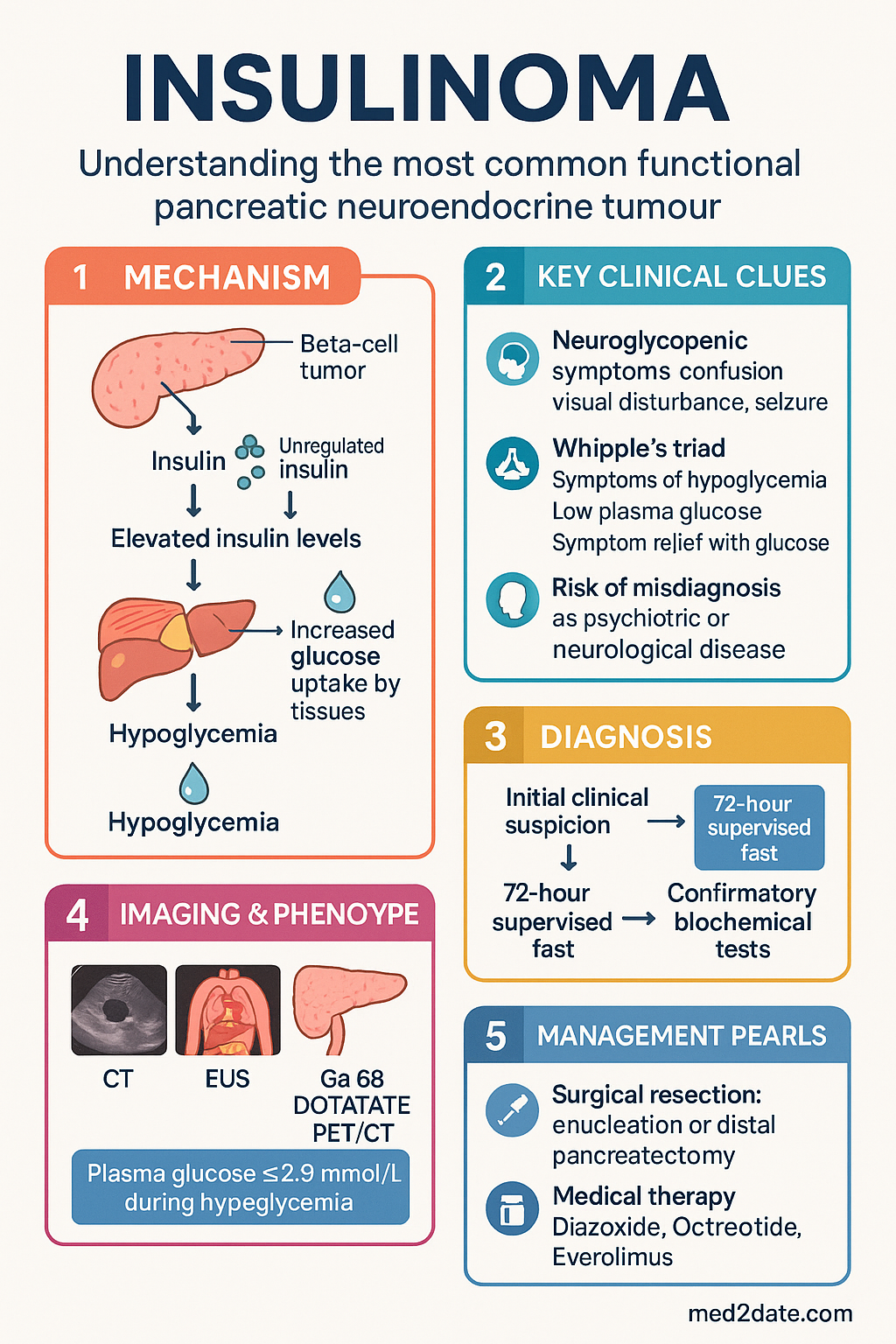
Insulinoma clinical infographic โ€” pathophysiology, clinical clues, diagnosis, imaging, and management
Tap or click image to enlarge โ€” Insulinoma: pathophysiology, clinical clues, diagnosis, imaging, and management.
Insulinoma infographic, full size

Pathophysiology & Epidemiology

Pathogenesis

Insulinomas arise from the pancreatic beta cells of the islets of Langerhans. They autonomously secrete insulin in an unregulated fashion, independent of the prevailing blood glucose concentration. This leads to inappropriately elevated circulating insulin levels during fasting states, driving glucose uptake into peripheral tissues and suppressing hepatic gluconeogenesis and glycogenolysis.

The molecular pathogenesis involves:

  • Sporadic insulinomas: Somatic mutations in YY1 (Yin Yang 1) at 14q32 are found in approximately 30% of cases. Recurrent mutations in MEN1, DAXX, ATRX, and TSC2 are also described.
  • MEN1-associated insulinomas: Germline loss-of-function mutations in the MEN1 tumour suppressor gene (chromosome 11q13) encoding menin, with subsequent somatic loss of heterozygosity. Multiple insulinomas and recurrence are common.
  • Malignant transformation: Associated with DAXX/ATRX mutations, alternative lengthening of telomeres (ALT), and higher Ki-67 proliferative indices (>5%).

Anatomical Distribution

Insulinomas are distributed roughly equally throughout the head, body, and tail of the pancreas. Ectopic insulinomas (duodenum, peripancreatic tissue) are exceedingly rare (<1%). Most tumours are <2 cm in diameter at diagnosis, which poses challenges for pre-operative localisation.

Australian Context

In Australia, insulinoma management is concentrated in tertiary centres with multidisciplinary neuroendocrine tumour (NET) teams, including endocrinologists, hepatobiliary surgeons, nuclear medicine physicians, and interventional radiologists. Key centres include Royal North Shore Hospital (Sydney), Austin Health (Melbourne), Royal Adelaide Hospital, and Royal Brisbane and Women's Hospital. The South Australian Cancer Registry and Australian Institute of Health and Welfare (AIHW) data capture pNETs under broader pancreatic cancer coding, making precise incidence data difficult to extract.

Clinical Features

Whipple's Triad

The hallmark diagnostic criterion for insulinoma is the presence of Whipple's triad, first described by Allen Oldfather Whipple in 1938:

โœ…
Whipple's Triad
  • 1. Symptoms consistent with hypoglycaemia (neuroglycopenic and/or adrenergic)
  • 2. Concomitant low plasma glucose at the time of symptoms (<2.8 mmol/L; or <3.0 mmol/L in the context of a supervised fast)
  • 3. Relief of symptoms upon administration of glucose

Whipple's triad should be demonstrated in a controlled setting (inpatient supervised fast) before proceeding with invasive investigations.

Symptom Classification

Symptoms of insulinoma-related hypoglycaemia can be categorised into two groups:

Symptom Category Features Mechanism
Neuroglycopenic Confusion, difficulty concentrating, abnormal behaviour, visual blurring/diplopia, dysarthria, seizures, loss of consciousness, coma Cerebral glucose deprivation โ€” the brain depends almost exclusively on glucose; cognitive function fails below ~3.0 mmol/L
Autonomic (Adrenergic) Tremor, palpitations, sweating, hunger, anxiety, pallor Counter-regulatory catecholamine release (adrenaline, noradrenaline) in response to falling glucose
โš ๏ธ
Diagnostic pitfall: Neuroglycopenic symptoms often precede or occur without adrenergic symptoms, especially after prolonged hypoglycaemia. This leads to frequent misdiagnosis as epilepsy, transient ischaemic attack, psychiatric illness (anxiety, panic disorder, factitious disorder), or dementia. A high index of suspicion is required in any patient with unexplained episodic neurological or psychiatric symptoms.

Temporal Pattern

Symptoms typically occur in the fasting state, particularly in the morning before breakfast or during prolonged physical activity. However, postprandial symptoms can occur. Patients frequently self-medicate with frequent carbohydrate-rich meals, leading to weight gain (reported in 20โ€“40% of patients at diagnosis).

Investigations

Phase 1 โ€” Biochemical Confirmation

The 72-hour supervised fast (also termed the prolonged fast test) remains the gold standard for confirming endogenous hyperinsulinaemic hypoglycaemia.

72-Hour Supervised Fast Protocol

Hour 0
Patient commences fast after last meal. Capillary blood glucose monitoring every 4โ€“6 hours. Serum samples for glucose, insulin, C-peptide, proinsulin, and beta-hydroxybutyrate drawn at baseline and at any symptomatic episode or glucose <3.0 mmol/L.
Hours 0โ€“48
Continue fasting with water and non-caloric beverages permitted. Monitor for symptoms. Suppression of ketogenesis (beta-hydroxybutyrate <2.7 mmol/L) suggests hyperinsulinaemia.
Any time glucose <2.8 mmol/L (or <3.0 with symptoms)
Draw critical sample: plasma glucose, serum insulin, C-peptide, proinsulin, sulphonylurea screen, beta-hydroxybutyrate. Administer IV 50% dextrose immediately if symptomatic.
Hour 72 (if no event)
Draw final samples even if glucose remains above threshold. Consider terminating fast with critical sample if glucose 2.8โ€“3.0 mmol/L and asymptomatic, then re-feed.

Diagnostic Criteria During Fast

Parameter Diagnostic Threshold Interpretation
Plasma glucose <2.8 mmol/L (venous, glucose oxidase) Confirms hypoglycaemia
Serum insulin โ‰ฅ36 pmol/L (โ‰ฅ6 ฮผU/mL) at time of hypoglycaemia Inappropriately non-suppressed
C-peptide โ‰ฅ200 pmol/L (โ‰ฅ0.6 ng/mL) Endogenous insulin production confirmed
Proinsulin โ‰ฅ5 pmol/L Elevated in insulinoma
Beta-hydroxybutyrate <2.7 mmol/L Insulin suppresses ketogenesis; low levels confirm hyperinsulinaemia
Sulphonylurea screen Negative Excludes factitious hypoglycaemia or surreptitious drug use
๐Ÿšจ
Essential: A serum sulphonylurea screen (glibenclamide, glipizide, gliclazide, glimepiride) must be performed on the critical sample to exclude factitious hypoglycaemia. False-negative C-peptide suppression with exogenous insulin administration is the differential for low C-peptide with high insulin โ€” but sulphonylurea ingestion produces high C-peptide mimicking insulinoma.

Phase 2 โ€” Tumour Localisation

Once biochemical confirmation of hyperinsulinaemic hypoglycaemia is established, tumour localisation is essential for surgical planning. Insulinomas are often small (<2 cm) and require multimodal imaging.

Available
Contrast-enhanced CT abdomen (pancreatic protocol)
First-line localisation; sensitivity 60โ€“80% for lesions >1 cm. Four-phase pancreatic protocol with arterial and portal venous phases recommended. MBS Item 56500 (CT abdomen).
Specialist
Endoscopic ultrasound (EUS)
Sensitivity 80โ€“95%; superior for small (<2 cm) and pancreatic head lesions. Allows simultaneous fine-needle aspiration (FNA) for histology. Requires experienced endosonographer. Available at major Australian tertiary centres.
Specialist
Ga-68 DOTATATE PET/CT
Emerging as highly sensitive for pNET localisation. Targets somatostatin receptor expression. Available at Austin Health, Royal North Shore, Royal Adelaide, and Peter MacCallum Cancer Centre. PBS authority may be required.
Specialist
MRI abdomen (diffusion-weighted)
Alternative if CT contraindicated (e.g., contrast allergy). Sensitivity 70โ€“85%. MBS Item 63024.
Referral
Selective arterial calcium stimulation with hepatic venous sampling (SACSHS)
Reserved for occult insulinomas not localised by non-invasive imaging. Invasive procedure requiring interventional radiology. Sensitivity 80โ€“90%. Available at selected centres (Royal North Shore Hospital, Austin Health).

Histopathology

Histological confirmation is obtained from the surgical specimen. Immunohistochemistry is positive for insulin, chromogranin A, and synaptophysin. Ki-67 proliferative index is critical for grading (WHO classification of NETs): G1 (<2%), G2 (2โ€“20%), G3 (>20%).

Management

Surgical Management (Definitive Therapy)

Surgical resection is the definitive treatment for insulinoma and is curative in >90% of benign, sporadic cases. The approach depends on tumour size, location, and number.

Surgical Approach Indication Key Details
Enucleation Solitary, superficial tumour <2 cm, not encroaching on main pancreatic duct Preferred when feasible; lower risk of pancreatic insufficiency. Laparoscopic enucleation increasingly performed in Australia.
Distal pancreatectomy ยฑ splenectomy Tumours in body/tail, or >2 cm, or close to main duct Spleen-preserving distal pancreatectomy preferred where oncologically appropriate.
Pancreaticoduodenectomy (Whipple's) Large head/uncinate tumours encroaching on bile duct or pancreatic duct Higher morbidity; performed at high-volume hepatobiliary centres.
Subtotal (near-total) pancreatectomy MEN1-associated multiple insulinomas Risk of surgical diabetes and exocrine insufficiency; requires lifelong endocrine management.
โ„น๏ธ
Intraoperative considerations: Intraoperative ultrasound (IOUS) significantly improves localisation of small lesions. Manual palpation by an experienced surgeon at laparotomy identifies 95% of tumours. Frozen section confirmation of the enucleated specimen is mandatory. Intraoperative blood glucose monitoring should demonstrate a rise to >2.8 mmol/L or โ‰ฅ1.7 mmol/L above pre-excision values within 30โ€“60 minutes of successful resection.

Medical Management

Medical therapy is indicated for: (1) pre-operative glycaemic stabilisation, (2) unresectable or metastatic disease, (3) patients unfit for surgery, and (4) bridging while awaiting surgery.

๐Ÿ’Š
Diazoxide
Proglicemยฎ ยท Hyperglycaemic agent ยท KATP channel opener
Adult dose 3โ€“8 mg/kg/day PO in 2โ€“3 divided doses; start 100 mg TDS and titrate up. Typical range 200โ€“600 mg/day.
Paediatric dose 8โ€“15 mg/kg/day PO in 2โ€“3 divided doses (used primarily for congenital hyperinsulinism)
Route Oral
Mechanism Opens KATP channels in beta cells, inhibiting insulin secretion; also has direct extrapancreatic hyperglycaemic effect.
Key ADRs Fluid retention/weight gain (co-prescribe furosemide if needed), hypertrichosis, nausea, hirsutism, hyperuricaemia, tachycardia
Renal adjustment Use with caution in renal impairment; reduce dose. Highly protein-bound โ€” monitor closely.
PBS status Authority Required
๐Ÿ’Š
Octreotide (long-acting)
Sandostatin LARยฎ ยท Somatostatin analogue
Adult dose 20โ€“30 mg IM every 4 weeks. Start with short-acting octreotide 50โ€“200 ฮผg SC TDS to assess response.
Indication Second-line; more effective if somatostatin receptor-positive (SSTR2/5) on Ga-68 DOTATATE scan.
Key ADRs Gallstones, steatorrhoea, injection site pain, bradycardia
PBS status Restricted Benefit
๐Ÿ’Š
Everolimus
Afinitorยฎ ยท mTOR inhibitor
Adult dose 10 mg PO daily. RADIANT-3 trial demonstrated progression-free survival benefit in advanced pNETs.
Indication Progressive, metastatic, or refractory insulinoma
Key ADRs Stomatitis, pneumonitis, hyperglycaemia, hyperlipidaemia, immunosuppression
PBS status Authority Required
๐Ÿ’Š
Sunitinib
Sutentยฎ ยท Multi-targeted TKI
Adult dose 37.5 mg PO daily. Continuous dosing regimen for pNETs.
Indication Progressive, well-differentiated advanced pNET Alternative to everolimus for metastatic disease.
PBS status Authority Required

Peptide Receptor Radionuclide Therapy (PRRT)

Lu-177 DOTATATE (Lutatheraยฎ) is available in Australia for somatostatin receptor-positive gastroenteropancreatic NETs (GEP-NETs). It may be considered for metastatic insulinoma with high somatostatin receptor expression on Ga-68 DOTATATE PET/CT. Available at specialised centres (Peter MacCallum, Austin Health). TGA-registered; PBS listing requires authority application.

Systemic Chemotherapy

For poorly differentiated (G3) or rapidly progressive malignant insulinoma, platinum-based regimens are considered:

  • Cisplatin + Etoposide: Standard for high-grade (G3) neuroendocrine carcinoma
  • Temozolomide ยฑ capecitabine: Alternative for well-differentiated progressive disease; activity in pNETs demonstrated in retrospective series
  • FOLFOX / FOLFIRI: Reserved for refractory disease; limited evidence

Acute Hypoglycaemia Management

1
Conscious patient
Oral glucose 20โ€“30 g (e.g., 200 mL Lucozadeยฎ, 4 glucose tablets). Recheck BGL in 15 min. Repeat if BGL remains <4.0 mmol/L.
2
Unconscious or unable to swallow
IV 50% dextrose 50 mL (25 g) bolus via large vein. Follow with 10% dextrose infusion at 100โ€“150 mL/hr. Avoid IM glucagon (stimulates insulin release from insulinoma โ€” may paradoxically worsen hypoglycaemia).
3
Refractory hypoglycaemia
Continuous IV 10โ€“20% dextrose. Consider IV octreotide 50โ€“100 ฮผg bolus to acutely suppress insulin secretion. Urgent endocrine consultation.

Special Populations

๐Ÿ‘ถ Paediatric
Congenital hyperinsulinism (CHI)
Distinct from insulinoma in infancy; caused by ABCC8/KCNJ11 mutations. Diazoxide is first-line (8โ€“15 mg/kg/day). Diazoxide-unresponsive CHI may require near-total pancreatectomy. Refer to paediatric endocrinology centres (RCH Melbourne, Sydney Children's Hospital, QCH Brisbane).
Insulinoma in children
Rare in paediatric age group. Consider MEN1 screening if diagnosed. Surgical enucleation remains curative. Weight-adjusted dosing for all medical therapies.
๐Ÿคฐ Pregnancy
Diagnosis
Insulinoma in pregnancy is exceedingly rare. The 72-hour fast may be modified (shorter fast with more frequent glucose monitoring). Insulin and C-peptide levels are physiologically elevated in pregnancy โ€” interpret with caution.
Management
Surgery (enucleation) in the second trimester is preferred if required. Diazoxide is Category B3 โ€” use with caution; causes neonatal hypertrichosis and fluid retention. Octreotide is Category B3. Frequent small meals may partially control symptoms.
๐Ÿ‘ด Elderly
Surgical fitness
Increased operative risk from pancreatic surgery. Comprehensive geriatric assessment pre-operatively. Consider medical management with diazoxide if unfit for surgery. Falls prevention critical โ€” hypoglycaemia-related falls are a major morbidity.
Drug interactions
Diazoxide interacts with warfarin (increased INR), antihypertensives (additive hypotension), and diuretics. Review polypharmacy carefully.
๐Ÿซ˜ Renal Impairment
Diazoxide
Highly protein-bound (90%); displaced in renal impairment leading to increased free drug. Reduce dose and monitor closely. Fluid retention exacerbated by renal impairment โ€” proactive diuretic use required.
Everolimus
No dose adjustment in mildโ€“moderate renal impairment. Monitor drug levels and renal function.
๐Ÿซ Hepatic Impairment
Metastatic hepatic disease
Hepatic metastases from malignant insulinoma may cause hepatic impairment and alter drug metabolism. Everolimus and sunitinib dose adjustment may be required. Consider hepatic arterial embolisation for symptomatic hepatic metastases.
๐Ÿ›ก๏ธ Immunocompromised
Everolimus
mTOR inhibitor โ€” causes significant immunosuppression. Monitor for opportunistic infections (PJP prophylaxis considered). Avoid live vaccines. Regular FBC monitoring.

Aboriginal and Torres Strait Islander Health

Aboriginal and Torres Strait Islander Health Considerations
Access to specialist endocrinology
Aboriginal and Torres Strait Islander peoples in remote and very remote areas have limited access to endocrinologists and tertiary NET multidisciplinary teams. Telehealth endocrinology consultations (MBS Items 91822, 91823) should be utilised where available through the Australian Government telehealth programme. Patient-assisted travel schemes (PATS) in NT, QLD, WA, SA, and NSW support travel to metropolitan centres for diagnostic workup and surgery.
Delayed diagnosis
Neuroglycopenic symptoms may be misattributed in remote settings where neurological and psychiatric services are limited. High index of suspicion for unexplained seizures, confusion, or unusual behaviour, particularly in younger adults. Point-of-care blood glucose testing in remote clinics is essential. Consider insulinoma in any patient with recurrent unexplained hypoglycaemia after excluding common causes (diabetes medications, alcohol, liver disease).
Diagnostic infrastructure
72-hour supervised fasts require inpatient admission and are not feasible in remote health centres. Arrangement for transfer to regional or metropolitan hospitals is required. CT and MRI are available at regional centres; EUS and Ga-68 DOTATATE PET/CT are restricted to metropolitan tertiary centres. Blood sample transport to reference laboratories must be planned โ€” samples for insulin, C-peptide, and proinsulin require cold chain transport.
Surgical access
Pancreatic surgery requires high-volume hepatobiliary centres. Aboriginal and Torres Strait Islander patients may face additional barriers including cultural safety in metropolitan hospitals, family separation, language differences, and distrust of the health system. Aboriginal Health Workers and Liaison Officers should be involved in care coordination. Interpreter services should be offered where English is not the patient's first language.
Chronic disease burden
Higher prevalence of type 2 diabetes, obesity, and chronic kidney disease in Aboriginal and Torres Strait Islander populations may complicate hypoglycaemia workup โ€” ensure sulphonylurea ingestion is excluded. Renal impairment may require dose adjustment of diazoxide. Health literacy support and culturally appropriate education materials are essential for post-operative monitoring and medication adherence.
Cultural safety
Engagement with Aboriginal Health Workers, community-controlled health services (ACCHOs), and cultural support is essential. Respect for gender-specific care preferences. Awareness of Sorry Business and its impact on appointment attendance. Flexible follow-up scheduling and outreach services improve outcomes. The RACGP and NACCHO partnership provides frameworks for culturally safe chronic disease management.

๐Ÿ“š References

  1. 1. Cryer PE, Axelrod L, Grossman AB, et al. Evaluation and management of adult hypoglycemic disorders: an Endocrine Society Clinical Practice Guideline. J Clin Endocrinol Metab. 2009;94(3):709โ€“728.
  2. 2. Service FJ, McMahon MM, O'Brien PC, Ballard DJ. Functioning insulinoma โ€” incidence, recurrence, and long-term survival of patients: a 60-year study. Mayo Clin Proc. 1991;66(7):711โ€“719.
  3. 3. Placzkowski KA, Vella A, Thompson GB, et al. Secular trends in the presentation and management of functioning insulinoma at the Mayo Clinic, 1987โ€“2007. J Clin Endocrinol Metab. 2009;94(4):1069โ€“1073.
  4. 4. Yao JC, Fazio N, Singh S, et al. Everolimus for the treatment of advanced, non-functional neuroendocrine tumours of the lung or gastrointestinal tract (RADIANT-4): a randomised, placebo-controlled, phase 3 study. Lancet. 2016;387(10022):968โ€“977.
  5. 5. Raymond E, Dahan L, Raoul JL, et al. Sunitinib malate for the treatment of pancreatic neuroendocrine tumors. N Engl J Med. 2011;364(6):501โ€“513.
  6. 6. Strosberg J, El-Haddad G, Wolin E, et al. Phase 3 trial of 177Lu-DOTATATE for midgut neuroendocrine tumors. N Engl J Med. 2017;376(2):125โ€“135.
  7. 7. Ramage JK, Ahmed A, Ardill J, et al. Guidelines for the management of gastroenteropancreatic neuroendocrine (including carcinoid) tumours. Gut. 2012;61(1):1โ€“22.
  8. 8. Australian Institute of Health and Welfare (AIHW). Cancer data in Australia. Canberra: AIHW; 2024. Available from: https://www.aihw.gov.au/reports/cancer/cancer-data-in-australia
  9. 9. Royal Australian College of General Practitioners (RACGP). General practice management of type 2 diabetes: 2016โ€“2018. East Melbourne: RACGP; 2016.
  10. 10. Jensen RT, Cadiot G, Brandi ML, et al. ENETS Consensus Guidelines for the management of patients with digestive neuroendocrine neoplasms: functional pancreatic endocrine tumor syndromes. Neuroendocrinology. 2012;95(2):98โ€“119.
  11. 11. Abboud B, Boujaoude J. Occult sporadic insulinoma: localization and surgical strategy. World J Gastroenterol. 2008;14(5):657โ€“665.
  12. 12. Dimitriadis GK, Weickert MO, Randeva HS, et al. Medical management of secretory syndromes. Neuroendocrinology. 2020;110(9โ€“10):813โ€“826.
co-pay for eligible patients).
Pregnancy & maternal health
Antenatal screening for thyroid disease should be integrated into Aboriginal Community Controlled Health Organisation (ACCHO) maternal health programmes. Untreated hypothyroidism in pregnancy disproportionately impacts communities with limited access to early antenatal care.
Comorbidity burden
Higher rates of diabetes, cardiovascular disease, and chronic kidney disease in Aboriginal and Torres Strait Islander communities mean hypothyroid-related dyslipidaemia and cardiovascular risk require particularly active management. Integrating thyroid function testing into chronic disease management plans (MBS Item 721) is recommended.
Iodine status
Although Australia-wide mandatory iodisation has improved status, some Aboriginal and Torres Strait Islander communities โ€” particularly in very remote areas โ€” may have borderline iodine adequacy. Urinary iodine monitoring in these communities should be maintained.

๐Ÿ“š References

  1. 1. Chaker L, Bianco AC, Jonklaas J, Peeters RP. Hypothyroidism. Lancet. 2017;390(10101):1550โ€“1562.
  2. 2. Garber JR, Cobin RH, Gharib H, et al. Clinical practice guidelines for hypothyroidism in adults: cosponsored by the American Association of Clinical Endocrinologists and the American Thyroid Association. Endocr Pract. 2012;18(6):988โ€“1028.
  3. 3. Pearce SH, Brabant G, Duntas LH, et al. 2013 ETA guideline: management of subclinical hypothyroidism. Eur Thyroid J. 2013;2(4):215โ€“228.
  4. 4. Alexander EK, Pearce EN, Brent GA, et al. 2017 guidelines of the American Thyroid Association for the diagnosis and management of thyroid disease during pregnancy and the postpartum. Thyroid. 2017;27(3):315โ€“389.
  5. 5. RACGP. Red Book: Guidelines for preventive activities in general practice. 9th ed. East Melbourne: RACGP; 2018.
  6. 6. Australian Institute of Health and Welfare (AIHW). Aboriginal and Torres Strait Islander health performance framework. Canberra: AIHW; 2023.
  7. 7. Li Y, Teng D, Shi X, et al. Prevalence of diabetes recorded in mainland China using 2018 diagnostic criteria from the American Diabetes Association: national cross sectional study. BMJ. 2020;369:m997. [TSH population reference data]
  8. 8. Ross DS. Diagnosis of and screening for hypothyroidism. In: UpToDate, Cooper DS (Ed). Wolters Kluwer; 2024. Accessed June 2024.
  9. 9. NHMRC. National evidence-based guideline: diagnosis, management and prevention of congenital hypothyroidism. Canberra: NHMRC; 2019.
  10. 10. Wiersinga WM, Duntas L, Fadeyev V, Nygaard B, Vanderpump MP. 2012 ETA guidelines: the use of L-T4 + L-T3 in the treatment of hypothyroidism. Eur Thyroid J. 2012;1(2):55โ€“71.
  11. 11. Pharmaceuticals Benefits Scheme (PBS). Levothyroxine sodium. Australian Government Department of Health. Available at: pbs.gov.au. Accessed June 2024.
  12. 12. Australian Government Department of Health. National Newborn Bloodspot Screening โ€” Congenital Hypothyroidism. Available at: www.newbornscreening.gov.au. Accessed June 2024.