Home Endocrinology Osteoporosis

Osteoporosis

📋 Key Information Summary

📋
  • Osteoporosis is defined by a bone mineral density (BMD) T-score ≤ −2.5 at the femoral neck, total hip, or lumbar spine on DXA scan.
  • Fracture risk is assessed using the FRAX® tool, integrating clinical risk factors and BMD to guide treatment thresholds.
  • First-line pharmacotherapy for most patients is an oral bisphosphonate (e.g., alendronate or risedronate).
  • Denosumab is a first-line alternative, particularly for those with renal impairment or intolerance to oral bisphosphonates.
  • Teriparatide is reserved for severe osteoporosis (e.g., very low T-scores, multiple fractures, or glucocorticoid-induced).
  • Adequate calcium (≥1300 mg/day) and vitamin D (supplementation if deficient) are foundational for all patients.
  • Weight-bearing and resistance exercise is a critical non-pharmacological intervention to reduce fall and fracture risk.
  • Secondary causes (e.g., hyperparathyroidism, coeliac disease, chronic corticosteroids) must be actively excluded.
  • Monitoring of treatment response is via serial DXA scans every 1–2 years and bone turnover markers.
  • Osteoporosis management must consider Aboriginal and Torres Strait Islander peoples, who have higher fracture rates and barriers to care.

🎧 Audio Brief

Stopping Catastrophic Bone Failure and Fractures

A short clinical audio briefing generated from this article — perfect for the commute or ward round.

Introduction & Australian Epidemiology

Osteoporosis is a systemic skeletal disorder characterised by low bone mass and microarchitectural deterioration of bone tissue, leading to enhanced bone fragility and a consequent increase in fracture risk. It represents a major public health issue in Australia.

In Australia, approximately 4.74 million people aged over 50 have osteoporosis or osteopenia. The condition is responsible for an estimated 172,000+ fractures each year, with significant associated morbidity, mortality, and healthcare costs. The risk of fragility fracture increases with age, and the burden falls disproportionately on women (approximately 75% of fractures), although men also account for a substantial proportion.

Hip fractures are particularly devastating, carrying a 1-year mortality rate of 20-30%. The direct medical costs of osteoporosis and related fractures in Australia are estimated at over $3.1 billion annually.
⚠️
Under-diagnosis & under-treatment: Despite its prevalence, osteoporosis remains significantly under-diagnosed and under-treated in Australia. A large proportion of patients presenting with a fragility fracture do not receive appropriate investigation (DXA scan) or initiation of anti-osteoporosis therapy.
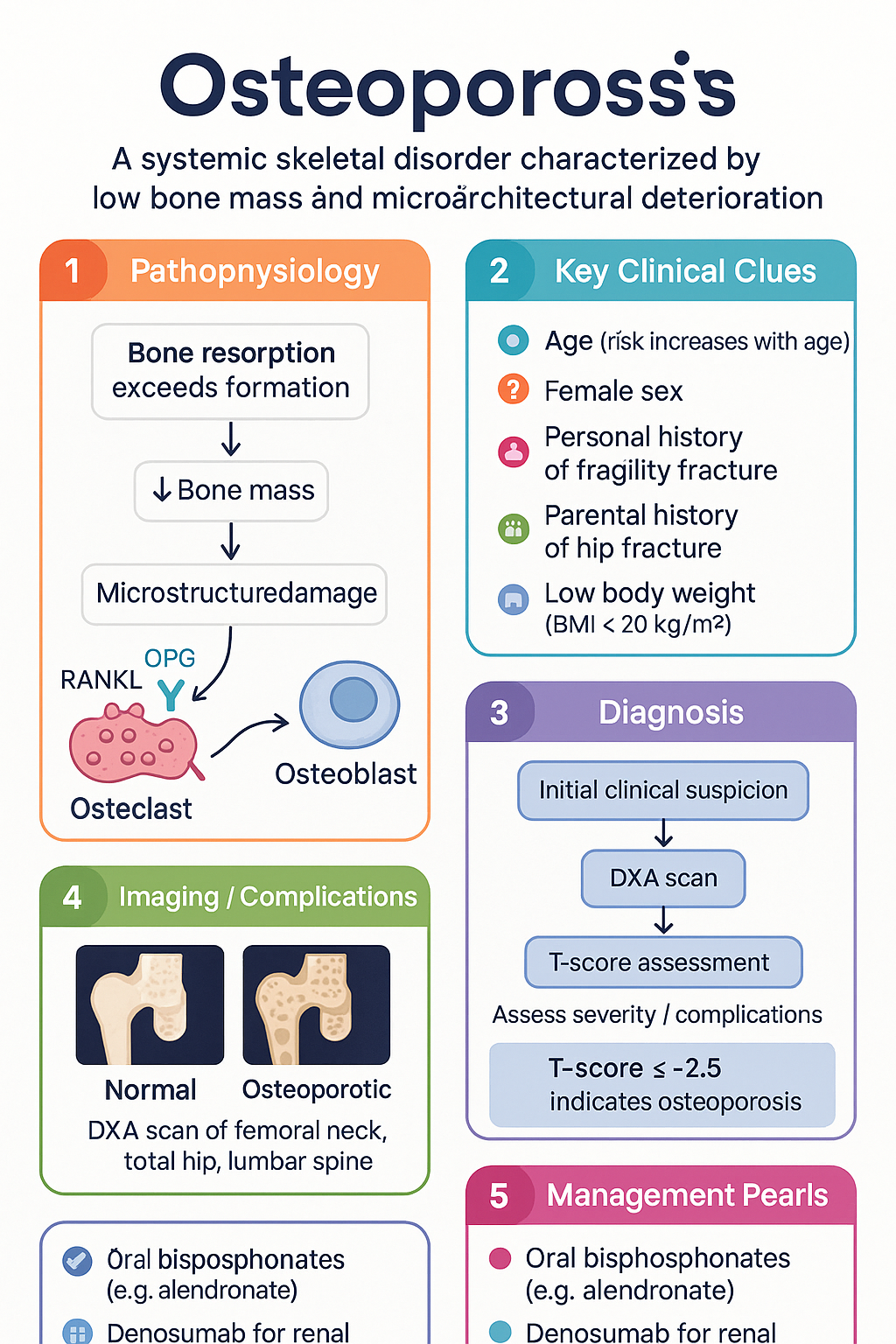
Osteoporosis clinical infographic — pathophysiology, clinical clues, diagnosis, imaging, and management
Tap or click image to enlarge — Osteoporosis: pathophysiology, clinical clues, diagnosis, imaging, and management.
Osteoporosis infographic, full size

Epidemiology & Risk Factors (FRAX Score)

A fragility fracture is a fracture resulting from mechanical forces that would not ordinarily cause a fracture, typically a fall from a standing height or less.

Key Non-Modifiable Risk Factors

  • Age (risk increases exponentially with age)
  • Female sex
  • Personal history of fragility fracture (strongest predictor of future fracture)
  • Parental history of hip fracture
  • Low body weight (BMI < 20 kg/m²)

Key Modifiable Risk Factors

  • Current smoking
  • Excess alcohol intake (> 3 standard drinks/day)
  • Glucocorticoid therapy (≥ 7.5 mg prednisolone equivalent/day for ≥ 3 months)
  • Vitamin D deficiency
  • Conditions leading to secondary osteoporosis

FRAX® Tool

The WHO Fracture Risk Assessment Tool (FRAX®) estimates the 10-year probability of a major osteoporotic fracture (hip, spine, forearm, humerus) and hip fracture alone. It incorporates clinical risk factors with or without a BMD T-score.

ℹ️
Australian FRAX: Use the Australian-calibrated FRAX model. The tool is used to guide treatment decisions, particularly for patients with osteopenia (T-score between −1.0 and −2.5). In Australia, a treatment threshold of ≥ 10% for 10-year major osteoporotic fracture risk is often used in conjunction with clinical assessment.

Pathophysiology & Secondary Causes

Bone is in a constant state of remodelling, with osteoclasts resorbing old bone and osteoblasts forming new bone. Osteoporosis arises when bone resorption exceeds formation, leading to a net loss of bone mass and strength.

Common Secondary Causes in Australia

It is estimated that up to 30% of postmenopausal women and 50% of men with osteoporosis have an underlying secondary cause. These must be actively investigated.

Category Specific Conditions / Agents
Endocrine Primary hyperparathyroidism, hyperthyroidism, Cushing's syndrome, hypogonadism, type 1 diabetes
Gastrointestinal Coeliac disease, inflammatory bowel disease, chronic liver disease, malabsorption
Rheumatological Rheumatoid arthritis, ankylosing spondylitis
Medications Glucocorticoids, aromatase inhibitors (e.g., anastrozole), androgen deprivation therapy, some anticonvulsants, proton pump inhibitors (long-term)
Other Chronic kidney disease (stage 4+), multiple myeloma, organ transplant, vitamin D deficiency

Investigations (DEXA Scan, T-Score)

Bone Densitometry (DXA Scan)

Central Dual-Energy X-ray Absorptiometry (DXA) of the hip (femoral neck and total hip) and lumbar spine (L1–L4) is the gold standard for diagnosing osteoporosis. It is a safe, quick, and low-radiation scan.

Central DXA Scan Essential
MBS Item 12312. Diagnostic criteria are based on the lowest T-score from the lumbar spine, femoral neck, or total hip. Measurement at the forearm (1/3 radius) may be used in certain cases (e.g., hyperparathyroidism).

Diagnostic Criteria (WHO)

  • Normal: T-score ≥ −1.0
  • Osteopenia (Low bone mass): T-score between −1.0 and −2.5
  • Osteoporosis: T-score ≤ −2.5
  • Severe Osteoporosis: T-score ≤ −2.5 with one or more fragility fractures.

Baseline & Screening Investigations

To exclude secondary causes and establish baseline parameters for monitoring.

Full Blood Examination (FBE) Available
Calcium, Phosphate, Albumin Available
Calculate corrected calcium.
Liver Function Tests (LFTs), Creatinine (eGFR) Available
25-Hydroxyvitamin D Available
Target level ≥ 50 nmol/L (sufficiency).
Thyroid Function Tests (TSH) Available
Testosterone (men), FSH (premature menopause) Available
Coeliac serology (anti-tTG IgA) Available
Consider in all patients with osteoporosis.

Management

Non-Pharmacological Management

  • Calcium: Aim for a total dietary + supplement intake of ≥ 1300 mg/day. Use supplements if intake is inadequate.
  • Vitamin D: Supplement with cholecalciferol (e.g., 1000–2000 IU daily, or higher loading doses if deficient) to maintain a serum 25(OH)D level ≥ 50 nmol/L.
  • Exercise: Weight-bearing (e.g., brisk walking, dancing) and resistance/strength training at least 3 times per week.
  • Fall prevention: Home hazard assessment, balance training (e.g., Tai Chi), vision correction, medication review.
  • Lifestyle: Smoking cessation, limit alcohol to ≤ 2 standard drinks/day.

Pharmacological Management — First-Line Therapies

💊
Alendronate
Fosamax® / Alendro-Binosto® · Oral bisphosphonate
Adult dose70 mg PO once weekly, on empty stomach with 200 mL plain water, remain upright 30 mins.
Paediatric doseFor paediatric osteoporosis specialist use only.
Renal adjustmentContraindicated if eGFR < 30 mL/min.
PBS status✔ PBS General Benefit
💊
Denosumab
Prolia® · RANKL inhibitor
Adult dose60 mg SC every 6 months, by healthcare professional.
Key cautionRebound vertebral fractures on discontinuation. Must continue long-term or transition to another agent.
Renal adjustmentSafe in renal impairment.
PBS status✔ PBS Authority Required
🚨
Denosumab Discontinuation: Abrupt cessation of denosumab can cause rapid bone loss and an increased risk of multiple vertebral fractures. A transition plan to an alternative anti-resorptive agent (e.g., bisphosphonate) is essential before stopping therapy.

Pharmacological Management — Second-Line & Severe Osteoporosis

💊
Teriparatide
Forteo® · Recombinant PTH (1-34)
Adult dose20 mcg SC daily (self-injection) for up to 24 months.
IndicationSevere osteoporosis: multiple fractures, very low T-score, or failure/intolerance to other agents.
Key cautionMust be followed by an anti-resorptive agent to maintain gains. Contraindicated in Paget's, unexplained ALP elevation, bone metastases.
PBS status✔ PBS Authority Required (Specialist)
💊
Romosozumab
Evenity® · Anti-sclerostin antibody
Adult dose210 mg SC monthly for 12 months (2 x 10⁵ mg injections).
IndicationSevere osteoporosis in postmenopausal women at very high fracture risk.
Key cautionIncreased risk of cardiovascular events. Contraindicated if MI or stroke within last year.
PBS status✔ PBS Authority Required (Specialist)

Monitoring Therapy

  • Bone Density (DXA): Repeat scan 1–2 years after initiating therapy, then every 2–3 years if stable. Assess for significant decline (least significant change ~4%).
  • Bone Turnover Markers (BTMs): P1NP (formation) and CTX (resorption) can help assess adherence and response. Check at baseline and 3–6 months after starting treatment.
  • Clinical Review: Monitor for new fractures, falls, medication side effects (e.g., GI for bisphosphonates), and adherence.

Special Populations

🤰 Pregnancy & Lactation
Bisphosphonates, Denosumab, Teriparatide: Contraindicated. Cross placenta, potential fetal harm. Teratogenic in animal studies.
Management: Focus on calcium, vitamin D, weight-bearing exercise. Consider specialist referral for high-risk cases.
👧 Paediatrics
Diagnosis: Based on clinical fracture history + vertebral fractures, not DXA T-scores alone. Z-scores used.
Treatment: Intravenous pamidronate is the most common agent used for pathological fractures in children (e.g., osteogenesis imperfecta). Specialist management essential.
🦴 Renal Impairment (CKD)
Bisphosphonates: Contraindicated if eGFR < 30 (risk of adynamic bone disease, nephrotoxicity).
Denosumab: Can be used in CKD 4-5D, but risk of hypocalcaemia is high. Monitor calcium closely.
Assessment: Requires differentiation between osteoporosis and CKD-mineral bone disorder (CKD-MBD). Specialist input recommended.
🇦🇺 ATSI Considerations
See dedicated ATSI section below for comprehensive details.
Aboriginal and Torres Strait Islander Health Considerations

Aboriginal and Torres Strait Islander peoples experience a higher burden of osteoporosis and fragility fractures at a younger age compared to non-Indigenous Australians, linked to earlier onset of chronic disease comorbidities and socioeconomic factors.

Equity & Access
Significant barriers exist to DXA scanning, specialist referral, and regular follow-up in rural and remote communities. Telehealth and outreach services are critical.
Comorbidities
Higher prevalence of type 2 diabetes (which can artificially elevate BMD on DXA), CKD, and rheumatic heart disease, complicating assessment and management.
Cultural Safety
Engagement with Aboriginal Community Controlled Health Organisations (ACCCHOs), use of Indigenous Health Workers, and culturally appropriate patient education materials are essential for adherence.
Prevention
Addressing falls risk in the home environment, promoting adequate nutrition (calcium, vitamin D), and supporting physical activity are key preventative strategies.

📚 References

  1. 1. The Royal Australian College of General Practitioners (RACGP). Clinical guideline for the diagnosis and management of osteoporosis in postmenopausal women and men. 2017.
  2. 2. Australian Institute of Health and Welfare (AIHW). Osteoporosis. Cat. no. PHE 236. Canberra: AIHW; 2020.
  3. 3. Endocrine Society of Australia and Osteoporosis Australia. Position statement on the management of osteoporosis. 2020.
  4. 4. Kanis JA, et al. European guidance for the diagnosis and management of osteoporosis in postmenopausal women. Osteoporos Int. 2019;30(1):3-44.
  5. 5. Australian Government Department of Health. Pharmaceutical Benefits Scheme (PBS). Alendronate, Denosumab, Teriparatide. Available at pbs.gov.au. Accessed 2024.
  6. 6. Osteoporosis Australia. Calcium and Vitamin D in Osteoporosis. Consumer information. 2021.
  7. 7. National Health and Medical Research Council (NHMRC). Australian Guidelines to Reduce Health Risks from Drinking Alcohol. Canberra: NHMRC; 2020.
  8. 8. Sherrington C, et al. Effective exercise for the prevention of falls: a systematic review and meta-analysis. J Am Geriatr Soc. 2019;67(12):2505-2514.
  9. 9. Cummings SR, et al. Denosumab for treatment of postmenopausal osteoporosis: results of a randomized trial. J Bone Miner Res. 2009;24(2):293-310.
  10. 10. Neubauer L, et al. Fracture risk in Aboriginal and non-Aboriginal populations in New South Wales. Aust N Z J Public Health. 2019;43(5):457-463.
co-pay for eligible patients).
Pregnancy & maternal health
Antenatal screening for thyroid disease should be integrated into Aboriginal Community Controlled Health Organisation (ACCHO) maternal health programmes. Untreated hypothyroidism in pregnancy disproportionately impacts communities with limited access to early antenatal care.
Comorbidity burden
Higher rates of diabetes, cardiovascular disease, and chronic kidney disease in Aboriginal and Torres Strait Islander communities mean hypothyroid-related dyslipidaemia and cardiovascular risk require particularly active management. Integrating thyroid function testing into chronic disease management plans (MBS Item 721) is recommended.
Iodine status
Although Australia-wide mandatory iodisation has improved status, some Aboriginal and Torres Strait Islander communities — particularly in very remote areas — may have borderline iodine adequacy. Urinary iodine monitoring in these communities should be maintained.

📚 References

  1. 1. Chaker L, Bianco AC, Jonklaas J, Peeters RP. Hypothyroidism. Lancet. 2017;390(10101):1550–1562.
  2. 2. Garber JR, Cobin RH, Gharib H, et al. Clinical practice guidelines for hypothyroidism in adults: cosponsored by the American Association of Clinical Endocrinologists and the American Thyroid Association. Endocr Pract. 2012;18(6):988–1028.
  3. 3. Pearce SH, Brabant G, Duntas LH, et al. 2013 ETA guideline: management of subclinical hypothyroidism. Eur Thyroid J. 2013;2(4):215–228.
  4. 4. Alexander EK, Pearce EN, Brent GA, et al. 2017 guidelines of the American Thyroid Association for the diagnosis and management of thyroid disease during pregnancy and the postpartum. Thyroid. 2017;27(3):315–389.
  5. 5. RACGP. Red Book: Guidelines for preventive activities in general practice. 9th ed. East Melbourne: RACGP; 2018.
  6. 6. Australian Institute of Health and Welfare (AIHW). Aboriginal and Torres Strait Islander health performance framework. Canberra: AIHW; 2023.
  7. 7. Li Y, Teng D, Shi X, et al. Prevalence of diabetes recorded in mainland China using 2018 diagnostic criteria from the American Diabetes Association: national cross sectional study. BMJ. 2020;369:m997. [TSH population reference data]
  8. 8. Ross DS. Diagnosis of and screening for hypothyroidism. In: UpToDate, Cooper DS (Ed). Wolters Kluwer; 2024. Accessed June 2024.
  9. 9. NHMRC. National evidence-based guideline: diagnosis, management and prevention of congenital hypothyroidism. Canberra: NHMRC; 2019.
  10. 10. Wiersinga WM, Duntas L, Fadeyev V, Nygaard B, Vanderpump MP. 2012 ETA guidelines: the use of L-T4 + L-T3 in the treatment of hypothyroidism. Eur Thyroid J. 2012;1(2):55–71.
  11. 11. Pharmaceuticals Benefits Scheme (PBS). Levothyroxine sodium. Australian Government Department of Health. Available at: pbs.gov.au. Accessed June 2024.
  12. 12. Australian Government Department of Health. National Newborn Bloodspot Screening — Congenital Hypothyroidism. Available at: www.newbornscreening.gov.au. Accessed June 2024.