📋 Key Information Summary
- Definition: Spontaneous infection of ascitic fluid in the absence of a contiguous source of infection, occurring in patients with advanced cirrhosis.
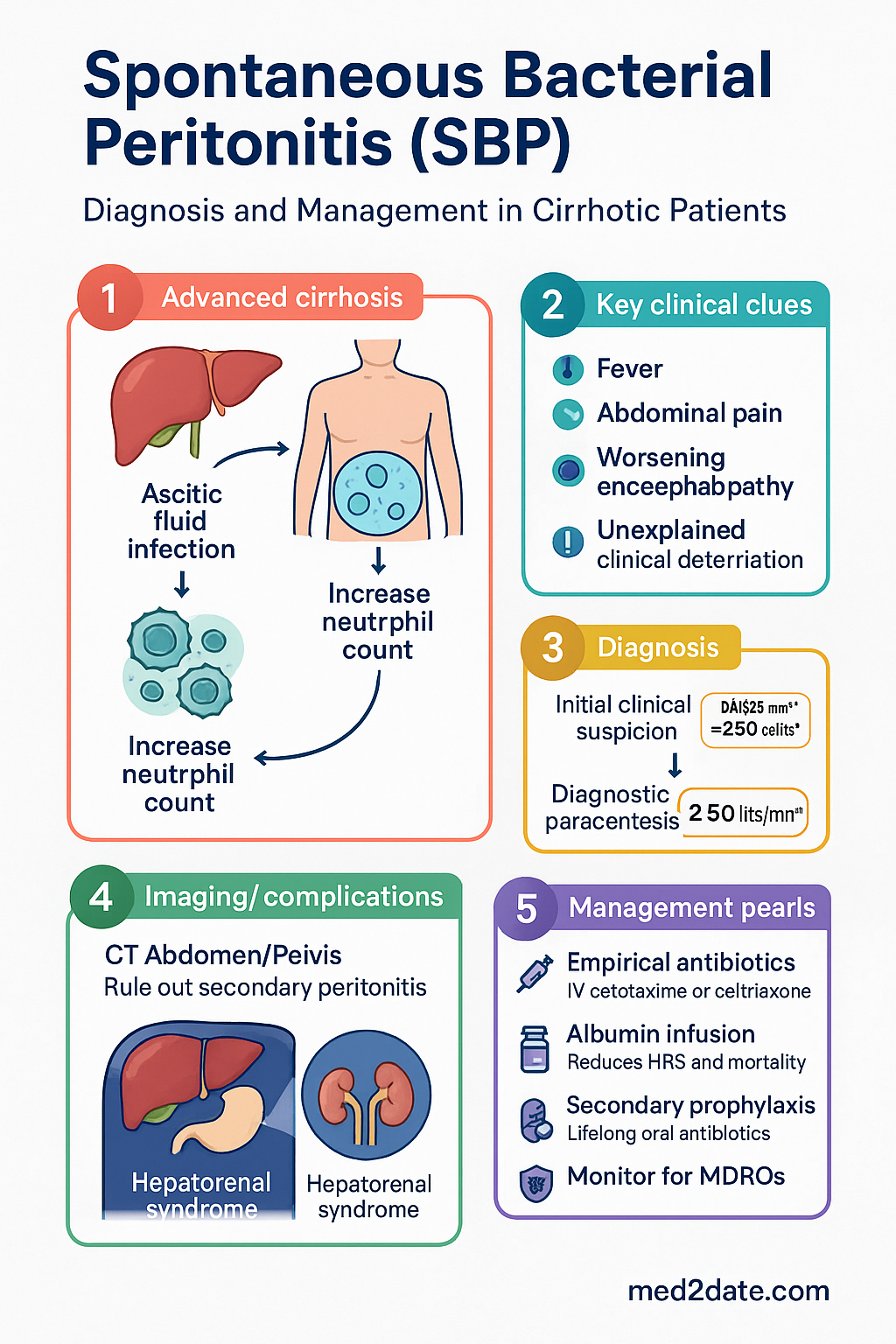
- Diagnostic Gold Standard: Ascitic fluid absolute neutrophil count (ANC) ≥250 cells/mm³. A positive ascitic fluid culture is supportive but not required for diagnosis.
- Culture Yield: Cultures are frequently negative. Inoculation of ascitic fluid into blood-culture bottles at the bedside significantly improves diagnostic yield.
- Key Variants: Culture-Negative Neutrocytic Ascites (CNNA; ANC ≥250, negative culture) is treated as SBP. Bacterascites (positive culture, ANC <250) is treated only if symptomatic.
- Rule Out Secondary Peritonitis: Essential. Suspect if ascitic fluid protein >10 g/L, glucose <2.8 mmol/L, or LDH > upper limit of serum normal (Runyon criteria). Requires urgent imaging to identify a surgically treatable source.
- Empirical Antibiotic Therapy: Immediate initiation of IV third-generation cephalosporin (cefotaxime or ceftriaxone) is first-line for community-acquired SBP.
- Healthcare/Nosocomial SBP: For nosocomial or healthcare-associated infections, use broader cover (e.g., piperacillin-tazobactam or a carbapenem) due to high MDRO risk, then de-escalate per culture results.
- Albumin Infusion: Mandatory adjunctive therapy. Dose: 1.5 g/kg on Day 1 and 1 g/kg on Day 3. Significantly reduces hepatorenal syndrome (HRS) and mortality, especially if serum creatinine >1 mg/dL (88 µmol/L) or bilirubin >68 µmol/L.
- Treatment Duration: 5 days of IV antibiotics is typically sufficient for uncomplicated SBP. Longer courses are not superior.
- Secondary Prophylaxis: Lifelong (until transplant) oral antibiotic prophylaxis (e.g., norfloxacin, ciprofloxacin, or TMP-SMX) is mandatory after an episode of SBP to prevent recurrence (~70% risk at 1 year).
- Primary Prophylaxis in GI Bleed: All cirrhotic patients with acute upper GI bleeding require IV antibiotics (ceftriaxone preferred for 7 days) to prevent SBP and other infections.
- Primary Prophylaxis in High-Risk Patients: Consider long-term prophylaxis in patients with low ascitic protein (<15 g/L) and advanced cirrhosis (Child-Pugh ≥9 with bilirubin ≥3 mg/dL) or renal dysfunction (Cr ≥1.2 mg/dL, Na ≤130 mmol/L).
- MDRO Consideration: Prophylactic antibiotics increase the risk of selecting for multidrug-resistant organisms (MDRO), which complicates future treatment episodes.
🎧 Audio Brief
Diagnosis
A high index of clinical suspicion is required for diagnosis in any patient with cirrhosis and ascites who presents with fever, abdominal pain, worsening encephalopathy, or unexplained clinical deterioration. Diagnosis is based on analysis of a diagnostic paracentesis.
Ascitic Fluid Analysis
| Parameter | Diagnostic Criterion | Notes |
|---|---|---|
| Absolute Neutrophil Count (ANC) | ≥ 250 cells/mm³ | The cornerstone of diagnosis. Calculated from total WBC and differential. A manual differential is preferred if the automated count is abnormal. |
| Culture | Ideally positive, but not required | Yield is increased by inoculating 10–20 mL of ascitic fluid directly into both aerobic and anaerobic blood-culture bottles at the bedside. Monomicrobial growth is typical. |
| Total Protein, Glucose, LDH | Assess Runyon Criteria | See below for distinguishing SBP from secondary peritonitis. |
Diagnostic Variants
Supportive Investigations
Treatment
Treatment must be initiated immediately upon suspicion or diagnosis, without awaiting culture results. It comprises empirical antibiotic therapy and adjunctive intravenous albumin.
Empirical Antibiotic Therapy
The choice depends on the likely source and setting of infection (community vs. healthcare-associated).
Adjunctive Albumin Infusion
Monitoring & Duration
- Repeat Paracentesis: Not routinely required if clinical improvement. Consider at 48 hours if no clinical improvement (persistent fever, no reduction in abdominal pain) to confirm a falling ANC and rule out secondary peritonitis.
- Treatment Duration: A 5-day course of IV antibiotics is standard and sufficient for uncomplicated SBP. Longer courses (e.g., 10–14 days) do not improve outcomes and increase MDRO risk.
- Clinical Response: Expect clinical improvement (resolution of fever, reduced pain) within 48–72 hours. Failure to improve should prompt a reassessment of diagnosis and consideration of resistant organisms or secondary peritonitis.
Prophylaxis
Antibiotic prophylaxis is a critical component of SBP management, aimed at preventing first episodes (primary prophylaxis) and recurrence (secondary prophylaxis). The decision to use prophylaxis must balance the significant risk of MDRO selection.
Secondary Prophylaxis (Post-SBP)
Indicated for all patients who have survived an episode of SBP, as the 1-year recurrence rate is approximately 70%.
Primary Prophylaxis: GI Bleed
Primary Prophylaxis in High-Risk Outpatients
Consider long-term oral prophylaxis in selected outpatients with cirrhosis who are at particularly high risk for a first episode of SBP. This is an area of active research and requires careful patient selection.
- Child-Pugh score ≥9 with serum bilirubin ≥3 mg/dL (51 µmol/L)
- Serum creatinine ≥1.2 mg/dL (106 µmol/L)
- Serum sodium ≤130 mmol/L
Aboriginal and Torres Strait Islander Health
📚 References
- 1. Runyon BA. Management of adult patients with ascites due to cirrhosis: update 2012. American Association for the Study of Liver Diseases (AASLD) Practice Guideline. Hepatology. 2013;57(4):1651-1663.
- 2. European Association for the Study of the Liver. EASL Clinical Practice Guidelines on the management of ascites, spontaneous bacterial peritonitis, and hepatorenal syndrome in cirrhosis. J Hepatol. 2010;53(3):397-417.
- 3. Biggins SW, Angeli P, Garcia-Tsao G, et al. Diagnosis, Evaluation, and Management of Ascites, Spontaneous Bacterial Peritonitis and Hepatorenal Syndrome: 2021 Practice Guidance by the American Association for the Study of Liver Diseases. Hepatology. 2021;74(2):1014-1048.
- 4. Sort P, Navasa M, Arroyo V, et al. Effect of intravenous albumin on renal impairment and mortality in patients with cirrhosis and spontaneous bacterial peritonitis. N Engl J Med. 1999;341(6):403-409.
- 5. Fernández J, Navasa M, Gómez J, et al. Bacterial infections in cirrhosis: epidemiological changes with invasive procedures and norfloxacin prophylaxis. Hepatology. 2002;35(1):140-148.
- 6. Terg R, Fassio E, Guevara M, et al. Ciprofloxacin in primary prophylaxis of spontaneous bacterial peritonitis: a randomized, placebo-controlled study. J Hepatol. 2008;48(5):774-779.
- 7. Chavez-Tapia NC, Soares-Weiser K, Brezis M, Leibovici L. Antibiotics for spontaneous bacterial peritonitis in cirrhosis. Cochrane Database Syst Rev. 2009;(1):CD002232.
- 8. Bernard B, Grangé JD, Khac EN, et al. Antibiotic prophylaxis for the prevention of bacterial infections in cirrhotic patients with gastrointestinal bleeding: a meta-analysis. Hepatology. 1999;29(6):1655-1661.
- 9. Runyon BA, Canawati HN, Akriviadis EA. Optimization of ascitic fluid culture technique. Gastroenterology. 1988;95(5):1351-1355.
- 10. Piano S, Fasolato S, Salinas F, et al. The empirical antibiotic treatment of nosocomial spontaneous bacterial peritonitis: Results of a randomized, controlled clinical trial. Hepatology. 2016;63(4):1299-1309.
- 11. Australian Institute of Health and Welfare (AIHW). Aboriginal and Torres Strait Islander Health Performance Framework 2020 summary report. Canberra: AIHW; 2020.
- 12. RHDAustralia (Rheumatic Heart Disease Australia). The 2020 Australian guideline for prevention, diagnosis and management of acute rheumatic fever and rheumatic heart disease (3rd edition). 2020. [Relevant for comorbid conditions and antibiotic prophylaxis principles].