📋 Key Information Summary
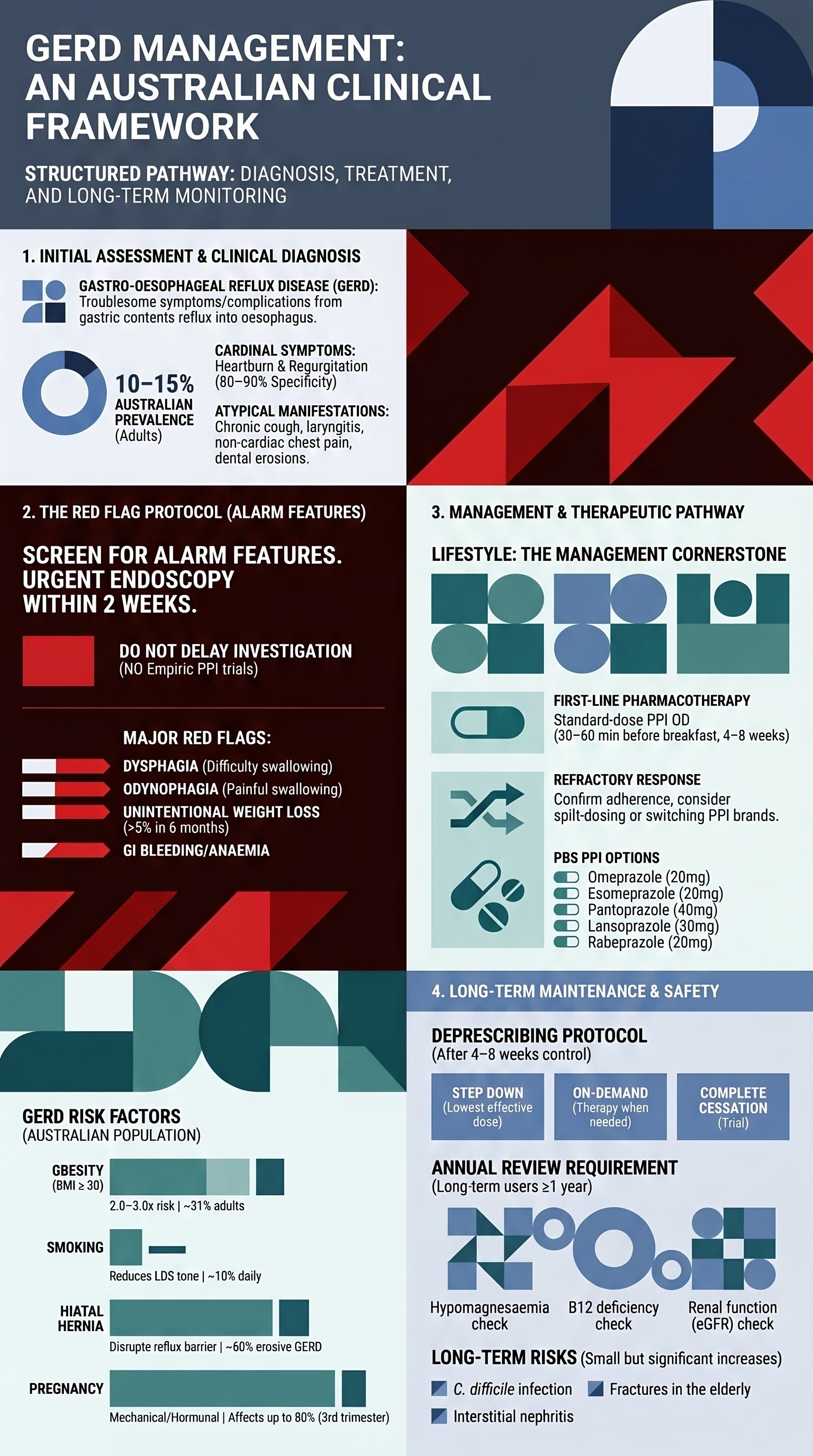
- Gastro-oesophageal reflux disease (GERD) is defined as troublesome symptoms or complications resulting from reflux of gastric contents into the oesophagus, affecting approximately 10–15% of Australian adults.
- Typical symptoms include heartburn and regurgitation; a clinical diagnosis can be made confidently when these are the presenting complaint and no alarm features are present.
- Alarm features — dysphagia, odynophagia, unintentional weight loss, gastrointestinal bleeding, iron-deficiency anaemia, and recurrent vomiting — mandate prompt endoscopy or specialist referral.
- Initial non-pharmacologic management includes weight loss (if BMI ≥ 25), elevation of the head of bed, avoidance of late-night meals, reduction of trigger foods (fatty, spicy, acidic, caffeine, chocolate, mint), and cessation of smoking and excess alcohol.
- First-line acid-suppressive therapy is a proton-pump inhibitor (PPI) once daily taken 30–60 minutes before breakfast for 4–8 weeks; options include omeprazole, esomeprazole, lansoprazole, pantoprazole, or rabeprazole.
- If symptoms persist after an adequate PPI trial, confirm adherence, consider twice-daily dosing (split before breakfast and dinner), or referral for diagnostic testing including oesophageal pH monitoring and manometry.
- Histamine H₂-receptor antagonists (e.g., famotidine) may be used as step-up therapy for mild symptoms or as nocturnal acid breakthrough adjunct, but are less effective than PPIs for moderate–severe GERD.
- Long-term PPI use should be reviewed annually; attempt step-down to the lowest effective dose or on-demand therapy. Long-term PPIs carry small risks of hypomagnesaemia, Clostridioides difficile infection, vitamin B₁₂ deficiency, and fractures in the elderly.
- Endoscopy is recommended for Barrett's oesophagus screening in patients with chronic GERD symptoms (≥ 5 years) plus additional risk factors: male sex, age > 50, central obesity, white race, smoking, or family history of Barrett's/oesophageal adenocarcinoma.
- Anti-reflux surgery (laparoscopic fundoplication) or newer endoscopic therapies may be considered for patients with objectively proven GERD who desire definitive treatment, have medication intolerance, or experience persistent symptoms despite optimised PPI therapy.
- Aboriginal and Torres Strait Islander peoples experience higher rates of Helicobacter pylori infection, delayed diagnosis, and barriers to specialist access; culturally safe care and proactive screening are essential.
Introduction & Australian Epidemiology
Gastro-oesophageal reflux disease (GERD) is a chronic, relapsing condition characterised by reflux of gastric contents into the oesophagus causing troublesome symptoms and/or complications. It is one of the most common gastrointestinal conditions managed in Australian general practice, with an estimated prevalence of 10–15% of adults experiencing at least weekly symptoms and up to 30% reporting monthly episodes.
GERD imposes a substantial healthcare burden in Australia. Direct costs include prescription and over-the-counter proton-pump inhibitor (PPI) use (one of the most frequently dispensed PBS medication classes), endoscopic procedures, and specialist referrals. Indirect costs relate to reduced quality of life, lost productivity, and complications such as erosive oesophagitis, Barrett's oesophagus, and rarely oesophageal adenocarcinoma.
The condition affects all age groups but prevalence increases with age, peaking in the 45–65-year age group. Obesity is a strong and modifiable risk factor, and with rising obesity rates in Australia, GERD-related presentations are anticipated to increase. GERD is slightly more common in males, and male sex is an independent risk factor for erosive disease and Barrett's oesophagus.
Key Risk Factors in the Australian Context
| Risk Factor | Details | Australian Relevance |
|---|---|---|
| Obesity (BMI ≥ 30) | OR 2.0–3.0 for GERD symptoms vs normal weight | ~31% of Australian adults are obese (ABS 2022) |
| Smoking | Reduces lower oesophageal sphincter (LOS) tone | ~10% daily smoking prevalence nationally |
| Hiatal hernia | Disrupts anti-reflux barrier; found in ~60% of erosive GERD | Increases with age; common incidental finding |
| Pregnancy | Mechanical and hormonal; affects up to 80% in 3rd trimester | ~300,000 pregnancies/year nationally |
| Medications | CCBs, nitrates, anticholinergics, NSAIDs, bisphosphonates | Widely prescribed in elderly populations |
| Connective tissue disease | Scleroderma — severe dysmotility and reflux | Specialist rheumatology co-management needed |
Typical Symptoms & Initial Diagnosis
GERD diagnosis is primarily clinical, based on a characteristic symptom history. The two cardinal symptoms are heartburn (a retrosternal burning sensation rising from the epigastrium towards the throat) and regurgitation (the effortless return of gastric contents into the pharynx or mouth). When these are the predominant presenting features and no alarm features are present, the clinician can make a presumptive diagnosis of GERD with high specificity (approximately 80–90%).
Typical Symptoms
- Heartburn: Retrosternal burning, often postprandial, worse when supine or bending over; relieved by antacids or acid suppression.
- Regurgitation: Effortless return of sour or bitter gastric contents, often worse at night or after large meals.
- Epigastric pain or discomfort: May overlap with functional dyspepsia (Rome IV criteria should be applied if symptoms are not typical).
- Water brash: Sudden hypersalivation during reflux episodes (less common).
Atypical / Extra-Oesophageal Symptoms
GERD may present with or contribute to extra-oesophageal symptoms. Causation is harder to establish and empiric PPI trials are longer (8–12 weeks, often twice-daily dosing). These include:
- Chronic cough (particularly nocturnal)
- Laryngitis, hoarseness, globus sensation
- Non-cardiac chest pain
- Worsening asthma symptoms
- Dental erosions (dental referral may be first presentation)
Diagnostic Approach
Differentiating GERD from Mimics
| Condition | Key Distinguishing Features | Diagnostic Approach |
|---|---|---|
| Functional dyspepsia (Rome IV) | Epigastric burning/pain, early satiety, postprandial fullness without heartburn/regurgitation | Clinical criteria; H. pylori test-and-treat; endoscopy if alarm features |
| Eosinophilic oesophagitis | Young male, dysphagia, food bolus obstruction, atopic history, PPI non-response | Endoscopy with biopsies (≥ 15 eos/HPF) |
| Cardiac chest pain | Exertional, associated dyspnoea/diaphoresis, risk factors for IHD | ECG, troponin, cardiology referral |
| Peptic ulcer disease | Epigastric pain, nocturnal, relieved by food or antacids; NSAID use | Endoscopy; H. pylori testing |
| Gastroparesis | Nausea, vomiting, early satiety, bloating; diabetic or post-surgical | Gastric emptying scintigraphy |
Lifestyle & Non-Pharmacologic Therapy
Lifestyle modification is the cornerstone of GERD management and should be recommended to all patients, whether as sole therapy for mild disease or as adjunctive measures alongside pharmacologic treatment. The evidence base for individual interventions varies, but the cumulative effect of multiple modifications is clinically meaningful.
- Weight loss: Highest-quality evidence; a 10% reduction in body weight significantly decreases reflux episodes. OR for GERD symptoms drops from ~2.5 to ~1.3 with weight normalisation. Essential advice for overweight/obese patients (BMI ≥ 25).
- Head-of-bed elevation: Raise the head of bed by 15–20 cm using bed blocks or a wedge pillow (extra pillows alone are insufficient). Reduces nocturnal reflux, acid clearance time, and symptom severity.
- Avoidance of late meals: No food intake within 2–3 hours of lying down. Late-night eating increases nocturnal oesophageal acid exposure.
- Smoking cessation: Reduces LOS relaxation frequency, improves oesophageal clearance, and has general health benefits. Refer to Quitline (13 7848) or GP management plan.
- Alcohol reduction: Alcohol directly irritates oesophageal mucosa, increases acid secretion, and reduces LOS tone. Limit to ≤ 10 standard drinks/week per NHMRC guidelines.
- Dietary modification: Individual trigger avoidance; common triggers include fatty/fried foods, spicy foods, citrus, tomato, chocolate, mint, caffeine, carbonated beverages. Evidence for universal restriction is limited — patient-specific triggers should be identified through a food diary.
- Left lateral decubitus sleeping: Anatomically reduces reflux compared to right lateral or supine position.
Medication Review in GERD
Medications that may exacerbate GERD and should be reviewed or substituted where clinically appropriate:
| Drug Class | Mechanism of Worsening | Alternative / Action |
|---|---|---|
| Calcium-channel blockers (e.g., amlodipine) | Reduce LOS tone | Consider ARB/ACEi if clinically appropriate |
| Nitrates (GTN, isosorbide) | Reduce LOS tone | Often unavoidable; counsel and increase PPI |
| NSAIDs / aspirin | Mucosal irritation, direct oesophageal injury | Use with food and water; consider paracetamol or topical NSAIDs; co-prescribe PPI if ongoing NSAID use |
| Anticholinergics (e.g., oxybutynin) | Reduce LOS tone, impair motility | Review indication; use lowest effective dose |
| Bisphosphonates (alendronate) | Direct oesophageal mucosal injury | Ensure strict upright posture and water intake; consider denosumab as alternative |
| Theophylline | Reduces LOS tone | Consider alternative bronchodilators |
Acid-Suppressive Therapy
Pharmacologic acid suppression is the mainstay of GERD treatment. Proton-pump inhibitors (PPIs) are the most effective class, achieving symptom relief in 70–80% of patients with erosive oesophagitis and 50–60% with non-erosive reflux disease (NERD). Treatment strategy should follow a step-up (for mild disease) or step-down (for severe disease) approach.
Pharmacologic Step-Up Approach
Proton-Pump Inhibitors — Australian PBS Options
PPI Prescribing Pearls
- Timing is critical: Take 30–60 minutes before a meal (ideally breakfast) for maximal acid suppression. Food activates parietal cells, and PPIs bind only to active proton pumps.
- If once-daily PPI insufficient: Split dose — half before breakfast, half before dinner (superior to double-dose at once for 24-hour pH control).
- PPI–drug interactions: Reduced absorption of clopidogrel (omeprazole > pantoprazole — use pantoprazole if combination required); increased methotrexate levels; reduced absorption of azole antifungals, iron, and B₁₂.
- Refractory symptoms: Ensure adherence, correct timing, and exclude functional heartburn (PPI non-response in up to 30–40%). Consider ambulatory pH monitoring off therapy (MBS item 12203).
Alarm Features & Atypical Symptoms
Certain clinical features should prompt urgent investigation rather than empirical treatment. These alarm features may indicate complications of GERD (strictures, Barrett's oesophagus, adenocarcinoma) or an alternative serious diagnosis.
Alarm Features Requiring Endoscopy
Atypical / Extra-Oesophageal Manifestations
Establishing GERD as the cause of extra-oesophageal symptoms is challenging because the relationship is often associative rather than causative. Key considerations:
| Manifestation | Approach | Notes |
|---|---|---|
| Chronic cough | Exclude asthma, post-nasal drip, ACEi use, smoking. Empiric twice-daily PPI for 8–12 weeks. If no response, 24-hr pH monitoring. | GERD accounts for ~25% of chronic cough referrals |
| Laryngopharyngeal reflux (LPR) | Hoarseness, globus, throat clearing. Twice-daily PPI for 8–12 weeks. ENT referral for laryngoscopy. | PPI response rate lower (~30%) than typical GERD; other causes common |
| Non-cardiac chest pain | Must exclude cardiac causes first (ECG, troponin, exercise stress test). Then empiric PPI trial for 8 weeks. | GERD accounts for ~30–60% of non-cardiac chest pain |
| Asthma exacerbation | Optimise asthma therapy first. Add PPI if nocturnal symptoms or acid taste. Consider pH monitoring. | Reflux may trigger bronchospasm via vagal reflex; PPI benefit modest |
| Dental erosions | Dental referral. Identify GERD vs bulimia vs dietary acid. PPI therapy + dental management. | Often first noted by dentist; check for eating disorders |
Barrett's Oesophagus Screening
Barrett's oesophagus is a metaplastic change in the distal oesophageal epithelium from squamous to intestinal-type columnar epithelium. It is a precursor for oesophageal adenocarcinoma (annual progression rate ~0.5%). Screening upper endoscopy is recommended in patients with chronic GERD (≥ 5 years) who have additional risk factors:
- Male sex
- Age ≥ 50 years
- Central (truncal) obesity (waist circumference > 102 cm men, > 88 cm women)
- White/Caucasian ethnicity
- Smoking history (current or former)
- Family history of Barrett's oesophagus or oesophageal adenocarcinoma (first-degree relative)
If Barrett's oesophagus is confirmed, surveillance intervals are determined by the length of the Barrett's segment and the presence/absence of dysplasia, per BSG/AGA guidelines. Referral to a gastroenterologist with expertise in Barrett's surveillance is recommended.
Long-Term Management & Referral
GERD is a chronic relapsing condition. Many patients require long-term acid suppression, but the goal should be the lowest effective dose for the shortest necessary duration. Regular review is essential to avoid indefinite PPI use without clear indication.
PPI Step-Down and Deprescribing Protocol
Indications for Long-Term PPI
Some patients have a genuine ongoing need for maintenance PPI therapy. Acceptable indications for long-term use include:
- Severe erosive oesophagitis (LA grade C/D) with relapse upon PPI cessation
- Confirmed Barrett's oesophagus (PPI may reduce progression risk)
- Peptic stricture requiring endoscopic dilatation (prevent recurrence)
- Patients on chronic anticoagulation, antiplatelet therapy, or corticosteroids with a history of peptic ulcer disease
- Zollinger-Ellison syndrome (high-dose PPI; specialist-managed)
Risks of Long-Term PPI Use
Indications for Gastroenterology Referral
| Indication | Urgency | MBS Item (if applicable) |
|---|---|---|
| Alarm features (dysphagia, bleeding, weight loss) | Urgent (category 2) — within 2 weeks | Endoscopy: MBS 30473 |
| PPI non-response (confirmed adherence, adequate trial, ≥ 8 weeks twice-daily) | Semi-urgent (category 3) | pH monitoring: MBS 12203; Manometry: MBS 12213 |
| Screening endoscopy for Barrett's (chronic GERD + risk factors) | Routine (category 3–4) | MBS 30473 |
| Confirmed Barrett's oesophagus — surveillance | Per dysplasia status (1–3 years) | MBS 30473 |
| Surgical referral for anti-reflux surgery | Routine — after objective GERD confirmation | Laparoscopic fundoplication: MBS 31575 |
| Recurrent peptic stricture | Semi-urgent | Endoscopic dilatation: MBS 30479 |
Anti-Reflux Surgery
Laparoscopic fundoplication (Nissen or Toupet) is the standard surgical intervention for GERD. It is indicated when:
- Objectively proven GERD (pH study positive, erosive oesophagitis, or Barrett's) with inadequate symptom control despite optimised PPI therapy
- Patient preference for definitive treatment over lifelong medication
- Medication intolerance or significant side-effects
- Large hiatal hernia with volume reflux or aspiration risk
- Young patients wishing to avoid decades of PPI use
Pre-operative assessment requires upper endoscopy, oesophageal manometry (to exclude achalasia and assess motility), and 24-hour pH monitoring (to confirm pathologic reflux). Patients should be counselled that ~20% resume PPI therapy within 10 years post-surgery, and side-effects include dysphagia (10–15% early), gas-bloat syndrome, and inability to vomit effectively.
Newer endoscopic therapies (transoral incisionless fundoplication [TIF], magnetic sphincter augmentation [LINX®]) are available in select Australian centres. Evidence is growing but long-term outcomes are less established than for laparoscopic fundoplication.
Annual Long-Term PPI Review Checklist
- ☐ Is the indication for ongoing PPI still valid?
- ☐ Attempt step-down or on-demand therapy if no high-risk indication
- ☐ Check serum magnesium (if ≥ 1 year use)
- ☐ Check vitamin B₁₂ (especially elderly)
- ☐ Check eGFR / renal function
- ☐ Ensure adequate calcium and vitamin D intake (elderly, fracture risk)
- ☐ Review concurrent medications for interactions
- ☐ Document lowest effective dose and plan for further deprescribing
Special Populations
Pregnancy
Paediatrics
Elderly (≥ 65 years)
Renal Impairment
Hepatic Impairment
Immunocompromised
Aboriginal and Torres Strait Islander Health Considerations
Quick Reference: GERD Management Summary
📚 References
- 1. Katz PO, Dunbar KB, Schnoll-Sussman FH, et al. ACG Clinical Guideline for the Diagnosis and Management of Gastroesophageal Reflux Disease. Am J Gastroenterol. 2022;117(1):27–56.
- 2. Gyawali CP, Kahrilas PJ, Savarino E, et al. Modern diagnosis of GERD: the Lyon Consensus. Gut. 2018;67(7):1351–1362.
- 3. National Institute for Health and Care Excellence (NICE). Gastro-oesophageal reflux disease and dyspepsia in adults: investigation and management. Clinical guideline CG184. Updated 2022.
- 4. World Gastroenterology Organisation (WGO). Global Guideline — Gastroesophageal Reflux Disease. Updated 2022.
- 5. Australian Institute of Health and Welfare (AIHW). Australia's Health 2022: Data insights. Canberra: AIHW; 2022.
- 6. Royal Australian College of General Practitioners (RACGP). Guidelines for preventive activities in general practice (Red Book). 9th edition. Melbourne: RACGP; 2016 (updated 2023).
- 7. Eusebi LH, Ratnakumaran R, Yuan Y, et al. Global prevalence of, and risk factors for, gastro-oesophageal reflux disease: a meta-analysis. Gut. 2018;67(7):1262–1272.
- 8. Shaheen NJ, Falk GW, Iyer PG, et al. Diagnosis and Management of Barrett's Esophagus: An Updated ACG Guideline. Am J Gastroenterol. 2022;117(4):559–587.
- 9. NHMRC. Australian Clinical Practice Guidelines for the Management of Acute Gastroenteritis. Canberra: NHMRC; 2023.
- 10. Maret-Ouda J, Markar SR, Lagergren J. Gastroesophageal Reflux Disease: A Review. JAMA. 2020;324(24):2536–2547.
- 11. Farrell B, Pottie K, Thompson W, et al. Deprescribing proton pump inhibitors: Evidence-based clinical practice guideline. Can Fam Physician. 2017;63(5):354–364.
- 12. Australian Bureau of Statistics (ABS). National Health Survey: First Results, 2022. Canberra: ABS; 2023.
- 13. RHDAustralia (RACP). Recommendations for Clinical Management of Helicobacter pylori Infection in Aboriginal and Torres Strait Islander Populations. Darwin: RHDAustralia; 2021.
- 14. Fitzgerald RC, di Pietro M, Ragunath K, et al. British Society of Gastroenterology guidelines on the diagnosis and management of Barrett's oesophagus. Gut. 2014;63(1):7–42.
- 15. Lundell L, Miettinen P, Myrvold HE, et al. Comparison of outcomes twelve years after antireflux surgery or omeprazole maintenance therapy for reflux esophagitis. Clin Gastroenterol Hepatol. 2009;7(12):1292–1298.