📋 Key Information Summary
- Hepatitis D (HDV) is an incomplete RNA virus that requires hepatitis B virus (HBV) co-infection to replicate — test all HBsAg-positive patients for anti-HDV at least once during their clinical course.
- Two patterns: co-infection (simultaneous acute HBV + HDV — usually self-limiting) vs superinfection (pre-existing chronic HBV acquiring HDV — high chronicity rate >80%, accelerated fibrosis, rapid cirrhosis).
- HDV accelerates liver disease progression 3–5-fold compared with HBV alone; it is the most severe form of chronic viral hepatitis.
- Treatment options for HDV: bulevirtide (entry inhibitor, PBS Authority Required), pegylated interferon alfa-2a (48-week course), plus ongoing HBV nucleos(t)ide antiviral (entecavir or tenofovir) — all regimens require specialist management.
- Hepatitis E (HEV) genotypes 1 and 2 are water-borne, endemic in South Asia and sub-Saharan Africa; genotype 1 causes severe disease in pregnancy with mortality up to 25 % (fulminant hepatic failure).
- HEV genotypes 3 and 4 are zoonotic (undercooked pork, game meat), the dominant genotypes in Australia; genotype 3 can cause chronic infection in immunocompromised hosts (solid-organ transplant, haematopoietic stem-cell transplant, advanced HIV).
- Diagnose HEV with IgM anti-HEV (acute) and HEV RNA PCR (chronic or immunocompromised); genotype 3 chronic HEV is treated with ribavirin (600 mg PO daily × 12 weeks; PBS Authority Required).
- For immunocompromised patients with chronic HEV, first reduce immunosuppression before starting ribavirin.
- Hepatitis G virus (GBV-C) is a pegivirus — a common bloodborne virus with no proven causal link to clinical hepatitis; routine testing is not recommended.
- GBV-C co-infection in HIV-positive individuals is associated with slower disease progression and reduced mortality — an immunomodulatory effect, not a therapeutic indication.
- Aboriginal and Torres Strait Islander peoples have higher HBV prevalence (and therefore higher HDV risk); ensure culturally safe testing, notification to jurisdictional health departments, and engagement with local Aboriginal Community Controlled Health Organisations (ACCHOs).
- All three hepatitis viruses require mandatory notification to state/territory health departments under Australian public-health legislation.
- Travellers to endemic regions should be counselled on safe water and food hygiene (HEV D/E prevention); HBV vaccination remains the cornerstone of HDV prevention.
Introduction & Australian Epidemiology
Beyond hepatitis A, B, and C, three additional hepatitis viruses — D, E, and G — contribute to liver disease in Australia, though each has a distinct epidemiology, clinical significance, and management paradigm. Understanding these agents is essential for comprehensive viral-hepatitis care in primary and specialist settings.
Hepatitis D (HDV)
HDV is a small, defective RNA virus (genus Deltavirus) that requires the HBV surface antigen (HBsAg) for assembly and transmission. Australia has a low but non-trivial prevalence of HDV, estimated at 1–5 % of HBsAg carriers. Risk groups include people who inject drugs (PWID), migrants from HDV-endemic regions (Mongolia, Central Africa, Eastern Mediterranean, Amazon basin), and men who have sex with men (MSM). In 2022–23, Australian sentinel surveillance identified increasing HDV awareness but persistent under-testing.
Hepatitis E (HEV)
HEV is the most common cause of acute viral hepatitis worldwide. In Australia, autochthonous genotype 3 infections from undercooked pork products (including pork liver pâté, salami, and wild boar) are increasingly recognised. Imported genotype 1/2 infections occur in returned travellers from South and South-East Asia. HEV notification rates have risen from <20 per year (pre-2010) to >100 per year nationally, reflecting improved diagnostics.
Hepatitis G (GBV-C)
GBV-C is a flavivirus-related pegivirus found in 1–4 % of Australian blood donors. It is parenterally transmitted and shares risk factors with HIV and hepatitis C virus (HCV). Despite its name, GBV-C has never been convincingly shown to cause hepatitis in humans. It is primarily of academic interest, though its interaction with HIV has generated significant research attention.
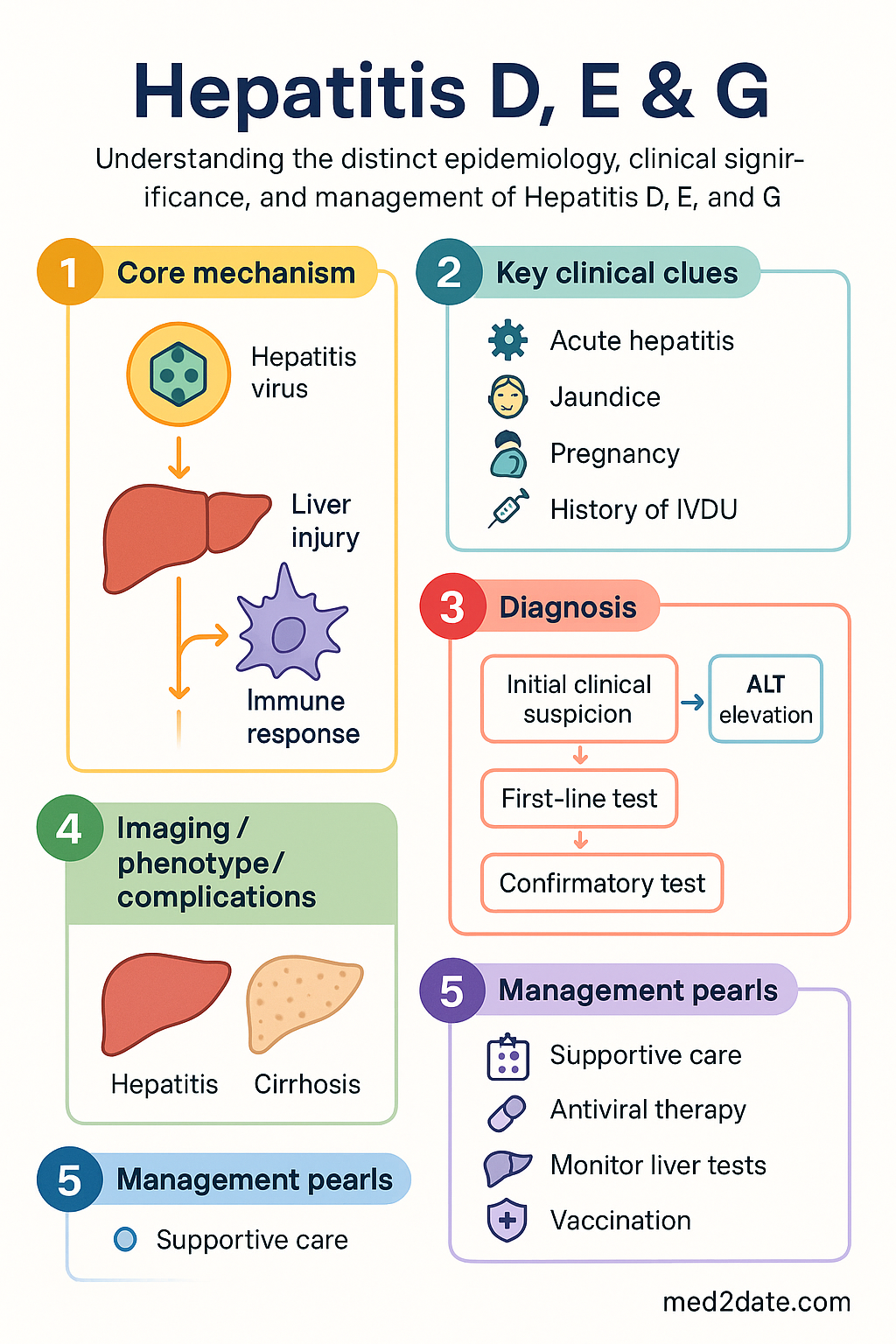
Hepatitis D
Virology & Requirement for HBV Co-infection
HDV is a 36 nm, single-stranded, circular RNA virus with an envelope derived from HBV surface antigens. It cannot replicate independently — it hijacks HBsAg production for virion assembly. Consequently, HDV infection only occurs in individuals who are HBsAg-positive, either as a simultaneous co-infection or as a superinfection of pre-existing chronic HBV.
Co-infection vs Superinfection
| Feature | Co-infection (acute HBV + HDV) | Superinfection (chronic HBV + new HDV) |
|---|---|---|
| Setting | Simultaneous acute infection with both viruses in a previously HBV-naïve patient | Pre-existing chronic HBV acquires HDV |
| Clinical course | Usually biphasic hepatitis; majority (>90 %) resolve both HBV and HDV spontaneously | Acute hepatitis flare; chronicity develops in >80 % of cases |
| Fulminant risk | 1–3 % (higher than HBV alone) | 5–10 % during acute flare |
| Chronicity | <5 % | >80 % |
| Fibrosis progression | If chronic: accelerated (3–5 × HBV alone) | Rapid — cirrhosis within 5–10 years in 70–80 % if untreated |
| HCC risk | Increased if chronic | Significantly elevated; surveillance every 6 months with AFP + ultrasound |
Diagnostic Pathway
Treatment of Hepatitis D
Treatment of HDV is complex and should be managed by a hepatologist or infectious-disease specialist experienced in viral hepatitis. Three therapeutic strategies are available in Australia:
Monitoring During HDV Treatment
- ALT and quantitative HDV RNA at weeks 12, 24, 48, and then every 24 weeks.
- HBV DNA every 12–24 weeks (ensure continued HBV suppression).
- FBC, thyroid function, and psychiatric screening (monthly for first 3 months) if on peg-IFN.
- Liver elastography (FibroScan®) annually to monitor fibrosis regression.
- HCC surveillance (AFP + liver ultrasound every 6 months) in all patients with established cirrhosis.
Prevention of Hepatitis D
- HBV vaccination is the most effective prevention — HDV cannot establish infection without HBV.
- Ensure all HBsAg-negative contacts of HDV patients are vaccinated against HBV.
- Harm-reduction counselling for PWID: needle-syringe programmes, safe injecting education.
- Screen blood and organ donations for HBsAg (already standard in Australian Blood Service).
Hepatitis E
Virology & Genotypes
HEV is a single-stranded, positive-sense RNA virus (family Hepeviridae). Four genotypes of clinical significance are recognised:
| Genotype | Transmission | Endemic regions | Key clinical features |
|---|---|---|---|
| 1 | Faecal–oral (contaminated water) | South Asia, North/West Africa | Large outbreaks; severe in pregnancy (mortality up to 25 %); self-limiting in immunocompetent |
| 2 | Faecal–oral (contaminated water) | Central America, West Africa | Similar to genotype 1; outbreaks in displaced populations |
| 3 | Zoonotic (pork, game meat) | Europe, Australia, Japan, USA | Predominant genotype in Australia; usually self-limiting; chronic in immunocompromised |
| 4 | Zoonotic (pork) | East/South-East Asia | Less common in Australia; sporadic; older-age predominance; chronic infection rare |
Clinical Presentation
In immunocompetent adults, HEV genotype 3 typically causes a self-limiting acute hepatitis with jaundice, malaise, nausea, and right-upper-quadrant discomfort. The incubation period is 2–8 weeks. Most patients recover fully within 4–6 weeks without antiviral therapy.
Chronic HEV in Immunocompromised Patients
Chronic HEV (HEV RNA positivity >3 months) is recognised almost exclusively with genotype 3 and occurs in:
- Solid-organ transplant recipients on calcineurin inhibitors (tacrolimus, ciclosporin) — prevalence 0.5–2 % in European/Australian cohorts.
- Haematopoietic stem-cell transplant recipients.
- Patients with advanced HIV (CD4 <200 cells/µL).
- Patients on rituximab or other anti-CD20 therapies.
Chronic HEV can lead to progressive hepatic fibrosis and cirrhosis within 2–3 years if untreated. Extrahepatic manifestations include neurological disease (neuralgic amyotrophy, Guillain-Barré syndrome, encephalitis), membranous nephropathy, and haematological cytopenias.
Diagnosis
Treatment
Prevention of Hepatitis E
- Food safety: cook pork and game meat thoroughly (core temperature ≥70 °C); avoid raw/undercooked pork liver, salami, and wild boar.
- Water safety: drink treated/boiled water when travelling to endemic regions (South Asia, Africa).
- No licensed HEV vaccine is available in Australia (HEV 239 vaccine licensed in China only).
- Screen donated blood and organs — Australian Red Cross Lifeblood introduced HEV screening (minipool NAT) in 2023.
- Counsel immunocompromised patients (especially transplant recipients) to avoid raw/undercooked pork products.
Hepatitis G (GBV-C / HGV)
Virology
Hepatitis G virus — also known as GB virus C (GBV-C) — is a single-stranded RNA virus of the genus Pegivirus within the family Flaviviridae. Despite its historical name, GBV-C is not a hepatotropic virus and has never been convincingly demonstrated to cause hepatitis or any other liver disease in humans.
Epidemiology
- GBV-C is a common bloodborne virus; seroprevalence is 1–4 % in Australian blood donors and up to 15–20 % in high-risk populations (PWID, haemodialysis patients, recipients of multiple transfusions).
- Transmission routes: parenteral (blood products, injecting drug use), sexual, and vertical (mother-to-child).
- Co-infection with HCV is common (20–30 % of HCV-positive individuals) and with HIV (15–40 %).
- Persistent viraemia occurs in ~25 % of infected individuals; the remainder clear the virus spontaneously.
Clinical Significance
- No association with acute or chronic hepatitis
- No association with hepatocellular carcinoma
- No association with cirrhosis or liver fibrosis
- Does not alter the course of HBV or HCV co-infection in a clinically meaningful way
- GBV-C co-infection in HIV-positive individuals is associated with slower CD4 decline, reduced HIV viral load, and lower mortality — a paradoxical protective effect
- Proposed mechanisms: down-regulation of HIV co-receptors (CCR5, CXCR4), modulation of cytokine milieu, T-cell homeostasis
- Clinical application: none at present — GBV-C is not recommended as a therapeutic agent for HIV
- GBV-C clearance (spontaneous or treatment-induced) in HIV co-infected patients may paradoxically worsen HIV outcomes — a research observation, not a clinical recommendation
Testing Recommendations
Management
No treatment is indicated for GBV-C infection. No antiviral therapy has demonstrated efficacy against GBV-C, and none is recommended. Patients found to have incidental GBV-C viraemia should be reassured that it is a benign finding and does not require follow-up, treatment, or referral.
Special Populations
Aboriginal and Torres Strait Islander Health Considerations
📚 References
- 1. European Association for the Study of the Liver (EASL). EASL 2023 Clinical Practice Guidelines on the management of hepatitis delta virus. J Hepatol. 2023;79(2):420–443.
- 2. World Health Organization (WHO). Hepatitis D — fact sheet. Geneva: WHO; 2024. Available from: https://www.who.int/news-room/fact-sheets/detail/hepatitis-d
- 3. Wedemeyer H, Negro F. Hepatitis D virus — a virus at the crossroads. N Engl J Med. 2023;389(2):153–162.
- 4. Bluemel J, Goldbeck C, Burchard G, et al. Bulevirtide for chronic hepatitis D — updated data from the phase 3 MYR301 trial. Lancet Infect Dis. 2024;24(1):45–55.
- 5. Kamar N, Izopet J, Pavio N, et al. Hepatitis E virus infection. Nat Rev Dis Primers. 2017;3:17086.
- 6. Horvatits T, Ozga AK, Westhölter D, et al. Hepatitis E seroprevalence in the Americas — a systematic review and meta-analysis. Liver Int. 2018;38(10):1715–1726.
- 7. > Dalton HR, Kamar N, van Eijk JJ, et al. Hepatitis E virus and neurological injury. Nat Rev Neurol. 2016;12(2):77–85.
- 8. Australian Government Department of Health and Aged Care. National Notifiable Diseases Surveillance System — hepatitis E notification data. Canberra: DoHAC; 2024.
- 9. Muerhoff AS, Leary TP, Simons JN, et al. Genomic organization of GB viruses A and B and relationship to hepatitis G virus. J Virol. 1995;69(9):5621–5630.
- 10. Schwarze-Zander C, Blackard JT, Rockstroh JK. Role of GB virus C in modulating HIV disease. . 2012;10(5):563–572.
- 11. Xiang J, Wünschmann S, Diekema DJ, et al. Effect of coinfection with GB virus C on survival among patients with HIV infection. N Engl J Med. 2001;345(10):707–714.
- 12. Australian Institute of Health and Welfare (AIHW). Aboriginal and Torres Strait Islander health performance framework — hepatitis B. Canberra: AIHW; 2023.
- 13. The Kirby Institute. HIV, viral hepatitis and sexually transmissible infections in Australia — annual surveillance report. Sydney: UNSW; 2023.
- 14. RHDAustralia (NT Department of Health and Menzies School of Health Research). Australian guidelines for the management of hepatitis B in Aboriginal and Torres Strait Islander peoples. Darwin: RHDAustralia; 2022.
- 15. Australian Commission on Safety and Quality in Health Care (ACSQHC). National Safety and Quality Health Service Standards. 2nd ed. Sydney: ACSQHC; 2021.