📋 Key Information Summary
- GORD affects ~15–20% of Australian adults; standard therapy is once-daily PPI (e.g. esomeprazole 20 mg) for 4–8 weeks, stepping up to BD dosing before investigating refractory symptoms with 96-hour wireless pH or pH-impedance monitoring off or on therapy.
- Achalasia is classified by HRM (Chicago v4.0) into types I, II, and III; type II has the best treatment response; first-line therapy is POEM or laparoscopic Heller myotomy + Dor fundoplication.
- Oesophageal cancer (adenocarcinoma and SCC) remains a leading cause of cancer death in Australia; early Barrett's detection and endoscopic surveillance reduce mortality.
- Barrett's oesophagus with dysplasia should be referred for endoscopic eradication therapy (radiofrequency ablation ± EMR/ESD); low-grade dysplasia RFA reduces progression to cancer by ~50%.
- Eosinophilic oesophagitis (EoE) prevalence in Australia is rising (~1% of adults); swallowed topical corticosteroids (budesonide oral viscous slurry or fluticasone MDI swallowed) are first-line.
- Aboriginal and Torres Strait Islander peoples have higher rates of oesophageal SCC, often presenting at advanced stage; culturally safe endoscopy access and GP-initiated referral pathways are essential.
- Para-oesophageal hiatus hernia with volvulus is a surgical emergency requiring urgent repair; sliding hiatus hernias are managed conservatively unless complicated.
- Functional chest pain mimicking cardiac disease should prompt oesophageal workup (HRM, pH monitoring) only after cardiac causes excluded; neuromodulators (low-dose TCAs or SSRIs) may help.
- Oesophageal strictures are dilated using through-the-scope balloon or Savary-Gilliard bougies; peptic strictures require ongoing PPI to prevent recurrence.
- Neoadjuvant chemoradiotherapy (CROSS regimen: carboplatin/paclitaxel + 41.4 Gy) is standard for locally advanced oesophageal cancer; perioperative FLOT (docetaxel/oxaliplatin/leucovorin/fluorouracil) is preferred for junctional adenocarcinoma.
- POEM (per-oral endoscopic myotomy) has comparable efficacy to Heller myotomy for achalasia with shorter hospital stays; both require gastroenterology/surgery subspecialty referral.
- Oesophageal manometry (HRM) and pH-impedance studies are available at major tertiary centres (MBS item 12207/12208); GPs can initiate empirical PPI trials before referral.
- Extra-oesophageal GORD (chronic cough, laryngitis, asthma) requires prolonged PPI trial (≥8 weeks) and often multidisciplinary assessment (ENT, respiratory, gastroenterology).
🎧 Audio Brief
Introduction & Australian Epidemiology
Oesophageal disorders encompass a broad spectrum of conditions ranging from the extremely common gastro-oesophageal reflux disease (GORD) to life-threatening malignancies. In Australia, oesophageal diseases contribute significantly to morbidity, healthcare utilisation, and mortality. The AIHW estimates that oesophageal cancer accounts for approximately 1,500 new diagnoses and over 1,300 deaths annually, while GORD-related presentations constitute a substantial proportion of gastroenterology referrals.
Australia's diverse population—including significant Aboriginal and Torres Strait Islander communities—requires culturally safe and geographically accessible diagnostic and therapeutic pathways. High-resolution manometry (HRM), pH-impedance monitoring, and advanced endoscopic therapies (POEM, ESD) are predominantly available at tertiary centres, highlighting the importance of robust primary care–specialist referral networks.
This guideline covers the major oesophageal disorders encountered in Australian clinical practice: GORD and Barrett's oesophagus, achalasia, other motility disorders, structural lesions, and oesophageal malignancy, with emphasis on evidence-based management aligned with Australian and international standards.
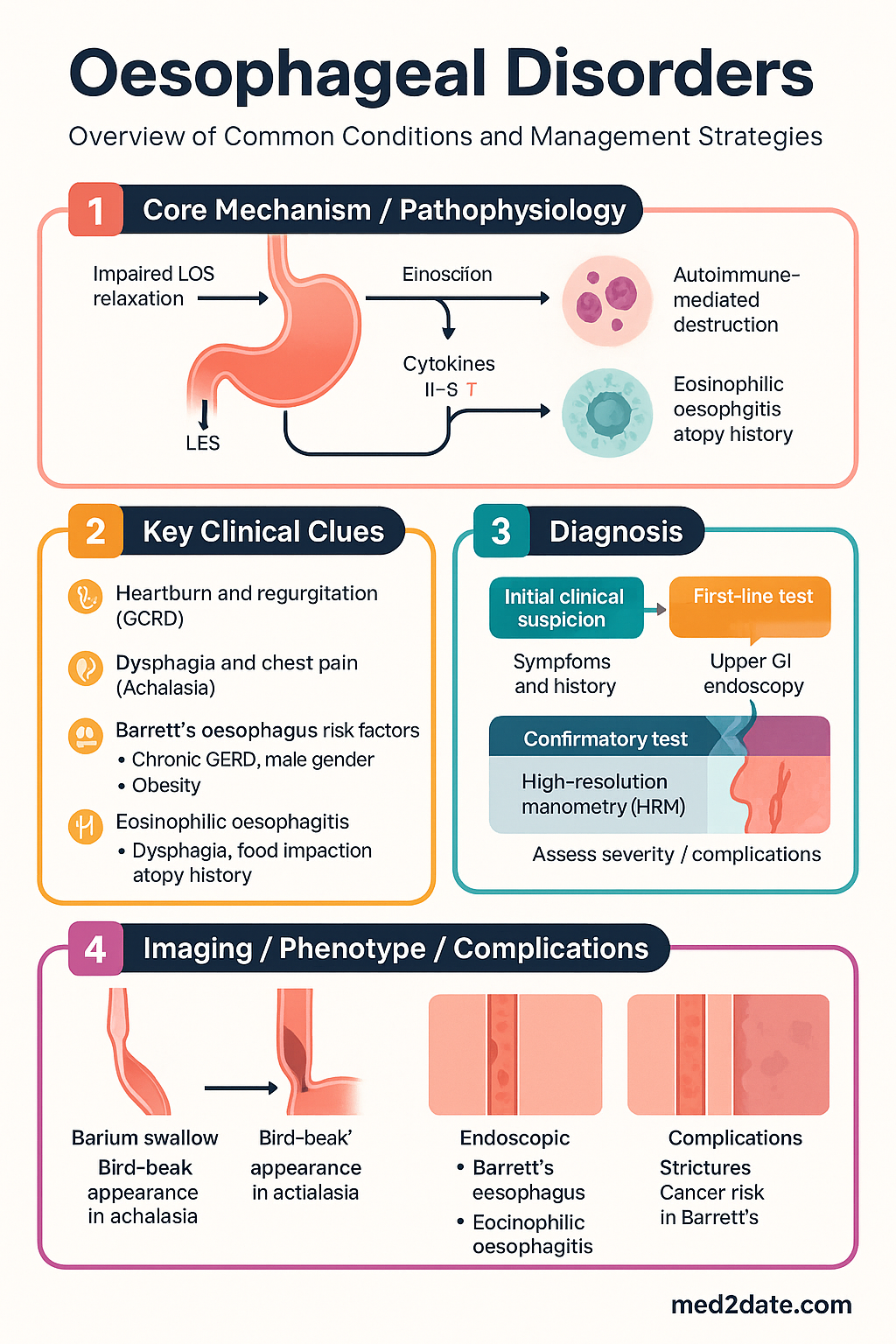
Gastro-Oesophageal Reflux Disease (GORD)
PPI Dose Optimisation
Proton pump inhibitors (PPIs) remain the mainstay of GORD therapy. Initial treatment is a once-daily standard-dose PPI taken 30–60 minutes before the first meal for 4–8 weeks. If symptoms persist, step-up to BD dosing is recommended before investigating refractory disease.
Lifestyle Measures
- Weight loss (target BMI <25 kg/m²): strongest evidence-based lifestyle intervention—reduces GORD symptoms by ~40%.
- Elevate head of bed 15–20 cm with bed blocks (not extra pillows).
- Avoid late-night eating; allow ≥3 hours between last meal and recumbency.
- Identify and avoid individual trigger foods (fatty foods, chocolate, caffeine, alcohol, tomatoes, citrus).
- Smoking cessation—reduces lower oesophageal sphincter (LOS) relaxation.
- Review medications that reduce LOS tone: calcium channel blockers, nitrates, benzodiazepines, anticholinergics, theophylline.
Refractory GORD Workup
Refractory GORD is defined as persistent typical or atypical symptoms despite ≥8 weeks of BD PPI therapy with confirmed adherence. Investigation aims to determine whether true acid reflux, non-acid reflux, functional heartburn, or an alternative diagnosis is responsible.
| Investigation | When to Use | Key Findings |
|---|---|---|
| Upper GI endoscopy (OGD) | All patients with alarm features; PPI-refractory symptoms | Oesophagitis (LA grade), Barrett's, stricture, eosinophilic oesophagitis |
| Wireless pH capsule (Bravo™) — off PPI | Confirms pathological acid exposure in suspected GORD before chronic therapy | DeMeester score >14.72 = pathological; >6% total time pH <4 abnormal |
| 24-hour pH-impedance — on PPI | Refractory GORD: distinguishes true non-acid reflux from functional heartburn | Non-acid reflux episodes, symptom association probability (SAP) |
| High-resolution manometry (HRM) | Pre-anti-reflux surgery; suspected motility disorder; refractory dysphagia | LOS pressure, peristaltic integrity, exclude achalasia/DES |
Anti-Reflux Surgery
Surgical intervention is considered when patients have objective evidence of pathological reflux, respond to PPIs but desire to discontinue medication, or have large hiatus hernias contributing to symptoms.
Endoscopic Therapies
Endoscopic anti-reflux therapies are evolving alternatives for selected patients who wish to avoid surgery and long-term PPIs but do not have large hiatus hernias or severe oesophagitis.
| Procedure | Mechanism | Indications & Outcomes |
|---|---|---|
| TIF (Transoral Incisionless Fundoplication) — EsophyX® | Creates partial (270°) fundoplication via serosa-to-serosa plications at GEJ | Hiatal hernia ≤2 cm, LA grade A/B oesophagitis, confirmed pathological reflux. ~70–80% PPI cessation at 3 years. Available at limited Australian centres. |
| Stretta® (Radiofrequency Ablation) | Delivers RF energy to LOS smooth muscle, causing remodelling and increased basal pressure | Mild-moderate GORD, small hiatal hernia, PPI-dependent. Improves symptoms and reduces but does not eliminate PPI use. Limited long-term durability data. Not widely available in Australia. |
| Anti-reflux mucosectomy (ARMS) | Endoscopic mucosal resection at GEJ creates scar tissue narrowing the cardia | Emerging technique; small Australian case series. Evidence base limited. |
Barrett's Oesophagus
Barrett's oesophagus (intestinal metaplasia of the distal oesophagus) affects 1.5–2% of the Australian population. It is the only known precursor to oesophageal adenocarcinoma. Surveillance endoscopy intervals depend on dysplasia status (see table below). All patients with Barrett's should be on long-term PPI therapy.
| Histological Finding | Surveillance Interval | Management |
|---|---|---|
| Non-dysplastic Barrett's | Every 3 years | Continue PPI; endoscopic surveillance |
| Indefinite for dysplasia | Repeat OGD at 6 months, then annual | Optimise PPI; ensure adequate biopsies (Seattle protocol) |
| Low-grade dysplasia (LGD) | Confirm with expert GI pathologist; then 6–12 monthly or treat | RFA recommended (reduces progression ~50%) |
| High-grade dysplasia (HGD) | Treat promptly | Endoscopic eradication: RFA ± EMR/ESD for visible lesions |
| Intramucosal carcinoma (T1a) | Treat promptly | EMR/ESD for staging; if T1a sm0 and well-differentiated → endoscopic Rx. If submucosal invasion (T1b) → surgical discussion. |
Extra-Oesophageal Manifestations of GORD
Extra-oesophageal GORD may present as chronic cough (25–40% of non-smoking, non-ACEi cough), laryngitis/hoarseness, asthma exacerbation, dental erosion, or recurrent otitis media. Diagnosis and management are challenging due to poor symptom correlation with objective reflux testing.
- Empirical BD PPI trial for ≥8 weeks is first-line; if response, attempt step-down.
- If PPI-refractory: 24-hour pH-impedance on PPI and HRM to assess non-acid reflux.
- Multidisciplinary assessment (ENT laryngoscopy, respiratory review, speech pathology) is often required.
- Anti-reflux surgery may be considered if objective reflux confirmed and PPI-responsive.
- Caution: many cases of "reflux laryngitis" are functional or related to laryngeal hypersensitivity (neuropathic) rather than true GORD.
Achalasia
Achalasia is a primary oesophageal motility disorder characterised by impaired LOS relaxation and absent oesophageal peristalsis. Incidence in Australia is approximately 1.6 per 100,000 per year, with a peak in the 30–60 year age group. It is thought to result from autoimmune-mediated destruction of myenteric plexus inhibitory neurons.
High-Resolution Manometry (HRM) — Chicago Classification v4.0
HRM is the gold standard for diagnosing achalasia and classifying it into subtypes, which guides treatment selection and predicts therapeutic response.
| Subtype | HRM Criteria | Prevalence | Treatment Response |
|---|---|---|---|
| Type I (Classic) | 100% failed peristalsis; no pan-oesophageal pressurisation (PEP); IRP >15 mmHg | ~25% | Intermediate—may require more aggressive therapy |
| Type II (Compression) | 100% failed peristalsis; ≥20% PEP; IRP >15 mmHg | ~50% | Best response to all therapies (~90% success with pneumatic dilation) |
| Type III (Spastic) | 100% failed peristalsis; ≥20% premature (spastic) contractions; IRP >15 mmHg | ~25% | POEM preferred (longer myotomy); lower response to pneumatic dilation |
Complementary Testing
- Timed barium swallow: Patient stands upright and swallows 200 mL barium; films at 1, 2, and 5 minutes. Assesses oesophageal emptying, degree of dilatation, and tortuosity (sigmoid oesophagus). Complements HRM for treatment planning.
- Functional luminal imaging probe (FLIP): Measures oesophageal distensibility (compliance) during endoscopy using impedance planimetry. Useful for diagnosing achalasia when HRM is equivocal and for assessing treatment adequacy intra-procedurally (during POEM).
- Upper GI endoscopy: Essential to exclude pseudoachalasia (tumour at GEJ). Findings may include dilated oesophagus, retained food/fluid, tight LOS with resistance, "pop-through" on scope passage.
Treatment Options
Post-Treatment Follow-Up
- Symptom assessment using Eckardt score (dysphagia, regurgitation, chest pain, weight loss) at 3, 6, and 12 months, then annually.
- Repeat timed barium swallow at 3–6 months to assess oesophageal emptying.
- HRM ± FLIP if symptoms recur to assess for treatment failure or recurrent obstruction.
- Endoscopic surveillance every 3–5 years post-achalasia treatment (increased risk of oesophageal SCC, particularly with food stasis and chronic inflammation).
- Post-POEM patients: long-term PPI (esomeprazole 20–40 mg daily) given high rate of silent reflux; consider pH-impedance at 6 months.
- Recurrent symptoms after Heller or POEM: pneumatic dilation is typically first re-intervention; repeat POEM or revision surgery considered case-by-case.
Other Oesophageal Motility Disorders
The Chicago Classification v4.0 identifies several disorders of oesophageal motility beyond achalasia. These are diagnosed by HRM and may present with dysphagia, chest pain, or heartburn-like symptoms.
HRM Interpretation Framework
HRM analysis evaluates: (1) Integrated Relaxation Pressure (IRP) for LOS relaxation; (2) Distal Contractile Integral (DCI) for contraction vigour; (3) Distal Latency (DL) for contraction timing; (4) Peristaltic integrity. An abnormal IRP (>15 mmHg) without achalasia pattern indicates oesophagogastric junction outflow obstruction (EGJOO).
Specific Disorders
| Disorder | HRM Criteria | Clinical Features | Management |
|---|---|---|---|
| Distal Oesophageal Spasm (DES) | IRP normal; ≥20% premature contractions (DL <4.5 s) | Chest pain (may mimic ACS), dysphagia, intermittent | Smooth muscle relaxants (GTN SL, CCBs), neuromodulators (TCA, SSRI); POEM in refractory cases |
| Hypercontractile (Jackhammer) Oesophagus | IRP normal; ≥20% swallows with DCI >8000 mmHg·s·cm | Chest pain, dysphagia; "nutcracker" pattern | CCBs (diltiazem 60–90 mg TDS), nitrates, neuromodulators; POEM if refractory |
| Ineffective Oesophageal Motility (IEM) | IRP normal; ≥50% swallows with DCI <450 mmHg·s·cm (weak/failed peristalsis) | Dysphagia (often mild), regurgitation; associated with GORD, scleroderma, CTD | Treat underlying cause; PPI for reflux; prokinetics (limited efficacy); avoid 360° Nissen before surgery—use partial wrap |
| Oesophagogastric Junction Outflow Obstruction (EGJOO) | IRP elevated (>15 mmHg) but some intact peristalsis present (does not meet achalasia criteria) | Often asymptomatic/incidental; may cause dysphagia | Observation if asymptomatic; if symptomatic → assess with timed barium swallow, FLIP; treat underlying cause (hiatus hernia, eosinophilic oesophagitis); PPI trial; rarely needs Heller/POEM |
Smooth Muscle Relaxants & Neuromodulators
Structural Oesophageal Disorders
Schatzki Ring
A mucosal ring at the squamocolumnar junction (GEJ), often associated with hiatal hernia. Typically presents with intermittent solid-food dysphagia ("steakhouse syndrome"). Incidence increases with age. Usually asymptomatic until the lumen narrows to <13 mm.
- Diagnosis: OGD (visible ring at GEJ) or barium swallow ("ring sign").
- Treatment: Endoscopic bougie or balloon dilation to 16–20 mm. Often requires serial dilations. PPI therapy reduces recurrence (associated with peptic inflammation).
- Electrocautery incisional therapy (ring disruption with needle-knife) for refractory cases.
Oesophageal Webs & Plummer-Vinson Syndrome
Thin mucosal projections typically in the upper (cervical) oesophagus. Plummer-Vinson (Patterson-Kelly) syndrome combines cervical oesophageal webs with iron deficiency anaemia and dysphagia. Rare but clinically significant due to association with hypopharyngeal/upper oesophageal SCC.
- Diagnosis: Barium swallow (thin, shelf-like filling defect) or OGD.
- Treatment: Iron replacement (IV iron if severe); endoscopic dilation or electrocautery incision for symptomatic webs.
- Surveillance: Annual OGD recommended given malignant potential of the web-associated mucosa.
Zenker's Diverticulum
A posterior pharyngo-oesophageal (Killian's dehiscence) pulsion diverticulum. Typically presents in patients >60 years with dysphagia, regurgitation of undigested food, gurgling, halitosis, and aspiration pneumonia. Relatively common in Australian clinical practice.
Treatment options:
- Endoscopic stapling (Dohlman technique): Endoscopic stapler divides the common wall between the diverticulum and oesophageal lumen. Shorter procedure, lower morbidity. Preferred for most patients. Available at major ENT/upper GI centres.
- Flexible endoscopic septotomy: Needle-knife or hook-knife division of the cricopharyngeal bar. No general anaesthesia required. Growing adoption in Australia.
- Open surgical diverticulectomy + cricopharyngeal myotomy: For very large diverticula or failed endoscopic approach. Higher morbidity but definitive.
Hiatus Hernia
Hiatus hernias are classified into four types. Types I (sliding) and II–IV (para-oesophageal/rolling) have different clinical implications and management approaches.
| Type | Mechanism | Clinical Significance | Management |
|---|---|---|---|
| Type I (Sliding) | GEJ migrates into thorax; fundus remains below diaphragm | Most common (~95%); associated with GORD, Barrett's | PPI for GORD symptoms; surgery only for refractory GORD or large hernia with complications |
| Type II (Rolling/Para-oesophageal) | Fundus herniates alongside oesophagus; GEJ remains intra-abdominal | Risk of gastric volvulus, incarceration, strangulation | Surgical repair recommended (laparoscopic reduction + crural repair ± fundoplication) |
| Type III (Mixed) | Both GEJ and fundus above diaphragm (combined sliding + rolling) | Large hernias with GORD + obstructive symptoms | Surgical repair if symptomatic; PPI for GORD component |
| Type IV | Other viscera (colon, spleen) herniate into thorax | Rare; usually large type III with additional organ herniation | Surgical repair |
Oesophageal Strictures
Oesophageal strictures may be benign or malignant. Benign strictures are classified as simple (short, focal, straight) or complex (long, angulated, tortuous, or associated with atherosclerotic ring). Management depends on aetiology.
| Aetiology | Characteristics | Management |
|---|---|---|
| Peptic stricture | Most common; distal oesophagus; associated with chronic GORD, Barrett's | Endoscopic dilation (balloon or bougie) + long-term PPI to prevent recurrence |
| Caustic ingestion | Alkali (drain cleaner) or acid ingestion; oedema → necrosis → fibrosis; long, complex strictures | Acute: NBM, IV fluids, endoscopy within 24 h (if safe). Chronic: serial dilation, stenting, or surgery for refractory |
| Radiation stricture | Post-radiotherapy (head/neck, lung, oesophageal cancer); progressive fibrosis months–years after treatment | Serial dilation; may be refractory; consider stenting for palliation of malignant transformation |
| Anastomotic stricture | Post-oesophagectomy anastomosis; common (up to 40%) | Endoscopic balloon dilation (12–20 mm); serial sessions often needed |
| Eosinophilic oesophagitis | Rings, furrows, white exudates on OGD; ≥15 eos/hpf on biopsy | Swallowed topical corticosteroids; dietary elimination; dilation for fibrostenotic phenotype |
Dilation Techniques
- Through-the-scope (TTS) balloon dilation: Endoscopic balloon catheter passed through the working channel; inflated under direct vision to target diameter (12–20 mm). Preferred for simple peptic and anastomotic strictures. Can be repeated at 2–4 week intervals.
- Savary-Gilliard bougie dilation: Over guidewire, fluoroscopic-guided progressive dilation. Preferred for long or tortuous strictures. Allows dilation to larger calibres (up to 20 mm). Standard at most Australian endoscopy units.
- Self-expandable metal stent (SEMS): For refractory benign strictures or malignant strictures. Covered stents preferred for benign disease (removable). Risk of stent migration, tissue ingrowth, and perforation.
Eosinophilic Oesophagitis (EoE)
EoE is a chronic, immune-mediated oesophageal disease characterised by symptoms of oesophageal dysfunction and ≥15 eosinophils per high-power field on oesophageal biopsy, in the absence of other causes of eosinophilia. Australian prevalence is estimated at ~1% of adults and is rising.
- First-line: Swallowed topical corticosteroids—budesonide oral viscous slurry (1 mg BD, hold in mouth and swallow) or fluticasone propionate MDI (250–500 mcg, puff into mouth and swallow, no inhalation) for 6–8 weeks.
- Dietary elimination: Empiric 6-food elimination diet (dairy, wheat, egg, soy, nuts, fish/seafood) or step-up approach. Allergy testing-guided elimination is less effective.
- Dilation for fibrostenotic phenotype (dysphagia with rings/stricture on OGD): careful balloon or bougie dilation to 12–16 mm.
- Dupilumab (anti-IL-4/13): PBS listed (Authority Required) for moderate-severe EoE in patients ≥12 years who have failed conventional therapy.
Oesophageal Cancer
Oesophageal cancer is the ninth most common cancer in Australia, with approximately 1,500–1,800 new cases diagnosed annually. It carries a poor prognosis with 5-year survival of ~20–25%. Australia has seen a marked increase in adenocarcinoma rates over the past three decades, linked to rising obesity and GORD prevalence, while SCC rates have remained relatively stable.
Adenocarcinoma vs Squamous Cell Carcinoma (SCC)
| Feature | Adenocarcinoma | Squamous Cell Carcinoma (SCC) |
|---|---|---|
| Proportion in Australia | ~60–65% | ~30–35% |
| Location | Distal oesophagus / GEJ (Siewert I–III) | Mid/upper oesophagus |
| Risk factors | Barrett's oesophagus, obesity, GORD, male sex, smoking | Smoking, alcohol, hot beverages, caustic injury, Plummer-Vinson, achalasia |
| Trend | Rising incidence (fastest-rising GI cancer in Australia) | Stable or declining |
| ATSI disparity | Lower incidence than non-Indigenous | Higher incidence in Aboriginal and Torres Strait Islander peoples |
Staging Investigations
TNM Staging Summary (AJCC 8th Edition)
| Stage | Definition | Treatment Approach |
|---|---|---|
| Tis / T1a (high-grade dysplasia / intramucosal) | Mucosal disease, no invasion beyond muscularis mucosae | Endoscopic resection (EMR/ESD) ± RFA for Barrett's |
| T1b (submucosal invasion) | Invasion into submucosa (sm1–sm3) | ESD for staging; if low-risk sm1 → endoscopic Rx. If sm2/3 or poor features → oesophagectomy |
| T2–3, N0–1, M0 (locally advanced) | Muscularis propria or adventitia ± regional nodes | Neoadjuvant therapy → oesophagectomy |
| T4 or N2–3 (locally advanced unresectable) | Invasion of adjacent structures or extensive nodal disease | Definitive chemoradiotherapy |
| M1 (distant metastases) | Distant organ or non-regional lymph node metastases | Palliative chemotherapy, immunotherapy, stenting, best supportive care |
Early-Stage Endoscopic Resection
Endoscopic resection is the treatment of choice for T1a (intramucosal) oesophageal adenocarcinoma and high-grade dysplasia in Barrett's oesophagus. It provides both therapeutic and staging information (complete histopathological specimen).
- Endoscopic Mucosal Resection (EMR): Cap-assisted or multiband mucosectomy. Suitable for lesions ≤15 mm. Piecemeal resection possible for larger lesions but increases recurrence risk. Residual Barrett's treated with RFA.
- Endoscopic Submucosal Dissection (ESD): En-bloc resection of larger lesions (any size). Superior histological assessment (R0 resection rates). Higher technical difficulty and perforation risk (~5%). Available at select Australian tertiary centres. Preferred for lesions >15 mm where en-bloc resection is critical for staging.
- Post-resection surveillance: OGD at 3, 6, and 12 months, then annually. Barrett's eradication with RFA to reduce metachronous neoplasia.
Neoadjuvant Chemoradiotherapy — CROSS Regimen
The CROSS (ChemoRadiotherapy for Oesophageal cancer followed by Surgery) trial established neoadjuvant chemoradiotherapy as standard of care for locally advanced oesophageal cancer (T1N1 or T2–3, any N).
Perioperative Chemotherapy — FLOT Regimen
For junctional (Siewert II/III) and gastric adenocarcinoma, the FLOT (Fluorouracil, Leucovorin, Oxaliplatin, Docetaxel) perioperative regimen has become standard in Australia based on the FLOT4 trial, demonstrating superior survival compared to ECF/ECX.