📋 Key Information Summary
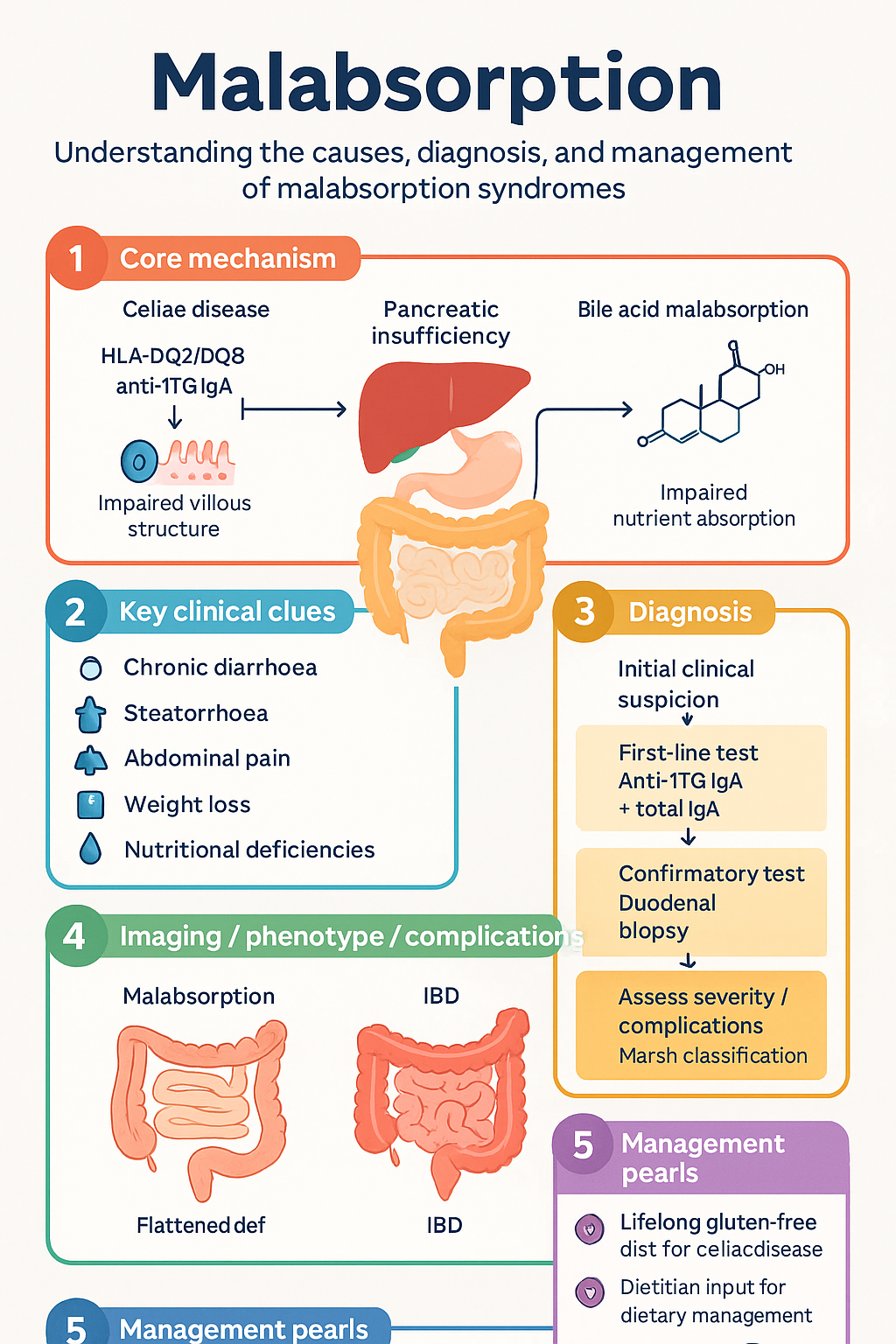
- Coeliac disease affects ~1 in 70 Australians and is the most common cause of small-bowel malabsorption in developed countries; diagnosis requires anti-tTG IgA with total IgA, confirmatory duodenal biopsy (≥4 D2 + 1–2 D1 bulb samples), and is supported by HLA-DQ2/DQ8 testing for exclusion.
- Marsh classification grades histopathology from 0 (normal) to 3c (total villous atrophy); Marsh ≥2 is diagnostic of coeliac disease in the correct clinical and serological context.
- Lifelong strict gluten-free diet (GFD) is the only effective treatment for coeliac disease, managed with dietitian input via Medicare-rebated chronic disease care plans.
- Refractory coeliac disease (RCD) is classified as type I (normal intraepithelial lymphocyte phenotype) or type II (clonal aberrant IELs); RCD-II carries a 40–60% 5-year risk of enteropathy-associated T-cell lymphoma (EATL).
- Faecal elastase-1 (<200 µg/g) is the first-line non-invasive test for exocrine pancreatic insufficiency; values <100 µg/g indicate severe deficiency.
- Bile acid malabsorption (BAM) is diagnosed by SeHCAT retention (available at select tertiary centres) or serum 7α-hydroxy-4-cholesten-3-one (C4); empirical trial of cholestyramine is an accepted alternative.
- Hydrogen-methane breath testing identifies lactose intolerance and small intestinal bacterial overgrowth (SIBO) and should include methane measurement for sensitivity.
- Faecal calprotectin <50 µg/g effectively excludes inflammatory bowel disease as a cause of chronic diarrhoea and steatorrhoea.
- MR enterography (MRE) and capsule endoscopy are complementary for evaluating small-bowel mucosal pathology not reached by standard gastroscopy.
- Tropical sprue should be considered in travellers or residents of tropical regions with persistent diarrhoea and megaloblastic anaemia; treatment is tetracycline + folate for ≥6 months.
- Short bowel syndrome (SBS) management centres on optimising residual absorptive capacity; teduglutide (Revestive®) is PBS Authority Required for dependent SBS with ≥3 L/day parenteral support.
- Post-bariatric malabsorption requires lifelong monitoring of fat-soluble vitamins (A, D, E, K), B₁₂, iron, calcium, zinc, and copper, with supplementation guided by malabsorptive procedure type.
- Common variable immunodeficiency (CVID) can mimic coeliac disease histologically; immunoglobulin levels must be checked before biopsy in patients with recurrent sinopulmonary infections and chronic diarrhoea.
- Aboriginal and Torres Strait Islander peoples have higher rates of chronic diarrhoeal illness, SBS following emergency surgery, and reduced access to gastroenterology specialist services in remote areas.
🎧 Audio Brief
Coeliac Disease
Australian Epidemiology
Coeliac disease (CD) affects approximately 1 in 70 Australians, yet only ~20% are formally diagnosed. The condition is equally prevalent in Aboriginal and Torres Strait Islander populations. Prevalence is increasing due to improved serological screening rather than a true rise in incidence. CD is strongly associated with HLA-DQ2 (90–95% of cases) and HLA-DQ8 (5–10%); these haplotypes are necessary but not sufficient for disease development.
Serological Diagnosis
All serological testing must be performed on a gluten-containing diet (≥2 slices of bread equivalent daily for ≥6 weeks prior). The recommended first-line test is tissue transglutaminase IgA (anti-tTG IgA) combined with total serum IgA.
| Test | Role | Key Detail | MBS Item |
|---|---|---|---|
| Anti-tTG IgA + total IgA | First-line screening | Sensitivity 95%, specificity 95% in adults; if total IgA low/absent, use anti-tTG IgG or deamidated gliadin peptide (DGP) IgG | MBS 69412 (coeliac serology bundle) |
| Deamidated gliadin peptide (DGP) IgG | IgA-deficient patients; children <2 years | Preferred in selective IgA deficiency; useful adjunct in equivocal anti-tTG | MBS 69412 |
| Endomysial antibody (EMA) IgA | Confirmatory in equivocal cases | Near 100% specificity; operator-dependent (immunofluorescence); not recommended as sole screening test | MBS 69412 |
| HLA-DQ2/DQ8 typing | Exclusion test (negative predictive value >99%) | NOT diagnostic — positive in ~40% general population. Useful to exclude CD in equivocal serology/histology, and in first-degree relatives | MBS 73848 (genetic testing, specialist order) |
Duodenal Biopsy — Marsh Classification
Upper gastrointestinal endoscopy with duodenal biopsies remains the gold standard for confirming CD in adults and older children. The 2024 Sydney classification and European Society for Paediatric Gastroenterology, Hepatology and Nutrition (ESPGHAN) guidelines recommend:
- ≥4 biopsies from D2 (second part of duodenum) + 1–2 biopsies from the D1 bulb (to improve diagnostic yield for patchy disease).
- Orientation of specimens in the histopathology laboratory is essential for accurate villous architecture assessment.
- Marsh classification:
Lifelong Gluten-Free Diet
Strict lifelong GFD is the only proven treatment. This requires elimination of all wheat, barley, rye, and contaminated oats. Dietitian-led education is essential and can be accessed via GP Management Plan (MBS 721) and Team Care Arrangement (MBS 723) with allied health Medicare rebates.
- Safe grains: rice, corn (maize), quinoa, millet, sorghum, buckwheat, amaranth, teff.
- Oats: Pure uncontaminated oats are tolerated by most CD patients; however, individual assessment is recommended as a minority react to avenin.
- Surveillance: Repeat anti-tTG IgA at 6 and 12 months, then annually — to monitor adherence. Histological recovery expected in 65–90% by 2 years on strict GFD.
- Nutritional deficiencies: Screen and replace iron, folate, vitamin B₁₂, vitamin D, calcium, zinc, and copper at diagnosis.
- Bone density: DEXA scan recommended at diagnosis for adults (especially Marsh 3b–3c); repeat in 2 years if abnormal.
Refractory Coeliac Disease (RCD)
RCD is defined as persistent villous atrophy with malabsorption symptoms despite strict GFD for ≥6–12 months after excluding other diagnoses (e.g., lymphoma, SIBO, collagenous sprue, Crohn's disease).
| Feature | RCD Type I | RCD Type II |
|---|---|---|
| IEL phenotype | Normal (CD3+, CD8+) | Aberrant (CD3+, CD8−, CD4−); clonal TCRγ rearrangement |
| 5-year mortality | ~5% | 40–60% (primarily from EATL) |
| EATL risk | Low | High — requires close surveillance |
| First-line treatment | Azathioprine 1.5–2 mg/kg/day + prednisolone 1 mg/kg taper | Cladribine (investigational in Australia), autologous stem cell transplant |
| Surveillance | Repeat biopsy at 6–12 months | Capsule endoscopy + PET-CT every 6–12 months for EATL |
Key Medications in Coeliac Disease Management
Diagnostic Workup
A systematic approach to malabsorption workup is essential. Investigations should be targeted based on clinical history, examination findings (e.g., steatorrhoea suggests fat malabsorption), and initial screening tests. The following tests are available in the Australian healthcare setting.
Faecal Elastase-1 (Pancreatic Insufficiency)
Faecal elastase-1 (FE-1) is the preferred first-line non-invasive marker for exocrine pancreatic insufficiency (EPI). It does not require a timed stool collection and is stable at room temperature.
Causes of low FE-1: Chronic pancreatitis, pancreatic cancer, cystic fibrosis, post-pancreatectomy, SIBO (false low).
Availability: Commercially available at major Australian pathology laboratories (Sullivan Nicolaides, Douglass Hanly Moir, Melbourne Pathology).
MBS: Not specifically itemised — included under faecal analysis (MBS 66600) or referred to specialist pathology.
Bile Acid Malabsorption (BAM)
BAM is an underdiagnosed cause of chronic diarrhoea and fat malabsorption, classified as:
- Type 1: Post-ileal resection or Crohn's disease affecting the terminal ileum.
- Type 2: Idiopathic (primary) — often misdiagnosed as diarrhoea-predominant IBS.
- Type 3: Secondary to cholecystectomy, vagotomy, coeliac disease, or chronic pancreatitis.
Availability: Limited to select tertiary centres (Royal Adelaide Hospital, Concord Hospital Sydney, Royal Melbourne Hospital). Not universally available.
Not PBS-listed.
Availability: Specialist reference laboratories; gaining wider availability.
Alternative approach: Empirical trial of cholestyramine 4 g TDS for 2 weeks — response supports BAM diagnosis.
Hydrogen-Methane Breath Testing
Breath testing is the primary non-invasive method for diagnosing carbohydrate malabsorption (lactose, fructose) and small intestinal bacterial overgrowth (SIBO).
| Test | Substrate | Positive Criteria | Clinical Indication |
|---|---|---|---|
| Lactose breath test | 50 g lactose | H₂ rise ≥20 ppm or CH₄ rise ≥10 ppm within 3 hours | Suspected lactose intolerance |
| Fructose breath test | 25 g fructose | H₂ rise ≥20 ppm or CH₄ rise ≥10 ppm within 3 hours | Suspected fructose malabsorption |
| Glucose breath test (SIBO) | 75 g glucose | H₂ rise ≥12 ppm within 90 minutes | Suspected SIBO (proximal) |
| Lactulose breath test (SIBO) | 10 g lactulose | Dual peak (early rise ≥20 ppm in first 90 min) or single rise ≥20 ppm within 90 min | Suspected SIBO (proximal + distal); higher false-positive rate |
D-Xylose Absorption Test
The D-xylose test assesses proximal small-bowel absorptive function and distinguishes mucosal malabsorption from pancreatic/biliary causes. It is rarely used in current Australian practice, having been largely replaced by specific serological and imaging tests.
- Protocol: 25 g D-xylose PO after overnight fast; collect urine for 5 hours + 1-hour serum level.
- Normal: Serum ≥1.33 mmol/L at 1 hour; urinary excretion ≥4.4 g (16% of dose) over 5 hours.
- Abnormal (mucosal): Low serum and low urine — indicates villous disease (coeliac, tropical sprue, Crohn's).
- Availability: Specialist pathology — limited to tertiary centres.
Faecal Calprotectin
Faecal calprotectin is a neutrophil-derived protein that serves as a non-invasive biomarker for intestinal inflammation.
Role in malabsorption: Helps exclude IBD as a cause of chronic diarrhoea and steatorrhoea; distinguishes inflammatory from osmotic/secretory mechanisms.
MBS: MBS 66600 (faecal analysis).
Limitations: False elevation with NSAIDs, PPIs, and infective gastroenteritis.
Small Bowel Imaging
When malabsorption persists despite negative coeliac serology and upper GI endoscopy, or when small-bowel pathology is suspected, dedicated small-bowel imaging is warranted.
Indications: Suspected Crohn's disease, SBS anatomy assessment, mesenteric ischaemia, lymphoma.
MBS: MBS 63080 (MRI abdomen, specialist-referral).
Contraindications: Pacemaker, severe claustrophobia (sedation available), eGFR <30 (gadolinium).
Indications: Unexplained iron-deficiency anaemia, suspected small-bowel bleeding, equivocal MRE findings, surveillance of RCD-II for EATL.
Contraindications: Known or suspected small-bowel stricture (patency capsule test recommended first), dysphagia.
MBS: MBS 30478 (capsule endoscopy, specialist).
Availability: Most public and private gastroenterology units.
1. Coeliac serology (anti-tTG IgA + total IgA) → if positive, endoscopy with duodenal biopsies
2. Faecal elastase-1 → if <200, pancreatic insufficiency confirmed
3. Faecal calprotectin → if >200, colonoscopy for IBD
4. If steatorrhoea + negative above → bile acid malabsorption (SeHCAT/C4 or empirical cholestyramine trial)
5. If bloating/distension → hydrogen-methane breath test for SIBO/carbohydrate malabsorption
6. If ongoing unexplained → MRE ± capsule endoscopy
Other Causes of Malabsorption
Tropical Sprue
Tropical sprue is an acquired malabsorptive disorder of uncertain aetiology, endemic in tropical regions including South-East Asia, the Indian subcontinent, the Caribbean, and parts of Central America and Africa. It should be considered in Australians who have resided in or recently travelled to endemic areas and present with chronic diarrhoea, megaloblastic anaemia, and weight loss.
- Pathophysiology: Postulated infectious aetiology (enterotoxigenic E. coli, Klebsiella spp.) causing chronic jejunal inflammation with villous atrophy and bacterial overgrowth.
- Histology: Villous atrophy and crypt hyperplasia similar to coeliac disease but more prominent in the jejunum; coeliac serology is negative.
- Investigations: Coeliac serology (negative to exclude CD), duodenal biopsy, folate/B₁₂ levels, stool cultures, blood film (megaloblastic changes).
- Treatment: Tetracycline 500 mg PO QDS (or doxycycline 100 mg PO BD) + folic acid 5 mg PO daily, for ≥6 months. Some patients require prolonged or indefinite therapy.
- Nutritional support: Replace iron, folate, B₁₂, calcium, and fat-soluble vitamins.
Short Bowel Syndrome (SBS)
Short bowel syndrome results from extensive small-bowel resection leaving insufficient absorptive surface area. In Australia, common causes include mesenteric ischaemia, Crohn's disease resection, radiation enteritis, and volvulus.
| Residual Anatomy | Adaptive Capacity | Key Malabsorption Issues |
|---|---|---|
| <200 cm jejunum, no colon | Poor — PN-dependent | Fluid/electrolyte, macronutrient; no bile acid absorption → fat malabsorption |
| <200 cm jejunum, colon in continuity | Moderate — PN often needed | Colonic SCFA salvage assists; bile acid wasting → BAM Type 1 |
| >200 cm with ICV intact | Good — may be PN-independent | Vitamin B₁₂, fat-soluble vitamins if terminal ileum resected |
Teduglutide (Revestive®)
Teduglutide is a recombinant analogue of glucagon-like peptide-2 (GLP-2) that promotes intestinal adaptation, increases villous height and crypt depth, and enhances fluid and nutrient absorption. It is indicated for SBS patients who are dependent on parenteral nutrition (PN).
Post-Bariatric Malabsorption
With over 20,000 bariatric procedures performed annually in Australia, post-bariatric malabsorption is increasingly encountered in primary care. The degree of malabsorption depends on the procedure type.
| Procedure | Mechanism | Key Deficiencies | Monitoring |
|---|---|---|---|
| Sleeve gastrectomy | Restrictive | Iron, B₁₂, folate, vitamin D | Bloods 3, 6, 12 months then annually |
| Roux-en-Y gastric bypass | Restrictive + malabsorptive | Iron, B₁₂, calcium, vitamin D, fat-soluble vitamins (A, E, K), zinc, copper, thiamine | Bloods 3, 6, 12 months then annually; DEXA at 2 years |
| One-anastomosis gastric bypass (OAGB) | Highly malabsorptive | As RYGB + protein malnutrition, steatorrhoea | As above + faecal elastase, liver function |
| Biliopancreatic diversion ± DS | Severely malabsorptive | All of the above + severe fat malabsorption, oxalate nephropathy risk | Comprehensive panel 3-monthly initially; renal ultrasound annually |
Intestinal Lymphangiectasia
Intestinal lymphangiectasia (IL) is characterised by dilated lymphatic lacteals in the small-bowel mucosa, leading to protein-losing enteropathy with hypoalbuminaemia, lymphopenia, and immunoglobulin loss.
- Classification: Primary (congenital, presents in childhood) or secondary (due to constrictive pericarditis, lymphoma, cirrhosis, retroperitoneal fibrosis, Fontan circulation).
- Clinical features: Peripheral oedema, ascites, diarrhoea, steatorrhoea, recurrent infections (due to hypogammaglobulinaemia and lymphopenia).
- Diagnosis: Hypoalbuminaemia + low immunoglobulins + peripheral lymphopenia + characteristic endoscopic findings (white villous tips) + biopsy showing dilated mucosal lacteals. Faecal α₁-antitrypsin clearance confirms protein-losing enteropathy.
- Treatment: Medium-chain triglyceride (MCT) diet (bypasses lymphatic system, absorbed directly into portal circulation); octreotide 50–100 µg SC TDS (reduces lymph flow); treat underlying cause if secondary.
- Prognosis: Primary IL is chronic; secondary IL resolves with treatment of the underlying condition.
Eosinophilic Enteropathy
Eosinophilic enteropathy (EE) encompasses eosinophilic oesophagitis (EoE) and non-EoE eosinophilic gastrointestinal disorders, characterised by eosinophilic infiltration of the GI tract in the absence of secondary causes.
- Classification by depth: Mucosal (most common — diarrhoea, pain, malabsorption), muscular (obstruction), serosal (ascites with eosinophil-rich fluid).
- Diagnostic criteria: GI symptoms + eosinophilic infiltration (≥20 eosinophils per HPF on biopsy) + exclusion of secondary causes (parasites, drugs, hypereosinophilic syndrome, connective tissue disease).
- Investigations: Peripheral eosinophil count (may be normal), endoscopic biopsies at multiple levels, stool ova/cysts/parasites (×3), serum tryptase (mastocytosis exclusion), food-specific IgE and skin-prick testing.
- Treatment: Dietary elimination (6-food elimination diet — dairy, wheat, egg, soy, fish/seafood, nuts); proton pump inhibitors (for EoE); topical swallowed fluticasone 250–500 µg BD (EoE); systemic corticosteroids for severe/refractory disease; biologics — dupilumab (Dupixent®) PBS Authority Required for EoE.
Common Variable Immunodeficiency (CVID)
CVID is the most common symptomatic primary immunodeficiency in adults, characterised by hypogammaglobulinaemia (reduced IgG and at least one of IgA or IgM), impaired antibody responses, and recurrent infections. GI involvement occurs in 20–50% of CVID patients and can mimic coeliac disease.
- GI manifestations: Chronic diarrhoea, malabsorption, villous atrophy (may be indistinguishable from CD histologically), pernicious anaemia, inflammatory bowel disease-like picture, nodular lymphoid hyperplasia, giardiasis (recurrent).
- Critical diagnostic clue: Suspect CVID when villous atrophy is found on biopsy but coeliac serology is negative, or when the patient has recurrent sinopulmonary infections.
- Essential tests: Quantitative immunoglobulins (IgG, IgA, IgM) — IgG <4.5 g/L + IgA <0.07 g/L + impaired vaccine responses (pneumococcal serology) confirms diagnosis. Do NOT diagnose coeliac disease in a patient with undetectable IgA.
- Treatment: Immunoglobulin replacement therapy (IVIg 400–600 mg/kg every 3–4 weeks, or SCIg 100–200 mg/kg weekly) — PBS Authority Required. Treat underlying GI pathology specifically (e.g., giardiasis with tinidazole/metronidazole). Gluten-free diet trial may be attempted but response is inconsistent.
- Monitoring: Regular lung function (bronchiectasis screening), hepatobiliary assessment, autoimmune disease screening, lymphoproliferative risk (increased lymphoma risk 8–12× general population).
📚 References
- 1. Makharia GK, Singh P, Catassi C, et al. The global burden of coeliac disease: opportunities and challenges. Nat Rev Gastroenterol Hepatol. 2024;21(5):313-326.
- 2. Husby S, Koletzko S, Korponay-Szabó I, et al. European Society for Paediatric Gastroenterology, Hepatology and Nutrition guidelines for diagnosing coeliac disease 2020. J Pediatr Gastroenterol Nutr. 2020;70(1):141-156.
- 3. Rostami-Nejad M, Aldulaimi D, Rostami K, et al. Refractory coeliac disease: a clinical review. Gastroenterol Hepatol Bed Bench. 2023;16(3):227-237.
- 4. Rashtak S, Murray JA. Coeliac disease in the elderly. Gastroenterol Clin North Am. 2009;38(3):433-446.
- 5. Lankisch PG, Dröge M, Hofses S, et al. Faecal elastase 1: not helpful in diagnosing chronic pancreatitis associated with mild to moderate exocrine pancreatic insufficiency. Gut. 1998;42(4):551-554.
- 6. Barkun AN, Love J, Gould M, et al. Bile acid malabsorption in chronic diarrhoea: a review. Can J Gastroenterol. 2013;27(6):351-355.
- 7. Rezaie A, Buresi M, Lembo A, et al. Hydrogen and methane-based breath testing in gastrointestinal disorders: the North American consensus. Am J Gastroenterol. 2017;112(5):775-784.
- 8. van Rheenen PF, Van de Vijver E, Fidler V. Faecal calprotectin for screening of patients with suspected inflammatory bowel disease: diagnostic meta-analysis. BMJ. 2010;341:c3369.
- 9. Billiauws L, Armengol Debeir L, Poullen JF, et al. Teduglutide for treatment of adults with short bowel syndrome: a systematic review and meta-analysis. JPEN J Parenter Enteral Nutr. 2023;47(1):43-54.
- 10. Buchman AL, Scolapio J, Fryer J. AGA technical review on short bowel syndrome and intestinal transplantation. Gastroenterology. 2003;124(4):1111-1134.
- 11. Mechanick JI, Youdim A, Jones DB, et al. Clinical practice guidelines for the perioperative nutritional, metabolic, and nonsurgical support of the bariatric surgery patient — 2013 update. Surg Obes Relat Dis. 2013;9(2):159-191.
- 12. Okazaki T, Watanabe T, Hiraishi H, et al. Intestinal lymphangiectasia: a comprehensive review. J Gastroenterol Hepatol. 2023;38(5):685-693.
- 13. Aceves SS. Eosinophilic oesophagitis and eosinophilic gastrointestinal disease. Gastroenterol Clin North Am. 2023;52(3):603-620.
- 14. Bonilla FA, Barlan I, Chapel H, et al. International Consensus Document (ICON): common variable immunodeficiency disorders. J Allergy Clin Immunol Pract. 2016;4(1):38-59.
- 15. Australian Institute of Health and Welfare. Aboriginal and Torres Strait Islander health performance framework 2023 summary report. Canberra: AIHW; 2023.
- 16. The Royal Australian College of General Practitioners. Guidelines for preventive activities in general practice (Red Book), 10th edition. East Melbourne: RACGP; 2024.