📋 Key Information Summary
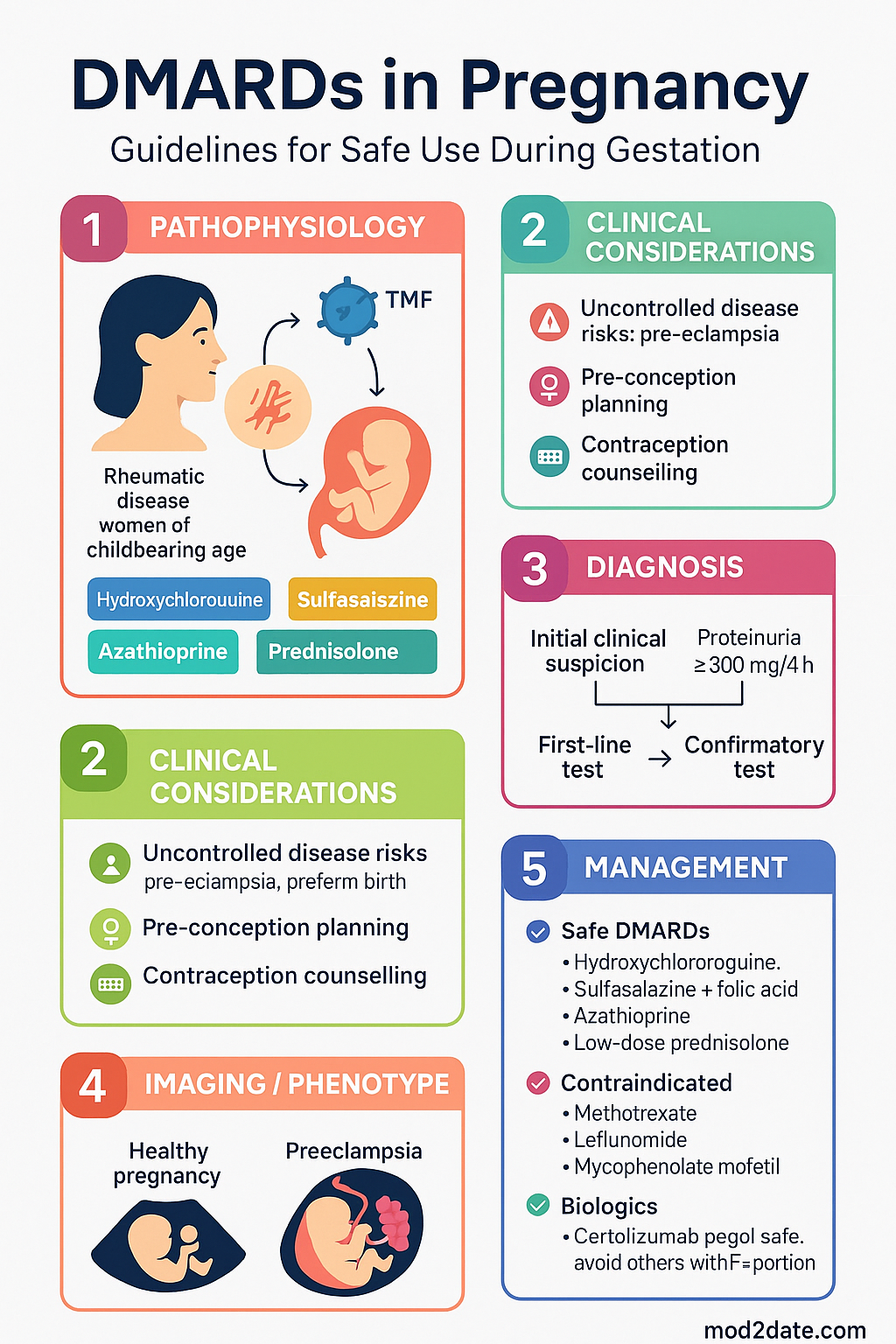
- Safe DMARDs to continue: Hydroxychloroquine (all trimesters), sulfasalazine with folic acid (5 mg/day), azathioprine up to 2 mg/kg/day, low-dose prednisolone (≤7.5 mg/day preferred), and ciclosporin if clinically required
- Must stop before conception: Methotrexate — discontinue at least 3 months before planned conception and ensure folate repletion
- Leflunomide washout: Cholestyramine 8 g TDS for 11 days (or activated charcoal) required before conception; confirm plasma teriflunomide level <0.02 mg/L before proceeding
- Mycophenolate mofetil: Discontinue at least 6 weeks before conception; high risk of first-trimester pregnancy loss and congenital malformations
- Safest biologic in pregnancy: Certolizumab pegol — no Fc portion, minimal transplacental transfer, safe across all trimesters
- Biologics with Fc — stop at 20–30 weeks: Etanercept and adalimumab should be discontinued by week 20–30 to reduce neonatal immunosuppression
- Avoid in pregnancy: Rituximab, abatacept, tocilizumab, and JAK inhibitors — insufficient safety data or known teratogenicity
- Live vaccines in infants: If a biologic was administered in the second or third trimester, live vaccines (including rotavirus) are contraindicated for the first 6 months of the infant's life
- Pre-conception counselling is essential — ideally 6–12 months before planned conception to allow washout of teratogenic drugs and disease stabilisation
- Active disease is harmful: Uncontrolled rheumatic disease increases the risk of pre-eclampsia, preterm birth, low birth weight, and disease flares — benefit of disease control often outweighs theoretical drug risk
- Contraception counselling is mandatory for all women of childbearing age on teratogenic DMARDs (MTX, LEF, MMF, cyclophosphamide)
- Multidisciplinary team: Rheumatologist, obstetric medicine, obstetrician, and GP should coordinate care throughout pregnancy and postpartum
- Breastfeeding: Hydroxychloroquine, sulfasalazine, azathioprine, low-dose prednisolone, and certolizumab are generally considered compatible with breastfeeding
Introduction & Australian Epidemiology
Rheumatic diseases disproportionately affect women of childbearing age, making the safety of disease-modifying anti-rheumatic drugs (DMARDs) in pregnancy a critical clinical consideration. In Australia, rheumatoid arthritis (RA) affects approximately 2% of women, with peak incidence between ages 25 and 50 years. Systemic lupus erythematosus (SLE), psoriatic arthritis, axial spondyloarthritis, and vasculitis similarly present during reproductive years, creating a large population of women who require DMARD therapy before, during, and after pregnancy.
Pre-conception planning is essential for all women with rheumatic disease considering pregnancy. The goals are to minimise exposure to teratogenic medications, maintain disease remission or low disease activity, and establish a safe medication regimen that can be continued throughout gestation. Active maternal disease is itself associated with adverse pregnancy outcomes, including pre-eclampsia, preterm delivery, intrauterine growth restriction, and low birth weight — therefore, undertreating disease to avoid medication exposure is not a risk-free strategy.
Australian data from the Australasian Rheumatology Association and AIHW indicate that unplanned pregnancy remains common among women on DMARDs, highlighting the need for routine contraception counselling and pregnancy planning discussions at every clinical encounter. Aboriginal and Torres Strait Islander women experience higher rates of rheumatic disease with later presentation, compounding barriers to safe pre-conception planning (see ATSI section).
This guideline provides a practical framework for Australian clinicians managing DMARD therapy in women with rheumatic disease who are planning pregnancy, currently pregnant, or breastfeeding. It is aligned with EULAR 2016 recommendations, ACR 2020 reproductive health guidelines, BSR guidelines on prescribing biologics in pregnancy, and Australian prescribing information.
Safe DMARDs: Compatible with Pregnancy
The following DMARDs have established safety data in pregnancy and can be continued throughout gestation to maintain disease control. These agents form the backbone of rheumatic disease management during pregnancy in Australian practice.
Contraindicated DMARDs: Must Stop Before Conception
The following DMARDs are teratogenic or have unacceptable risk in pregnancy. They must be discontinued before conception with appropriate washout periods. Pre-conception counselling should include reliable contraception during washout.
Additional Contraindicated Agents
| Drug | Class | Reason | Washout |
|---|---|---|---|
| Cyclophosphamide | Alkylating agent | High teratogenicity — gonadotoxic | Stop ≥3 months before conception |
| Methotrexate (high dose) | Antifolate | Methotrexate embryopathy | ≥3 months (as above) |
| JAK inhibitors (tofacitinib, baricitinib, upadacitinib) | JAK inhibitor | Animal data: teratogenic; insufficient human data | Stop ≥4 weeks (1 week washout of drug) |
| Thalidomide / Lenalidomide | Immunomodulatory | Severe limb defects — absolutely contraindicated | Thalidomide Pregnancy Prevention Programme mandatory |
Biologics in Pregnancy
Biologic DMARDs are increasingly used in women of childbearing age for RA, axial spondyloarthritis, psoriatic arthritis, and SLE. The key pharmacological distinction in pregnancy is the presence or absence of an Fc portion on the immunoglobulin molecule, which determines transplacental transfer via the neonatal Fc receptor (FcRn).
Certolizumab Pegol — Safest Biologic in Pregnancy
Anti-TNF Agents with Fc — Stop at 20–30 Weeks
The following anti-TNF agents contain an Fc portion and undergo active transplacental transfer during the second and third trimesters via the neonatal Fc receptor. Concentrations in the infant at birth can exceed maternal levels by 2–4 fold, increasing the risk of neonatal immunosuppression.
Biologics to Avoid in Pregnancy
| Biologic | Class | Recommendation | Rationale |
|---|---|---|---|
| Rituximab | Anti-CD20 | Avoid — stop ≥6 months before conception | B-cell depletion in neonate; neonatal pancytopenia reported; prolonged pharmacodynamic effect |
| Abatacept | CTLA-4 Ig | Avoid — stop ≥10 weeks before conception (5 × half-life) | Transplacental transfer; theoretical risk of immune suppression in fetus |
| Tocilizumab | Anti-IL-6R | Avoid — stop ≥3 months before conception | Animal data: embryotoxicity at high doses; limited human pregnancy data |
| Secukinumab / Ixekizumab | Anti-IL-17 | Avoid — insufficient data | Minimal human pregnancy exposure data; animal data not reassuring |
| Ustekinumab | Anti-IL-12/23 | Consider if no alternative — registry data growing but limited | Pregnancy registry data (moderate numbers) largely reassuring; BSR cautious endorsement |
| Belimumab | Anti-BLyS | Avoid — limited data | BRIGHTE study: limited human data; animal studies show B-cell reduction in offspring |
Live Vaccine Guidance for Infants
Pre-Conception Planning & Counselling
Pre-conception counselling should be offered to all women of childbearing age with rheumatic disease, ideally 6–12 months before planned conception. This allows adequate time for teratogenic drug washout, transition to pregnancy-compatible regimens, and disease stabilisation.
- Identify all teratogenic DMARDs and biologics
- Commence washout protocols (MTX ≥3 months, LEF cholestyramine washout, MMF ≥6 weeks)
- Ensure reliable contraception during washout period
- Check TPMT if azathioprine will be used as bridge
- Target remission or low disease activity before conception
- Transition to pregnancy-compatible DMARDs (HCQ, SSZ, AZA, low-dose prednisolone)
- Select biologic: certolizumab pegol preferred; plan stop date for Fc-containing biologics
- Baseline bloods: FBC, LFTs, renal function, anti-Ro/SSA and anti-La/SSB antibodies (risk of neonatal lupus)
- Folic acid 5 mg daily (high dose due to prior MTX exposure and rheumatic disease)
- Cease MTX and continue folic acid throughout washout and into first trimester
- Smoking cessation, alcohol cessation, BMI optimisation
- Review teratogenic medications beyond DMARDs (ACE inhibitors, statins, NSAIDs — stop at 32 weeks)
- Update vaccinations (MMR, varicella — wait 4 weeks before conceiving)
- Rheumatologist — medication management, disease monitoring
- Obstetric medicine physician — high-risk pregnancy coordination
- Obstetrician — delivery planning, monitoring for pre-eclampsia/IUGR
- GP — ongoing coordination, contraception, postpartum care
- Consider maternal–fetal medicine referral for SLE with antiphospholipid syndrome, anti-Ro/La antibodies, or renal involvement
Management During Pregnancy & Postpartum
Monitoring Schedule
Managing Flares During Pregnancy
- Increase prednisolone to control flare — short courses of high-dose prednisolone with rapid taper are acceptable
- Intra-articular corticosteroid injections are safe and effective for localised joint flares
- NSAIDs (ibuprofen, naproxen) — use lowest dose, shortest duration; stop at 32 weeks (premature ductus arteriosus closure risk)
- Consider initiating or increasing certolizumab pegol
- IV methylprednisolone pulses (500–1000 mg) for severe SLE flares — safe in pregnancy
Labour & Delivery Considerations
- Stress-dose corticosteroids (hydrocortisone 50–100 mg IV) for women on ≥7.5 mg prednisolone daily for >3 weeks in the preceding 6 months
- Vaginal delivery preferred unless obstetric indication for caesarean section
- Epidural analgesia is safe and encouraged for pain management
- Thromboprophylaxis — women with SLE, APS, or immobility are at increased VTE risk; follow local obstetric thromboprophylaxis guidelines
- If anti-Ro/SSA positive: neonatal assessment for congenital heart block and neonatal lupus at delivery
Postpartum Management
- Restart pre-conception DMARDs promptly postpartum to prevent flares — 50–75% of women with RA experience postpartum flare
- All pregnancy-compatible DMARDs (HCQ, SSZ, AZA, low-dose prednisolone, certolizumab) are compatible with breastfeeding
- Methotrexate and leflunomide are contraindicated in breastfeeding
- Discuss contraception — progesterone-only methods preferred if on teratogenic agents; combined OCP may be used if no APS/vascular contraindication
- Screen for postpartum depression — higher rates in women with chronic rheumatic disease
- Infant immunisation: follow standard NIP schedule; defer live vaccines (rotavirus, BCG) if maternal biologic exposure in T2/T3
Special Populations
Aboriginal and Torres Strait Islander Health Considerations
📚 References
- 1. Götestam Skorpen C, Hoeltzenbein M, Tincani A, et al. The EULAR points to consider for use of antirheumatic drugs before pregnancy, and during pregnancy and lactation. Ann Rheum Dis. 2016;75(5):795–810.
- 2. Sammaritano LR, Bermas BL, Chakravarty EE, et al. 2020 American College of Rheumatology Guideline for the Management of Reproductive Health in Rheumatic and Musculoskeletal Diseases. Arthritis Rheumatol. 2020;72(4):529–556.
- 3. Flint J, Panchal S, Hurrell A, et al. BSR and BHPR guideline on prescribing drugs in pregnancy and breastfeeding — Part I: standard and biologic disease modifying anti-rheumatic drugs and corticosteroids. Rheumatology (Oxford). 2016;55(9):1693–1697.
- 4. Mariette X, Förger F, Abraham B, et al. Lack of placental transfer of certolizumab pegol during pregnancy: results from CRIB, a prospective, postmarketing, pharmacokinetic study. Ann Rheum Dis. 2018;77(2):228–233.
- 5. Clowse ME, Förger F, Hwang C, et al. Minimal to no transfer of certolizumab pegol into breast milk: results from CRADLE, a prospective, postmarketing, multicentre, pharmacokinetic study. Ann Rheum Dis. 2017;76(11):1890–1896.
- 6. Ostensen M, Förger F. Management of RA medications in pregnant patients. Nat Rev Rheumatol. 2009;5(10):564–572.
- 7. Australian Institute of Health and Welfare (AIHW). Rheumatic heart disease and acute rheumatic fever in Australia. AIHW. 2023. Cat. no. CVD 91.
- 8. Mehta B, Luo Y, Xu J, et al. Trends in maternal and fetal outcomes among pregnant women with systemic lupus erythematosus in the United States. Ann Intern Med. 2019;171(3):164–171.
- 9. Andreoli L, Bertsias GK, Agmon-Levin N, et al. EULAR recommendations for women's health and the management of family planning, assisted reproduction, pregnancy and menopause in patients with systemic lupus erythematosus and/or antiphospholipid syndrome. Ann Rheum Dis. 2017;76(3):476–485.
- 10. Izmirly PM, Kim MY, Llanos C, et al. Evaluation of the risk of anti-SSA/Ro-SSB/La antibody-associated cardiac neonatal lupus in fetuses of mothers with systemic lupus erythematosus. Ann Rheum Dis. 2010;69(8):1470–1474.
- 11. National Aboriginal Community Controlled Health Organisation (NACCHO). Cultural safety in health care for Aboriginal and Torres Strait Islander peoples. NACCHO. 2023.
- 12. RANZCOG. Management of pregnancy in women with autoimmune disease. RANZCOG Clinical Guideline. 2022. C-Obs 50.
- 13. Australian Technical Advisory Group on Immunisation (ATAGI). The Australian Immunisation Handbook. Australian Government Department of Health. 2023. Available at: immunisationhandbook.health.gov.au.