Home Rheumatology Classic Polyarteritis Nodosa (PAN)

Classic Polyarteritis Nodosa (PAN)

๐Ÿ“‹ Key Information Summary

๐Ÿ“‹
  • Classic PAN is a systemic necrotising vasculitis of medium-sized muscular arteries โ€” ANCA-negative and does NOT cause glomerulonephritis or pulmonary capillaritis.
  • Approximately 30% of cases are associated with hepatitis B virus (HBV) infection via immune complex deposition; idiopathic cases account for the remainder.
  • Hallmark pathology: transmural fibrinoid necrosis with neutrophilic infiltrate at arterial bifurcations, progressing to segmental aneurysms visible on conventional angiography.
  • Classic organ involvement includes renal (infarcts, renovascular hypertension โ€” no glomerulonephritis), peripheral nerves (mononeuritis multiplex), mesenteric vasculature (ischaemic colitis), and testes.
  • Diagnosis rests on clinical features plus either histological confirmation (biopsy of symptomatic site) or characteristic angiographic aneurysms โ€” ACR 1990 classification criteria require โ‰ฅ3 of 10 features.
  • Five-factor score (FFS 2009) stratifies prognosis and guides treatment intensity: age >65, cardiac involvement, GI involvement, renal insufficiency (Cr >140 ยตmol/L), ear/nose/throat involvement.
  • Idiopathic PAN: treat with combination cyclophosphamide + high-dose prednisolone for remission induction; azathioprine or methotrexate for maintenance.
  • HBV-associated PAN: antiviral therapy (entecavir or tenofovir) is the cornerstone; short-course corticosteroids plus plasma exchange โ€” do NOT give prolonged cyclophosphamide.
  • Prednisolone taper typically extends over 12โ€“18 months; abrupt discontinuation risks relapse.
  • Pulmonary involvement is ABSENT in classic PAN โ€” if present, consider ANCA-associated vasculitis (e.g., GPA, MPA, EGPA) instead.
  • Aboriginal and Torres Strait Islander peoples have higher HBV prevalence; screen all PAN patients for HBV and tailor therapy accordingly.
  • Relapse occurs in 10โ€“20% of idiopathic PAN; monitor for recurrent neuropathy, skin lesions, or rising inflammatory markers after remission.

Introduction & Australian Epidemiology

Classic polyarteritis nodosa (PAN) is a systemic necrotising vasculitis predominantly affecting medium-sized muscular arteries, causing transmural inflammation, segmental necrosis, and subsequent ischaemic injury to visceral organs and peripheral nerves. Crucially, PAN spares the pulmonary circulation and does not produce glomerulonephritis โ€” features that distinguish it from ANCA-associated vasculitides.

In Australia, PAN is rare, with an estimated incidence of 2โ€“9 per million population per year. The disease shows a male predominance (M:F ratio ~2:1) and a peak incidence in the fifth to sixth decade of life. Approximately 30% of cases are associated with hepatitis B virus (HBV) infection, an important consideration given the higher prevalence of chronic HBV in Aboriginal and Torres Strait Islander communities and among migrants from endemic regions (Southeast Asia, Sub-Saharan Africa, Pacific Islands).

The distinction between HBV-associated and idiopathic PAN is therapeutically critical: HBV-associated PAN responds best to antiviral therapy with short-course corticosteroids and plasma exchange, whereas idiopathic PAN requires immunosuppressive induction with cyclophosphamide. Accurate classification therefore directly impacts treatment outcomes.
โš ๏ธ
Do not confuse with ANCA-associated vasculitis: Classic PAN is ANCA-negative. A positive c-ANCA or p-ANCA should prompt consideration of granulomatosis with polyangiitis (GPA), microscopic polyangiitis (MPA), or eosinophilic granulomatosis with polyangiitis (EGPA) โ€” which involve small vessels, may cause glomerulonephritis, and have different treatment algorithms.
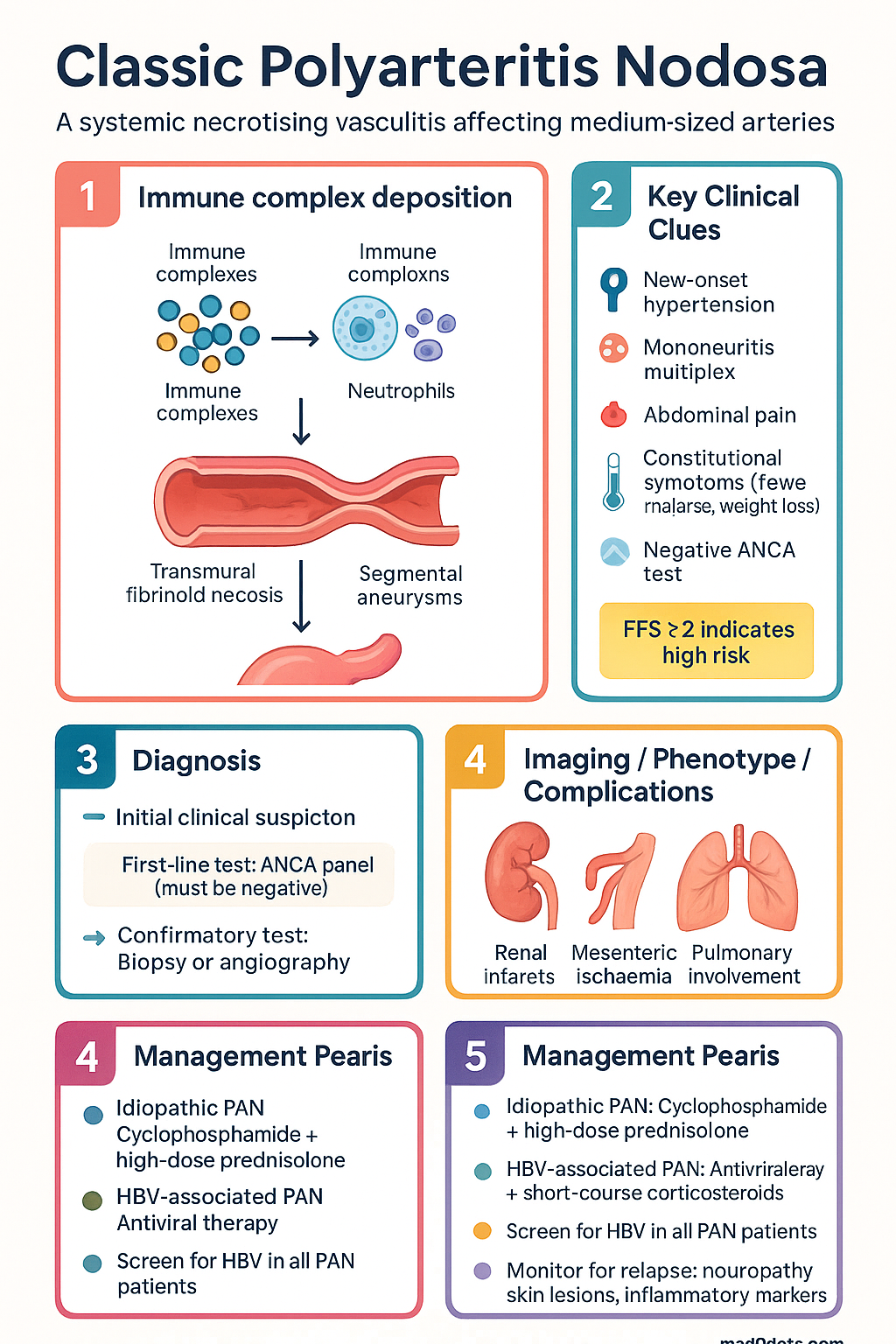
Classic Polyarteritis Nodosa (PAN) clinical infographic โ€” pathophysiology, clinical clues, diagnosis, imaging, and management
Tap or click image to enlarge โ€” Classic Polyarteritis Nodosa (PAN): pathophysiology, clinical clues, diagnosis, imaging, and management.
Classic Polyarteritis Nodosa (PAN) infographic, full size

Pathophysiology & Classification

Pathogenesis

Classic PAN is characterised by ANCA-negative necrotising arteritis of medium-sized muscular arteries at branch points. The pathological hallmark is transmural fibrinoid necrosis with neutrophil infiltration of the vessel wall, progressing to mononuclear cell infiltrates, intimal proliferation, and eventual fibrosis. Segmental aneurysms (up to 1 cm) form at arterial bifurcations and are visible on conventional catheter-based angiography.

Two distinct aetiological pathways are recognised:

  • HBV-associated PAN (~30% of cases): Immune complexes containing HBV surface antigen (HBsAg) and antibody deposit in arterial walls, activating complement and driving transmural inflammation. Circulating immune complexes correlate with disease activity. This form typically presents within six months of acute HBV infection and is more common in younger patients.
  • Idiopathic PAN (~70% of cases): No identifiable infectious trigger. The immunopathogenesis is incompletely understood but involves T-cellโ€“mediated vascular injury and macrophage activation. Some cases are associated with hairy-cell leukaemia, relapsing polychondritis, or familial Mediterranean fever (FMF).

Classification Criteria โ€” ACR 1990

The American College of Rheumatology (ACR) 1990 classification criteria require โ‰ฅ3 of the following 10 features for classifying a patient as having PAN:

Criterion Definition Sensitivity / Specificity
1. Weight loss โ‰ฅ4 kg Unintentional, since illness began, not attributable to dieting 73% / 73%
2. Livedo reticularis Mottled, net-like violaceous skin discolouration 16% / 96%
3. Testicular pain or tenderness On history or examination, not attributable to infection or trauma 16% / 96%
4. Myalgia, weakness, or leg tenderness Diffuse myalgias or leg tenderness, or mild muscle weakness of intrinsic muscles 65% / 75%
5. Mononeuropathy or polyneuropathy Development of mononeuritis multiplex or peripheral polyneuropathy 58% / 74%
6. Diastolic BP >90 mmHg New-onset or worsening hypertension 53% / 73%
7. Elevated BUN or creatinine BUN >40 mg/dL (14.3 mmol/L) or creatinine >1.5 mg/dL (133 ยตmol/L) โ€” due to renal infarction, NOT glomerulonephritis 37% / 88%
8. HBV seropositivity Positive anti-HBsAg antibody or HBsAg 19% / 89%
9. Arteriographic abnormality Aneurysms or occlusions of visceral arteries (not due to atherosclerosis, fibromuscular dysplasia, or other causes) 45% / 91%
10. Biopsy of small or medium artery containing PMN Histological evidence of granulocytes or granulocytes and mononuclear cells in the artery wall 22% / 91%

The 1990 ACR criteria have a reported sensitivity of 82.2% and specificity of 86.6% for distinguishing PAN from other vasculitides. These are classification criteria (designed for research), not diagnostic criteria โ€” clinical judgement remains essential.

โ„น๏ธ
Chapel Hill Consensus (2012): PAN is defined as "necrotising arteritis of medium or small arteries without vasculitis in arterioles, capillaries, or venules, and not associated with ANCA." This emphasises the medium-vessel and ANCA-negative nature of the disease.

Clinical Features

PAN is a multisystem disease with protean manifestations driven by ischaemia and infarction of medium-sized arteries. Constitutional symptoms (fever, malaise, weight loss) are present in >50% of patients at diagnosis. Organ-specific features depend on the vascular bed involved:

System Manifestations Frequency
Peripheral nerves Mononeuritis multiplex (foot/wrist drop); painful sensory neuropathy; asymmetric polyneuropathy 50โ€“70%
Renal Renovascular hypertension (renal artery branch involvement); renal infarction (flank pain, haematuria); progressive renal impairment โ€” NO glomerulonephritis 40โ€“60%
Gastrointestinal Mesenteric ischaemia (postprandial abdominal pain, weight loss, GI haemorrhage, bowel perforation); hepatic artery involvement 30โ€“40%
Skin Livedo reticularis; subcutaneous nodules (classic "nodosa"); purpura; digital gangrene; ulcers 30โ€“40%
Musculoskeletal Myalgia; arthralgia (non-erosive, non-deforming); leg tenderness 50โ€“65%
Testicular Testicular pain/tenderness (highly specific but low sensitivity) 16%
Cardiac Coronary arteritis (angina, MI); pericarditis; cardiomyopathy โ€” contributes to mortality 10โ€“30%
Central nervous system Cerebral infarction; seizures; encephalopathy (less common than peripheral neuropathy) 5โ€“10%
๐Ÿšจ
Key diagnostic clues: The combination of new-onset hypertension + mononeuritis multiplex + abdominal pain + constitutional symptoms โ€” with active urine sediment absent (no dysmorphic RBCs or RBC casts) โ€” should strongly suggest PAN. ANCA testing should be negative. Fever of unknown origin with neuropathy is another classic presentation.

Features That EXCLUDE Classic PAN

  • Pulmonary involvement (haemoptysis, nodules, cavitation) โ†’ consider GPA, MPA, or EGPA
  • Glomerulonephritis (dysmorphic red cells, RBC casts, rapidly declining GFR) โ†’ consider ANCA-associated vasculitis or IgA vasculitis
  • Positive ANCA (c-ANCA/PR3 or p-ANCA/MPO) โ†’ not classic PAN
  • Small-vessel involvement on biopsy (capillaritis, venulitis) โ†’ not classic PAN

Investigations

Laboratory Tests

Essential
Full blood count (FBC)
MBS Item 65070. Typically shows normocytic anaemia, leucocytosis, thrombocytosis โ€” reactive changes.
Essential
ESR and CRP
MBS Item 65070 / 65081. Almost always markedly elevated at presentation (ESR often >60 mm/hr). Useful for monitoring disease activity.
Essential
ANCA panel (c-ANCA/PR3, p-ANCA/MPO)
MBS Item 65103. MUST be NEGATIVE in classic PAN. A positive result redirects diagnosis to ANCA-associated vasculitis.
Essential
Hepatitis B serology (HBsAg, anti-HBs, anti-HBc, HBV DNA)
MBS Item 69483 / 69484. Mandatory โ€” determines HBV-associated vs idiopathic PAN and directly guides treatment. HBV DNA quantitative if HBsAg positive.
Essential
Serum creatinine, eGFR, urea, electrolytes
MBS Item 65070. Renal impairment from infarction (NOT glomerulonephritis). Urinalysis should show bland sediment (no RBC casts).
Available
Hepatitis C, HIV serology
MBS Item 69484. Exclude HCV and HIV co-infection, especially in HBV-associated PAN.
Available
LFTs, serum albumin
MBS Item 65070. Hepatic artery involvement may elevate transaminases. Hypoalbuminaemia reflects systemic inflammation or malnutrition.
Available
Complement levels (C3, C4, CH50)
MBS Item 65093. May be low in HBV-associated PAN (immune complex consumption). Usually normal in idiopathic PAN.
Available
Serum cryoglobulins
MBS Item 65093. Type III cryoglobulinaemia can mimic PAN; sample must be kept warm during transport (37ยฐC).

Imaging

Essential
Conventional catheter-based angiography
Gold standard โ€” demonstrates microaneurysms (up to 1 cm) at renal, hepatic, mesenteric, and coeliac artery bifurcations. Also shows segmental stenoses and occlusions. MBS Item 13200 series. CTA/MRA are less sensitive for small aneurysms but may be used as initial screening.
Available
CT angiography (CTA) abdomen/pelvis
MBS Item 56800. Non-invasive screening for larger visceral artery aneurysms. Less sensitive than catheter angiography for small branch-vessel disease.
Available
MR angiography (MRA)
MBS Item 63001 series. Alternative non-invasive modality; useful if contrast allergy precludes CTA. Limited spatial resolution for small aneurysms.
Available
Nerve conduction studies / EMG
MBS Item 11702 / 11703. Confirms mononeuritis multiplex (asymmetric, axonal pattern) โ€” supports diagnosis when clinical features are equivocal.

Histopathology

Essential if biopsy target available
Tissue biopsy (nerve + muscle, skin, kidney, testis)
Highest diagnostic yield from sural nerve biopsy combined with peroneus brevis muscle (yield ~60โ€“70%). Skin biopsy of a symptomatic lesion (nodule, purpura) has moderate yield. Renal biopsy shows interlobular/arcuate arteritis โ€” NOT glomerulonephritis. Testicular biopsy rarely needed unless clinically indicated.
โš ๏ธ
Bland urinary sediment is expected: In classic PAN, the urinalysis should show NO dysmorphic red blood cells and NO red blood cell casts. If present, consider ANCA-associated vasculitis or IgA nephropathy. Mild proteinuria and haematuria from renal infarction may occur but should not produce an active sediment.

Risk Stratification & Severity Scoring

The Five-Factor Score (FFS), revised in 2009 by the French Vasculitis Study Group (FVSG), is used to predict mortality and guide treatment intensity in systemic vasculitides including PAN:

Low Risk
FFS = 0
No adverse prognostic factors present. Five-year survival >90%.
Setting: Treat with glucocorticoids alone in idiopathic PAN; antivirals + short-course steroids in HBV-PAN
Intermediate Risk
FFS = 1
One adverse prognostic factor. Five-year survival ~80โ€“85%.
Setting: Add immunosuppressive agent (cyclophosphamide) to induction regimen
High Risk
FFS โ‰ฅ 2
Two or more adverse factors. Five-year survival ~55โ€“70%.
Setting: Intensive combination therapy; consider plasma exchange; ICU-level monitoring if visceral crisis

Five-Factor Score (FFS 2009) โ€” Adverse Prognostic Factors

Factor Definition
Age >65 years At time of diagnosis
Cardiac symptoms Cardiomyopathy, heart failure, or pericarditis attributable to vasculitis
GI involvement Mesenteric ischaemia, perforation, haemorrhage, pancreatitis, or biliary involvement
Renal insufficiency Serum creatinine >140 ยตmol/L (โ‰ฅ1.58 mg/dL)
ENT involvement Absent in classic PAN (only scored in AAV) โ€” effectively only 4 factors apply to PAN
โ„น๏ธ
Note on FFS and PAN: The ENT factor is scored as 0 in PAN by definition (PAN does not affect the respiratory tract). For PAN, only age >65, cardiac, GI, and renal factors apply. GI involvement carries the worst prognosis and is the strongest single predictor of mortality.

Treatment

Treatment of PAN depends critically on whether the disease is idiopathic or HBV-associated. The two forms require fundamentally different therapeutic strategies.

Idiopathic PAN โ€” Remission Induction

๐Ÿ’Š
Prednisolone
Soloneยฎ ยท Panafcorteloneยฎ ยท Glucocorticoid
Adult dose 1 mg/kg/day PO (max 60 mg) for 2โ€“4 weeks, then taper by 5โ€“10 mg every 1โ€“2 weeks to 20 mg, then by 2.5 mg every 2โ€“4 weeks; total taper 12โ€“18 months
Paediatric dose 1โ€“2 mg/kg/day PO (max 60 mg); taper guided by paediatric rheumatologist
Route Oral (IV methylprednisolone pulse 500 mgโ€“1 g for severe/fulminant disease ร— 3 days)
Renal adjustment No dose adjustment; monitor glucose, potassium, and BP closely
PBS status โœ” PBS General Benefit
๐Ÿ’Š
Cyclophosphamide
Endoxanยฎ ยท Alkylating agent
Adult dose โ€” oral 2 mg/kg/day PO (max 150 mg/day) for 3โ€“6 months, combined with prednisolone
Adult dose โ€” IV pulse 15 mg/kg IV pulse every 2โ€“3 weeks for 3โ€“6 pulses; lower cumulative dose, fewer side effects โ€” preferred in many Australian centres
Paediatric dose 2 mg/kg/day PO or 10โ€“15 mg/kg IV pulse; specialist supervision mandatory
Renal adjustment eGFR 10โ€“50: reduce dose by 25%; eGFR <10: reduce by 50%; dialysed patient: give after dialysis
Key monitoring FBC fortnightly (neutropenia risk); urinalysis (haemorrhagic cystitis); mesna co-administration with IV pulses; lifetime bladder cancer risk
PBS status โœ” PBS General Benefit

Idiopathic PAN โ€” Remission Maintenance

๐Ÿ’Š
Azathioprine
Imuranยฎ ยท Purine analogue
Adult dose 2 mg/kg/day PO (typically 100โ€“200 mg/day) after cyclophosphamide induction; continue for โ‰ฅ2 years
Paediatric dose 2 mg/kg/day PO; specialist guidance required
Key note Check TPMT/NUDT15 genotype before commencing; FBC monitoring fortnightly ร— 8 weeks then monthly
PBS status โœ” PBS General Benefit
๐Ÿ’Š
Methotrexate
Methoblastinยฎ ยท Antifolate
Adult dose 15โ€“25 mg PO/SC weekly with folic acid 5 mg the day after methotrexate
Renal adjustment eGFR <30: avoid; eGFR 30โ€“50: reduce dose by 50%; use with extreme caution
PBS status โœ” PBS General Benefit

HBV-Associated PAN โ€” Specific Treatment

๐Ÿšจ
Do NOT give prolonged immunosuppression in HBV-PAN: Cyclophosphamide and sustained high-dose corticosteroids promote HBV replication and risk fatal hepatic flare. Antiviral therapy is the cornerstone of treatment.
๐Ÿ’Š
Entecavir
Baracludeยฎ ยท Nucleoside analogue
Adult dose 0.5 mg PO daily (1 mg if lamivudine-resistant); first-line antiviral for HBV-PAN
Duration Continue until HBsAg seroconversion or indefinite (long-term suppressive therapy)
Renal adjustment eGFR 30โ€“49: 0.25 mg daily; eGFR 10โ€“29: 0.15 mg daily; dialysis: 0.05 mg after dialysis
PBS status โš  PBS Authority Required
๐Ÿ’Š
Tenofovir alafenamide (TAF)
Vemlidyยฎ ยท Nucleotide analogue
Adult dose 25 mg PO daily; alternative first-line antiviral with less nephrotoxicity than tenofovir disoproxil (TDF)
Renal adjustment eGFR <15: not recommended; preferred over TDF in CKD
PBS status โš  PBS Authority Required

Short-course corticosteroids in HBV-PAN: Prednisolone 1 mg/kg/day for 2 weeks, then rapid taper over 2โ€“4 weeks (total duration โ‰ค6 weeks). Only enough to control acute vasculitis while antivirals take effect.

Plasma exchange in HBV-PAN: 3โ€“7 sessions (60 mL/kg per session) in the first 2 weeks to remove circulating immune complexes. Indicated for severe disease (FFS โ‰ฅ1) or visceral crisis. Available at major tertiary centres.

Supportive Therapies

Intervention Indication Details
Antihypertensive therapy Renovascular hypertension ACE inhibitor or ARB first-line; target BP <130/80 mmHg
Pneumocystis jirovecii prophylaxis All patients on cyclophosphamide or โ‰ฅ20 mg prednisolone >4 weeks Trimethoprim 160 mg / sulfamethoxazole 800 mg PO daily (or 3 times/week) โ€” PBS General Benefit
Osteoporosis prophylaxis Prednisolone โ‰ฅ7.5 mg for โ‰ฅ3 months Calcium 1000 mg + vitamin D 1000 IU daily; consider bisphosphonate if age >65 or prior fracture
Gastric protection Prednisolone + NSAID or GI risk factors Pantoprazole 20โ€“40 mg daily โ€” PBS General Benefit
Analgesia Neuropathic pain, myalgia Gabapentin, pregabalin, or duloxetine for neuropathic pain; paracetamol for myalgia

Monitoring

Disease Activity Monitoring

Monthly
ESR and CRP during active treatment and tapering; clinical review for new symptoms (neuropathy, skin lesions, abdominal pain).
Every 3 months
FBC, renal function, LFTs (cyclophosphamide/azathioprine toxicity); urinalysis (bland sediment expected); BP monitoring.
Every 6 months
HBV DNA quantitative (in HBV-PAN โ€” should become undetectable); HBsAg status.
After remission
Clinical review every 3โ€“6 months for โ‰ฅ5 years; relapse rate ~10โ€“20% in idiopathic PAN.

Relapse Surveillance

  • Watch for recurrent mononeuritis multiplex, new skin nodules/ulcers, rising ESR/CRP, worsening hypertension, or abdominal symptoms.
  • Relapse is more common during steroid taper โ€” reduce taper rate if relapse occurs.
  • HBV-PAN relapse usually indicates antiviral failure or non-adherence โ€” check HBV DNA and antiviral resistance.

Cyclophosphamide Toxicity Monitoring

Toxicity Monitoring Action
Neutropenia FBC every 2 weeks during oral therapy; day 10โ€“14 after IV pulse Hold if ANC <1.5 ร— 10โน/L; G-CSF if clinically indicated
Haemorrhagic cystitis Urinalysis each visit; maintain hydration โ‰ฅ2 L/day Mesna co-administration with IV pulses; switch to azathioprine if recurrent
Gonadal toxicity Counselling at baseline Consider GnRH agonist (goserelin) or sperm/egg cryopreservation before treatment
Bladder malignancy Lifelong risk; annual urinalysis for haematuria Urological referral if persistent haematuria after cumulative dose >30 g

Special Populations

๐Ÿคฐ
Pregnancy
Cyclophosphamide: Contraindicated โ€” teratogenic (FDA Category D). Avoid conception during and for 3 months after treatment.
Prednisolone: Relatively safe in pregnancy; use lowest effective dose. Monitor for gestational diabetes.
Azathioprine: Can be continued in pregnancy if needed for maintenance (no significant teratogenic risk at standard doses).
Methotrexate: Contraindicated โ€” abortifacient and teratogenic; discontinue โ‰ฅ3 months before conception.
Entecavir/TAF: Limited human data; switch to tenofovir disoproxil (TDF) which has more established safety data in pregnancy.
Ideally, achieve remission before pregnancy. Manage with obstetrician and rheumatologist co-care.
๐Ÿ‘ถ
Paediatrics
PAN in children is rare and more frequently linked to streptococcal infection than HBV in Australia.
Cutaneous PAN (limited to skin and musculoskeletal) is more common in children and may respond to corticosteroids alone or colchicine.
Cyclophosphamide: 2 mg/kg/day or 10โ€“15 mg/kg IV pulse; dose-limiting side effects are more significant in children.
Mycophenolate: Used as steroid-sparing agent in some paediatric centres; PBS available with authority.
Growth monitoring essential on long-term steroids. Bone age assessment if prolonged glucocorticoid use.
๐Ÿ‘ด
Elderly (>65 years)
Age >65 is an independent adverse prognostic factor in the FFS.
Higher risk of cyclophosphamide toxicity (myelosuppression, infection). Prefer IV pulse over daily oral.
Glucocorticoid complications more common: diabetes, osteoporosis, cataracts, psychosis.
Consider rituximab off-label as cyclophosphamide-sparing agent if significant comorbidities (discuss with rheumatology).
Aggressive osteoporosis prophylaxis; monitor glucose closely; lower threshold for PJP prophylaxis.
๐Ÿซ˜
Renal Impairment
Renal impairment in PAN is from infarction, not glomerulonephritis โ€” renal function often does not improve with immunosuppression.
Cyclophosphamide: Dose reduce: eGFR 10โ€“50: โˆ’25%; eGFR <10: โˆ’50%.
Methotrexate: eGFR <30: avoid. eGFR 30โ€“50: reduce by 50%.
Nephrotoxic agents (NSAIDs, gentamicin) should be avoided.
Reno-protective strategies (ACEi/ARB) important. Monitor for accelerated atherosclerosis from renovascular disease.
๐Ÿซ
Hepatic Impairment
Hepatic artery vasculitis may cause abnormal LFTs โ€” do not assume drug toxicity.
Azathioprine: Hepatotoxic; reduce dose or avoid in significant hepatic impairment.
Methotrexate: Avoid in significant hepatic impairment (hepatotoxic; alcohol abstinence essential).
In HBV-PAN: monitor for hepatic flare during immunosuppression; antiviral therapy should be initiated BEFORE corticosteroids.
Hepatology referral for HBV-PAN with significant liver involvement.
๐Ÿ›ก๏ธ
Immunocompromised
Cyclophosphamide + corticosteroids carry a high risk of opportunistic infection.
PJP prophylaxis is mandatory (co-trimoxazole).
Screen for latent TB (IGRA) before starting immunosuppression.
Avoid live vaccines during immunosuppression; ensure influenza and pneumococcal vaccination up to date.
If recurrent infections on cyclophosphamide, switch to azathioprine or rituximab early.

Aboriginal and Torres Strait Islander Health Considerations

Aboriginal and Torres Strait Islander Health
HBV prevalence
Chronic HBV prevalence is significantly higher in Aboriginal and Torres Strait Islander communities (estimated 5โ€“6% in some remote NT communities vs <1% non-Indigenous Australians). All PAN patients of ATSI background must be screened for HBV โ€” HBV-associated PAN may account for a higher proportion of disease in these populations.
Access to specialist care
Rheumatologists and immunologists are concentrated in metropolitan centres. Remote and very remote communities rely on fly-in/fly-out services and telehealth. Rheumatology telehealth reviews (MBS Item 91822) are critical for ongoing management.
Diagnostic delays
PAN may present late in communities where access to diagnostic angiography and nerve conduction studies is limited. Consider empirical treatment when clinical suspicion is high and specialist review is delayed.
Medication access and monitoring
PBS prescriptions require reliable pharmacy access; remote communities may face supply interruptions. FBC monitoring for cyclophosphamide toxicity must be feasible โ€” if pathology collection is unreliable, consider treatment regimens that require less intensive monitoring (e.g., IV pulse cyclophosphamide over oral).
HBV vaccination
National Immunisation Programme provides funded HBV vaccination. ATSI infants receive hepatitis B vaccine at birth. Catch-up vaccination for unvaccinated adolescents and adults is critical. Partners and household contacts of HBV-PAN patients should be tested and vaccinated.
Cultural safety
Ensure culturally safe communication and involvement of Aboriginal Health Workers (AHWs) and Aboriginal Liaison Officers (ALOs) in care planning. Use of interpreter services for patients speaking Aboriginal or Torres Strait Islander languages. Acknowledge the disproportionate burden of chronic HBV and its consequences in ATSI communities.

Quick Reference โ€” Treatment Summary

Idiopathic PAN (FFS = 0)
Prednisolone alone
Taper over 12โ€“18 months
Monitor for relapse during taper
Idiopathic PAN (FFS โ‰ฅ 1)
Cyclophosphamide + Prednisolone
CYC 3โ€“6 months โ†’ Azathioprine โ‰ฅ2 years
PJP prophylaxis; FBC monitoring
HBV-Associated PAN
Entecavir 0.5 mg daily + short-course prednisolone (โ‰ค6 weeks) ยฑ plasma exchange
Antiviral until HBsAg seroconversion (often indefinite)
NO prolonged cyclophosphamide; monitor HBV DNA

๐Ÿ“š References

  1. 1. Jennette JC, Falk RJ, Bacon PA, et al. 2012 revised International Chapel Hill Consensus Conference nomenclature of vasculitides. Arthritis Rheum. 2013;65(1):1โ€“11.
  2. 2. Lightfoot RW Jr, Michel BA, Bloch DA, et al. The American College of Rheumatology 1990 criteria for the classification of polyarteritis nodosa. Arthritis Rheum. 1990;33(8):1088โ€“1093.
  3. 3. Guillevin L, Pagnoux C, Seror R, et al. The Five-Factor Score revisited: assessment of prognoses of systemic necrotizing vasculitides based on the French Vasculitis Study Group (FVSG) cohort. Medicine (Baltimore). 2011;90(1):19โ€“27.
  4. 4. Pagnoux C, Seror R, Henegar C, et al. Clinical features and outcomes in 348 patients with polyarteritis nodosa: a systematic retrospective study of patients diagnosed between 1963 and 2005 and entered into the French Vasculitis Study Group Database. Arthritis Rheum. 2010;62(2):616โ€“626.
  5. 5. Guillevin L, Mahr A, Callard P, et al. Hepatitis B virus-associated polyarteritis nodosa: clinical characteristics, outcome, and impact of treatment in 115 patients. Medicine (Baltimore). 2005;84(5):313โ€“322.
  6. 6. Mukhtyar C, Guillevin L, Cid MC, et al. EULAR recommendations for the management of primary small and medium vessel vasculitis. Ann Rheum Dis. 2009;68(3):310โ€“317.
  7. 7. De Virgilio A, Greco A, Magliulo G, et al. Polyarteritis nodosa: a contemporary overview. Autoimmun Rev. 2016;15(6):564โ€“570.
  8. 8. Australian Government Department of Health. National Hepatitis B Strategy 2018โ€“2022. Canberra: Commonwealth of Australia; 2018.
  9. 9. Australian Institute of Health and Welfare (AIHW). Aboriginal and Torres Strait Islander Health Performance Framework 2020 summary report. Canberra: AIHW; 2020.
  10. 10. Kidney Health Australia. Caring for Australasians with Renal Impairment (CARI) Guidelines โ€” Renal Vasculitis. Melbourne: KHA; 2020.
  11. 11. RACGP. Guidelines for preventive activities in general practice (Red Book). 10th edn. East Melbourne: RACGP; 2018.
  12. 12. Australian Technical Advisory Group on Immunisation (ATAGI). Australian Immunisation Handbook. Australian Government Department of Health, Canberra. Updated 2023. Available at: immunisationhandbook.health.gov.au.
  13. 13. Robson JC, Dawson J, Cronholm PF, et al. Patient-reported outcomes in vasculitis. Curr Opin Rheumatol. 2018;30(1):48โ€“54.