📋 Key Information Summary
- Ask, Advise, Assess, Assist, Arrange (5 A's) — every health encounter is an opportunity to address smoking; use the framework at every consultation.
- Approximately 10.6% of Australian adults smoke daily (ABS 2022–23), with rates 2–3 times higher among Aboriginal and Torres Strait Islander peoples.
- Brief advice from a GP increases quit attempts by 30–60% — even 3 minutes of counselling is effective; do not wait for the patient to raise the topic.
- Varenicline (Champix®) is the most effective single pharmacotherapy, roughly doubling quit rates versus placebo; now PBS-listed (Authority Required) following re-listing in 2024.
- Nicotine replacement therapy (NRT) — combination therapy (patch + short-acting form) outperforms monotherapy; all NRT forms are PBS-listed as General Benefit.
- Bupropion (Zyban®) is an alternative first-line agent, especially where nicotine dependence co-exists with depression; PBS Authority Required.
- Combining pharmacotherapy with behavioural support (≥4 sessions) yields the highest quit rates — up to 25–30% at 6 months.
- Quitline 13 7848 is a free, evidence-based telephone counselling service available nationwide; refer every patient who smokes.
- Pregnancy: NRT is preferred over varenicline/bupropion; offer NRT from the second trimester if non-pharmacological strategies fail. Varenicline and bupropion are contraindicated in pregnancy.
- Relapse is not failure — normalise setbacks; review pharmacotherapy dose/duration, re-engage behavioural support, and set a new quit date promptly.
- E-cigarettes/vaping: Not TGA-approved as cessation aids; emerging evidence of harm; not recommended as first-line in Australian guidelines. Discuss the current regulatory landscape (nicotine e-cigarettes require a prescription in Australia).
- COPD and CVD patients derive the greatest absolute benefit from cessation — smoking cessation is the single most effective intervention to slow COPD progression and reduce cardiovascular events.
- Patients with psychiatric comorbidities smoke at 2–3× the general population rate; cessation does not worsen mental health — it improves anxiety, depression, and quality of life.
Introduction & Australian Epidemiology
Tobacco smoking remains the leading preventable cause of death and disease in Australia, responsible for approximately 20,000 deaths annually and contributing to ischaemic heart disease, chronic obstructive pulmonary disease (COPD), lung cancer, stroke, and numerous other conditions. Although daily smoking prevalence has declined substantially — from 24% in 1995 to approximately 10.6% in 2022–23 — smoking-attributable burden persists, particularly among disadvantaged populations.
Australia has been a global leader in tobacco control through plain packaging (2012), high excise taxation, comprehensive advertising bans, and smoke-free legislation. Despite this progress, approximately 2.1 million Australians continue to smoke daily, and an additional 1.6 million smoke irregularly. The annual economic cost of smoking exceeds $136 billion (including health costs, lost productivity, and carer burden).
General practitioners are the most frequently accessed health professionals for smoking cessation advice in Australia. Evidence consistently shows that even brief clinician-delivered interventions significantly increase quit attempts and long-term abstinence. Every contact with a person who smokes is an opportunity to offer evidence-based support.
Key Australian Statistics
| Indicator | Value | Source |
|---|---|---|
| Daily smoking prevalence (≥15 years) | 10.6% | ABS National Health Survey 2022–23 |
| Aboriginal & Torres Strait Islander daily smoking | ~37% | AIHW Aboriginal and Torres Strait Islander Health Performance Framework 2023 |
| Annual smoking-attributable deaths | ~20,000 | AIHW Burden of Disease 2023 |
| Smoking-attributable burden (DALYs) | ~9.3% of total burden | AIHW Burden of Disease 2023 |
| Youth smoking (14–17 years) | <2% daily | National Drug Strategy Household Survey 2022–23 |
| Smokers who want to quit | ~70% | National Drug Strategy Household Survey 2022–23 |
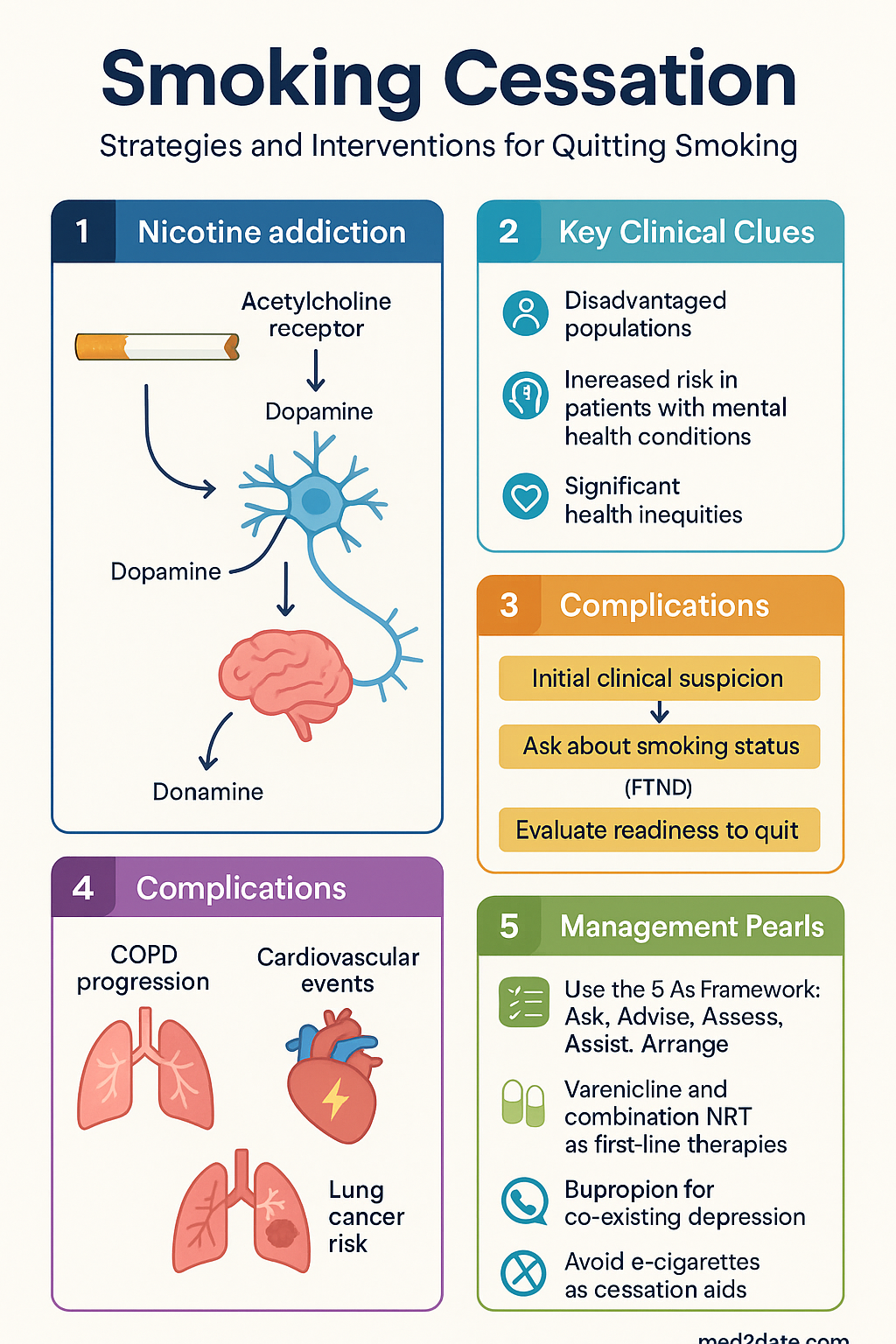
Assessment & Counselling — The 5 A's Framework
The 5 A's framework (Ask, Advise, Assess, Assist, Arrange) is the gold standard brief intervention for smoking cessation in primary care. It can be delivered in as little as 3 minutes and is supported by NHMRC Level I evidence. Embedding the 5 A's into routine practice at every consultation — regardless of the presenting complaint — is the single most important systemic change a practice can make.
The Fagerström Test for Nicotine Dependence (FTND)
| Item | Response | Score |
|---|---|---|
| Time to first cigarette after waking | ≤5 min / 6–30 min / 31–60 min / >60 min | 3 / 2 / 1 / 0 |
| Hardest cigarette to give up | First of the day / Other | 1 / 0 |
| Smoking when ill in bed | Yes / No | 1 / 0 |
| Cigarettes per day | ≤10 / 11–20 / 21–30 / ≥31 | 0 / 1 / 2 / 3 |
| Smokes more in the morning | Yes / No | 1 / 0 |
| Smokes even when very ill | Yes / No | 1 / 0 |
Interpretation: 0–2 = very low dependence; 3–4 = low; 5 = moderate; 6–7 = high; 8–10 = very high dependence. Scores ≥6 favour combination NRT or varenicline.
Motivational Interviewing Principles
Motivational interviewing (MI) is a patient-centred counselling technique that enhances intrinsic motivation to change. It is particularly useful for patients in the pre-contemplation or contemplation stages. Core principles include:
- Express empathy: Use reflective listening; accept ambivalence as normal.
- Develop discrepancy: Help the patient see the gap between current behaviour and personal goals/values.
- Avoid argumentation: Do not impose; the patient presents the reasons for change.
- Roll with resistance: Reframe resistance rather than confronting it directly.
- Support self-efficacy: Reinforce the patient's confidence and past successes.
Pharmacotherapy for Smoking Cessation
Pharmacotherapy approximately doubles quit rates compared with placebo. Three first-line agents are available in Australia: nicotine replacement therapy (NRT), varenicline, and bupropion. Combination pharmacotherapy (e.g., NRT patch + short-acting NRT, or varenicline + NRT) may be considered for highly dependent smokers or those who have relapsed on monotherapy.
First-Line Pharmacotherapy Agents
Pharmacotherapy Selection Guide
| Clinical Scenario | Preferred Agent | Rationale |
|---|---|---|
| Standard first attempt, moderate–high dependence | Combination NRT or Varenicline | Both double quit rates; combination NRT is PBS-listed without authority |
| Very high dependence (FTND ≥8) | Varenicline | Most effective single agent; blocks reward from nicotine |
| Co-existing depression/anxiety | Bupropion or Varenicline | Bupropion has antidepressant properties; both are safe with psychiatric monitoring |
| Patient preference for non-prescription | Combination NRT | Available OTC (pharmacy) and PBS (prescription) |
| Failed first-line monotherapy | Switch agent or combine NRT + varenicline | Different mechanism may succeed; combination approach for refractory cases |
| Pregnancy | NRT (patch + short-acting from 2nd trimester) | Varenicline and bupropion contraindicated |
| Adolescents (≥12 years) | NRT (short-acting preferred) | Best safety data; varenicline/bupropion not TGA-approved <18 years |
Combination and Second-Line Strategies
- NRT patch + short-acting NRT: First-line combination approach. The patch provides steady-state nicotine; the short-acting form (gum, lozenge, spray) manages breakthrough cravings.
- Varenicline + NRT: Emerging evidence supports combining varenicline with NRT patch for highly dependent smokers or those who have failed monotherapy. May be considered on a case-by-case basis.
- NRT + bupropion: May be used when neither agent alone is sufficient. Monitor blood pressure and for seizure risk.
- Second-line (not PBS-listed for cessation): Clonidine (0.1 mg BD, titrate) or nortriptyline (25 mg OD, titrate to 75–100 mg) — limited evidence, more side effects. Reserve for cases where all first-line options are contraindicated or have failed.
Behavioural Support
Behavioural support, when combined with pharmacotherapy, produces the highest quit rates achievable with current interventions — approximately 25–30% sustained abstinence at 6 months. The combination is synergistic: pharmacotherapy reduces withdrawal and craving, while behavioural support addresses the psychological and social dimensions of nicotine addiction.
Levels of Behavioural Intervention
Counselling Strategies
- Problem-solving and skills training: Help the patient identify triggers (stress, alcohol, social situations) and develop specific coping strategies (delay, deep breathing, distraction, substitution).
- Cognitive restructuring: Challenge unhelpful thoughts (e.g., "I can't cope without cigarettes" → "I've coped with difficult situations before; smoking doesn't actually help me cope").
- Stress management: Teach relaxation techniques — progressive muscle relaxation, mindfulness, and paced breathing.
- Weight management support: Address weight gain concerns proactively. Average weight gain is 3–5 kg in the first year. Emphasise that health benefits of quitting far outweigh modest weight gain. Encourage physical activity.
- Mood management: Monitor for depressive symptoms during quit attempts. Provide strategies or referral as needed. Depression during cessation is often transient.
Digital Interventions & Australian Resources
| Resource | Type | Access |
|---|---|---|
| Quitline | Telephone counselling (proactive callback available) | 13 7848 (13 QUIT) — free, all states/territories |
| My QuitBuddy | Smartphone app (iOS/Android) | Free — developed by the Australian Government |
| QuitCoach | Online interactive tool | quit.org.au — personalised quit plan |
| iCanQuit | Online community and resources | icanquit.com.au — NSW-focused, nationally available |
| QuitTxt | SMS-based support programme | Available via Quitline registration |
Relapse Prevention
Relapse is common and should be expected — it is part of the quitting process, not a sign of failure. Most smokers require multiple quit attempts before achieving sustained abstinence (average 8–30 attempts in the literature).
- Identify high-risk situations: Alcohol consumption, socialising with smokers, stress, boredom, and specific locations (pubs, work breaks).
- Develop coping plans: For each high-risk situation, the patient should have a pre-planned alternative behaviour.
- Extend pharmacotherapy: Consider extended courses of varenicline (24 weeks) or NRT patch for patients who relapse during or shortly after a standard course.
- Maintain contact: Schedule regular follow-up for at least 12 months. Monthly check-ins (phone, SMS, or in-person) sustain motivation and catch early relapse.
- Address alcohol and other substance use: Heavy alcohol use is a major relapse trigger. Address concurrently.
Special Populations
Pregnancy
Smoking during pregnancy increases the risk of miscarriage, preterm birth, low birth weight, placental abruption, stillbirth, and sudden infant death syndrome (SIDS). Approximately 9% of Australian women smoke during pregnancy, with rates up to 40% among Aboriginal and Torres Strait Islander women.
Adolescents (12–17 years)
Adolescent smoking rates in Australia have declined to <2% daily smoking, but experimentation continues. Adolescents who smoke are highly susceptible to rapid nicotine dependence. Evidence for pharmacotherapy in adolescents is limited.
Psychiatric Comorbidities
People with mental illness smoke at 2–3 times the population rate and have higher nicotine dependence. Smoking contributes significantly to their excess cardiovascular and cancer mortality. Critically, cessation does not worsen psychiatric symptoms — meta-analyses show improvements in anxiety, depression, and quality of life after quitting.
COPD Patients
Smoking cessation is the single most effective intervention to slow the rate of FEV₁ decline and reduce exacerbations in COPD. Even in severe COPD, cessation improves symptoms, exercise tolerance, and quality of life. The benefits of cessation exceed those of any inhaled pharmacotherapy.
Cardiovascular Disease (CVD) Patients
Smoking cessation after acute coronary syndrome reduces mortality by 30–50% — more effective than any single cardiac medication. Benefits are seen at any age. NRT is safe post-MI and post-stroke (discuss with cardiologist for patch use in acute setting). Varenicline does not increase cardiovascular events (EAGLES trial).
E-Cigarette / Vaping Cessation
E-cigarette use (vaping) is increasing in Australia, particularly among young adults. While e-cigarettes are promoted by some as cessation aids, Australian regulatory authorities (TGA, NHMRC) do not endorse them as first-line cessation tools due to insufficient evidence of long-term efficacy and safety, and concerns about dual use, youth uptake, and lung injury.
Aboriginal and Torres Strait Islander Health Considerations
Tobacco smoking is the most modifiable risk factor contributing to the health gap between Aboriginal and Torres Strait Islander peoples and non-Indigenous Australians. Approximately 37% of Indigenous Australians smoke daily — more than three times the non-Indigenous rate. Smoking is a major contributor to the excess burden of cardiovascular disease, COPD, lung cancer, and low birth weight in Indigenous communities.
Importantly, smoking rates among Aboriginal and Torres Strait Islander peoples have been declining significantly — from 51% in 2002 to approximately 37% in 2022–23 — reflecting the success of Indigenous-led health promotion initiatives. However, further progress requires culturally safe, community-driven approaches.
Evidence-Based Strategies for Aboriginal and Torres Strait Islander Communities
Monitoring & Follow-Up
Regular follow-up is one of the strongest predictors of sustained smoking abstinence. A structured monitoring plan increases quit rates by 25% or more compared to unstructured care.
Objective Verification
- Exhaled carbon monoxide (CO-oximetry): A reading <10 ppm suggests abstinence (or very low tobacco intake). Useful for confirming self-report in clinical settings. Handheld devices are available in most respiratory clinics and some GP practices.
- Urinary cotinine: More sensitive than CO but more expensive. Cotinine has a half-life of 16–20 hours and detects nicotine use within the preceding 3–4 days. Useful for research, medicolegal, or insurance contexts.
- Self-report: Adequate for routine clinical care when supported by therapeutic rapport. Validate non-judgementally.
Relapse Assessment & Management
If a patient relapses, assess the circumstances systematically:
- What triggered the relapse? (Stress, alcohol, social situations, medication side effects leading to discontinuation)
- Was pharmacotherapy used correctly and at adequate dose/duration?
- Was behavioural support engaged?
- Are there untreated comorbidities (depression, anxiety, substance use)?
- Is the patient ready to try again? If so, set a new quit date within 2–4 weeks and intensify treatment (switch agent, combine therapies, increase counselling).
Quick Reference: Smoking Cessation Pharmacotherapy
📚 References
- 1. Australian Bureau of Statistics. National Health Survey 2022–23. Canberra: ABS; 2024. Smoking behaviour and tobacco use statistics.
- 2. Australian Institute of Health and Welfare. National Drug Strategy Household Survey 2022–23. Drug Statistics series no. 40. Canberra: AIHW; 2024.
- 3. Australian Institute of Health and Welfare. Aboriginal and Torres Strait Islander Health Performance Framework: Summary report 2023. Canberra: AIHW; 2023.
- 4. Lindson N, Chepkin SC, Livingstone-Banks J, et al. Different doses, durations and modes of delivery of nicotine replacement therapy for smoking cessation. Cochrane Database Syst Rev. 2019;4(4):CD013308.
- 5. Anthenelli RM, Benowitz NL, West R, et al. Neuropsychiatric safety and efficacy of varenicline, bupropion, and nicotine patch in smokers with and without psychiatric disorders (EAGLES): a double-blind, randomised, placebo-controlled clinical trial. Lancet. 2016;387(10037):2507–2520.
- 6. Cahill K, Lindson-Hawley N, Thomas KH, Fanshawe TR, Lancaster T. Nicotine receptor partial agonists for smoking cessation. Cochrane Database Syst Rev. 2016;(5):CD006103.
- 7. Stead LF, Koilpillai P, Fanshawe TR, Lancaster T. Combined pharmacotherapy and behavioural interventions for smoking cessation. Cochrane Database Syst Rev. 2016;(3):CD008286.
- 8. Royal Australian College of General Practitioners. Supporting smoking cessation: A guide for health professionals. Melbourne: RACGP; 2021.
- 9. Department of Health and Aged Care (Australia). Tackling Indigenous Smoking Programme. Canberra: Australian Government; 2023. Available at: https://www.health.gov.au/our-work/tackling-indigenous-smoking
- 10. National Health and Medical Research Council. CEO Statement on Electronic Cigarettes. Canberra: NHMRC; 2022.
- 11. Thomas D, Abramson MJ, Bonevski B, George J. System-level change for smoking cessation in general practice: a cluster randomised trial. Addiction. 2018;113(6):1081–1089.
- 12. van der Deen FS, Wilson N, Blakely T. Smoking prevalence trends in New Zealand and Australia: implications for tobacco control policy. Aust N Z J Public Health. 2023;47(1):100010.
- 13. Hartmann-Boyce J, Chepkin SC, Ye W, Bullen C, Lancaster T. Nicotine replacement therapy versus control for smoking cessation. Cochrane Database Syst Rev. 2018;(5):CD000146.
- 14. Bhalala U, Ghafoor A, Mistry R, et al. Bupropion for smoking cessation in people with schizophrenia and schizoaffective disorder: a systematic review. J Clin Psychiatry. 2022;83(3):21r14118.
- 15. Therapeutic Goods Administration. Reforms to regulation of nicotine vaping products. Canberra: Department of Health and Aged Care; 2024. Available at: https://www.tga.gov.au/products/unapproved-therapeutic-products/nicotine-vaping-therapeutic-goods