📋 Key Information Summary
- NSCLC accounts for approximately 80–85% of all lung cancers in Australia; lung cancer is the leading cause of cancer death nationally, with over 14,000 new diagnoses annually (AIHW 2024).
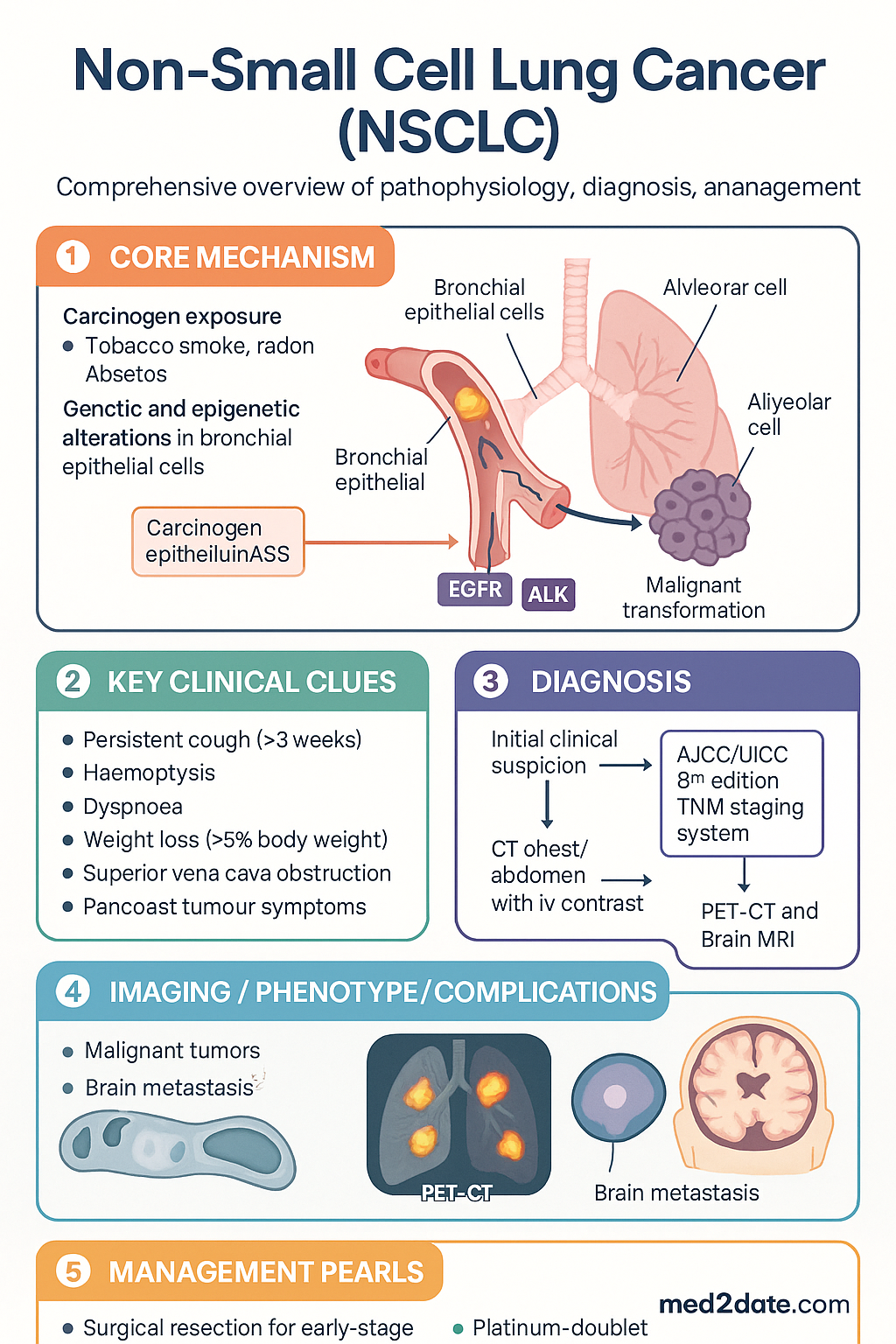
- Staging follows the AJCC/UICC 8th edition TNM system; accurate staging with PET-CT, brain MRI, and mediastinal tissue sampling is essential before treatment decisions.
- Early-stage (Stage I–II) NSCLC is treated with surgical resection (lobectomy preferred via VATS), with adjuvant cisplatin-based chemotherapy for Stage II and select Stage IB tumours ≥4 cm.
- Stereotactic body radiotherapy (SBRT) is the standard of care for medically inoperable Stage I–II NSCLC, delivering biologically effective doses ≥100 Gy.
- Platinum-doublet chemotherapy (cisplatin or carboplatin + pemetrexed, paclitaxel, gemcitabine, or docetaxel) remains the backbone for advanced non-squamous and squamous NSCLC without driver mutations.
- Comprehensive molecular testing (EGFR, ALK, ROS1, BRAF V600E, KRAS G12C, MET exon 14, RET, NTRK, HER2) is mandatory for all advanced non-squamous NSCLC and should be considered for squamous histology in never/light smokers.
- First-line EGFR TKIs (osimertinib), ALK inhibitors (alectinib, lorlatinib), and ROS1 inhibitors (crizotinib, entrectinib) produce superior progression-free survival compared with chemotherapy.
- Immunotherapy with PD-1/PD-L1 inhibitors (pembrolizumab, nivolumab, atezolizumab, durvalumab) has transformed outcomes; PD-L1 tumour proportion score (TPS) guides first-line use as monotherapy or in combination.
- Pembrolizumab monotherapy is first-line for PD-L1 TPS ≥50% without targetable mutations; pembrolizumab + platinum-pemetrexed is standard for PD-L1 <50% non-squamous NSCLC.
- Immune-related adverse events (irAEs) — pneumonitis, colitis, hepatitis, endocrinopathy, nephritis — require early recognition, steroid therapy, and potential permanent discontinuation of immunotherapy.
- Stage III unresectable NSCLC is treated with concurrent chemoradiation followed by durvalumab consolidation (PACIFIC regimen) for up to 12 months.
- Palliative radiotherapy, bone-modifying agents, and multimodal analgesia are essential components of supportive care for metastatic disease.
- Aboriginal and Torres Strait Islander Australians have significantly higher lung cancer incidence and mortality, later-stage diagnosis, and lower treatment uptake — culturally safe care pathways and equitable access are critical.
Introduction & Australian Epidemiology
Non-small cell lung cancer (NSCLC) is the most common histological subtype of lung cancer, comprising approximately 80–85% of all primary lung malignancies. The three principal histological subtypes are adenocarcinoma (~40%), squamous cell carcinoma (~25–30%), and large cell carcinoma (~5–10%). Lung cancer remains the leading cause of cancer-related death in Australia for both men and women, responsible for more deaths than breast, prostate, and colorectal cancers combined.
In Australia, the age-standardised incidence of lung cancer is approximately 38 per 100,000 population, with over 14,000 new cases diagnosed annually. Five-year overall survival remains approximately 20–22% nationally, though this varies dramatically by stage — exceeding 70% for Stage IA disease and falling below 10% for Stage IV. The most significant modifiable risk factor is tobacco smoking (responsible for ~80% of cases), though approximately 10–15% of lung cancers occur in never-smokers, driven increasingly by targetable molecular alterations.
The molecular landscape of NSCLC has been increasingly characterised, with actionable driver mutations identified in 50–70% of adenocarcinomas in never-smokers and approximately 10–30% in smokers. This has ushered in the era of precision oncology, where treatment selection is guided by molecular profiling and PD-L1 expression rather than histology alone.
| Parameter | Australian Data |
|---|---|
| Annual new cases | ~14,000 (2024 estimate, AIHW) |
| 5-year survival (all stages) | ~20–22% |
| 5-year survival (Stage IA) | ~77% |
| 5-year survival (Stage IV) | ~6–8% |
| Proportion presenting at Stage IV | ~45% |
| ATSI rate ratio vs non-Indigenous | 1.6× incidence, 1.8× mortality |
| Median age at diagnosis | 72 years |
| Smoking-related proportion | ~80% |
Pathophysiology & Molecular Classification
NSCLC arises through the sequential accumulation of genetic and epigenetic alterations in bronchial epithelial cells and alveolar cells, driven primarily by carcinogen exposure (tobacco smoke, radon, asbestos) or, in never-smokers, by endogenous mutagenic processes and oncogenic driver mutations.
Histological Subtypes
- Adenocarcinoma: Arises from peripheral glandular epithelium; most common subtype. Defined by glandular differentiation, mucin production, or specific immunohistochemical markers (TTF-1, Napsin-A). Subclassified as lepidic, acinar, papillary, micropapillary, or solid pattern. Highest prevalence of actionable driver mutations.
- Squamous cell carcinoma: Arises from central bronchial epithelium, strongly associated with smoking. CK5/6 and p40 positive. Fewer targetable mutations (PD-L1 expression often higher; FGFR alterations, PIK3CA mutations).
- Large cell carcinoma: Diagnosis of exclusion — lacks glandular, squamous, or neuroendocrine differentiation. Aggressive; large cell neuroendocrine carcinoma (LCNEC) is classified separately and managed like small cell lung cancer.
- Adenosquamous carcinoma: Mixed adenocarcinoma and squamous components (each ≥10%); managed according to predominant molecular profile.
Key Oncogenic Driver Mutations
Oncogenic driver mutations are mutually exclusive in most cases and define therapeutic targets. Their prevalence varies by smoking status and ethnicity:
| Driver Alteration | Frequency (Adenocarcinoma) | Smoking Association | Approved Targeted Therapy |
|---|---|---|---|
| EGFR mutation (exon 19 del, L858R) | 15–25% | Never/light smokers | Osimertinib, gefitinib, erlotinib, afatinib, dacomitinib |
| ALK rearrangement | 3–7% | Younger, never/light smokers | Alectinib, lorlatinib, crizotinib, brigatinib, ceritinib |
| KRAS G12C | 10–15% | Smokers | Sotorasib, adagrasib |
| ROS1 rearrangement | 1–2% | Never/light smokers | Crizotinib, entrectinib |
| BRAF V600E | 1–3% | Smokers | Dabrafenib + trametinib |
| MET exon 14 skipping | 2–4% | Elderly, smokers | Capmatinib, tepotinib |
| RET rearrangement | 1–2% | Never/light smokers | Selpercatinib, pralsetinib |
| NTRK fusion | <1% | Variable | Larotrectinib, entrectinib |
| HER2 mutation | 2–4% | Never/light smokers | Trastuzumab deruxtecan |
Clinical Presentation & Diagnostic Criteria
NSCLC presents across a wide spectrum from asymptomatic incidental findings on imaging to advanced symptomatic disease. Approximately 10–15% are detected incidentally.
Common Presenting Features
- Pulmonary symptoms: Persistent cough (>3 weeks), haemoptysis, dyspnoea, recurrent pneumonia, pleuritic chest pain, wheeze
- Systemic symptoms: Weight loss (>5% body weight), fatigue, anorexia, night sweats
- Locally advanced features: Superior vena cava (SVC) obstruction (facial swelling, plethora), hoarseness (recurrent laryngeal nerve), Horner syndrome (Pancoast tumour), phrenic nerve palsy, dysphagia (oesophageal compression), Pancoast syndrome (shoulder/arm pain, Horner's)
- Metastatic presentations: Bone pain, pathological fracture, seizures/focal neurology (brain metastases), jaundice (hepatic metastases), spinal cord compression, lymphangitis carcinomatosis
- Paraneoplastic syndromes: SIADH (small cell more common but occurs in NSCLC), hypercalcaemia (PTHrP — squamous cell), Cushing syndrome (ectopic ACTH), clubbing, hypertrophic pulmonary osteoarthropathy, Lambert-Eaton myasthenic syndrome, dermatomyositis
Diagnostic Confirmation
A tissue diagnosis (histological or cytological) is required before initiating treatment in most clinical scenarios. Adequate tissue must be obtained for histological subtype determination and molecular testing. Methods include:
- CT-guided transthoracic core biopsy: For peripheral lesions (sensitivity 85–93%)
- Bronchoscopy with endobronchial biopsy/EBUS-TBNA: For central lesions and mediastinal staging
- Endobronchial ultrasound-guided transbronchial needle aspiration (EBUS-TBNA): Gold standard for mediastinal lymph node sampling (N staging)
- Surgical biopsy (VATS wedge): When less invasive methods are non-diagnostic
- Liquid biopsy (ctDNA): Acceptable for molecular testing when tissue is insufficient or unavailable; complement to tissue biopsy
Pathology reporting must include histological subtype, differentiation grade, immunohistochemical markers (TTF-1, Napsin-A, p40, CK5/6, PD-L1 [22C3 pharmDx assay preferred for pembrolizumab eligibility]), and sufficient material for next-generation sequencing (NGS) panel testing.
Investigations
Staging Investigations
Staging & Risk Stratification
NSCLC is staged using the AJCC/UICC 8th edition TNM classification (2017). Accurate staging dictates treatment intent (curative vs palliative) and modality selection.
| Stage | TNM | 5-Year Survival | Treatment Intent |
|---|---|---|---|
| IA1–IA3 | T1a–T1c N0 M0 | 77–92% | Curative — surgery ± adjuvant |
| IB | T2a N0 M0 | 68% | Curative — surgery ± adjuvant chemo if ≥4 cm |
| IIA–IIB | T2b–T3, N0–N1 M0 | 53–60% | Curative — surgery + adjuvant chemo ± atezolizumab (if PD-L1 ≥1%) |
| IIIA | T1–T4, N2 M0 | 36% | Curative — neoadjuvant chemo/immuno + surgery or concurrent CRT |
| IIIB–IIIC | T any, N3 M0 | 13–26% | Curative intent — concurrent CRT → durvalumab |
| IVA | T any, N any, M1a–M1b | 10% | Palliative — systemic therapy |
| IVB | T any, N any, M1c | ~1–3% | Palliative — systemic therapy + supportive care |
Performance Status Assessment
Eastern Cooperative Oncology Group (ECOG) performance status (PS) is the strongest independent prognostic factor and guides treatment intensity:
Early Stage Management (Stage I–II)
Surgical resection with lobectomy remains the gold standard for early-stage NSCLC in medically fit patients. The goal is complete (R0) resection with systematic mediastinal lymph node dissection. Five-year survival for Stage IA following complete resection exceeds 80%.
Surgical Approaches
| Approach | Indications | Advantages | Considerations |
|---|---|---|---|
| VATS lobectomy | Preferred for Stage I–II, peripheral tumours ≤5 cm | Reduced pain, shorter hospital stay (3–5 days), lower morbidity, equivalent oncological outcomes | Requires experienced thoracic surgeon; conversion to open in ~5–10% |
| Robotic-assisted thoracoscopic surgery (RATS) | As per VATS; increased dexterity for complex resections | Enhanced 3D visualisation, wristed instruments | Higher cost; limited availability in regional Australia |
| Open thoracotomy | Large/central tumours, chest wall invasion, completion pneumonectomy, N2 disease requiring extensive dissection | Direct visualisation, tactile assessment | Greater postoperative pain, longer recovery (7–10 days) |
| Segmentectomy / Wedge | Stage IA1 (≤1 cm, ≥50% ground glass), poor surgical candidates, elderly with limited pulmonary reserve | Parenchymal preservation; comparable for ≤2 cm tumours (JCOG0802 trial) | Higher local recurrence risk vs lobectomy for larger tumours |
Adjuvant Chemotherapy
Adjuvant platinum-based chemotherapy improves overall survival following complete resection for Stage II and select high-risk Stage IB (≥4 cm) NSCLC. The benefit is greatest when initiated within 6–8 weeks of surgery.
Neoadjuvant Immunotherapy + Chemotherapy
Based on the CheckMate 816 trial, neoadjuvant nivolumab + platinum-doublet chemotherapy followed by surgery is now an approved option for resectable Stage IB (≥4 cm) to IIIA NSCLC. This approach significantly improved pathological complete response (pCR 24% vs 2.2%) and event-free survival.
Stereotactic Body Radiotherapy (SBRT) / SABR
Stereotactic ablative body radiotherapy (SABR/SBRT) is the standard of care for medically inoperable Stage I–II NSCLC and is increasingly discussed as an alternative to surgery for high-risk operable patients. Local control rates exceed 90% at 3 years.
- CT simulation with 4D-CT for respiratory motion management is mandatory
- Image-guided radiotherapy (IGRT) with cone-beam CT at each fraction
- Available at all major radiation oncology centres across Australia; regional access via telehealth-linked treatment planning
- Local control >90% at 3 years; comparable to surgery for T1 tumours in propensity-matched analyses
- Toxicity: radiation pneumonitis (Grade 2+ ~5–10%), rib fracture, chest wall pain
Advanced Stage Treatment (Stage IIIB–IV)
Treatment of advanced NSCLC is guided by three key assessments: (1) PD-L1 expression, (2) molecular driver mutation status, and (3) patient fitness (ECOG PS). The treatment algorithm has become increasingly complex with multiple concurrent testing modalities informing treatment selection.
First-Line Treatment Algorithm
Platinum-Doublet Chemotherapy Regimens
For patients without targetable mutations and where immunotherapy is contraindicated or as the chemotherapy backbone in chemoimmunotherapy combinations:
| Regimen | Histology | Schedule | Cycles |
|---|---|---|---|
| Cisplatin + Pemetrexed | Non-squamous | Cisplatin 75 mg/m² + Pemetrexed 500 mg/m² q21d | 4–6 + maintenance pemetrexed |
| Carboplatin + Pemetrexed | Non-squamous | Carboplatin AUC 5 + Pemetrexed 500 mg/m² q21d | 4–6 + maintenance pemetrexed |
| Carboplatin + Paclitaxel | Squamous or non-squamous | Carboplatin AUC 6 + Paclitaxel 200 mg/m² q21d | 4–6 cycles |
| Carboplatin + Gemcitabine | Squamous | Carboplatin AUC 5 Day 1 + Gemcitabine 1000 mg/m² Days 1,8 q21d | 4–6 cycles |
| Cisplatin + Gemcitabine | Squamous | Cisplatin 75 mg/m² Day 1 + Gemcitabine 1250 mg/m² Days 1,8 q21d | 4–6 cycles |
| Carboplatin + Docetaxel | Squamous or non-squamous | Carboplatin AUC 6 + Docetaxel 75 mg/m² q21d | 4–6 cycles |
Immunotherapy
Immune checkpoint inhibitors (ICIs) targeting the PD-1/PD-L1 axis have transformed the treatment landscape for NSCLC, producing durable responses in 15–25% of patients and significantly improving overall survival. Immunotherapy is now standard of care in the first-line, second-line, adjuvant, consolidation (Stage III), and neoadjuvant settings.
PD-1/PD-L1 Inhibitors — Approved Agents
Combination Strategies
| Setting | Regimen | Key Trial | PD-L1 Requirement |
|---|---|---|---|
| 1st line, PD-L1 ≥50% | Pembrolizumab monotherapy | KEYNOTE-024 | TPS ≥50% |
| 1st line, non-squamous | Pembrolizumab + carboplatin + pemetrexed | KEYNOTE-189 | All comers |
| 1st line, squamous | Pembrolizumab + carboplatin + paclitaxel/nab-paclitaxel | KEYNOTE-407 | All comers |
| 1st line, non-squamous (bevacizumab eligible) | Atezolizumab + bevacizumab + carboplatin + paclitaxel | IMpower150 | All comers (no EGFR/ALK) |
| Stage III, post-CRT | Durvalumab consolidation | PACIFIC | All comers |
| 2nd line | Nivolumab monotherapy | CheckMate 017/057 | Not required |
| Nivo + Ipi (1st line, PD-L1 ≥1%) | Nivolumab + ipilimumab ± chemo | CheckMate 227 / 9LA | TC ≥1% (227) / All comers (9LA) |
Immune-Related Adverse Events (irAEs)
| irAE | Incidence | Key Features | Management |
|---|---|---|---|
| Pneumonitis | 3–5% (Grade ≥3: 1–2%) | Cough, dyspnoea, new ground-glass opacities on CT | Grade 2: Hold ICI, prednisolone 1–2 mg/kg/day, taper over ≥4 weeks. Grade 3–4: Permanently discontinue, methylprednisolone 1–2 mg/kg IV, add infliximab or mycophenolate if refractory. |
| Colitis | 1–4% | Diarrhoea, abdominal pain, raised CRP/faecal calprotectin | Grade 2: Hold ICI, prednisolone 1 mg/kg. Grade 3–4: Discontinue, IV steroids, infliximab if steroid-refractory. |
| Hepatitis | 1–3% | Elevated ALT/AST, may be asymptomatic | Grade 2: Hold, prednisolone 0.5–1 mg/kg. Grade 3–4: Discontinue, IV steroids, mycophenolate if refractory (avoid infliximab). |
| Endocrinopathy | 5–10% | Thyroiditis/hypothyroidism, hypophysitis, adrenal insufficiency, Type 1 DM | Thyroid: levothyroxine replacement; continue ICI if mild. Hypophysitis: hydrocortisone replacement, may continue ICI. Adrenal crisis: urgent IV hydrocortisone 100 mg stat. |
| Nephritis | 1–2% | Rising creatinine, proteinuria, eosinophiluria | Grade 2: Hold, prednisolone 0.5–1 mg/kg. Grade 3–4: Discontinue, IV steroids. |
| Dermatological | 15–30% | Maculopapular rash, pruritus, vitiligo (associated with response) | Topical corticosteroids for mild; oral steroids for severe. May continue ICI for mild–moderate. |
Biomarker Testing for Immunotherapy
- PD-L1 TPS (22C3 pharmDx): Required for all advanced NSCLC. TPS ≥50%: high expression; TPS 1–49%: low expression; TPS <1%: negative. Used to guide pembrolizumab monotherapy eligibility.
- PD-L1 TC/IC (SP142 and SP263): Used for atezolizumab (IMpower studies). Different assays may give discordant results — assays are not interchangeable.
- Tumour mutational burden (TMB): Not routinely recommended in Australia. High TMB (≥10 mutations/Mb) may predict benefit from immunotherapy but is not a required companion diagnostic.
- Microsatellite instability (MSI-H) / dMMR: Rare in NSCLC (<1%) but pembrolizumab approved as tumour-agnostic indication (KEYNOTE-158).
Targeted Therapy
Molecular-targeted therapies represent the most significant advance in NSCLC treatment for patients with actionable driver mutations. These agents produce superior progression-free survival, response rates, and quality of life compared with chemotherapy, and should be used as first-line therapy when a targetable alteration is identified.
EGFR-Mutant NSCLC
EGFR mutations (exon 19 deletion and L858R point mutation account for ~85% of EGFR mutations) are the most common actionable drivers in Australian NSCLC, found in 15–25% of adenocarcinomas, predominantly in never-smokers and those of Asian ancestry.
ALK-Rearranged NSCLC
ALK rearrangements are found in 3–7% of NSCLC adenocarcinomas, predominantly in younger patients and never/light smokers. Multiple generations of ALK inhibitors are available with sequential benefit at progression.
ROS1-Rearranged NSCLC
BRAF V600E-Mutant NSCLC
KRAS G12C-Mutant NSCLC
Other Emerging Targets
| Target | Agent | Key Data | Australian Access |
|---|---|---|---|
| MET exon 14 skipping | Capmatinib (Tabrecta®), tepotinib (Tepmetko®) | ORR 41–68%; responses in treatment-naïve and pre-treated | SAS / compassionate access |
| RET rearrangement | Selpercatinib (Retevmo®), pralsetinib (Gavreto®) | ORR 61–85% (treatment-naïve); LIBRETTO-431, ARROW trials | PBS Authority Required (selpercatinib — 2024 listing) |
| NTRK fusion | Larotrectinib (Vitrakvi®), entrectinib (Rozlytrek®) | ORR 57–75% (tumour-agnostic); rare in NSCLC | SAS / compassionate access |
| HER2 mutation | Trastuzumab deruxtecan (Enhertu®) | DESTINY-Lung02: ORR ~49%; antibody-drug conjugate | SAS / compassionate access |
Resistance Mechanisms
Resistance to targeted therapy is inevitable and is broadly classified as on-target (alteration in the target itself) or off-target (activation of bypass signalling pathways):
- EGFR TKI resistance: T790M (1st/2nd gen TKIs — treat with osimertinib); C797S (osimertinib); MET amplification (15–20%); SCLC histological transformation (3–10%); HER2 amplification; RAS-MAPK pathway activation
- ALK TKI resistance: ALK secondary mutations (G1202R — sensitive to lorlatinib); ALK amplification; bypass signalling (EGFR, KIT, RAS)
- Management at progression: Re-biopsy (tissue and/or liquid) to identify resistance mechanism and guide subsequent therapy. Participation in clinical trials encouraged.
Supportive Care & Palliative Management
Supportive care is integral to NSCLC management at all stages and should be introduced early alongside active treatment. Early palliative care integration has been shown to improve quality of life and overall survival in metastatic NSCLC (Temel et al., NEJM 2010).
Palliative Radiotherapy
Pleural Effusion Management
Pain Management
Cancer pain in NSCLC is multifactorial (tumour invasion, bone metastases, neuropathic pain from nerve involvement, treatment-related). Use the WHO analgesic ladder with modification:
Bone-Modifying Agents
Palliative Chemotherapy
Palliative-intent chemotherapy aims to improve symptoms, quality of life, and survival. Treatment decisions balance benefit against toxicity, considering comorbidities, patient preference, and PS. Maintenance therapy (pemetrexed for non-squamous, pembrolizumab for responders) extends benefit after initial response.
Monitoring
Post-Treatment Surveillance (Curative Intent)
Monitoring During Systemic Therapy
| Therapy | Monitoring Parameters | Frequency |
|---|---|---|
| Chemotherapy | FBC (nadir), LFTs, renal function (eGFR), electrolytes, CT response assessment q6–9 weeks | Pre each cycle; CT every 2–3 cycles |
| Immunotherapy | TFTs, LFTs, cortisol, glucose, renal function, FBC; CT response q9–12 weeks | Every cycle; TFTs/cortisol q6–8 weeks |
| EGFR TKIs | LFTs, ECG (QTc — osimertinib), electrolytes; CT response q6–12 weeks | Monthly LFTs initially; ECG baseline + 1 month |
| ALK inhibitors | LFTs, CPK, lipids (lorlatinib), ECG (bradycardia), blood glucose; CT response q6–12 weeks | Monthly initially; lipid panel with lorlatinib |
| Bone-modifying agents | Calcium, phosphate, magnesium (each cycle); renal function; dental review q6–12 months | Pre each infusion; dental within 3 months of starting |
Response Assessment
- RECIST 1.1: Standard criteria for assessing response on CT — complete response (CR), partial response (PR), stable disease (SD), progressive disease (PD)
- iRECIST: Modified criteria for immunotherapy — allows for pseudoprogression (initial tumour growth followed by response). Confirmation scan at 4–8 weeks recommended before declaring progression on immunotherapy.
- Pseudoprogression: Occurs in ~5–10% of immunotherapy patients. If clinical status stable, continue immunotherapy and re-scan in 4–8 weeks before changing treatment.
Special Populations
Pregnancy
Paediatrics & Young Adults
Elderly (≥70 years)
Renal Impairment
Hepatic Impairment
Immunocompromised
Aboriginal and Torres Strait Islander Australians experience a disproportionate burden of lung cancer, with incidence approximately 1.6 times and mortality 1.8 times that of non-Indigenous Australians (AIHW 2023). Lung cancer is the most commonly diagnosed cancer and leading cause of cancer death among Indigenous Australians. The disparity is driven by higher smoking prevalence (40% vs 11% in non-Indigenous), later-stage diagnosis, reduced access to specialist services in regional and remote areas, and lower treatment uptake rates.
📚 References
- 1. Australian Institute of Health and Welfare (AIHW). Lung cancer in Australia. Canberra: AIHW; 2024. Cat. no. CAN 142.
- 2. National Health and Medical Research Council (NHMRC). Clinical practice guidelines for the prevention, diagnosis and management of lung cancer. Sydney: Cancer Council Australia; 2023. Available from: wiki.cancer.org.au.
- 3. Goldstraw P, Chansky K, Crowley J, et al. The IASLC Lung Cancer Staging Project: proposals for revision of the TNM stage groupings in the forthcoming (eighth) edition of the TNM Classification for Lung Cancer. J Thorac Oncol. 2016;11(1):39–51.
- 4. Soria JC, Ohe Y, Vansteenkiste J, et al. Osimertinib in untreated EGFR-mutated advanced non–small-cell lung cancer. N Engl J Med. 2018;378(2):113–125. (FLAURA trial)
- 5. Peters S, Camidge DR, Shaw AT, et al. Alectinib versus crizotinib in untreated ALK-positive non–small-cell lung cancer. N Engl J Med. 2017;377(9):829–838. (ALEX trial)
- 6. Gandhi L, Rodríguez-Abreu D, Gadgeel S, et al. Pembrolizumab plus chemotherapy in metastatic non–small-cell lung cancer. N Engl J Med. 2018;378(22):2078–2092. (KEYNOTE-189)
- 7. Antonia SJ, Villegas A, Daniel D, et al. Durvalumab after chemoradiotherapy in stage III non–small-cell lung cancer. N Engl J Med. 2017;377(20):1919–1929. (PACIFIC trial)
- 8. Forde PM, Spicer J, Lu S, et al. Neoadjuvant nivolumab plus chemotherapy in resectable lung cancer. N Engl J Med. 2022;386(21):1973–1985. (CheckMate 816)
- 9. Wu YL, Tsuboi M, He J, et al. Osimertinib in resected EGFR-mutated non–small-cell lung cancer. N Engl J Med. 2020;383(18):1711–1723. (ADAURA trial)
- 10. Skoulidis F, Li BT, Dy GK, et al. Sotorasib for lung cancers with KRAS p.G12C mutation. N Engl J Med. 2021;384(25):2371–2381. (CodeBreaK 100/200)
- 11. Temel JS, Greer JA, Muzikansky A, et al. Early palliative care for patients with metastatic non–small-cell lung cancer. N Engl J Med. 2010;363(8):733–742.
- 12. Shaw AT, Bauer TM, de Marinis F, et al. First-line lorlatinib or crizotinib in advanced ALK-positive lung cancer. N Engl J Med. 2020;383(21):2018–2029. (CROWN trial)
- 13. Royal Australian and New Zealand College of Radiologists (RANZCR). Quality Use of Radiation in Oncology — Lung Cancer Guidelines. Sydney: RANZCR; 2023.
- 14. Australian Government Department of Health. National Lung Cancer Screening Programme — Program guidelines. Canberra: Department of Health and Aged Care; 2025.
- 15. Conners P, Stajic J, Diaz A, et al. Lung cancer outcomes for Aboriginal and Torres Strait Islander peoples in Australia: a systematic review. Aust N Z J Public Health. 2023;47(2):100035.
- 16. Brahmer JR, Lacchetti C, Schneider BJ, et al. Management of immune-related adverse events in patients treated with immune checkpoint inhibitor therapy: American Society of Clinical Oncology clinical practice guideline. J Clin Oncol. 2018;36(17):1714–1768.
- 17. Planchard D, Besse B, Groen HJM, et al. Dabrafenib plus trametinib in patients with previously treated BRAF V600E-mutant metastatic non-small cell lung cancer: an open-label, multicentre phase 2 trial. Lancet Oncol. 2016;17(7):984–993.
- 18. Socinski MA, Jotte RM, Cappuzzo F, et al. Atezolizumab for first-line treatment of metastatic nonsquamous NSCLC. N Engl J Med. 2018;378(24):2288–2301. (IMpower150)