📋 Key Information Summary
- Asthma affects approximately 2.7 million Australians (~11% of the population); it is one of the most common chronic diseases managed in primary care and a leading cause of preventable hospitalisation.
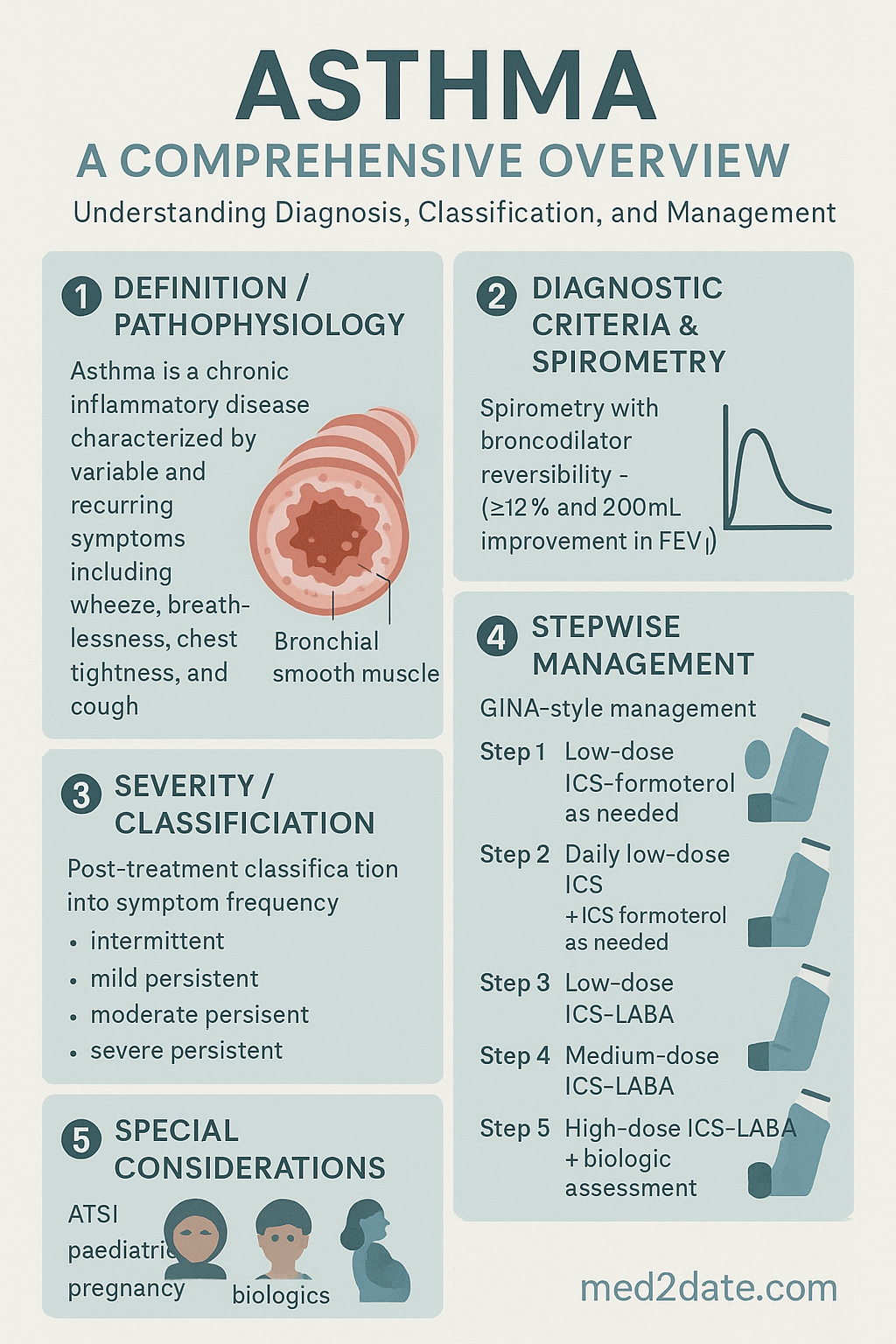
- Diagnosis requires evidence of variable airflow obstruction — spirometry with bronchodilator reversibility (≥12% and ≥200 mL improvement in FEV₁) is the gold standard; fractional exhaled nitric oxide (FeNO ≥40 ppb) supports eosinophilic airway inflammation.
- Severity is classified post-treatment as intermittent, mild persistent, moderate persistent, or severe persistent based on symptom frequency, night-time awakening, reliever use, and lung function.
- Phenotyping (eosinophilic T2-high vs non-eosinophilic T2-low) guides biologic selection and predicts corticosteroid responsiveness.
- GINA stepwise management: Step 1–2 — low-dose ICS-formoterol as needed (MART) or regular low-dose ICS + as-needed SABA; Step 3 — low-dose ICS-LABA maintenance; Step 4 — medium-dose ICS-LABA ± LAMA; Step 5 — high-dose ICS-LABA + refer for biologic assessment.
- Low-dose ICS-formoterol as-needed (MART approach) is now preferred at GINA Steps 1–2 over SABA-only to reduce the risk of serious exacerbations and asthma-related death.
- Acute severe asthma: give oxygen to target SpO₂ 94–98%, nebulised salbutamol 5 mg every 20 min for 3 doses then 4–6-hourly, ipratropium bromide 500 µg nebulised every 20 min for 3 doses in severe attacks, and systemic corticosteroids (prednisolone 50 mg PO or hydrocortisone 200 mg IV) within 1 hour.
- Life-threatening features requiring ICU: SpO₂ <92%, silent chest, cyanosis, feeble respiratory effort, confusion, exhaustion, PaCO₂ ≥45 mmHg, pH <7.35 — escalate to IV magnesium sulphate 2 g over 20 min and consider intubation.
- Five biologic classes are PBS-listed for severe uncontrolled asthma (≥2 exacerbations/year despite high-dose ICS-LABA ± LAMA): omalizumab (anti-IgE), mepolizumab and reslizumab (anti-IL-5), benralizumab (anti-IL-5Rα), and dupilumab (anti-IL-4Rα) — all require authority PBS approval.
- Exercise-induced bronchoconstriction (EIB) is managed with warm-up, SABA pre-exercise, and regular ICS if frequent; occupational asthma requires early identification, exposure cessation, and WorkCover notification.
- In pregnancy, maintain asthma control — uncontrolled asthma poses greater fetal risk than controller medications; budesonide ICS is the preferred controller (most safety data), and montelukast is generally avoided.
- Aboriginal and Torres Strait Islander Australians have 1.4–2.1 times the asthma prevalence and 2–3 times the hospitalisation rate; culturally safe care, Indigenous health worker support, and addressing environmental triggers (dust, smoke, overcrowded housing) are essential.
- Annual influenza vaccination and pneumococcal vaccination are recommended; smoking cessation support is a priority in all patients with asthma.
Introduction & Australian Epidemiology
Asthma is a heterogeneous chronic inflammatory disease of the airways characterised by variable and recurring episodes of wheeze, breathlessness, chest tightness, and cough. These symptoms are associated with variable expiratory airflow limitation that is often reversible — either spontaneously or with treatment. The condition affects all ages, though onset is most common in childhood and a second peak occurs in middle age.
In Australia, asthma is a major public health burden. The Australian Bureau of Statistics National Health Survey (2022) estimates that approximately 2.7 million Australians (10.7%) currently have asthma. Key Australian epidemiological data include:
- Asthma is the leading cause of preventable hospitalisation in children under 15 and among the top five chronic conditions managed in general practice nationally.
- Approximately 40,000 asthma-related hospitalisations occur annually, with the highest rates in children aged 0–4 and adults over 65.
- Around 400 Australians die from asthma each year (AIHW, 2023), with a disproportionate number being older adults and those with underrecognised or undertreated disease.
- Prevalence is highest in Tasmania and Queensland and lowest in the Northern Territory for non-Indigenous populations; however, the reverse is true for Aboriginal and Torres Strait Islander Australians in remote areas.
- Approximately 50% of Australians with asthma report poorly controlled symptoms — defined by the Asthma Control Questionnaire or frequent reliever use (>2 days/week).
- The economic burden exceeds AUD 28 billion annually (including direct healthcare costs, productivity losses, and carer burden), as estimated by Asthma Australia (2023).
Asthma phenotyping has evolved considerably. The traditional approach — classifying by severity alone — has been supplemented by treatable traits and endotype-driven therapy. The key distinction is between T2-high (eosinophilic) and T2-low (neutropholic or paucigranulocytic) asthma, which has direct implications for biologic eligibility and corticosteroid responsiveness.
Diagnosis & Classification
Clinical Diagnosis
A diagnosis of asthma should be suspected in any patient presenting with episodic wheeze, breathlessness, chest tightness, or cough — particularly if symptoms are worse at night, on exercise, or with allergen exposure, and improve spontaneously or with bronchodilator therapy. Diagnosis must be confirmed objectively wherever possible; treatment should not be initiated empirically without at least one supporting objective test, except in acute presentations where treatment should not be delayed.
Spirometry with Bronchodilator Response
Spirometry is the gold-standard investigation for diagnosing airflow obstruction and demonstrating reversibility. Per NHMRC/Australian Asthma Handbook guidelines:
- Obtain baseline FEV₁, FVC, and FEV₁/FVC ratio.
- An FEV₁/FVC ratio below the lower limit of normal (LLN, generally <0.70 in adults) confirms airflow obstruction.
- Administer 200–400 µg salbutamol via MDI + spacer and repeat spirometry after 15–20 minutes.
- A positive bronchodilator response is defined as ≥12% AND ≥200 mL improvement in FEV₁ from baseline.
- If baseline spirometry is normal but clinical suspicion remains, consider a bronchial provocation challenge (mannitol — Aridol® — or methacholine) to assess airway hyperresponsiveness. A PD₂₀ mannitol <155 mg or PC₂₀ methacholine <8 mg/mL is considered positive.
Fractional Exhaled Nitric Oxide (FeNO)
FeNO is a point-of-care biomarker of eosinophilic (T2-high) airway inflammation. It is measured by having the patient exhale at a steady flow rate of 50 mL/s into a portable analyser (NIOX VERO® or NObreath®).
- FeNO <25 ppb (adults) or <20 ppb (children): Eosinophilic inflammation unlikely; consider non-eosinophilic causes. A low FeNO with persistent symptoms should prompt reconsideration of the diagnosis.
- FeNO 25–50 ppb: Intermediate — interpret alongside clinical context, blood eosinophils, and spirometry.
- FeNO >50 ppb: Strongly suggestive of eosinophilic airway inflammation; predicts good response to ICS therapy and supports biologic eligibility.
- FeNO can be elevated by atopy, rhinosinusitis, and dietary nitrates; it is reduced by smoking, bronchoconstriction, and within 4 hours of SABA use.
MBS item 11506 covers FeNO measurement in Australia. It is available in most respiratory function laboratories and some specialist practices.
Other Investigations
Severity Classification
Asthma severity should be assessed after the patient has been on controller therapy for at least 2–3 months. Severity reflects the minimum treatment required to maintain control. The Australian Asthma Handbook (NHMRC) classifies severity as follows:
| Severity | Daytime Symptoms | Night-Time Waking | Reliever Use | Activity Limitation | FEV₁ (% predicted) |
|---|---|---|---|---|---|
| Intermittent | ≤2 days/week | ≤2 times/month | ≤2 days/week | None | ≥80% |
| Mild Persistent | >2 days/week but not daily | 3–4 times/month | >2 days/week but not daily | Minor | ≥80% |
| Moderate Persistent | Daily | >1 time/week but not nightly | Daily | Some limitation | 60–80% |
| Severe Persistent | Throughout the day | Often nightly | Several times/day | Extremely limited | <60% |
Phenotyping — T2-High vs T2-Low
Modern asthma management increasingly relies on endotyping to guide therapy. The distinction between type 2 inflammatory (T2-high) and non-type 2 (T2-low) phenotypes has direct therapeutic implications, particularly for biologic eligibility.
Stepwise Management
The stepwise approach to asthma management follows the Global Initiative for Asthma (GINA) 2023/2024 strategy, adapted for the Australian context by the NHMRC Australian Asthma Handbook. The goal is to achieve and maintain symptom control with the minimum effective therapy, while minimising the risk of exacerbations, fixed airflow limitation, and medication side effects.
GINA Stepwise Framework
Controller Medications
Reliever Medications
Step-Up / Step-Down Protocols
Review every 2–3 months when initiating or changing therapy. When asthma has been well controlled for at least 3 months, consider stepping down:
- Step-down from Step 3 or 4: Reduce ICS dose by 25–50% every 3 months while maintaining LABA. Do not stop ICS abruptly.
- Step-down from Step 2: Reduce ICS to lowest effective dose (e.g., budesonide 100–200 µg/day). MART patients can reduce maintenance to once daily.
- Discontinuing controller therapy: Consider only if symptom-free for ≥3 months on lowest-dose ICS, normal FeNO, and no risk factors for exacerbations. Continue as-needed ICS-formoterol if previously MART.
- Never stop ICS completely in patients with prior life-threatening exacerbations, fixed airflow limitation, or frequent exacerbations on step-down.
Acute Exacerbations
Severity Assessment
Acute asthma exacerbations (asthma attacks) are characterised by progressive worsening of breathlessness, cough, wheeze, or chest tightness over hours to days, associated with a reduction in expiratory airflow. Rapid assessment using clinical features and objective measures is essential to guide treatment intensity.
Emergency Management
Step 1 — Immediate (within minutes)
- Oxygen: Titrate to maintain SpO₂ 94–98%. Avoid hyperoxaemia (routine high-flow O₂ is not recommended unless life-threatening). Use nasal prongs or Hudson mask.
- Salbutamol nebulised: 5 mg via oxygen-driven nebuliser, repeated every 20 minutes for 3 doses in the first hour. Can also use 4–8 puffs of salbutamol 100 µg via MDI + spacer (equivalent efficacy in mild–moderate attacks). Continuous nebulisation (10–15 mg/hr) for severe attacks.
- Ipratropium bromide: 500 µg nebulised, added to salbutamol every 20 minutes for 3 doses in moderate–severe attacks and life-threatening presentations.
- Systemic corticosteroids — within 1 hour:
Step 2 — Escalation (poor response after 1 hour)
- IV magnesium sulphate: 2 g (adults) or 25–40 mg/kg (children, max 2 g) IV over 20 minutes. Improves bronchodilation and reduces ICU admission. Monitor for hypotension and flushing. NOT for routine use — reserved for severe/life-threatening attack or PEF <50% predicted after initial treatment.
- Continuous nebulised salbutamol: 10–15 mg/hr via oxygen-driven nebuliser for persistent severe obstruction.
- Aminophylline: 5 mg/kg IV loading over 20 min (omit if already on theophylline), then 0.5–0.7 mg/kg/hr infusion. Rarely used in Australia due to narrow therapeutic index and lack of strong evidence. Requires theophylline level monitoring.
Step 3 — ICU / Intubation
- Ketamine: 1–2 mg/kg IV — useful as an induction agent for intubation in the asthmatic patient due to bronchodilatory properties.
- Ventilation strategy: Low tidal volume (6–8 mL/kg), low respiratory rate (10–12/min), long expiratory time (I:E ratio ≥1:3), permissive hypercapnia acceptable. Avoid auto-PEEP.
- Indications for intubation: Respiratory arrest, altered consciousness with respiratory failure, severe exhaustion, PaCO₂ rising despite maximal therapy.
ICU Admission Criteria
Discharge Planning
- Discharge criteria: SpO₂ ≥94% on room air for ≥4 hours, stable for ≥1 hour on 4-hourly salbutamol, PEF ≥75% predicted or personal best, able to tolerate oral medications, and patient education completed.
- Prescribe or step-up controller therapy — ensure all patients leave on ICS-containing regimen.
- Provide written Asthma Action Plan (AAP) — strongly associated with reduced readmission (NHMRC evidence level I).
- Review by GP or respiratory specialist within 1 week of discharge.
- Ensure adequate inhaler technique assessment and spacer provision.
- Prednisolone course (5–7 days) to complete — ensure prescription is filled before discharge.
Biologics for Severe Asthma
Biologic therapies are indicated for patients with severe uncontrolled asthma despite optimised inhaled therapy (GINA Step 5). In Australia, these are specialist-initiated and require PBS Authority approval. Eligibility criteria vary by agent but generally require evidence of T2-high inflammation and ≥2 exacerbations in the preceding 12 months despite high-dose ICS-LABA (± LAMA) for ≥6 months.
Anti-IgE — Omalizumab
Anti-IL-5 — Mepolizumab & Reslizumab
Anti-IL-5Rα — Benralizumab
Anti-IL-4Rα — Dupilumab
Biologic Selection Guide
| Agent | Target | Key Biomarker Criteria | Route | Frequency | Key Advantage |
|---|---|---|---|---|---|
| Omalizumab | IgE | sIgE+ to perennial allergen, total IgE 30–1500 IU/mL | SC | Every 2–4 weeks | Allergic phenotype with allergen sensitisation |
| Mepolizumab | IL-5 | Blood eosinophils ≥300/µL | SC | Every 4 weeks | Strong evidence in EGPA comorbidity |
| Reslizumab | IL-5 | Blood eosinophils ≥400/µL | IV | Every 4 weeks | Alternative to mepolizumab; IV infusion in clinic |
| Benralizumab | IL-5Rα | Blood eosinophils ≥300/µL | SC | Every 8 weeks (maintenance) | Complete eosinophil depletion; less frequent dosing |
| Dupilumab | IL-4Rα | Eosinophils ≥150/µL or FeNO ≥20 ppb | SC | Every 2 weeks | Broadest biomarker eligibility; atopic dermatitis/nasal polyposis comorbidity |
Special Populations
Aboriginal and Torres Strait Islander Health
Asthma has a disproportionate impact on Aboriginal and Torres Strait Islander Australians. Understanding and addressing the social, cultural, and environmental determinants of this inequity is essential for safe, effective, and culturally responsive care.
📚 References
- 1. Global Initiative for Asthma (GINA). Global Strategy for Asthma Management and Prevention 2023 Update. Available from: https://ginasthma.org. Updated 2023.
- 2. National Asthma Council Australia. Australian Asthma Handbook, Version 2.2. Melbourne: National Asthma Council; 2024. Available from: https://www.asthmahandbook.org.au.
- 3. Australian Institute of Health and Welfare (AIHW). Asthma. Cat. no. ACM 33. Canberra: AIHW; 2023.
- 4. Pavord ID, Korn S, Howarth P, et al. Mepolizumab for severe eosinophilic asthma (DREAM): a multicentre, double-blind, placebo-controlled trial. Lancet. 2012;380(9842):651–659. doi:10.1016/S0140-6736(12)60988-X.
- 5. Busse WW, Maspero JF, Rabe KF, et al. Liberty Asthma QUEST: Phase 3 randomized, double-blind, placebo-controlled, parallel-group study to evaluate dupilumab efficacy/safety in patients with uncontrolled moderate-to-severe asthma. N Engl J Med. 2018;378(26):2486–2496. doi:10.1056/NEJMoa1804092.
- 6. Bleecker ER, FitzGerald JM, Chanez P, et al. Efficacy and safety of benralizumab for patients with severe asthma uncontrolled with high-dosage inhaled corticosteroids and long-acting β2-agonists (SIROCCO): a randomised, multicentre, placebo-controlled phase 3 trial. Lancet. 2016;388(10056):2115–2127. doi:10.1016/S0140-6736(16)31322-8.
- 7. Normansell R, Walker S, Milan SJ, et al. Omalizumab for asthma in adults and children. Cochrane Database Syst Rev. 2014;(1):CD003559. doi:10.1002/14651858.CD003559.pub4.
- 8. Gibson PG, Yang IA, Upham JW, et al. Effect of azithromycin on asthma exacerbations and quality of life in adults with persistent uncontrolled asthma (AMAZES): a randomised, double-blind, placebo-controlled trial. Lancet. 2017;390(10095):659–668. doi:10.1016/S0140-6736(17)31281-3.
- 9. Abramson MJ, Puy RM, Weiner JM. Injection allergen immunotherapy for asthma. Cochrane Database Syst Rev. 2010;(8):CD001186. doi:10.1002/14651858.CD001186.pub2.
- 10. Asthma Australia. The Hidden Cost of Asthma. Sydney: Asthma Australia; 2023. Available from: https://www.asthmaaustralia.org.au.
- 11. Beasley R, Holliday M, Reddel HK, et al. Controlled trial of budesonide-formoterol as needed for mild asthma. N Engl J Med. 2019;380(21):2020–2030. doi:10.1056/NEJMoa1901963.
- 12. Chung KF, Wenzel SE, Brozek JL, et al. International ERS/ATS guidelines on definition, evaluation and treatment of severe asthma. Eur Respir J. 2014;43(2):343–373. doi:10.1183/09031936.00202013.
- 13. Australian Indigenous HealthInfoNet. Asthma among Aboriginal and Torres Strait Islander people — Summary. Perth: Edith Cowan University; 2023. Available from: https://healthinfonet.ecu.edu.au.
- 14. Sá-Sousa A, Vicente M, Almeida R, et al. A clinical predictive model of aspirin-exacerbated respiratory disease. Allergy. 2023;78(5):1324–1335. doi:10.1111/all.15610.
- 15. Reddel HK, Bacharier LB, Bateman ED, et al. Global Initiative for Asthma (GINA) Strategy 2021 — executive summary and rationale for key changes. Eur Respir J. 2022;59(1):2102730. doi:10.1183/13993003.02730-2021.