📋 Key Information Summary
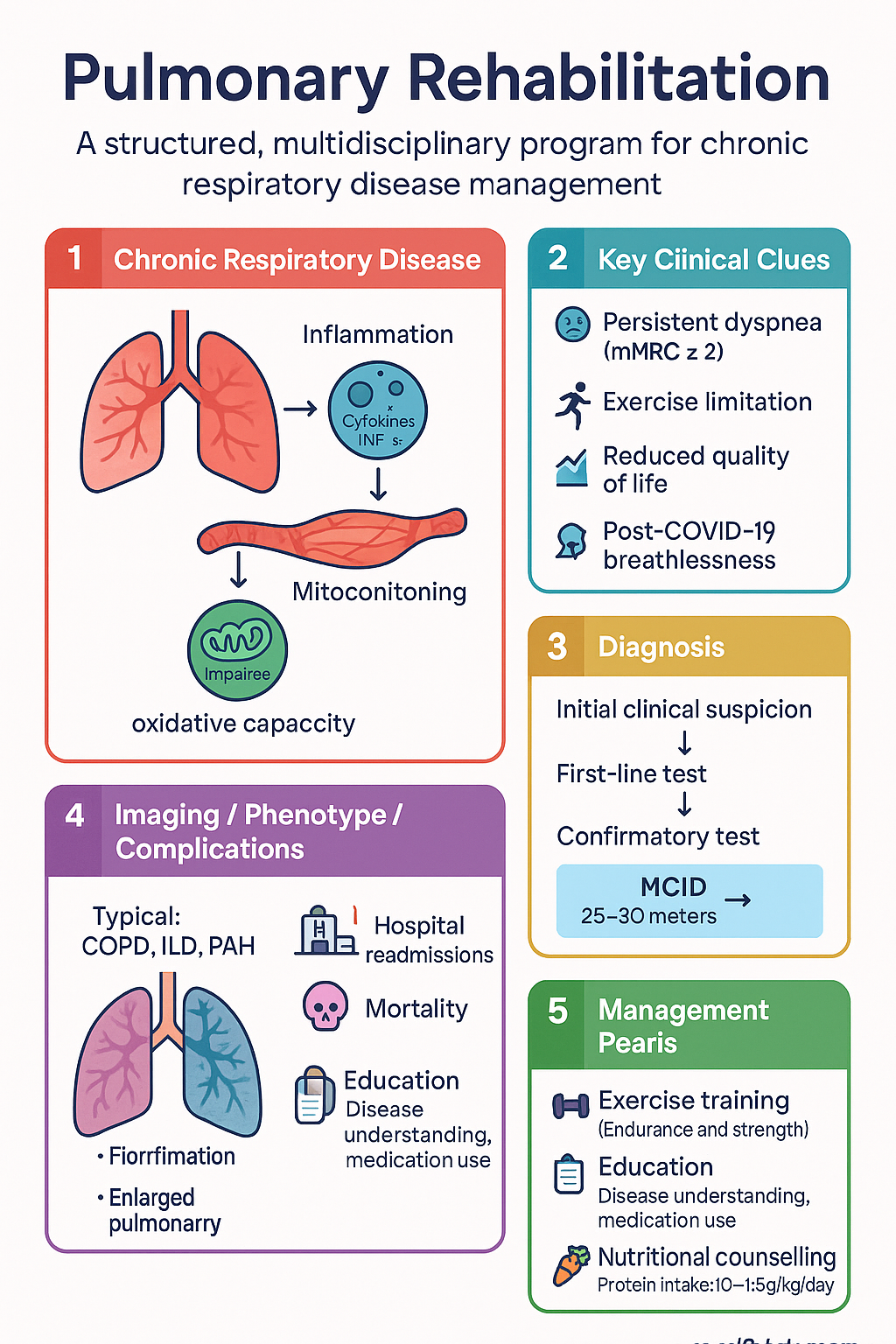
- Pulmonary rehabilitation (PR) is a structured, multidisciplinary program of exercise training, education, and self-management support for people with chronic respiratory disease — it is the single most effective non-pharmacological intervention for COPD.
- Strongest indication is COPD with persistent dyspnea (mMRC ≥ 2) despite optimal pharmacotherapy; referral should not wait until end-stage disease.
- Evidence also supports PR in interstitial lung disease (ILD), pulmonary hypertension (PAH/CTEPH), bronchiectasis, pre- and post-lung surgery, and post-COVID-19 persistent breathlessness.
- The Australian Lung Foundation's Lungs in Action® and LungNet programs provide community-based maintenance pathways after hospital-based PR completion.
- A standard PR program comprises 6–8 weeks (minimum 2 supervised sessions/week), ideally commencing within 2–4 weeks of referral to reduce dropout.
- Exercise prescription includes endurance (walking or cycling) and peripheral muscle strength training; interval training is preferred for severely deconditioned patients.
- Target intensity: 60–80% of peak work rate or 60–80% of 6-minute walk distance-derived speed; Borg dyspnoea score 3–5 / 10 as an intensity guide.
- Minimum clinically important difference (MCID) for 6-minute walk test (6MWT) is 25–30 metres in COPD; for the Chronic Respiratory Questionnaire (CRQ), 0.5 units per domain.
- PR significantly reduces hospital admissions and may reduce mortality in COPD; benefits wane after 12 months without a maintenance strategy.
- Aboriginal and Torres Strait Islander peoples are under-referred to PR; culturally adapted programs with Indigenous health workers improve engagement and completion.
- Contraindications include unstable angina, recent myocardial infarction (<4 weeks), uncontrolled heart failure, and musculoskeletal conditions preventing exercise — most comorbidities require modification, not exclusion.
- PR is funded via Medicare (MBS items for chronic disease management plans) and state health services; private health funds typically cover hospital-based programs.
Introduction & Australian Epidemiology
Pulmonary rehabilitation (PR) is a comprehensive, evidence-based intervention comprising supervised exercise training, disease-specific education, nutritional counselling, and psychosocial support delivered by a multidisciplinary team. It is endorsed by the Thoracic Society of Australia and New Zealand (TSANZ), the Lung Foundation Australia, and international bodies (ATS/ERS) as a cornerstone of chronic respiratory disease management.
In Australia, chronic obstructive pulmonary disease (COPD) affects approximately 1 in 13 Australians aged ≥ 40 years and is the fifth leading cause of death. The Australian Institute of Health and Welfare (AIHW) reports over 7,600 COPD-related deaths annually. Interstitial lung disease (ILD), bronchiectasis, and pulmonary arterial hypertension (PAH) contribute additional substantial morbidity. The post-COVID-19 pandemic has further expanded the population living with chronic respiratory symptoms and functional limitation.
Despite strong evidence, PR utilisation in Australia remains alarmingly low. Fewer than 5% of eligible COPD patients are referred, and program completion rates average 50–60%. Barriers include limited program availability in rural and remote areas, long wait times, lack of clinician awareness, and patient transport difficulties. Lung Foundation Australia advocates for expanded access and has developed the Lungs in Action® community maintenance exercise program delivered across >150 sites nationally.
The economic burden is significant: COPD costs the Australian health system over $900 million annually in direct hospital costs, with exacerbations accounting for the majority. PR has been shown to reduce hospital readmissions by 30–40% in the 12 months following an exacerbation-related admission, making it one of the most cost-effective interventions in respiratory medicine.
Indications & Referral
Pulmonary rehabilitation is indicated for any patient with chronic respiratory disease who experiences persistent breathlessness, exercise limitation, or reduced health-related quality of life despite optimal medical therapy. Referral should be considered early in the disease course — not reserved for end-stage disease.
Primary Indications
| Condition | Indication for Referral | Evidence Level |
|---|---|---|
| COPD | mMRC dyspnoea scale ≥ 2; FEV1 < 80% predicted with symptoms; any recent exacerbation requiring hospitalisation or oral corticosteroids/antibiotics | Level I (Cochrane) |
| Interstitial Lung Disease (ILD) | IPF, hypersensitivity pneumonitis, connective tissue disease-ILD with exertional desaturation or functional limitation; stable disease on treatment | Level I (Cochrane) |
| Post-COVID-19 | Persistent breathlessness and/or fatigue ≥ 4 weeks after acute illness; deconditioning; documented lung impairment or normal imaging with functional limitation | Level II |
| Pre/Post Lung Surgery | Pre-habilitation for lung cancer resection or transplant; post-surgical deconditioning; low predicted post-operative FEV1 (<40% predicted) | Level II |
| Non-CF Bronchiectasis | Recurrent exacerbations, chronic breathlessness, sputum production, reduced exercise capacity | Level II |
| Pulmonary Arterial Hypertension | Stable PAH on targeted therapy; WHO functional class II–III; exercise limitation despite optimised pharmacotherapy | Level I (RCT) |
| Thoracic Malignancy | Pre-treatment deconditioning; breathlessness from lung cancer/mesothelioma; post-chemoradiation functional decline | Level III |
Referral Criteria & Pathways
In Australia, referral pathways vary by state and territory. General practitioners can refer directly to hospital-based or community-based PR programs under a Chronic Disease Management (CDM) plan using MBS items 721 (GP Management Plan) and 723 (Team Care Arrangement). Patients may also self-refer to some community programs. Referral after an exacerbation-related hospital admission is a key quality indicator (Lung Foundation Australia's COPD-X guidelines recommend referral at discharge).
Contraindications
Absolute contraindications are few. Most comorbidities require exercise modification rather than exclusion:
- Unstable angina or recent myocardial infarction (<4 weeks)
- Acute decompensated heart failure
- Severe aortic stenosis (symptomatic)
- Acute pulmonary embolism
- Acute febrile illness
- Stable ischaemic heart disease
- Controlled heart failure (NYHA I–III)
- Musculoskeletal comorbidity (adapt exercises)
- Peripheral vascular disease
- Cognitive impairment (carer-assisted programs)
- Supplemental oxygen requirement
Program Components
A comprehensive PR program comprises supervised exercise training, self-management education, nutritional counselling, and psychosocial support. Programs are delivered by a multidisciplinary team typically including a physiotherapist, respiratory physician, exercise physiologist, occupational therapist, dietitian, psychologist, social worker, and smoking cessation counsellor. The Lung Foundation Australia recommends a minimum of 6–8 weeks with at least 2 supervised sessions per week.
Multidisciplinary Team Roles
| Discipline | Role in PR |
|---|---|
| Physiotherapist | Exercise prescription and supervision, 6MWT, breathing techniques (pursed-lip, diaphragmatic), airway clearance, mobility assessment |
| Exercise Physiologist | Cardiopulmonary exercise testing, exercise programming, strength assessment, community exercise transition |
| Respiratory Physician | Medical assessment, comorbidity management, oxygen titration, referral authorisation |
| Occupational Therapist | Energy conservation strategies, activities of daily living assessment, assistive equipment prescription |
| Dietitian | Nutritional assessment, weight management (obesity and cachexia), micronutrient advice, meal planning |
| Psychologist | Screening for anxiety/depression (PHQ-9, GAD-7), cognitive-behavioural therapy, motivational interviewing |
| Smoking Cessation Counsellor | Quit support, pharmacotherapy initiation (varenicline, NRT), relapse prevention |
| Indigenous Health Worker | Cultural liaison, yarning-based education, community engagement, transport coordination for ATSI patients |
Exercise Training
Exercise training is the cornerstone of PR and the component with the strongest evidence base. It includes endurance (aerobic) training, peripheral muscle strength training, and flexibility/balance exercises. Exercise sessions should include warm-up (5–10 minutes), active training (20–40 minutes), and cool-down (5–10 minutes). All sessions should be supervised by a trained clinician with access to emergency resuscitation equipment, supplemental oxygen, and bronchodilators.
Education Sessions
Structured education should cover disease understanding, medication use (inhaler technique, oxygen therapy), action plans for exacerbation management, breathing strategies, energy conservation, nutrition, travel and altitude advice, advance care planning, and psychological well-being. Education should be interactive and culturally appropriate.
Nutritional Counselling
Both obesity (BMI ≥ 30) and low body weight (BMI < 18.5) are independent predictors of worse outcomes in COPD. Dietitian-led assessment should include body composition (ideally bioelectrical impedance), micronutrient status (vitamin D, iron), and sarcopenia screening. Protein intake of 1.0–1.5 g/kg/day is recommended to support exercise-induced muscle adaptation, particularly in cachectic patients.
Psychosocial Support
Anxiety and depression are prevalent in 40–60% of people with COPD and are associated with worse adherence, more frequent exacerbations, and increased mortality. Routine screening with the Hospital Anxiety and Depression Scale (HADS) or PHQ-9/GAD-7 should occur at PR entry. Cognitive-behavioural therapy (CBT), motivational interviewing, and peer support groups are effective adjuncts.
Outcome Measures
| Domain | Tool | MCID | Timing |
|---|---|---|---|
| Exercise capacity | 6-Minute Walk Test (6MWT) | 25–30 m | Baseline and completion |
| Exercise capacity | Sit-to-Stand Test (1-min STS) | 3 repetitions | Baseline and completion |
| Health-related QoL | Chronic Respiratory Questionnaire (CRQ-SR) | 0.5 units/domain | Baseline and completion |
| Health-related QoL | COPD Assessment Test (CAT) | 2 units | Baseline and completion |
| Dyspnoea | Modified Medical Research Council (mMRC) Dyspnoea Scale | 1 grade | Baseline and completion |
| Dyspnoea | Borg Dyspnoea Scale (0–10) | 1 unit | During exercise |
| Psychological | HADS / PHQ-9 / GAD-7 | Variable | Baseline and completion |
| Physical activity | Activity monitor (accelerometer) | Context-specific | Baseline and 12-month |
Exercise Prescription
Exercise prescription in pulmonary rehabilitation must be individualised based on baseline assessment, comorbidities, patient goals, and available resources. The three main modalities are endurance (aerobic) training, resistance (strength) training, and interval training. Peripheral muscle dysfunction is a key therapeutic target, as limb muscle weakness contributes more to exercise limitation than ventilatory impairment in many patients with COPD.
Endurance (Aerobic) Training
Endurance training is the most evidence-based component and may use walking (ground-based or treadmill) or cycling (stationary cycle ergometer). Cycling is preferred in severe COPD as it reduces the oxygen cost of locomotion and allows better symptom monitoring.
| Parameter | Recommendation | Intensity Guide |
|---|---|---|
| Mode | Walking or cycling | — |
| Frequency | 2–5 sessions/week (minimum 2 supervised) | — |
| Duration | 20–30 minutes continuous (or accumulate in intervals) | Increase by 5 min/week |
| Intensity — % peak work rate | 60–80% of peak work rate (from CPET) | Severe dyspnoea: start 40–50% |
| Intensity — % 6MWT speed | 60–80% of average 6MWT speed | Calculate from 6MWT distance |
| Intensity — Borg dyspnoea | Target Borg 3–5 / 10 (moderate to severe) | Stop if Borg ≥ 7 |
| Intensity — Borg fatigue | Target Borg 3–4 / 10 | Stop if Borg ≥ 7 |
Resistance (Strength) Training
Peripheral muscle strength training targets quadriceps, hip flexors, and upper limb muscles. It produces additional gains in muscle strength and functional performance beyond endurance training alone and is recommended as a mandatory component of all PR programs (TSANZ/Lung Foundation Australia).
| Parameter | Recommendation |
|---|---|
| Exercises | Quadriceps (leg press/squats), hamstrings, hip flexors, deltoids, biceps, triceps; minimum 4–6 exercises |
| Sets × Repetitions | 1–3 sets of 8–12 repetitions |
| Intensity | 60–70% of 1-repetition maximum (1-RM); begin 30–40% if severely deconditioned |
| Frequency | 2–3 sessions/week (non-consecutive days) |
| Progression | Increase load by 5–10% when patient can complete 12 reps at current weight comfortably |
| Equipment | Free weights, resistance bands, ankle weights, weight machines; bands suitable for home/community programs |
Interval Training
Interval training alternates short bouts of high-intensity exercise (30 seconds to 2 minutes at 80–100% peak work rate) with recovery periods (equal or longer duration at low intensity). It is particularly beneficial for patients who cannot sustain continuous endurance training due to severe ventilatory limitation, dynamic hyperinflation, or extreme deconditioning.
Supplemental Oxygen During Exercise
Patients who desaturate to SpO2 < 88% during exercise should receive supplemental oxygen titrated to maintain SpO2 ≥ 88–90%. Ambulatory oxygen (portable concentrator or cylinder) enables higher training intensities and longer exercise durations. Exercise prescription should always include continuous pulse oximetry monitoring.
Breathing Strategies
Pursed-lip breathing during exercise reduces dynamic hyperinflation and improves ventilatory efficiency. Diaphragmatic breathing, active cycle of breathing technique (ACBT), and inspiratory muscle training (IMT, threshold loading at 30–40% maximal inspiratory pressure) are adjunctive techniques that may benefit selected patients, particularly those with bronchiectasis or severe dyspnoea.
Outcomes & Maintenance
The evidence base for pulmonary rehabilitation is among the strongest in respiratory medicine. Benefits span exercise capacity, dyspnoea, health-related quality of life, psychological well-being, healthcare utilisation, and survival. However, these benefits attenuate after 12–18 months without ongoing exercise maintenance, underscoring the critical importance of long-term adherence strategies.
Key Outcomes
Exacerbation Reduction
PR commencing within 4 weeks of an acute exacerbation significantly reduces the risk of subsequent exacerbations and hospital readmissions. A meta-analysis demonstrated a 40% relative risk reduction in hospital readmission at 12 months. PR also improves the speed of recovery from exacerbations and reduces the time to return to baseline functional status. Patients should be educated on self-management action plans with early rescue medication use (short-acting bronchodilators and corticosteroid packs).
Maintenance Strategies
The benefits of a standard 6–8 week PR program decline significantly by 12 months unless a maintenance strategy is in place. The following approaches should be discussed at program completion:
Long-Term Adherence Strategies
| Strategy | Evidence & Practical Application |
|---|---|
| Home exercise programs | Written and video-based programs with pedometer/step-count targets; comparable outcomes to supervised programs in motivated patients (Level II) |
| Telephone/telehealth follow-up | Monthly coaching calls or video sessions improve exercise adherence and reduce hospital presentations (Level II). Particularly valuable in rural/remote Australia. |
| Lungs in Action® | Lung Foundation Australia's community maintenance program at >150 sites nationally; led by trained exercise professionals; low-cost group sessions |
| Activity monitoring | Pedometers and accelerometers with step-count goals (aim for 5,000–7,000 steps/day); digital health platforms for self-monitoring |
| Behavioural change techniques | Motivational interviewing, goal-setting, action planning, self-monitoring, social support, and relapse prevention planning |
| Re-referral | Patients who experience an exacerbation, significant functional decline, or haven't attended PR >12 months should be re-referred. Repeat PR is as effective as initial PR. |
Special Populations
Pulmonary rehabilitation must be adapted for special populations. Most patients with comorbidities can safely participate with appropriate modifications. Exclusion of older adults, those with multimorbidity, or patients with cognitive impairment leads to inequitable access.
Paediatric
Elderly (≥ 75 years)
Renal Impairment
Hepatic Impairment
Immunocompromised
Pregnancy
Aboriginal and Torres Strait Islander Health Considerations
Chronic respiratory disease is a leading cause of the health gap between Aboriginal and Torres Strait Islander peoples and non-Indigenous Australians. COPD hospitalisation rates are 2.4 times higher in Indigenous Australians, and chronic lower respiratory disease is the sixth leading cause of Indigenous mortality. Despite this disproportionate burden, access to pulmonary rehabilitation for Indigenous Australians remains critically limited, particularly in remote and very remote communities.
Quick Reference: PR Prescription Summary
📚 References
- 1. Spruit MA, Singh SJ, Garvey C, et al. An official American Thoracic Society/European Respiratory Society statement: key concepts and advances in pulmonary rehabilitation. Am J Respir Crit Care Med. 2013;188(8):e13–e64.
- 2. McCarthy B, Casey D, Devane D, et al. Pulmonary rehabilitation for chronic obstructive pulmonary disease. Cochrane Database Syst Rev. 2015;(2):CD003793.
- 3. Alison JA, McKeough ZJ, Johnston K, et al. Australian and New Zealand Pulmonary Rehabilitation Guidelines. Respirology. 2017;22(4):800–819.
- 4. Dowman L, Hill CJ, Holland AE. Pulmonary rehabilitation for interstitial lung disease. Cochrane Database Syst Rev. 2014;(10):CD006322.
- 5. Morris NR, Kermeen FD, Holland AE. Exercise-based rehabilitation programmes for pulmonary hypertension. Cochrane Database Syst Rev. 2017;(8):CD011285.
- 6. Puhan MA, Gimeno-Santos E, Scharplatz M, et al. Pulmonary rehabilitation following exacerbations of chronic obstructive pulmonary disease. Cochrane Database Syst Rev. 2011;(10):CD005305.
- 7. Australian Institute of Health and Welfare. Chronic obstructive pulmonary disease (COPD). AIHW; 2023. Available from: https://www.aihw.gov.au/reports/chronic-respiratory-conditions/copd
- 8. Lung Foundation Australia. Pulmonary Rehabilitation Toolkit. 2023. Available from: https://lungfoundation.com.au/patients-carers/pulmonary-rehabilitation/
- 9. Singh SJ, Puhan MA, Andrianopoulos V, et al. An official systematic review of the European Respiratory Society/American Thoracic Society: measurement properties of field walking tests in chronic respiratory disease. Eur Respir J. 2014;44(6):1447–1478.
- 10. Holland AE, Spruit MA, Troosters T, et al. An official European Respiratory Society/American Thoracic Society technical standard: field walking tests in chronic respiratory disease. Eur Respir J. 2014;44(6):1428–1446.
- 11. Cox NS, Dal Corso S, Hansen H, et al. Telerehabilitation for chronic respiratory disease. Cochrane Database Syst Rev. 2021;(1):CD013040.
- 12. McNamara RJ, McKeough ZJ, McKenzie DK, Alison JA. Water-based exercise training for chronic obstructive pulmonary disease. Cochrane Database Syst Rev. 2013;(12):CD008290.
- 13. Yang IA, Brown JL, George J, et al. COPD-X Australian and New Zealand guidelines for the diagnosis and management of chronic obstructive pulmonary disease: 2024 update. Respirology. 2024;29(5):359–382.
- 14. World Health Organization. WHO consolidated guidelines on tuberculosis: module 4 treatment – drug-resistant tuberculosis treatment, 2022 update. Geneva: WHO; 2022.
- 15. Australian Government Department of Health and Aged Care. Medicare Benefits Schedule Book — Category 1: Professional Attendances. Canberra: Commonwealth of Australia; 2024.