📋 Key Information Summary
- Chronic cough is defined as a cough persisting for ≥8 weeks in adults and ≥4 weeks in children, affecting up to 10% of the Australian adult population.
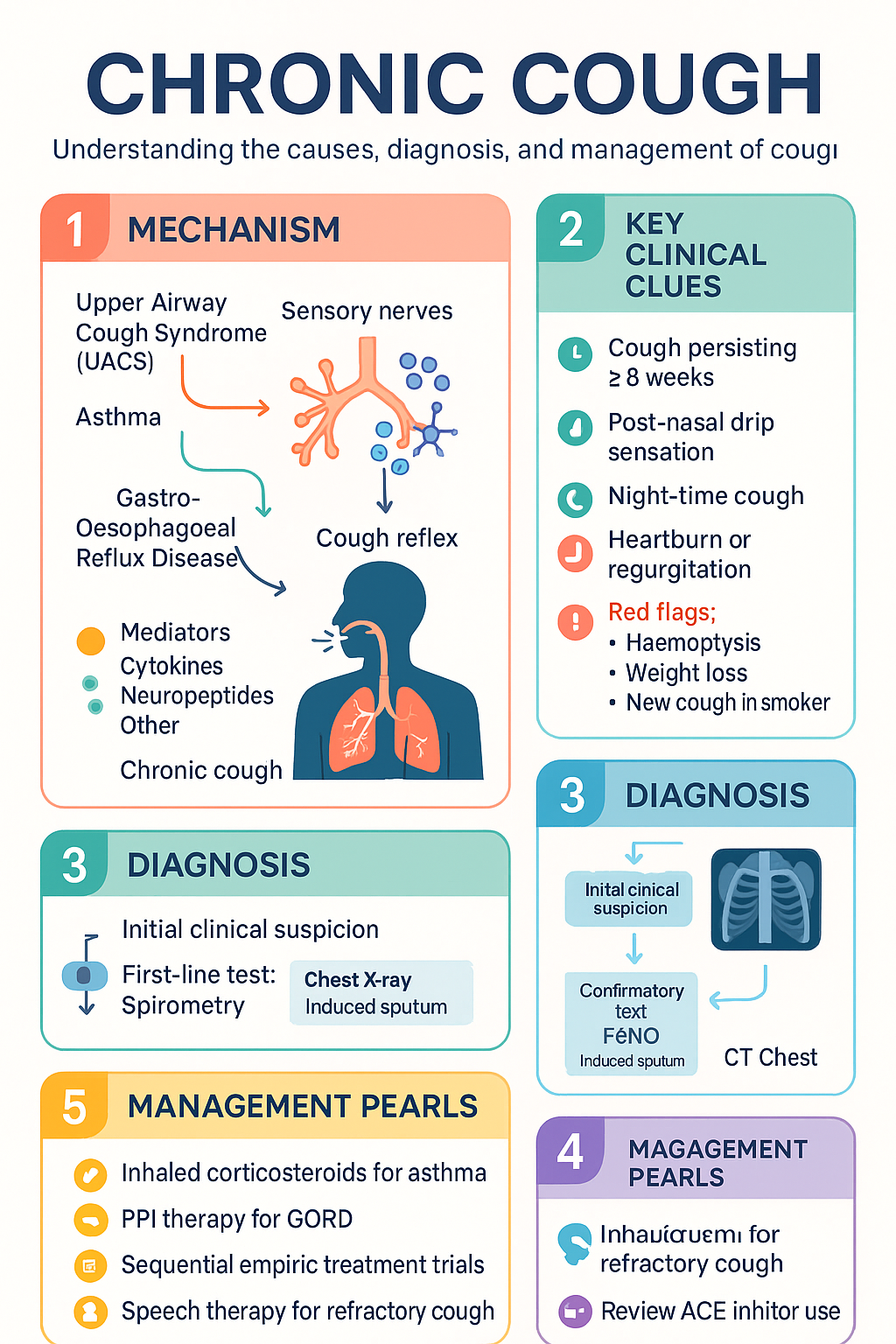
- The three most common causes in non-smokers with a normal chest X-ray are upper airway cough syndrome (UACS), asthma/Cough-variant asthma, and gastro-oesophageal reflux disease (GORD) — responsible for up to 90% of cases.
- Eosinophilic bronchitis (sputum eosinophilia without airflow obstruction) accounts for 10–30% of referrals to cough clinics and responds to inhaled corticosteroids.
- ACE inhibitor–induced cough affects 5–35% of patients on ACE inhibitors; switch to an ARB and allow 4 weeks for resolution.
- A stepwise diagnostic workup begins with chest X-ray and spirometry with bronchodilator reversibility, followed by FeNO, induced sputum eosinophils, and CT chest where indicated.
- Empiric sequential treatment trials (first UACS, then asthma, then GORD) are an accepted diagnostic strategy when initial investigations are non-diagnostic.
- Red flags requiring urgent referral: haemoptysis, significant weight loss, new cough in a smoker aged >45 years, stridor, lymphadenopathy, or suspected foreign body.
- Inhaled corticosteroids (e.g. fluticasone propionate 250–500 µg BD) are the mainstay of therapy for cough-variant asthma and eosinophilic bronchitis; PPI therapy for GORD-related cough.
- Refractory chronic cough (cough persisting despite optimal treatment of all identified causes) is increasingly recognised as cough hypersensitivity syndrome (CHS).
- For refractory cough: speech pathology/behavioural therapy (level 1 evidence), gabapentin 300–1800 mg/day, pregabalin 150–300 mg/day, or the P2X3 antagonist gefapixant 45 mg BD (PBS Authority Required, listed 2024).
- Consider Aboriginal and Torres Strait Islander communities: higher prevalence of bronchiectasis, chronic suppurative lung disease, environmental exposures, and barriers to specialist access in remote regions.
- Always review medication lists for ACE inhibitors and check adherence/prescribing errors. A systematic, protocol-driven approach (Morice et al. ERJ 2020) achieves diagnosis in >90% of cases.
Introduction & Australian Epidemiology
Chronic cough is one of the most common presentations to Australian general practice, accounting for an estimated 2–3 million consultations annually. It is defined in adults as a cough persisting for ≥8 weeks; in children, the threshold is ≥4 weeks. The condition places a substantial burden on quality of life, sleep, continence, social functioning, and workplace productivity.
Australian population data suggest a prevalence of 9–12% among adults, with higher rates among women (2:1 female-to-male ratio in specialist cough clinics), older adults, and Aboriginal and Torres Strait Islander populations, in whom chronic suppurative lung disease and bronchiectasis remain highly prevalent.
In approximately 90% of immunocompetent, non-smoking adults with a normal chest X-ray, chronic cough is attributable to one or more of three conditions: upper airway cough syndrome (UACS), asthma (including cough-variant asthma), and gastro-oesophageal reflux disease (GORD). Eosinophilic bronchitis and medication-related cough (particularly ACE inhibitors) account for most of the remainder.
A structured, evidence-based approach — combining targeted history, examination, investigation, and sequential empiric therapy — achieves a specific diagnosis in over 90% of patients. Australian respiratory specialists and the Thoracic Society of Australia and New Zealand (TSANZ) advocate a protocol-driven algorithm modelled on the European Respiratory Society (ERS) 2020 guidelines, adapted to the Australian healthcare context including PBS availability, MBS item numbers, and access to specialist cough clinics.
Evaluation & Causes
Defining Chronic Cough
Chronic cough is defined as a cough lasting ≥8 weeks in adults. Subacute cough (3–8 weeks) most commonly follows upper respiratory tract infection and is self-limiting; however, it warrants investigation if it fails to resolve. The aetiological approach to chronic cough differs fundamentally from acute cough.
The Three Common Causes
1. Upper Airway Cough Syndrome (UACS) — formerly "Post-nasal Drip Syndrome"
UACS is the single most common cause of chronic cough, implicated in 20–40% of cases. It arises from conditions affecting the nose, sinuses, and pharynx that stimulate afferent cough receptors in the upper airway.
- Common aetiologies: Allergic rhinitis, perennial non-allergic rhinitis, vasomotor rhinitis, chronic sinusitis (with or without nasal polyps), post-infectious rhinitis.
- Clinical features: Sensation of post-nasal drip, nasal congestion, rhinorrhoea, frequent throat clearing, cobblestone pharyngeal mucosa, mucus in the oropharynx. However, many patients are unaware of nasal symptoms — a history of post-nasal drip is absent in up to 50% of cases confirmed at specialist cough clinics.
- Diagnostic approach: Clinical response to empiric first-generation antihistamine/decongestant combination therapy (e.g. loratadine + pseudoephedrine, or brompheniramine + pseudoephedrine) serves as both diagnostic trial and treatment. Sinus CT is reserved for suspected chronic rhinosinusitis.
2. Asthma and Cough-Variant Asthma
Asthma accounts for 25–30% of chronic cough cases. Cough-variant asthma is a phenotype in which cough is the sole or predominant symptom, without the classic triad of wheeze, dyspnoea, and chest tightness.
- Clinical features: Cough worse at night or in the early morning, triggered by cold air, exercise, allergens, or respiratory infections. May be seasonal.
- Diagnostic criteria: Demonstration of variable airflow obstruction on spirometry (≥12% and ≥200 mL improvement in FEV₁ post-bronchodilator), positive methacholine challenge (PC₂₀ <8 mg/mL), elevated exhaled nitric oxide (FeNO ≥40 ppb in adults), or sputum eosinophilia (≥3%). A positive response to empiric inhaled corticosteroid trial is supportive.
- Important distinction: Cough-variant asthma and eosinophilic bronchitis overlap clinically; the key difference is normal spirometry and no bronchial hyperresponsiveness in eosinophilic bronchitis.
3. Gastro-Oesophageal Reflux Disease (GORD)
GORD is implicated in 10–20% of chronic cough cases. The relationship is complex — cough can cause reflux (via transient lower oesophageal sphincter relaxation) and reflux can cause cough (via vagal-mediated oesophago-bronchial reflex and micro-aspiration).
- Clinical features: Heartburn, regurgitation, cough worse after meals or when supine, waterbrash. However, up to 75% of patients with GORD-related cough have no typical reflux symptoms ("silent reflux").
- Diagnostic approach: Empiric PPI trial (e.g. esomeprazole 40 mg BD for ≥8 weeks) is the recommended initial strategy. Ambulatory pH-impedance monitoring (MBS item 32222) is reserved for refractory cases or where anti-reflux surgery is being considered.
- Key point: GORD should only be assigned as a cause of chronic cough when cough improves or resolves with anti-reflux therapy.
Other Important Causes
| Cause | Proportion | Key Features | Diagnostic Test |
|---|---|---|---|
| Eosinophilic bronchitis | 10–30% | Cough with sputum eosinophilia, normal spirometry, no bronchial hyperresponsiveness | Induced sputum eosinophils ≥3% |
| ACE inhibitor cough | 5–35% of ACEi users | Dry, tickly cough; onset days to months after starting ACEi; more common in women and patients of East Asian descent | Resolution after ACEi cessation (allow 4 weeks) |
| Chronic bronchitis/COPD | 5–10% | Productive cough ≥3 months/year for ≥2 consecutive years; current or ex-smoker | Spirometry showing fixed airflow obstruction |
| Bronchiectasis | Up to 30% in ATSI populations | Chronic productive cough, recurrent infections, coarse crackles | HRCT chest |
| Lung malignancy | <2% | New cough in smoker >45 yrs, haemoptysis, weight loss, clubbing | CT chest ± bronchoscopy |
| Post-infectious cough | Common (<8 weeks, may persist) | Following URTI; Bordetella pertussis, Mycoplasma, Chlamydophila | Serology, PCR nasopharyngeal aspirate |
| Interstitial lung disease | Variable | Dry cough, progressive dyspnoea, bibasal crackles, restrictive defect | HRCT, PFTs, autoimmune serology |
| Obstructive sleep apnoea | Emerging data | Nocturnal cough, snoring, daytime somnolence | Polysomnography |
Diagnostic Workup
Initial Assessment in General Practice
A thorough history and targeted examination form the foundation of the diagnostic workup. The initial assessment should systematically address red flags, medication review, occupational/environmental exposures, and features of the three common causes.
History — Key Elements
- Cough character: Dry vs. productive, timing (nocturnal, postprandial), triggers (cold air, exercise, talking, eating, position), duration, and progression.
- Associated symptoms: Rhinorrhoea, nasal congestion, heartburn, regurgitation, wheeze, dyspnoea, sputum colour/volume, haemoptysis.
- Medication review: ACE inhibitors (any duration), beta-blockers, and rarely inhaled medications.
- Smoking history: Pack-years, current status, passive exposure.
- Occupational history: Exposure to dusts, chemicals, fumes; isocyanate exposure; farming/animal contact.
- Atopic history: Personal/family history of asthma, eczema, allergic rhinitis.
- Impact on quality of life: The Leicester Cough Questionnaire (LCQ) provides a validated symptom score.
First-Line Investigations
Second-Line Investigations
Empiric Treatment Trials
When initial investigations do not reveal a clear diagnosis, sequential empiric treatment trials are an accepted and guideline-recommended diagnostic strategy. Each trial should be of sufficient duration and dose before assessing response.
Specialty Referral Indications
Treatment Strategies
The cornerstone of chronic cough management is treating the underlying cause(s). Up to 25% of patients have multiple concurrent causes, each of which must be addressed simultaneously. Treatment should follow a systematic, stepwise approach with regular reassessment.
Treatment of Specific Causes
Upper Airway Cough Syndrome
Cough-Variant Asthma and Eosinophilic Bronchitis
ACE Inhibitor–Induced Cough
GORD-Related Cough
Lifestyle measures should accompany PPI therapy: weight loss (if BMI >25), elevation of bedhead (15–20 cm), avoidance of late meals (≥3 hours before lying down), reduction of alcohol, caffeine, chocolate, and fatty foods. Alginate-based therapies (e.g. Gaviscon Advance®) may provide additional benefit for non-acid reflux.
Adjunctive and Supportive Therapies
Speech Pathology / Behavioural Cough Suppression Therapy
Speech pathology-led cough suppression therapy (CST) is an evidence-based intervention with Level 1 evidence (randomised controlled trials). It involves education on cough suppression techniques, breathing pattern retraining, voluntary cough control, and psychoeducation about the cough hypersensitivity cycle.
- Components: Education on the cough cycle, controlled breathing techniques (slow, low breathing through the nose), voluntary cough suppression ("the natural urge suppression technique"), hydration and vocal hygiene, and identification/management of laryngeal irritants.
- Efficacy: RCTs show a 40–60% reduction in cough frequency; comparable to pharmacotherapy with fewer side effects.
- Access: Available through hospital outpatient speech pathology departments and some private practices. Medicare rebate via GP Management Plan (MBS item 721) and Team Care Arrangement (MBS item 723) — up to 5 allied health sessions per year under Medicare.
- Telehealth: Increasingly delivered via telehealth, which is particularly valuable for patients in regional and remote Australia.
Other Adjunctive Measures
- Smoking cessation: Essential. Offer NRT, varenicline (Champix®), or bupropion. Refer to Quitline (13 7848).
- Environmental modification: Occupational dust/mask exposure — workplace health assessment; allergen avoidance for allergic patients.
- Hydration: Adequate fluid intake; steam inhalation may provide temporary symptomatic relief.
- Avoid over-the-counter cough suppressants: Codeine, dextromethorphan, and antitussives have limited evidence in chronic cough and carry risk of dependence and side effects.
Refractory Chronic Cough
Definition and Concept
Chronic cough is classified as refractory when it persists despite systematic investigation and treatment of all identified causes. It is important to distinguish:
- Refractory chronic cough: Cough persisting despite treatment of identified causes.
- Unexplained chronic cough: Cough persisting despite thorough evaluation with no identifiable cause.
Both categories are increasingly understood through the lens of cough hypersensitivity syndrome (CHS).
Cough Hypersensitivity Syndrome (CHS)
CHS is a clinical concept endorsed by the ERS (2020) describing a condition characterised by exaggerated cough response to low-level stimuli (cold air, talking, laughing, strong odours, eating dry food) that would not normally provoke cough. The underlying mechanism involves:
- Peripheral sensitisation: Upregulation of vagal afferent nerve receptors (particularly P2X3 receptors on C-fibre afferents) in the larynx, trachea, and bronchi. ATP acting on P2X3 receptors is a key mediator of the urge-to-cough sensation.
- Central sensitisation: Enhanced processing of cough signals in the brainstem nucleus tractus solitarius and higher cortical centres, analogous to central sensitisation in chronic pain syndromes.
- Neuroplasticity: Persistent cough becomes self-perpetuating — the cough itself causes airway inflammation and mucosal damage, which further drives peripheral sensitisation.
- Female predominance: The 2:1 female-to-male ratio in chronic cough clinics may relate to sex differences in cough reflex sensitivity (hormonal influences, ACE2 expression).
Pharmacotherapy for Refractory Chronic Cough
Neuromodulators
P2X3 Antagonists — Targeted Peripheral Therapy
Other Agents (Limited Evidence)
- Low-dose morphine: 2.5–5 mg PO BD (modified release). Evidence from small RCTs showing benefit. Used cautiously due to dependence risk, constipation, and respiratory depression. PBS Authority Required (for palliative care; off-label for cough).
- Speech pathology/behavioural cough suppression therapy: Should be offered to ALL patients with refractory cough, either alone or in combination with pharmacotherapy. Level 1 evidence, no side effects.
- Proton pump inhibitors (high-dose, prolonged): Even without clear GORD symptoms, some cough specialists trial extended PPI courses (3–6 months) given the high prevalence of "silent" reflux. Evidence remains debated.
- Inhaled corticosteroid/nebulised lidocaine: Case series support short-term benefit with nebulised lignocaine 2% (2–4 mL BD) for severe refractory cough; access via specialist cough clinic only.
Behavioural and Psychological Interventions
For patients with refractory cough, the interplay between psychological factors (anxiety, depression, catastrophising) and cough hypersensitivity should be addressed:
- Speech pathology-led CST (as above) — first-line non-pharmacological intervention.
- Cognitive behavioural therapy (CBT) — emerging evidence for addressing the psychosocial impact of chronic cough and modifying illness beliefs.
- Mindfulness-based stress reduction — may help with central sensitisation and hypervigilance to cough.
- Support groups: Lung Foundation Australia offers patient resources and peer support for chronic respiratory conditions.
Monitoring
Monitoring Framework
Objective Assessment Tools
| Tool | Type | Details | Use |
|---|---|---|---|
| Leicester Cough Questionnaire (LCQ) | Patient-reported outcome | 19-item validated tool; physical, psychological, and social domains. Score range 3–21; higher = better. Minimum clinically important difference (MCID) = 1.3 points. | Baseline and serial monitoring |
| Visual Analogue Scale (VAS) | Patient-reported outcome | 0–100 mm scale for cough severity. Quick to administer. MCID = 17 mm. | Clinic visits; quick assessment |
| Cough Severity Diary (CSD) | Patient-reported outcome | 7-item daily diary; validated for clinical trials. Captures day-to-day variability. | Clinical trials and specialist assessment |
| 24-hour cough monitoring | Objective | Leicester Cough Monitor or VitaloJAK ambulatory recording device. Cough frequency (coughs/hour). MCID = not yet standardised for clinical use. | Specialist cough clinics; clinical trials |
Special Populations
Aboriginal and Torres Strait Islander Health
Chronic cough in Aboriginal and Torres Strait Islander peoples carries particular significance due to a disproportionately higher burden of chronic respiratory disease, delayed diagnosis, and barriers to specialist access. The following considerations are essential for culturally safe, evidence-based care.
Epidemiological Context
- Bronchiectasis prevalence: Aboriginal and Torres Strait Islander children and adults have among the highest rates of bronchiectasis globally — up to 10 times the non-Indigenous Australian rate. Chronic wet/productive cough in an Indigenous child or young adult should always prompt consideration of bronchiectasis (HRCT, sputum culture).
- Chronic suppurative lung disease (CSLD): Common in remote and very remote communities, particularly in the Northern Territory, Cape York, and Kimberley regions. Often underdiagnosed.
- Post-infectious cough and pertussis: Higher rates of pertussis (whooping cough) in some communities due to lower vaccination coverage. Post-infectious cough may be protracted.
- Environmental exposures: Wood smoke from indoor cooking/heating in remote communities, dust (red dust in central Australia), and overcrowded housing with poor ventilation contribute to chronic airway irritation and cough.
- Smoking rates: Aboriginal and Torres Strait Islander adults smoke at approximately 2.5 times the rate of non-Indigenous Australians (AIHW 2023). Smoking cessation is a critical intervention for chronic cough.
- Rheumatic heart disease: May cause pulmonary congestion and cough; ACE inhibitor therapy (for cardiac indications) may itself cause cough.
Barriers to Diagnosis and Management
Quick Reference — Empiric Treatment Algorithm
📚 References
- 1. Morice AH, Millqvist E, Bieksiene K, et al. ERS guidelines on the diagnosis and treatment of chronic cough in adults and children. Eur Respir J. 2020;55(1):1901136. doi:10.1183/13993003.01136-2019
- 2. Gibson PG, Vertigan AE. Speech pathology for chronic cough: a new approach. Pulm Pharmacol Ther. 2009;22(2):159-162.
- 3. Ryan NM, Birring SS, Gibson PG. Gabapentin for refractory chronic cough: a randomised, double-blind, placebo-controlled trial. Lancet. 2012;380(9853):1583-1589.
- 4. McGarvey L, Birring SS, Morice AH, et al. Efficacy and safety of gefapixant, a P2X3 receptor antagonist, in refractory chronic cough and unexplained chronic cough (COUGH-1 and COUGH-2): results from two double-blind, randomised, parallel-group, placebo-controlled, phase 3 trials. Lancet. 2022;399(10328):909-923.
- 5. Irwin RS, French CL, Chang AB, Altman KW; CHEST Expert Cough Panel. Classification of cough as a symptom in adults and management algorithms: CHEST guideline and expert panel report. Chest. 2018;153(1):196-209.
- 6. Australian Institute of Health and Welfare (AIHW). Aboriginal and Torres Strait Islander Health Performance Framework: Summary report 2023. Canberra: AIHW; 2023.
- 7. Chang AB, Upham JW, Masters IB, et al. Protracted bacterial bronchitis: the last decade and the road ahead. Pediatr Pulmonol. 2016;51(3):225-242.
- 8. Vertigan AE, Kapela SL, Ryan NM, Birring SS, Gibson PG. Effect of speech pathology management on chronic cough: a randomised controlled trial. Pulm Pharmacol Ther. 2016;40:58-64.
- 9. Lai K, Chen R, Lin J, et al. A prospective, multicenter survey on causes of chronic cough in China. Chest. 2013;143(3):613-620.
- 10. Mazzone SB, McGarvey L. Mechanisms and rationale for targeted therapies in reflex and central cough. Clin Chest Med. 2022;43(2):263-278.
- 11. Lung Foundation Australia. Bronchiectasis guidelines for Aboriginal and Torres Strait Islander health professionals. Milton QLD: Lung Foundation Australia; 2021.
- 12. Song WJ, Chang YS, Faruqi S, et al. The global epidemiology of chronic cough in adults: a systematic review and meta-analysis. Eur Respir J. 2015;45(5):1479-1481.
- 13. Department of Health and Aged Care. MBS Online — Medicare Benefits Schedule. Canberra: Australian Government. Available at: www.mbsonline.gov.au. Accessed January 2025.
- 14. Australian Government Department of Health. Pharmaceutical Benefits Schedule (PBS). Canberra: Commonwealth of Australia. Available at: www.pbs.gov.au. Accessed January 2025.
- 15. Birring SS, Prudon B, Carr AJ, Singh SJ, Morgan MDL, Pavord ID. Development of a symptom specific health status measure in patients with chronic cough: the Leicester Cough Questionnaire (LCQ). Thorax. 2003;58(4):339-343.