📋 Key Information Summary
- Community-acquired pneumonia (CAP) is the leading infectious cause of hospitalisation and death in Australia, with highest burden in Aboriginal and Torres Strait Islander peoples and the elderly.
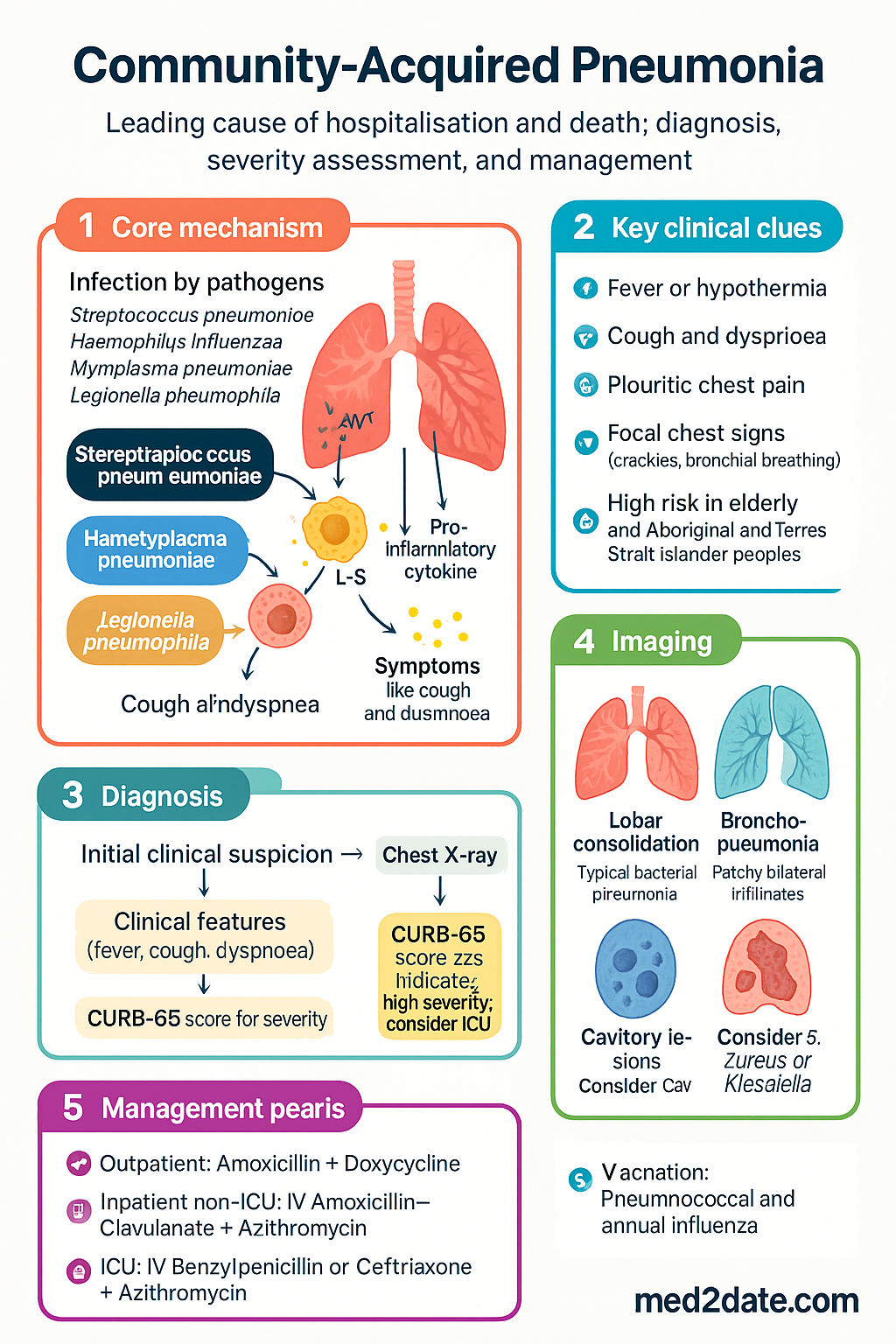
- Diagnosis requires a new chest X-ray infiltrate PLUS at least one clinical feature (fever, cough, dyspnoea, pleuritic chest pain, or focal chest signs).
- CURB-65 (score 0–5) is the preferred severity tool in Australian emergency departments; scores 0–1 generally suitable for outpatient management, 2 for inpatient ward, ≥3 consider ICU.
- PSI/PORT score may supplement CURB-65 but is less practical at the bedside; it classifies patients into risk classes I–V.
- Outpatient CAP (low severity): amoxicillin 1 g TDS PO for 5 days is first-line; add doxycycline or a macrolide if atypical pathogens suspected.
- Inpatient non-ICU CAP (moderate severity): IV amoxicillin–clavulanate 1.2 g TDS + IV azithromycin 500 mg daily; switch to oral when clinically improving (48–72 h).
- ICU CAP (high severity): IV benzylpenicillin 1.2 g 4-hourly or IV ceftriaxone 2 g daily + IV azithromycin 500 mg daily; consider piperacillin–tazobactam if Pseudomonas risk factors present.
- Add vancomycin or linezolid for suspected MRSA pneumonia (post-influenza, known colonisation, cavitary infiltrates); add anti-pseudomonal β-lactam if structural lung disease or recent hospital/antibiotic exposure.
- Standard antibiotic duration is 5 days for uncomplicated CAP; extend to 7–10 days for complicated disease, empyema, bacteraemia, or immunocompromise.
- Legionella urinary antigen and pneumococcal urinary antigen testing should be performed in all hospitalised CAP patients; blood cultures before antibiotics in all inpatients.
- Repeat chest X-ray at 6 weeks for all patients aged ≥50 years or with persistent symptoms to exclude underlying malignancy (non-resolving pneumonia workup).
- Pneumococcal vaccination (PCV13 → PPSV23) is funded under the NIP for Aboriginal and Torres Strait Islander peoples from age 50, and for all Australians ≥65 years; annual influenza vaccination reduces CAP incidence.
- Aboriginal and Torres Strait Islander Australians experience CAP rates 5–8 times higher than non-Indigenous Australians, with earlier age of onset and higher mortality; ensure culturally safe communication and address rural/remote access barriers.
Introduction & Australian Epidemiology
Community-acquired pneumonia (CAP) is defined as an acute infection of the lung parenchyma acquired outside of a hospital or healthcare facility. It remains a major cause of morbidity, hospitalisation, and mortality in Australia, responsible for over 100,000 hospital admissions annually and approximately 4,000 deaths per year. CAP disproportionately affects Aboriginal and Torres Strait Islander peoples, the elderly, and those with chronic comorbidities.
Streptococcus pneumoniae remains the most commonly identified pathogen across all age groups and severity levels in Australia. Other frequently implicated organisms include Haemophilus influenzae, Mycoplasma pneumoniae, Legionella pneumophila, respiratory viruses (influenza, SARS-CoV-2, RSV), and Staphylococcus aureus (including community-acquired MRSA — CA-MRSA). In tropical northern Australia, Burkholderia pseudomallei (melioidosis) and Acinetobacter baumannii should be considered during the wet season.
Australian Burden of Disease
| Parameter | Value (Australia) |
|---|---|
| Annual hospitalisations | ~100,000–120,000 |
| Annual deaths | ~3,500–4,500 |
| In-hospital mortality (all comers) | 4–7% |
| ICU admission rate | 10–15% of hospitalised |
| ICU mortality | 20–35% |
| ATSI:non-Indigenous incidence ratio | 5–8× (highest in remote NT and QLD) |
| Peak season | June–September (winter); wet season tropical NT (Nov–Apr) |
Diagnosis & Evaluation
Clinical Diagnostic Criteria
A diagnosis of CAP is made when there is a new opacity on chest X-ray (CXR) consistent with pneumonia, plus at least two of the following clinical features:
- Fever (≥38.0°C) or hypothermia (<36°C)
- New or worsening cough
- Dyspnoea or increased respiratory rate (≥20 breaths/min)
- Pleuritic chest pain
- Focal chest signs on auscultation (crackles, bronchial breathing, dullness to percussion)
- Sputum production (purulent or mucopurulent)
Chest X-ray Interpretation
A plain posteroanterior (PA) and lateral CXR remains the cornerstone of CAP diagnosis. MBS Item 58505 applies. Key radiological patterns include:
| Pattern | Suggests | Key Considerations |
|---|---|---|
| Lobar consolidation | Typical bacterial (S. pneumoniae) | Air bronchograms, silhouette sign |
| Bronchopneumonia (patchy bilateral) | S. aureus, H. influenzae, Gram-negatives | Common in elderly, aspiration |
| Interstitial / reticulonodular | Atypical (Mycoplasma, Legionella, viral, Pneumocystis) | May be subtle; consider CT if high clinical suspicion |
| Cavitary lesion | S. aureus, Klebsiella, TB, anaerobes, lung malignancy | Urgent CT chest; consider bronchoscopy |
| Pleural effusion ± consolidation | Parapneumonic effusion / empyema | Ultrasound-guided aspiration if loculated or large |
Microbiological Investigations
The intensity of microbiological workup depends on severity and care setting:
Routine Blood Investigations
- Full blood count (FBC): Leucocytosis (bacterial), lymphopenia (viral), eosinophilia (rare — consider eosinophilic pneumonia)
- C-reactive protein (CRP): Useful for monitoring treatment response; procalcitonin (PCT) may help distinguish bacterial from viral aetiology and guide antibiotic duration
- Urea and electrolytes (U&E): Assess renal function (components of CURB-65); guide fluid management
- Liver function tests (LFTs): Baseline; hyponatraemia may suggest Legionella
- Lactate: If sepsis suspected; levels ≥2 mmol/L warrant escalation of care
- HIV serology: Consider in all patients with atypical organisms, Pneumocystis, or unexplained immunosuppression
Severity Assessment
Accurate severity assessment is critical for determining the appropriate site of care (outpatient, inpatient ward, or ICU) and guiding empiric antibiotic selection. Two validated tools are in widespread use in Australian emergency departments.
CURB-65 Score
The BTS-derived CURB-65 score is the recommended severity tool for CAP in Australia. Each criterion scores 1 point (maximum 5):
| Criterion | Definition | Points |
|---|---|---|
| C — Confusion | New confusion, AMT ≤8 (or equivalent) | 1 |
| U — Urea | Serum urea >7 mmol/L | 1 |
| R — Respiratory rate | ≥30 breaths/min | 1 |
| B — Blood pressure | SBP <90 mmHg or DBP ≤60 mmHg | 1 |
| 65 — Age | ≥65 years | 1 |
PSI/PORT Score (Pneumonia Severity Index)
The PSI/PORT score is more complex (assigns points for 20 variables) and has higher discriminatory power for identifying low-risk patients, but is less practical for bedside decision-making. It stratifies patients into five risk classes:
| Risk Class | Points | 30-Day Mortality | Disposition |
|---|---|---|---|
| Class I | Age <50, no comorbidities, no adverse features | 0.1% | Outpatient |
| Class II | ≤70 | 0.6% | Outpatient |
| Class III | 71–90 | 2.8% | Observation / short stay |
| Class IV | 91–130 | 8.2% | Hospital ward admission |
| Class V | >130 | 29.2% | ICU / high dependency |
ICU Admission Criteria (ATS/IDSA Major Criteria)
Patients with any one major criterion or ≥three minor criteria should be considered for ICU admission:
- Septic shock requiring vasopressors
- Respiratory failure requiring invasive mechanical ventilation
- Respiratory rate ≥30 breaths/min
- PaO₂/FiO₂ ratio ≤250
- Multilobar infiltrates
- Confusion (new onset)
- Urea ≥20 mg/dL (≥7 mmol/L)
- Leucopenia (WBC <4 × 10⁹/L)
- Thrombocytopenia (platelets <100 × 10⁹/L)
- Hypothermia (core temp <36°C)
- Hypotension requiring aggressive fluid resuscitation
Sepsis Screening (qSOFA)
The quick Sequential Organ Failure Assessment (qSOFA) score should be applied to all patients with suspected infection. A score ≥2 at the bedside (without laboratory values) suggests high risk for poor outcomes and triggers escalation of care:
- Altered mental status (GCS <15 or new confusion)
- Systolic blood pressure ≤100 mmHg
- Respiratory rate ≥22 breaths/min
Empiric Antibiotic Therapy
Empiric antibiotic therapy for CAP in Australia is guided by the eTG Antibiotic Guidelines, incorporating local antimicrobial resistance patterns (notably rising CA-MRSA rates in northern and remote communities). Antibiotics should be initiated within 4 hours of presentation for hospitalised patients; within 1 hour if sepsis or ICU admission.
Outpatient (Low Severity — CURB-65 0–1)
Inpatient Non-ICU (Moderate Severity — CURB-65 2)
Penicillin-allergic patients (non-anaphylaxis): Ceftriaxone 2 g IV daily + azithromycin 500 mg daily. For severe penicillin allergy (anaphylaxis, Stevens–Johnson): moxifloxacin 400 mg PO/IV daily monotherapy or doxycycline 100 mg BD + IV azithromycin 500 mg daily.
ICU (High Severity — CURB-65 ≥3)
MRSA Risk Factors & Coverage
Pseudomonas Risk Factors & Coverage
- Structural lung disease (bronchiectasis, severe COPD with frequent exacerbations, cystic fibrosis)
- Recent broad-spectrum antibiotic exposure (within 90 days)
- Recent hospitalisation (within 90 days)
- Chronic systemic corticosteroid use
If Pseudomonas coverage is required, replace benzylpenicillin/ceftriaxone with:
Antibiotic Duration & IV-to-Oral Switch
- Temperature <38°C for ≥24 hours
- Heart rate <100 bpm
- Respiratory rate <24 breaths/min
- Tolerating oral medications
- Systolic BP ≥90 mmHg without vasopressors
| Clinical Scenario | Duration |
|---|---|
| Uncomplicated CAP (outpatient or ward) | 5 days |
| CAP with bacteraemia (S. pneumoniae) | 7–10 days |
| Legionella pneumonia | 7–10 days (azithromycin) or 10–14 days (fluoroquinolone) |
| S. aureus pneumonia (including MRSA) | 10–14 days |
| Empyema / complicated parapneumonic effusion | 4–6 weeks (with drainage) |
| Immunocompromised host | 10–14 days (minimum); individualised |
Procalcitonin-guided antibiotic cessation (PCT <0.25 µg/L or >80% decrease from peak) may be used to support duration decisions but should not replace clinical assessment.
Complications
Complications of CAP may arise from the primary infection, an exaggerated host response, or inadequate initial therapy. Early recognition and management are essential to reduce morbidity and mortality.
Parapneumonic Effusion & Empyema
Parapneumonic effusions occur in 20–57% of hospitalised CAP patients. Most resolve with antibiotics alone, but complicated effusions and empyema require drainage.
Intrapleural fibrinolytic therapy: For loculated empyema not responding to ICC drainage, consider intrapleural alteplase 10 mg + dornase alfa 5 mg in 50 mL normal saline, instilled via ICC twice daily for 3 days (per MIST-2 trial). Flush with 20 mL 0.9% NaCl after each dose. Clamp ICC for 1 hour.
Lung Abscess
Lung abscess presents with high, swinging fevers, foul-smelling (anaerobic) sputum, and cavitary lesion on CXR/CT with an air-fluid level. Risk factors include aspiration (alcohol excess, seizure, stroke, dysphagia), periodontal disease, and immunosuppression.
- First-line: Amoxicillin–clavulanate 875/125 mg PO BD (mild–moderate) or 1.2 g IV TDS (severe) for 4–6 weeks
- Penicillin allergy: Moxifloxacin 400 mg PO/IV daily or clindamycin 600 mg IV TDS → 300–450 mg PO QDS
- Percutaneous catheter drainage if abscess >6 cm, failure to respond to antibiotics in 7–10 days, or risk of rupture
- Surgical resection rarely needed; consider for failed medical therapy, massive haemoptysis, or underlying malignancy
Respiratory Failure
Type 1 respiratory failure (hypoxaemic: PaO₂ <8 kPa) and Type 2 (hypercapnic: PaCO₂ >6 kPa) may complicate severe CAP.
Septic Shock
CAP-related septic shock carries 30–50% mortality. Management follows the Surviving Sepsis Campaign (Australian adaptation):
- Fluid resuscitation: 20–30 mL/kg crystalloid (compound sodium lactate/Hartmann's) bolus within first 3 hours; reassess after each bolus using dynamic measures (stroke volume variation, passive leg raise)
- Vasopressors: Noradrenaline first-line (commence if MAP <65 mmHg despite fluids); target MAP ≥65 mmHg. Available via central line or peripherally (dilute concentration) for short duration
- Antibiotics within 1 hour: Broad-spectrum per severity guidelines above; obtain cultures before first dose but do not delay treatment
- Hydrocortisone 50 mg IV QDS if persistent hypotension despite adequate fluids + vasopressors (noradrenaline ≥0.25 µg/kg/min for ≥4 hours)
- Lactate monitoring: Re-measure within 2–4 hours; lactate clearance ≥10% in 2 hours is a positive prognostic sign
Other Complications
- Acute kidney injury (AKI): Common in severe CAP; maintain renal perfusion with adequate fluid balance; adjust nephrotoxic antibiotics (vancomycin, aminoglycosides)
- Cardiac events: Myocardial infarction, arrhythmias (especially atrial fibrillation), and myocarditis may complicate severe pneumonia; troponin and ECG recommended in ICU patients
- Disseminated intravascular coagulation (DIC): Associated with severe sepsis; monitor coagulation and platelet counts
- Secondary infection / superinfection: Consider if initial improvement followed by clinical deterioration; re-culture and broaden antibiotics; consider Clostridioides difficile if antibiotics prolonged
Special Populations
Pregnancy
Paediatrics
Elderly (≥65 years)
Renal Impairment
Hepatic Impairment
Immunocompromised
Follow-up & Prevention
Repeat Chest X-ray Indications
Routine follow-up CXR is not required for all patients. However, it is strongly recommended at 6 weeks in the following groups to exclude underlying malignancy (the "non-resolving pneumonia" scenario):
- All patients aged ≥50 years — mandatory 6-week CXR (MBS Item 58505)
- Current smokers or ex-smokers (≥10 pack-years) of any age
- Persistent symptoms (cough, haemoptysis, weight loss, fatigue) beyond expected recovery
- Radiological features at presentation suggesting possible malignancy (mass lesion, unilateral volume loss, mediastinal lymphadenopathy)
- Recurrence at the same anatomical site
Non-Resolving Pneumonia — Differential Diagnosis
Failure to improve by 72 hours, or worsening despite appropriate antibiotics, should prompt reassessment:
| Category | Differential | Next Step |
|---|---|---|
| Incorrect diagnosis | Pulmonary embolism, lung cancer, cryptogenic organising pneumonia (COP), eosinophilic pneumonia | CT pulmonary angiography; consider biopsy |
| Resistant organism | MRSA, Pseudomonas, extended-spectrum β-lactamase (ESBL) producers | Review cultures; broaden antibiotics; re-culture |
| Unusual pathogen | TB, fungal infection, Nocardia, PCP | Induced sputum for AFB; HIV test; BAL |
| Complication | Empyema, abscess, bronchopleural fistula | CT chest with contrast; ultrasound pleura; drainage |
| Drug fever | Antibiotic-related fever without active infection | Diagnosis of exclusion; consider antibiotic switch |
Post-Discharge Follow-up
- GP review within 48–72 hours of discharge for clinical assessment and medication review
- Ensure completion of antibiotic course (provide written discharge instructions with stop date)
- Review and optimise chronic disease management (COPD inhalers, diabetes control, heart failure medications)
- Assess for post-infectious complications: pleural thickening, bronchiectasis, progressive fibrosis
- Smoking cessation counselling — CAP is a "teachable moment"; offer NRT or varenicline (Champix®)
- Alcohol dependence screening and referral (AUDIT-C); link to community alcohol and drug services
- Consider functional and nutritional rehabilitation in elderly patients with prolonged hospital stay
Vaccination — Prevention of CAP
Quick Reference — Preferred Regimens
Aboriginal and Torres Strait Islander Health Considerations
Aboriginal and Torres Strait Islander Australians bear a disproportionate burden of CAP, with hospitalisation rates 5–8 times higher than non-Indigenous Australians and mortality rates up to 10 times higher in some age groups. The disease occurs at a younger age, is more often severe, and is frequently complicated by chronic suppurative lung disease, rheumatic heart disease, and delayed presentation due to geographic and systemic barriers.
Key Actions for Clinicians
- Consider CA-MRSA in all severe ATSI CAP presentations from high-prevalence communities; empiric vancomycin should be added early if severe or cavitary disease
- Consider melioidosis in any ATSI patient from tropical Australia presenting with severe CAP during or after the wet season — ceftazidime (50 mg/kg IV TDS, max 2 g TDS) or meropenem is the treatment of choice for suspected melioidosis
- Screen for rheumatic heart disease (RHD) in ATSI patients with recurrent CAP — echocardiography referral if new murmur detected
- Ensure pneumococcal and influenza vaccination is up to date before discharge; opportunistic vaccination in ED and wards
- Engage Aboriginal Health Workers in discharge planning, medication education, and follow-up coordination
- Refer to smoking cessation support services (e.g., Tackling Indigenous Smoking program)
- Address housing and overcrowding through advocacy and referral to community services
📚 References
- 1. Mandell LA, Wunderink RG, Anzueto A, et al. Infectious Diseases Society of America/American Thoracic Society consensus guidelines on the management of community-acquired pneumonia in adults. Clin Infect Dis. 2007;44(Suppl 2):S27–S72.
- 2. Lim WS, Baudouin SV, George RC, et al. BTS guidelines for the management of community acquired pneumonia in adults: update 2009. Thorax. 2009;64(Suppl III):iii1–iii55.
- 3. Waterer GW, Rello J, Wunderink RG. Management of community-acquired pneumonia in adults. Am J Respir Crit Care Med. 2011;183(2):157–164.
- 4. Australian Institute of Health and Welfare (AIHW). Aboriginal and Torres Strait Islander Health Performance Framework: Pneumonia and influenza. Canberra: AIHW; 2023.
- 5. Charles PGP, Whitby M, Fuller AJ, et al. The etiology of community-acquired pneumonia in Australia: why penicillin plus doxycycline or a macrolide is the most appropriate therapy. Clin Infect Dis. 2008;46(10):1513–1521.
- 6. Fine MJ, Auble TE, Yealy DM, et al. A prediction rule to identify low-risk patients with community-acquired pneumonia. N Engl J Med. 1997;336(4):243–250.
- 7. National Health and Medical Research Council (NHMRC). The Australian Immunisation Handbook. 11th ed. Canberra: Australian Government Department of Health; updated 2024. Available at: immunisationhandbook.health.gov.au.
- 8. Tong S, Bishop P, Charles P, et al. Severe community-acquired pneumonia in Australian ICUs: a multi-centre prospective study. Intensive Care Med. 2015;41(12):2111–2118.
- 9. Rahman NM, Maskell NA, West A, et al. Intrapleural use of tissue plasminogen activator and DNase in pleural infection (MIST-2 trial). N Engl J Med. 2011;365(6):518–526.
- 10. Australian Commission on Safety and Quality in Health Care (ACSQHC). National Safety and Quality Health Service Standards. 2nd ed. Sydney: ACSQHC; 2021.
- 11. > Jacups SP, Cheng A. The epidemiology of community-acquired pneumonia in the Top End of the Northern Territory. Aust N Z J Public Health. 2016;40(2):171–174.
- 12. Evans SA, Aitken J, Coggon D, et al. Community-acquired pneumonia management in Australian hospitals. Med J Aust. 2020;212(9):417–422.
- 13. Djelantik IGG, Gessner BD, Sutanto A, et al. Incidence of severe and non-severe community-acquired pneumonia in children aged <5 years in rural Indonesia. Pneumonia. 2023;15:6.
- 14. Surviving Sepsis Campaign. International guidelines for management of sepsis and septic shock 2021. Intensive Care Med. 2021;47(11):1181–1247.
- 15. Royal Australian College of General Practitioners (RACGP). Management of community-acquired pneumonia in adults: RACGP guidance. Melbourne: RACGP; 2023.