📋 Key Information Summary
- Renal transplantation is the optimal renal replacement therapy for eligible patients with ESKD, offering superior survival and quality of life compared with dialysis.
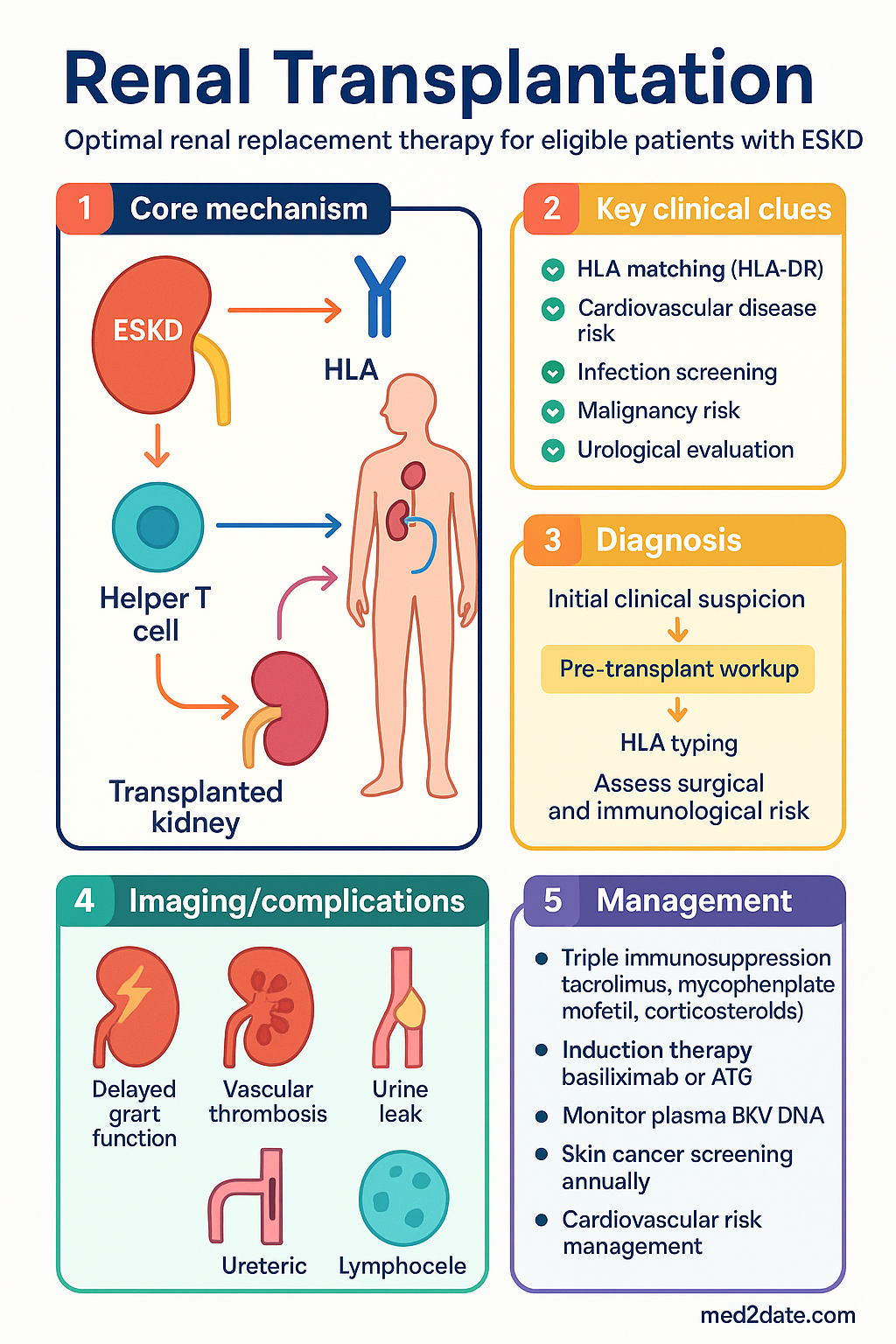
- Pre-transplant workup includes cardiovascular assessment, infection screening, urological evaluation, malignancy risk assessment, and HLA typing.
- HLA matching (particularly HLA-DR) significantly influences graft survival; zero-mismatch deceased-donor transplants have the best long-term outcomes.
- Living-donor kidney transplant achieves 5-year graft survival of approximately 90–95%, superior to deceased-donor transplant at 85–90%.
- Triple immunosuppression with a calcineurin inhibitor (tacrolimus), mycophenolate mofetil, and corticosteroids remains the standard of care.
- Tacrolimus trough targets: 8–12 ng/mL in first 3 months, tapering to 5–8 ng/mL by 6–12 months; therapeutic drug monitoring is mandatory.
- Induction therapy with basiliximab (IL-2 receptor antagonist) for standard-risk and anti-thymocyte globulin (ATG) for high-immunological-risk recipients.
- BK virus nephropathy affects 1–10% of recipients; monitor plasma BKV DNA monthly for 6 months, then 3-monthly for 2 years; treat with immunosuppression reduction.
- Post-transplant malignancy risk is elevated 3–5-fold; skin cancer screening annually is mandatory in Australia; reduce immunosuppression when malignancy is diagnosed.
- Cardiovascular disease is the leading cause of death with a functioning graft; manage modifiable risk factors aggressively post-transplant.
- Aboriginal and Torres Strait Islander patients face lower transplant rates, longer wait times, and worse graft survival; culturally safe care pathways are essential.
- Antibiotic prophylaxis: trimethoprim-sulfamethoxazole (TMP-SMX) for PJP and UTI prophylaxis for 3–6 months; ganciclovir or valganciclovir for CMV prophylaxis in D+/R− or R+ patients.
Introduction & Australian Epidemiology
Renal transplantation is the optimal treatment for end-stage kidney disease (ESKD), providing superior survival, quality of life, and cost-effectiveness compared with maintenance dialysis. In Australia, more than 1,200 kidney transplants are performed annually, with approximately one-third from living donors. Outcomes depend critically on HLA matching, immunosuppression protocols, donor selection, and early recognition of rejection.
According to the Australia and New Zealand Dialysis and Transplant Registry (ANZDATA), the median waiting time for a deceased-donor kidney transplant in Australia is 2–4 years. At 31 December 2023, over 10,000 Australians were living with a functioning kidney transplant. One-year graft survival exceeds 97% for living-donor and 95% for deceased-donor transplants, with 5-year survival of 90–95% and 85–90% respectively.
The Organ and Tissue Authority (OTA) oversees the national DonateLife programme, and the Transplantation Society of Australia and New Zealand (TSANZ) provides clinical practice guidelines. Allocation is managed through the national organ matching system, prioritising sensitised patients, paediatric recipients, and those with longer waiting times.
Pre-transplant Assessment & HLA Matching
Recipient Assessment
Comprehensive pre-transplant evaluation aims to identify contraindications, optimise modifiable risk factors, and stratify surgical and immunological risk. Assessment is performed by the transplant centre multidisciplinary team.
| Domain | Assessment | Key Considerations |
|---|---|---|
| Cardiovascular | ECG, echocardiography, stress testing ± coronary angiography | Age >50, diabetes, smoking, >10 years on dialysis; revascularise significant CAD prior to listing |
| Infection | HBV, HCV, HIV, CMV, EBV, VZV, TB (IGRA), syphilis serology | Active TB must be treated prior to transplant; CMV/EBV serostatus guides post-transplant prophylaxis |
| Urological | Renal tract ultrasound, urodynamic studies if indicated | Lower urinary tract dysfunction, recurrent UTI, bladder augmentation may preclude transplant |
| Malignancy | Age-appropriate cancer screening; dermatology review | Most cancers require disease-free interval of ≥2 years (≥5 years for some); prior skin cancers common in Australia |
| Immunological | HLA typing, panel reactive antibody (PRA), donor-specific antibody (DSA) | PRA >80% = highly sensitised; virtual crossmatch; desensitisation protocols for positive crossmatch |
| Dental | Dental review and treatment of active infection | Periodontal disease is an unrecognised source of chronic inflammation |
| Psychosocial | Social work assessment, adherence history, substance use screening | Non-adherence is a leading cause of graft loss in young adults |
HLA Matching
Human leucocyte antigen (HLA) matching at the A, B, and DR loci is a key determinant of long-term graft survival. A zero HLA-mismatch deceased-donor transplant carries 10–15% better 10-year graft survival compared with a fully mismatched graft. In Australia, allocation algorithms balance HLA matching, waiting time, sensitisation (PRA), donor-recipient age matching, and geographic factors.
- HLA-DR matching has the greatest impact on graft outcome; HLA-DR identical grafts are prioritised.
- Crossmatch must be negative (or desensitisation protocol applied) prior to transplantation.
- Donor-specific antibodies (DSA) detected by solid-phase immunoassay identify patients at risk of antibody-mediated rejection (ABMR).
- ABO-incompatible transplantation is feasible with desensitisation (plasmapheresis, rituximab) but carries higher rejection rates and is performed at select Australian centres.
Living Donor Assessment
Living-donor kidney transplant (LDKT) is the preferred option due to superior outcomes, reduced waiting time, and the opportunity for pre-emptive transplantation. Donor evaluation includes medical fitness, renal function (GFR >80 mL/min), anatomical assessment (CT angiogram), and psychosocial evaluation with independent donor advocacy.
Surgical Procedure & Early Complications
Surgical Technique
The donor kidney is implanted heterotopically into the iliac fossa via an extraperitoneal approach. The renal artery is anastomosed (end-to-side) to the external or internal iliac artery, and the renal vein to the external iliac vein. The ureter is implanted into the bladder via a Politano-Leadbetter or Lich-Gregoir technique with a ureteric stent placed for 4–6 weeks.
- Right iliac fossa is preferred for paediatric recipients and when the left kidney (longer renal vein) is transplanted.
- Cold ischaemia time: target <12 hours for deceased-donor kidneys; warm ischaemia time <30 minutes.
- Machine perfusion (hypothermic or normothermic) is increasingly used for marginal deceased-donor kidneys to improve outcomes.
Early Complications (0–30 Days)
| Complication | Incidence | Management |
|---|---|---|
| Delayed graft function (DGF) | 20–30% deceased donor | Supportive; dialysis if needed; exclude rejection with biopsy if no improvement by day 7 |
| Vascular thrombosis | 1–3% | Surgical emergency; urgent duplex ultrasound; return to theatre for thrombectomy if within 6 hours |
| Urine leak | 2–5% | Drain; ureteric reimplantation or JJ stent; check creatinine of drain fluid |
| Ureteric stricture | 2–8% | Antegrade nephrostogram; balloon dilatation ± stenting; surgical revision if recurrent |
| Lymphocele | 5–20% | Asymptomatic: observe; symptomatic: laparoscopic marsupialisation |
| Wound infection | 5–10% | Wound swab; antibiotics per local antibiogram; consider surgical debridement |
| Haemorrhage | 1–5% | Hb monitoring; transfusion; return to theatre if haemodynamic instability |
Immunosuppression Protocols
Immunosuppression in renal transplantation follows a layered approach: induction therapy at the time of transplant, followed by maintenance triple therapy, with protocols for antibody-mediated rejection (AMR) and T-cell-mediated rejection (TCMR) episodes.
Induction Therapy
| Agent | Indication | Dose | Notes |
|---|---|---|---|
| Basiliximab (Simulect®) | Standard immunological risk | 20 mg IV on Day 0 and Day 4 | IL-2 receptor antagonist; PBS Authority Required; well tolerated |
| Anti-thymocyte globulin (ATG, Thymoglobulin®) | High immunological risk (PRA >20%, retransplant, DSA+) | 1–1.5 mg/kg IV daily × 3–5 doses starting intraoperatively | Depleting antibody; increases infection risk; CMV prophylaxis essential |
Maintenance Immunosuppression — Triple Therapy
Standard maintenance comprises a calcineurin inhibitor (CNI), an antiproliferative agent, and corticosteroids. Tacrolimus has largely replaced ciclosporin as the CNI of choice based on superior efficacy.
Alternative & Adjunctive Agents
| Agent | Role | Notes |
|---|---|---|
| Ciclosporin | Alternative CNI to tacrolimus | 3–5 mg/kg/day PO BD; target trough 150–250 ng/mL; less potent, more metabolic side effects |
| Sirolimus / Everolimus (mTOR inhibitors) | CNI minimisation or conversion | Reduce CNI nephrotoxicity; avoid in first 3 months (impaired wound healing); antiproliferative benefit (malignancy risk reduction) |
| Azathioprine | Alternative to MMF (e.g. pregnancy) | 1–2 mg/kg/day PO; check TPMT before starting; PBS General Benefit |
| Belatacept (Nulojix®) | CNI-free option | 5 mg/kg IV monthly after initial loading; avoid in EBV-seronegative recipients (PTLD risk); limited PBS availability |
Therapeutic Drug Monitoring
Tacrolimus requires trough level monitoring (C0) 2–3 times per week in the first month, weekly for months 2–3, fortnightly for months 3–6, and monthly thereafter. C2 monitoring for ciclosporin may improve dose individualisation. Mycophenolic acid (MPA) AUC monitoring is available at some centres but not routine practice in Australia.
Long-term Complications
Rejection
Rejection remains a significant cause of graft loss. The Banff classification system is the international standard for grading allograft rejection histology. Kidney biopsy is the gold standard for diagnosis.
Post-transplant Malignancy
Transplant recipients have a 3–5-fold increased cancer risk compared with the general population, driven by chronic immunosuppression and impaired tumour immunosurveillance. In Australia, skin cancer (squamous cell carcinoma > basal cell carcinoma) is the most common post-transplant malignancy.
- Skin cancer: Annual dermatological surveillance is mandatory; SCC risk increases 65–250-fold; reduce immunosuppression; consider conversion from azathioprine/MMF to mTOR inhibitor (sirolimus/everolimus).
- Post-transplant lymphoproliferative disorder (PTLD): Primarily EBV-driven; risk highest in D+/R− mismatch; present with fevers, lymphadenopathy, graft dysfunction; reduce immunosuppression; rituximab for CD20+ disease; chemotherapy for aggressive subtypes.
- Kaposi sarcoma: HHV-8 associated; reduce immunosuppression; sirolimus may be beneficial.
- Kidney cancer: Native kidney and graft kidney; screening ultrasound every 2–3 years is recommended by some centres.
Cardiovascular Disease
Cardiovascular disease (CVD) is the leading cause of death with a functioning graft, accounting for approximately 30–40% of deaths in transplant recipients. Traditional risk factors are compounded by transplant-specific factors including immunosuppressive drug toxicity, chronic kidney disease, and proteinuria.
| Risk Factor | Transplant-specific Contribution | Management |
|---|---|---|
| Hypertension | Tacrolimus, ciclosporin, corticosteroids; transplant renal artery stenosis | Target <130/80 mmHg; ACEi/ARB preferred (monitor K+ and creatinine); amlodipine if CNI-related |
| Dyslipidaemia | Corticosteroids, ciclosporin, mTOR inhibitors, sirolimus | Statin therapy (atorvastatin 10–20 mg); check for CNI–statin interaction (avoid high-dose simvastatin with ciclosporin) |
| Diabetes (NODAT) | Tacrolimus, corticosteroids, obesity | Screen with OGTT at 3 months; minimise tacrolimus trough; steroid-sparing protocols; SGLT2 inhibitors emerging data |
| Smoking | Accelerated atherosclerosis, malignancy | Cessation support; NRT, varenicline (no significant CNI interaction); PBS General Benefit |
Chronic Allograft Nephropathy & Graft Loss
Chronic allograft nephropathy (CAN), now termed interstitial fibrosis and tubular atrophy (IF/TA), is a leading cause of late graft loss. It is multifactorial, involving CNI nephrotoxicity, chronic rejection, recurrent primary disease, BK nephropathy, and donor-derived factors. Management includes optimising CNI levels, controlling proteinuria with ACEi/ARB, managing cardiovascular risk factors, and monitoring for BK viraemia.
Infection Complications
Infection Prophylaxis
Special Populations
Monitoring
Post-transplant monitoring is lifelong and involves graft function surveillance, immunosuppression drug monitoring, infection screening, and metabolic complication management.
| Test | Frequency (Year 1) | Frequency (Year 2+) | Purpose |
|---|---|---|---|
| Creatinine, eGFR, K+, Mg²⁺ | Weekly × 1 month → fortnightly → monthly | Every 2–3 months | Graft function, CNI toxicity |
| Tacrolimus trough | 2–3×/week (month 1) → weekly → fortnightly | Monthly → 3-monthly | Dose adjustment |
| FBC, LFTs | Weekly → fortnightly → monthly | Every 2–3 months | MMF/azathioprine toxicity, infection |
| BK virus PCR (plasma) | Monthly × 6 months | 3-monthly × 2 years | BK nephropathy screening |
| CMV PCR | Monthly during prophylaxis; then as indicated | As clinically indicated | CMV detection (D+/R−, R+) |
| Glucose (HbA1c or OGTT) | 3 months (OGTT for NODAT screening) | Annually | New-onset diabetes after transplant |
| Lipid profile | 3 months | Annually | Cardiovascular risk management |
| Proteinuria (ACR) | Each visit | Each visit | Rejection, recurrent disease, CAN |
| DSA (if indicated) | As indicated (rising creatinine, protocol biopsy) | Annually or as indicated | ABMR risk stratification |
| Skin cancer check | Annually | 6–12 monthly | Post-transplant malignancy screening |
| Renal transplant ultrasound | As indicated (rising creatinine) | As indicated | Hydronephrosis, renal artery stenosis |
| Protocol biopsy | 3 and 12 months (selected centres) | As indicated | Subclinical rejection, CAN/IF-TA |
MBS-Relevant Investigations
- MBS Item 66843: Renal transplant biopsy — percutaneous, with imaging guidance.
- MBS Item 73018: Quantitative CMV DNA detection (PCR).
- MBS Item 73016: BK virus quantitative PCR.
- MBS Item 66836: Renal transplant ultrasound with Doppler.
- MBS Item 66500: HLA typing — molecular (PCR-based) high resolution.
Aboriginal and Torres Strait Islander Health
📚 References
- 1. Clayton PA, McDonald SP, Russ GR, Chadban SJ. Long-term outcomes after acute rejection in kidney transplant recipients from the Australia and New Zealand Dialysis and Transplant Registry. Transplantation. 2019;103(8):1653–1660.
- 2. Transplantation Society of Australia and New Zealand (TSANZ). Clinical guidelines for organ transplantation from deceased donors. Version 1.6. TSANZ; 2023.
- 3. Australia and New Zealand Dialysis and Transplant Registry (ANZDATA). 47th Annual Report 2024. Adelaide, SA: ANZDATA; 2024.
- 4. KDIGO Clinical Practice Guideline on the Evaluation and Management of Candidates for Kidney Transplantation. Transplantation. 2020;104(4S1):S1–S103.
- 5. KDIGO Clinical Practice Guideline for the Care of Kidney Transplant Recipients. Am J Transplant. 2009;9(Suppl 3):S1–S155.
- 6. Wong G, Chapman JR, Craig JC. Death from cancer and cardiovascular disease in kidney transplant recipients: a systematic review and meta-analysis. Nephrol Dial Transplant. 2014;29(Suppl 4):iv89–iv98.
- 7. Ong SC, Gaston RS, Davies A, et al. The Banff 2019 Kidney Meeting Report. Am J Transplant. 2020;20(4):804–820.
- 8. Australian Commission on Safety and Quality in Health Care (ACSQHC). National Safety and Quality Health Service Standards. 2nd ed. ACSQHC; 2021.
- 9. Australian Institute of Health and Welfare (AIHW). Chronic kidney disease: Aboriginal and Torres Strait Islander people. Cat. no. PHE 229. Canberra: AIHW; 2020.
- 10. Australian Institute of Health and Welfare (AIHW). Organ and tissue donation. In: Australia's health 2022. AIHW; 2022.
- 11. Lim WH, Chapman JR, Wong G. Skin cancer in Australian kidney transplant recipients. Am J Transplant. 2016;16(5):1502–1510.
- 12. Chadban SJ, Ahn C, Axelrod DA, et al. KDIGO Clinical Practice Guideline on the Evaluation and Management of Candidates for Kidney Transplantation. Transplantation. 2020;104(Suppl 1):S11–S103.
- 13. Halleck F, Budde K. New developments in immunosuppression for kidney transplantation. Lancet. 2019;393(10188):2420–2431.