📋 Key Information Summary
- Drug-induced nephrotoxicity accounts for approximately 20% of community- and hospital-acquired acute kidney injury (AKI) in Australia.
- NSAIDs cause nephrotoxicity primarily through haemodynamic mechanisms — inhibition of renal prostaglandin synthesis reduces afferent arteriolar vasodilation, precipitating pre-renal AKI.
- COX-2 inhibitors (celecoxib, etoricoxib) are not renal-sparing; they carry equivalent nephrotoxic risk to traditional NSAIDs.
- Aminoglycosides (gentamicin, tobramycin) cause dose-dependent proximal tubular necrosis (acute tubular necrosis — ATN); trough levels must be monitored and nephrotoxic courses minimised.
- Cisplatin causes direct tubular toxicity with cumulative dose-dependent AKI; aggressive IV hydration with 0.9% sodium chloride is mandatory pre- and post-infusion.
- Lithium accumulates in the distal collecting duct, causing nephrogenic diabetes insipidus (NDI) acutely and chronic tubulointerstitial nephritis with chronic use; eGFR must be monitored 6-monthly.
- All renally excreted or nephrotoxic drugs require dose adjustment based on eGFR (CKD-EPI 2021 equation); calculate using the patient's most recent serum creatinine.
- Risks of nephrotoxicity are multiplicative — concurrent use of two or more nephrotoxins (e.g., NSAID + ACE inhibitor + diuretic — the "triple whammy") dramatically increases AKI risk.
- For Aboriginal and Torres Strait Islander peoples, CKD prevalence is 2–3 times higher; drug dosing must account for reduced renal reserve and remote monitoring limitations.
- Use the CKD-EPI 2021 creatinine equation (without race coefficient) to estimate GFR for all drug dose adjustments in Australia.
- Prescribing in CKD requires checking a medicines resource (e.g., Australian Medicines Handbook, renal drug databases) for every new and existing medication.
- Refer for nephrology input when eGFR <30 mL/min/1.73 m², when nephrotoxic drug cessation does not improve AKI within 48–72 hours, or for complex polypharmacy in advanced CKD.
Introduction & Australian Epidemiology
Drug-induced nephrotoxicity remains one of the most common preventable causes of acute kidney injury (AKI) in Australia, accounting for an estimated 20% of all AKI presentations in hospital and a significant proportion in the community. The kidney is uniquely vulnerable to drug toxicity because of its high blood flow (20–25% of cardiac output), concentration of drugs in the medullary interstitium, and metabolic activity of tubular epithelial cells.
The mechanisms by which drugs injure the kidney are diverse and include haemodynamic alterations (e.g., NSAIDs, ACE inhibitors), direct tubular cell toxicity (e.g., aminoglycosides, cisplatin, amphotericin B), crystal nephropathy (e.g., aciclovir, methotrexate, indinavir), thrombotic microangiopathy (e.g., gemcitabine, VEGF inhibitors), and immune-mediated tubulointerstitial nephritis (e.g., proton pump inhibitors, penicillins, NSAIDs).
In Australia, approximately 1.7 million adults have chronic kidney disease (CKD), with stages 3–5 affecting over 600,000 people. The burden is disproportionately borne by Aboriginal and Torres Strait Islander peoples, among whom CKD prevalence is 2–3 times that of non-Indigenous Australians. Polypharmacy is common in CKD populations — up to 80% of patients with eGFR <60 mL/min/1.73 m² take five or more regular medications, amplifying nephrotoxic risk.
The concept of the "triple whammy" — concurrent use of an NSAID (or COX-2 inhibitor), an ACE inhibitor or angiotensin receptor blocker (ARB), and a diuretic — is well recognised in Australian prescribing safety literature as a major risk factor for AKI, particularly in elderly patients during intercurrent illness or dehydration.
This guideline provides an Australian-focused overview of the major drug classes causing nephrotoxicity, with practical recommendations for prevention, monitoring, and dose adjustment in renal impairment.
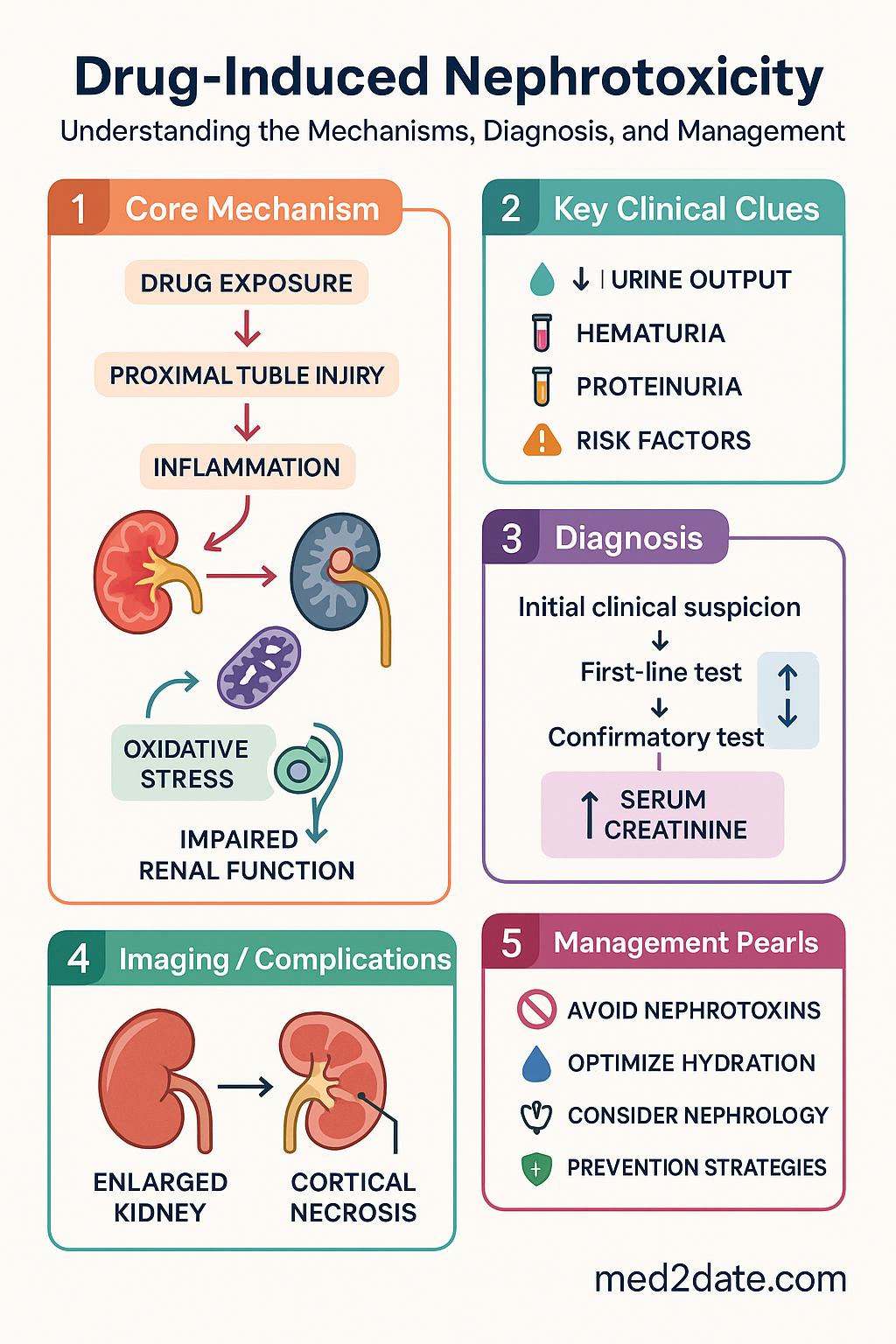
NSAIDs & COX-2 Inhibitors (Haemodynamic Nephrotoxicity)
Mechanism
Non-steroidal anti-inflammatory drugs (NSAIDs) inhibit cyclooxygenase (COX) enzymes, reducing renal prostaglandin E₂ (PGE₂) and prostacyclin (PGI₂) synthesis. These prostaglandins normally mediate afferent arteriolar vasodilation to maintain glomerular filtration rate (GFR), particularly in states of reduced renal perfusion (hypovolaemia, heart failure, cirrhosis, CKD). Their inhibition causes afferent arteriolar vasoconstriction, reducing GFR and precipitating pre-renal AKI.
With prolonged use, NSAIDs can also cause sodium and water retention (oedema, hypertension), hyperkalaemia (via suppression of renin–aldosterone), and — less commonly — acute interstitial nephritis (AIN) or papillary necrosis.
COX-2 Selective Inhibitors
COX-2 inhibitors (celecoxib, etoricoxib) were initially thought to be renal-sparing because COX-1–derived prostaglandins play the predominant role in renal haemostasis. However, COX-2 is constitutively expressed in the macula densa, thick ascending limb, and medullary interstitial cells. Clinical evidence confirms that COX-2 inhibitors carry equivalent risk of haemodynamic nephrotoxicity, sodium retention, and hyperkalaemia as non-selective NSAIDs.
Risk Factors for NSAID Nephrotoxicity
| Risk Factor | Rationale |
|---|---|
| eGFR <60 mL/min/1.73 m² | Reduced renal reserve; prostaglandin-dependent GFR maintenance |
| Age ≥65 years | Age-related GFR decline, polypharmacy, reduced thirst mechanism |
| Concurrent ACEi/ARB + diuretic | "Triple whammy" — synergistic haemodynamic insult |
| Heart failure (NYHA III–IV) | Low cardiac output → prostaglandin-dependent renal perfusion |
| Cirrhosis / hepatic impairment | Splanchnic vasodilation → renal vasoconstriction compensated by PGs |
| Dehydration / diarrhoea / vomiting | Reduced effective circulating volume |
| Concurrent nephrotoxins (aminoglycosides, contrast) | Additive renal injury |
| Duration >7 days | Cumulative exposure increases risk of AIN and CKD progression |
Management
- Prevention: Avoid NSAIDs where possible in patients with eGFR <30 mL/min/1.73 m² (relative contraindication). Use for shortest possible duration at lowest effective dose.
- When NSAID is necessary in CKD 3 (eGFR 30–59): Use with caution, monitor serum creatinine and potassium at baseline, 1–2 weeks after initiation, and periodically thereafter.
- If AKI develops: Cease the NSAID immediately. Most haemodynamic AKI is reversible within 3–7 days of cessation. Provide IV 0.9% sodium chloride if dehydrated.
- Alternatives for analgesia: Paracetamol (first-line), tramadol (dose-adjust in CKD), low-dose opioid (with renal caution), topical NSAIDs (lower systemic exposure).
Aminoglycosides & Cisplatin (Tubular Toxicity)
Aminoglycosides
Aminoglycosides (gentamicin, tobramycin, amikacin) are concentration-dependent bactericidal antibiotics widely used in Australia for Gram-negative sepsis, endocarditis (synergistic), and perioperative prophylaxis. They are freely filtered at the glomerulus and actively reabsorbed by proximal tubular epithelial cells via megalin-mediated endocytosis, where they accumulate in lysosomes and cause direct tubular cell injury, necrosis, and apoptosis.
Dosing Strategy in Australia
- Once-daily dosing (ODD): Gentamicin 5–7 mg/kg IV (based on ideal or adjusted body weight) once daily. Preferred for most indications. Trough level taken just before the next dose; target trough <1 mg/L (ideally <0.5 mg/L for courses >5 days).
- Extended-interval dosing in CKD: If eGFR <40 mL/min/1.73 m², extended-interval dosing may be unreliable. Consult infectious diseases or pharmacy for individualised dosing and monitoring.
- Monitoring: Serum creatinine and potassium daily during treatment. Trough level at 48 hours and then every 2–3 days. Discontinue if trough ≥2 mg/L or creatinine rises >50% from baseline.
- Duration: Maximum 5–7 days for empiric therapy. Longer courses (e.g., endocarditis synergistic therapy) require enhanced monitoring and nephrology input.
Cisplatin
Cisplatin is a platinum-based chemotherapeutic agent used in testicular, ovarian, bladder, head and neck, and lung cancers. It is freely filtered at the glomerulus and actively taken up by proximal tubular cells via organic cation transporter 2 (OCT2), where it forms DNA crosslinks and generates reactive oxygen species, causing tubular necrosis and apoptosis. Nephrotoxicity is the principal dose-limiting toxicity.
Prevention of Cisplatin Nephrotoxicity
Renal Thresholds for Aminoglycoside & Cisplatin Use
| Drug | eGFR Threshold | Action |
|---|---|---|
| Gentamicin (ODD) | eGFR <40 | Extended-interval unreliable; consider ID/pharmacy dosing; daily levels |
| Gentamicin | eGFR <20 | Avoid if possible; use alternative agent |
| Tobramycin | eGFR <40 | As per gentamicin — individualise dose |
| Cisplatin | eGFR <60 | Contraindicated in most protocols; switch to carboplatin |
| Cisplatin | eGFR <45 | Absolute contraindication for full-dose cisplatin |
Lithium Nephrotoxicity
Mechanisms
Lithium has a narrow therapeutic index (0.4–1.0 mmol/L) and is exclusively renally excreted with no hepatic metabolism. It is freely filtered at the glomerulus and approximately 80% is reabsorbed in the proximal tubule. Lithium accumulates in principal cells of the collecting duct, where it inhibits glycogen synthase kinase 3β (GSK-3β), downregulates aquaporin-2 (AQP2) channels, and impairs the renal response to antidiuretic hormone (ADH), leading to nephrogenic diabetes insipidus (NDI).
Chronic lithium exposure (>10 years) causes chronic tubulointerstitial nephritis, progressive CKD (estimated 15–20% of long-term lithium users develop eGFR <60), and — rarely — renal tubular acidosis (type 1 or 2) or hyperparathyroidism-mediated hypercalcaemia.
Monitoring Requirements
| Parameter | Frequency | Action Threshold |
|---|---|---|
| Serum lithium level | Every 3–6 months (stable); within 5–7 days of dose change | Target 0.4–0.8 mmol/L (maintenance); toxicity >1.2 mmol/L |
| eGFR / serum creatinine | Every 6 months | If eGFR decline >5 mL/min/year — nephrology referral |
| Electrolytes (Na⁺, K⁺) | Every 6 months | Hyperkalaemia, hyponatraemia |
| Calcium / PTH | Annually | Hypercalcaemia (lithium-associated hyperparathyroidism in 10–25%) |
| Thyroid function (TSH) | Every 6 months | Hypothyroidism in 5–35% |
| Urine osmolality (water deprivation test) | If polyuria (>3 L/day) | NDI: urine osmolality <300 mOsm/kg after 8-hr fluid restriction |
Management of Lithium-Induced Nephrotoxicity
- Acute toxicity: Cease lithium. IV 0.9% NaCl for rehydration. Monitor lithium levels 4–6 hourly. Consider haemodialysis if lithium >4 mmol/L (acute ingestion), >2.5 mmol/L (chronic), or if symptomatic (seizures, reduced consciousness, cardiac arrhythmia) regardless of level.
- Chronic CKD: The decision to continue or cease lithium in CKD is complex and requires shared decision-making involving psychiatry, nephrology, and the patient. Many patients can continue lithium with eGFR 30–59 if psychiatrically stable and lithium is essential, with enhanced renal monitoring.
- NDI management: Amiloride 5–10 mg PO daily blocks lithium entry into principal cells via ENaC and may partially reverse NDI. Adequate free water intake essential.
- Alternative mood stabilisers (if lithium must be ceased): Sodium valproate, lamotrigine, or carbamazepine — discuss with psychiatry.
Drug Dosing in Renal Impairment
Accurate estimation of renal function is essential for safe prescribing in CKD. The CKD-EPI 2021 creatinine equation (without race coefficient) is recommended in Australia for eGFR reporting and drug dose adjustment. The Cockcroft-Gault equation estimates creatinine clearance (CrCl) and is still used for some drug-specific dosing recommendations in product information.
CKD Staging and Prescribing Implications
Common Drugs Requiring Dose Adjustment in CKD
| Drug | Normal Dose | eGFR 30–59 | eGFR 10–29 | eGFR <10 / Dialysis |
|---|---|---|---|---|
| Metformin | 500–1000 mg BD | Max 1000 mg/day; review at eGFR 30 | Cease (eGFR <30) | Contraindicated |
| Enoxaparin | 1 mg/kg BD or 1.5 mg/kg OD | 1 mg/kg OD (prophylaxis: 20 mg OD) | 1 mg/kg OD; consider anti-Xa monitoring | Use UFH instead; not dialysable |
| Gabapentin | 300–1200 mg TDS | 200–700 mg BD | 200–700 mg OD | 100–300 mg OD; supplement post-HD |
| Pregabalin | 75–300 mg BD | 75–300 mg/day in divided doses | 25–150 mg/day | 25–75 mg/day; supplement post-HD |
| Morphine | 10–20 mg PO 4-hourly | Reduce dose; active metabolite (M6G) accumulates | Avoid; use fentanyl or buprenorphine | Contraindicated — M6G toxicity risk |
| Vancomycin | 15–20 mg/kg IV 8–12 hourly | 15 mg/kg IV 12–24 hourly; AUC-guided dosing | 15 mg/kg IV 24–48 hourly; trough monitoring | 15 mg/kg IV 48–96 hourly; dialysis-adjusted |
| Allopurinol | 100–300 mg PO daily | 100–200 mg daily | 100 mg daily or alternate days | 100 mg 2–3 times/week post-dialysis |
| Colchicine | 500 μg BD–TDS (acute gout) | 500 μg BD; max 1 mg/day | 500 μg OD; avoid repeated courses | Contraindicated (cumulative toxicity) |
Principles of Dose Adjustment
- Reduce the dose when the drug has active/toxic metabolites that accumulate in renal impairment (e.g., morphine, codeine, dabigatran).
- Extend the dosing interval when the parent drug accumulates but is non-toxic at standard peak concentrations (e.g., aminoglycosides, vancomycin).
- Use a loading dose (unchanged from normal renal function) when therapeutic levels need to be achieved quickly (e.g., digoxin, phenytoin), then reduce the maintenance dose.
- Monitor drug levels where available (vancomycin, gentamicin, lithium, digoxin, phenytoin) and adjust based on measured concentrations.
- Consider dialysis clearance: Some drugs are removed by haemodialysis (e.g., lithium, gabapentin, vancomycin) and require post-dialysis supplementation. Others are not dialysable (e.g., digoxin, aminoglycosides with tissue accumulation).
Drugs to Avoid in CKD
- NSAIDs: Avoid if eGFR <30; extreme caution eGFR 30–59.
- Metformin: Cease if eGFR <30 (lactic acidosis risk). Reduce dose eGFR 30–45.
- Nitrofurantoin: Ineffective and toxic if eGFR <45 (poor urinary concentration; peripheral neuropathy risk).
- Methenamine (hiprex): Ineffective if eGFR <30 (requires acidic urine; inadequate urinary concentration).
- Gadolinium-based contrast agents: Risk of nephrogenic systemic fibrosis if eGFR <30; use group II agents only (e.g., gadoterate, gadobutrol).
- Dabigatran: Contraindicated if eGFR <30 (significant accumulation; no reversal agent readily available in all centres).
- Spironolactone / eplerenone: Avoid if eGFR <30 or K⁺ >5.0 mmol/L (hyperkalaemia risk).
- Trimethoprim: Increases serum creatinine (inhibits tubular secretion — not true AKI) and can cause hyperkalaemia; use with caution in CKD.
Pathophysiology of Drug-Induced Kidney Injury
Understanding the mechanism of drug nephrotoxicity guides prevention and management. The following classification summarises the principal mechanisms:
| Mechanism | Site | Example Drugs | Pathology |
|---|---|---|---|
| Haemodynamic | Afferent arteriole | NSAIDs, COX-2 inhibitors | ↓ Prostaglandin → vasoconstriction → pre-renal AKI |
| Haemodynamic | Efferent arteriole | ACE inhibitors, ARBs | ↓ Angiotensin II → efferent dilation → ↓ GFR |
| Direct tubular toxicity | Proximal tubule | Aminoglycosides, cisplatin, tenofovir, ifosfamide | Tubular cell necrosis/apoptosis → ATN |
| Crystal nephropathy | Tubular lumen / collecting duct | Aciclovir, methotrexate, sulfonamides, indinavir | Intratubular crystal precipitation → obstruction |
| Immune-mediated (AIN) | Tubulointerstitium | PPIs, NSAIDs, penicillins, rifampicin | T-cell mediated interstitial inflammation → AIN |
| Thrombotic microangiopathy | Glomerular / arteriolar endothelium | Gemcitabine, VEGF inhibitors, calcineurin inhibitors | Endothelial injury → TMA → haemolytic uraemic syndrome |
| Osmotic nephrosis | Proximal tubule | IV immunoglobulin (sucrose), hydroxyethyl starch, mannitol | Vacuolisation of tubular cells → reduced GFR |
| Chronic tubulointerstitial | Collecting duct / interstitium | Lithium, calcineurin inhibitors (cyclosporin, tacrolimus) | Fibrosis, tubular atrophy → progressive CKD |
Investigations
When drug-induced nephrotoxicity is suspected, the following investigations should be performed:
Special Populations
Aboriginal and Torres Strait Islander Health Considerations
Aboriginal and Torres Strait Islander peoples experience CKD at 2–3 times the rate of non-Indigenous Australians, with end-stage kidney disease (ESKD) rates 7–8 times higher in some age groups (AIHW, 2023). Drug-induced nephrotoxicity is a particularly important consideration given the higher prevalence of risk factors including diabetes, hypertension, obesity, and recurrent infections requiring antibiotics.
Monitoring Framework
A structured monitoring approach minimises the risk of unrecognised drug nephrotoxicity:
📚 References
- 1. Kidney Disease: Improving Global Outcomes (KDIGO). KDIGO 2024 Clinical Practice Guideline for the Evaluation and Management of Chronic Kidney Disease. Kidney Int. 2024;105(4S):S117–S314.
- 2. Australian Institute of Health and Welfare (AIHW). Chronic kidney disease: Australian facts. Cat. no. CKD 8. Canberra: AIHW; 2023.
- 3. NPS MedicineWise. The triple whammy: avoiding a dangerous combination. NPS Radar. 2022. Available from: https://www.nps.org.au
- 4. Australian Commission on Safety and Quality in Health Care (ACSQHC). Acute Kidney Injury Clinical Care Standard. Sydney: ACSQHC; 2020.
- 5. Rossi S, editor. Australian Medicines Handbook (AMH). Adelaide: AMH Pty Ltd; 2024.
- 6. Perazella MA. Pharmacology behind Common Drug-Nephrotoxicity Mechanisms. Clin J Am Soc Nephrol. 2023;18(10):1310–1321.
- 7. Lameire NH, Bagga A, Cruz D, et al. Acute kidney injury: an increasing global concern. Lancet. 2013;382(9887):170–179.
- 8. National Kidney Foundation. KDOQI Clinical Practice Guideline for Diabetes and CKD: 2022 Update. Am J Kidney Dis. 2022;80(2):S1–S127.
- 9. Royal Australian College of General Practitioners (RACGP). Guidelines for preventive activities in general practice (Red Book). 10th ed. East Melbourne: RACGP; 2023.
- 10. Haase M, Bellomo R, Devarajan P, et al. Accuracy of neutrophil gelatinase-associated lipocalin (NGAL) in diagnosis and prognosis in acute kidney injury: a systematic review and meta-analysis. Am J Kidney Dis. 2009;54(6):1012–1024.
- 11. Prescribing Competencies Framework Working Group. Prescribing Competencies Framework. 2nd ed. Melbourne: NPS MedicineWise; 2021.
- 12. McDonald SP, Russ GR. Burden of end-stage renal disease among indigenous peoples in Australia and New Zealand. Kidney Int Suppl. 2003;(83):S123–S127.
- 13. RHDAustralia (Australian Government Department of Health). The 2020 Australian guideline for prevention, diagnosis and management of acute rheumatic fever and rheumatic heart disease. 3rd ed. Darwin: Menzies School of Health Research; 2020.
- 14. Grünfeld JP, Rossier BC. Lithium nephrotoxicity revisited. Nat Rev Nephrol. 2009;5(5):270–276.
- 15. Kidney Health Australia. Caring for Australasians with Renal Impairment (CARING) — Drug Dosing in Kidney Disease. Available from: https://www.kidney.org.au