📋 Key Information Summary
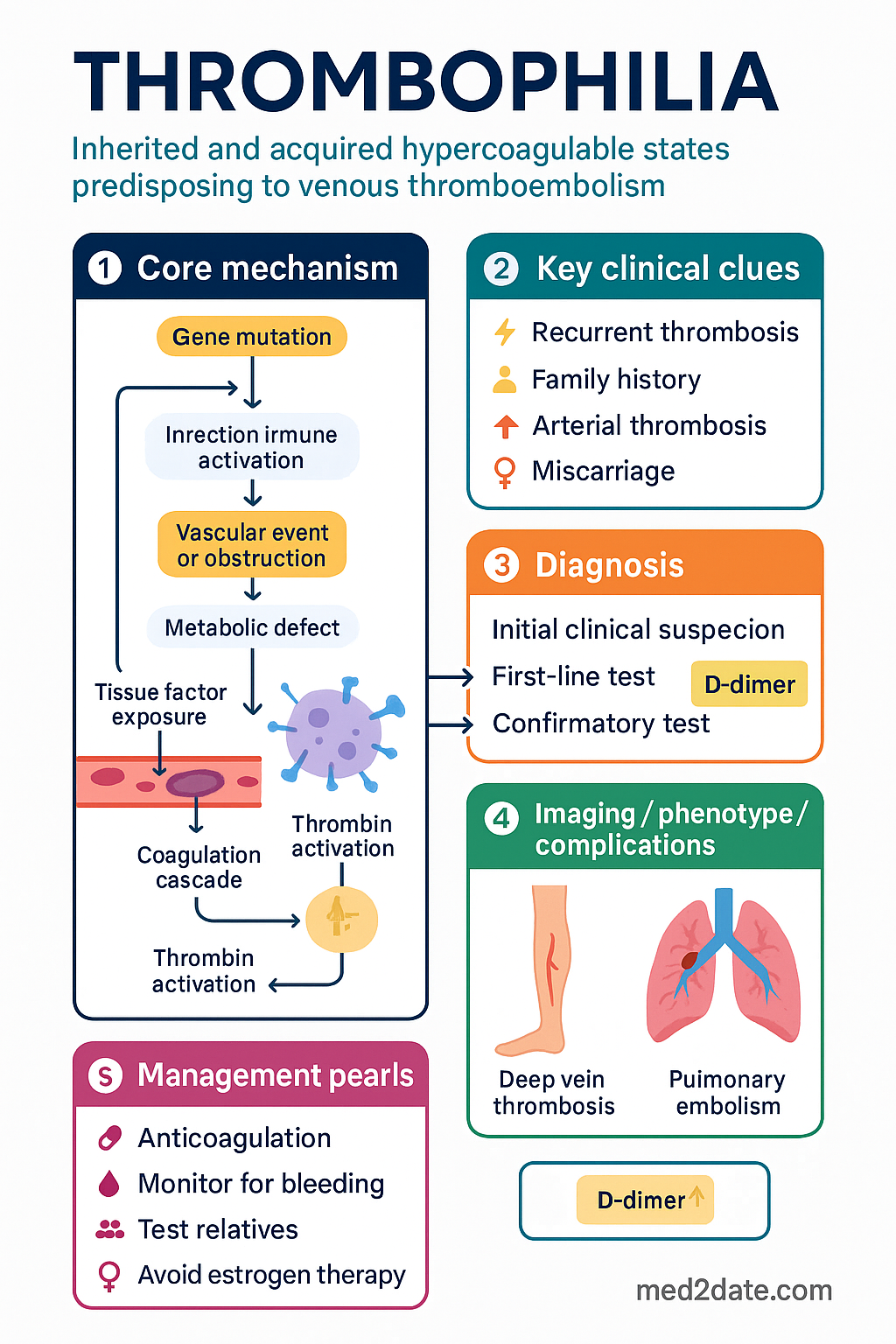
- Thrombophilia encompasses inherited and acquired hypercoagulable states predisposing to venous thromboembolism (VTE), with the majority presenting as deep vein thrombosis (DVT) or pulmonary embolism (PE).
- Factor V Leiden (FVL) is the most common inherited thrombophilia in Australian populations, with a heterozygous prevalence of approximately 5–8% in people of European descent.
- Prothrombin G20210A mutation is the second most common inherited thrombophilia, with a heterozygous prevalence of approximately 2–3% in Europeans.
- Protein C, Protein S, and antithrombin (AT) deficiency are rarer but confer significantly higher thrombotic risk (especially homozygous compound states).
- Routine thrombophilia screening after a first unprovoked VTE is generally not recommended — test only when results will change management (e.g., anticoagulation duration, family screening in first-degree relatives).
- Testing should be deferred for at least 2–4 weeks after completing anticoagulation to avoid false-negative results from consumption or warfarin interference.
- Anticoagulation duration is determined by the balance of provoked vs unprovoked VTE, recurrence risk (VTE-DASH or Vienna Prediction Model score), and bleeding risk — not by thrombophilia genotype alone.
- Heterozygous FVL or PT G20210A alone is not an indication for extended anticoagulation after provoked VTE.
- Antithrombin deficiency, combined thrombophilias, or homozygous/mixed states generally warrant extended or indefinite anticoagulation after VTE.
- Direct oral anticoagulants (DOACs) are first-line for most patients; warfarin remains preferred for antithrombin deficiency and antiphospholipid syndrome (APS).
- Pre-procedural and peri-partum bridging with low-molecular-weight heparin (LMWH) is essential in high-risk thrombophilias (AT deficiency, Protein C/S deficiency, combined defects).
- Aboriginal and Torres Strait Islander peoples may have under-diagnosed thrombophilia; access to specialist haematology and thrombophilia clinics is limited in remote Australia, increasing the need for GP-initiated testing frameworks.
🎧 Audio Brief
Introduction & Australian Epidemiology
Thrombophilia refers to an inherited or acquired predisposition to venous thromboembolism (VTE), encompassing deep vein thrombosis (DVT) and pulmonary embolism (PE). The concept encompasses genetic mutations affecting coagulation factor function, natural anticoagulant deficiency, and acquired hypercoagulable states such as antiphospholipid syndrome (APS) and malignancy.
VTE affects approximately 1–2 per 1,000 Australian adults annually, with incidence rising sharply with age (≥6 per 1,000 in those >70 years). Thrombophilias modify recurrence risk rather than being the primary driver of first VTE events, which remain most commonly provoked by surgery, immobilisation, oestrogen-containing medications, pregnancy, and malignancy.
The overall prevalence of inherited thrombophilias in the Australian population is as follows:
| Thrombophilia | Heterozygous Prevalence | Homozygous Prevalence | Relative Risk (first VTE) |
|---|---|---|---|
| Factor V Leiden | 5–8% (European) | ~1 in 5,000 | ×3–8 (het) / ×50–80 (hom) |
| Prothrombin G20210A | 2–3% (European) | ~1 in 10,000 | ×2–5 (het) / ×20+ (hom) |
| Antithrombin deficiency | 0.02–0.2% | Rare (often lethal) | ×5–50 |
| Protein C deficiency | 0.2–0.5% | ~1 in 500,000–1,000,000 | ×7–10 (het) |
| Protein S deficiency | 0.1–1% | Very rare | ×5–10 (het) |
In Australia, inherited thrombophilias are predominantly identified in people of European descent. Factor V Leiden and prothrombin G20210A are exceedingly rare in East Asian, African, and First Nations populations, while Protein C/S and antithrombin deficiency occur across all ancestries. Thrombophilia testing patterns vary widely across Australian states and territories, with significant practice variation between metropolitan and rural/remote settings.
Inherited Thrombophilias — Factor V Leiden & Prothrombin G20210A
Factor V Leiden (FVL)
Factor V Leiden results from a point mutation (G1691A) in the F5 gene causing an arginine-to-glutamine substitution at position 506 (R506Q). This renders activated Factor V resistant to cleavage by activated Protein C (APC resistance), thereby sustaining the prothrombotic state.
Prothrombin Gene Mutation (PT G20210A)
The prothrombin G20210A mutation is a gain-of-function variant in the 3′ untranslated region of the F2 gene, leading to increased prothrombin (Factor II) plasma levels (approximately 30% elevation). Elevated prothrombin enhances thrombin generation and promotes a prothrombotic phenotype.
Protein C, Protein S & Antithrombin Deficiency
These natural anticoagulant deficiencies are less common than FVL or PT G20210A but confer significantly higher thrombotic risk and are more likely to influence anticoagulation decisions. All three follow autosomal dominant inheritance with variable penetrance.
Antithrombin (AT) Deficiency
Antithrombin is the primary physiological inhibitor of thrombin (Factor IIa) and Factor Xa. Deficiency may be quantitative (Type I — reduced synthesis) or qualitative (Type II — functional defect in the reactive site, heparin-binding site, or pleiotropic). AT deficiency confers the highest thrombotic risk of all inherited thrombophilias.
Protein C Deficiency
Protein C is a vitamin K-dependent zymogen that, when activated by the thrombin-thrombomodulin complex, proteolytically inactivates Factors Va and VIIIa. Heterozygous deficiency confers a ×7–10 increased VTE risk. Critically, warfarin initiation can precipitate warfarin-induced skin necrosis (WISN) due to the more rapid fall in Protein C relative to procoagulant factors.
Protein S Deficiency
Protein S is a cofactor for activated Protein C and also has independent anticoagulant activity via direct inhibition of prothrombinase. Three types are recognised:
| Type | Free PS | Total PS | PS Activity |
|---|---|---|---|
| Type I | ↓ | ↓ | ↓ |
| Type II | Normal | Normal | ↓ |
| Type III | ↓ | Normal | ↓ |
Testing Indications & Interpretation
When to Test
Appropriate indications for thrombophilia testing in Australia:
- Unprovoked VTE in a patient <50 years, especially if considering stopping anticoagulation
- Recurrent VTE (≥2 episodes)
- VTE in unusual sites (cerebral venous sinus, hepatic, mesenteric, portal veins)
- First-degree relative with high-risk thrombophilia (AT deficiency, homozygous FVL, combined defects)
- Neonatal purpura fulminans or warfarin-induced skin necrosis (test for Protein C/S deficiency)
- Recurrent pregnancy loss (≥3 first-trimester or ≥1 second-trimester losses) — after exclusion of APS
- Heparin resistance (suggestive of AT deficiency)
When NOT to Test
- First provoked VTE with a strong transient risk factor (surgery, plaster cast, >3 days immobility)
- During acute VTE (consumption lowers Protein C/S/AT levels)
- While on anticoagulation (warfarin lowers Protein C/S; DOACs interfere with clot-based assays)
- During pregnancy or oestrogen use (falsely low Protein S)
- Routine screening in the general population or pre-employment
Interpretation Framework
| Test | Method | Timing Requirements | Interference |
|---|---|---|---|
| Factor V Leiden | DNA-based (PCR); APTT-based APC-R screening | Any time (genetic test — constant) | APC-R assay unreliable if on warfarin or lupus anticoagulant present |
| Prothrombin G20210A | DNA-based (PCR); prothrombin level screening | Any time (genetic test — constant) | Prothrombin levels unreliable on warfarin |
| Antithrombin | Chromogenic activity assay ± antigen | ≥2 weeks off anticoagulation; not during acute thrombosis | Heparin (in vitro); acute thrombosis (consumption); DIC |
| Protein C | Chromogenic or clot-based activity ± antigen | ≥2–4 weeks off warfarin (Vit K-dependent); can test on heparin | Warfarin (falsely ↓); acute thrombosis; liver disease; DIC |
| Protein S | Free PS antigen (immunological) + activity | ≥2–4 weeks off warfarin; not during pregnancy or OCP | Warfarin, pregnancy, OCP, acute thrombosis, liver disease — all falsely ↓ |
Australian Laboratory Considerations
Management — Anticoagulation Duration
Anticoagulation decisions in thrombophilia should be based on the clinical context of the VTE (provoked vs unprovoked), validated recurrence risk scores, bleeding risk, and patient preference — not the thrombophilia genotype alone.
Anticoagulation Duration Decision Framework
Recommended Duration by Thrombophilia Type
| Thrombophilia | Provoked VTE | Unprovoked VTE |
|---|---|---|
| No thrombophilia | 3 months | ≥3 months; reassess for extended |
| Heterozygous FVL or PT G20210A | 3 months | ≥3 months; reassess — genotype alone does not mandate extended |
| Homozygous FVL or PT G20210A | 3–6 months; reassess | Extended/indefinite |
| Compound heterozygous (FVL + PT) | 3–6 months; reassess | Extended/indefinite |
| Protein C deficiency (het) | 3–6 months | Extended/indefinite |
| Protein S deficiency (het) | 3–6 months | Extended/indefinite |
| Antithrombin deficiency (het) | Extended/indefinite | Extended/indefinite |
| Combined thrombophilias | Extended/indefinite | Extended/indefinite |
Pharmacological Agents — Australian PBS
Monitoring
Warfarin Monitoring
- Target INR: 2.0–3.0 for most VTE. Target INR 2.5–3.5 for APS with recurrent thrombosis.
- INR monitoring every 1–2 weeks initially, then every 4–6 weeks when stable.
- Time in therapeutic range (TTR) should be >65% — if lower, consider DOAC switch if appropriate.
- CYP2C9 and VKORC1 genotyping (MBS Item 73302) may guide initial dosing in complex cases.
DOAC Monitoring
- DOACs do not require routine coagulation monitoring.
- Check renal function (eGFR) every 6–12 months — essential for dose adjustment.
- Anti-Xa levels (calibrated for specific DOAC) can be measured in clinical emergencies (major bleeding, urgent surgery, suspected treatment failure) — available at tertiary centres.
Special Populations
Aboriginal and Torres Strait Islander Health Considerations
📚 References
- 1. Connors JM. Thrombophilia testing and venous thrombosis. N Engl J Med. 2017;377(12):1177–1187.
- 2. Middeldorp S, Nieuwlaat R, Baumann Kreuziger L, et al. American Society of Hematology 2023 guidelines for management of venous thromboembolism: thrombophilia testing. Blood Adv. 2023;7(22):7101–7138.
- 3. Baglin T, Gray E, Greaves M, et al. Clinical guidelines for testing for heritable thrombophilia. Br J Haematol. 2010;149(2):209–220.
- 4. Kearon C, Akl EA, Ornelas J, et al. Antithrombotic therapy for VTE disease: CHEST guideline and expert panel report. Chest. 2016;149(2):315–352.
- 5. Tran HA, Gibbs H, Merriman E, et al. New guidelines from the Thrombosis and Haemostasis Society of Australia and New Zealand for the diagnosis and management of venous thromboembolism. Med J Aust. 2019;210(5):227–235.
- 6. Australian Institute of Health and Welfare (AIHW). Cardiovascular disease in Aboriginal and Torres Strait Islander people. AIHW; 2023. Available from: https://www.aihw.gov.au
- 7. Bates SM, Greer IA, Middeldorp S, et al. VTE, thrombophilia, antithrombotic therapy, and pregnancy: ACCP evidence-based clinical practice guidelines (9th ed). Chest. 2012;141(2 Suppl):e691S–e736S.
- 8. Pengo V, Lensing AWA, Prins MH, et al. Incidence of chronic thromboembolic pulmonary hypertension after pulmonary embolism (for the Thromboembolic Hypertension Study Group). N Engl J Med. 2004;350(22):2257–2264.
- 9. Dentali F, Ageno W, Bozzato S, et al. Role of Factor V Leiden and prothrombin G20210A in patients with pulmonary embolism: systematic review and meta-analysis. Thromb Haemost. 2012;107(2):251–258.
- 10. Crowther MA, Kelton JG. Congenital thrombophilic states associated with venous thrombosis: a qualitative overview and proposed classification system. Ann Intern Med. 2003;138(2):128–134.
- 11. Monagle P, Cuello CA, Augustine C, et al. American Society of Hematology 2018 guidelines for management of venous thromboembolism: treatment of pediatric venous thromboembolism. Blood Adv. 2018;2(22):3292–3316.
- 12. RHDAustralia. Australian guideline for prevention, diagnosis and management of acute rheumatic fever and rheumatic heart disease (3rd ed). Menzies School of Health Research; 2020. [Referenced for ATSI health frameworks].