📋 Key Information Summary
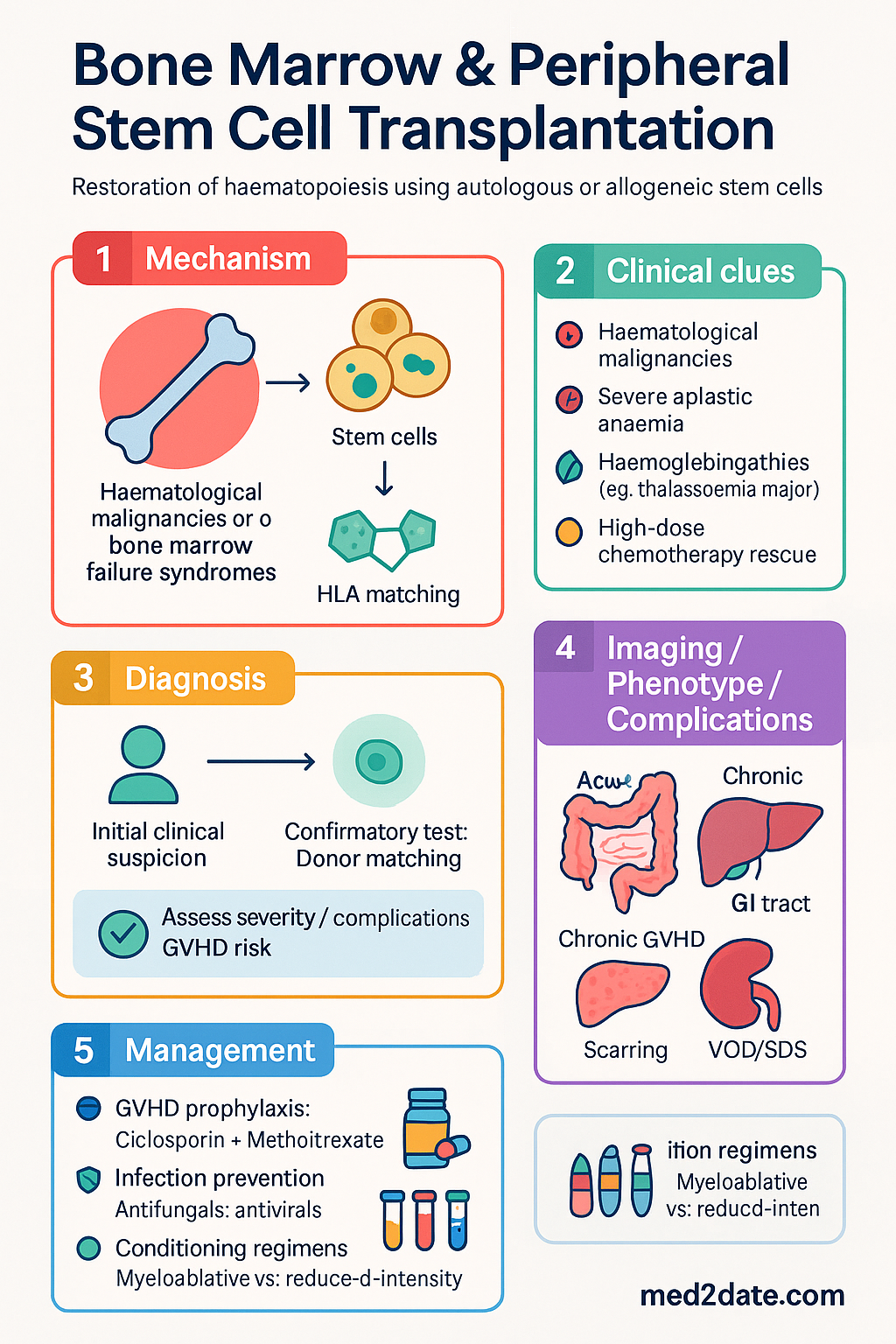
- Haematopoietic stem cell transplantation (HSCT) uses allogeneic (donor) or autologous (self) stem cells to restore haematopoiesis following myeloablative or reduced-intensity conditioning for haematological malignancies and selected non-malignant diseases.
- Australia performs approximately 1,000–1,200 HSCT procedures annually across 22 specialised transplant centres, with the majority in NSW, VIC, and QLD.
- Autologous HSCT is most commonly used for multiple myeloma, lymphoma (Hodgkin and non-Hodgkin), and selected germ cell tumours, serving as a high-dose chemotherapy rescue.
- Allogeneic HSCT is indicated for acute leukaemia (AML, ALL), high-risk MDS, CML (tyrosine kinase inhibitor failure), severe aplastic anaemia, and haemoglobinopathies including thalassaemia major.
- HLA matching is critical for allogeneic transplants — an 8/8 or 10/10 matched related donor is preferred; unrelated donors are sourced through the Australian Bone Marrow Donor Registry (ABMDR) or international registries.
- Conditioning regimens range from myeloablative (busulphan/cyclophosphamide, TBI-based) to reduced-intensity conditioning (fludarabine-based) depending on patient age, comorbidities, and disease risk.
- Graft-versus-host disease (GVHD) remains the leading cause of non-relapse morbidity and mortality in allogeneic HSCT, occurring in 30–50% of recipients (acute) and 30–70% (chronic).
- Acute GVHD prophylaxis standard is ciclosporin + short-course methotrexate; first-line treatment is methylprednisolone 2 mg/kg/day with calcineurin inhibitor optimisation.
- Major complications include infections (bacterial, viral reactivation — CMV, EBV, adenovirus; fungal — Aspergillus, Candida), veno-occlusive disease/sinusoidal obstruction syndrome (VOD/SOS), and graft failure.
- Autologous HSCT carries lower transplant-related mortality (TRM) of 1–3% compared to allogeneic HSCT (TRM 10–30% depending on conditioning intensity and donor source).
- Survival outcomes vary: autologous HSCT for myeloma 5-year OS 50–60%; allogeneic HSCR for AML in CR1 5-year OS 50–70% (matched sibling), 40–60% (matched unrelated).
- Long-term follow-up is essential for monitoring late effects including secondary malignancies, endocrine dysfunction, cataracts, avascular necrosis, and chronic GVHD.
- Aboriginal and Torres Strait Islander patients face significant barriers to HSCT access including geographic remoteness, donor registry underrepresentation, and systemic healthcare inequities requiring targeted programmes.
🎧 Audio Brief
Introduction & Australian Epidemiology
Haematopoietic stem cell transplantation (HSCT) is a critical therapeutic modality in which haematopoietic stem cells — sourced from bone marrow, peripheral blood, or umbilical cord blood — are infused to restore normal haematopoiesis following intensive conditioning therapy. It is employed for a range of malignant haematological disorders, selected solid tumours, bone marrow failure syndromes, haemoglobinopathies, and severe immunodeficiencies.
The procedure encompasses two broad categories: autologous HSCT, in which the patient's own previously harvested stem cells are reinfused after high-dose chemotherapy, and allogeneic HSCT, in which stem cells from a human leucocyte antigen (HLA)-matched or haploidentical donor are used to establish a new donor-derived haematopoietic and immune system.
| Parameter | Australia |
|---|---|
| Annual HSCT procedures | ~1,000–1,200 (autologous ~60%, allogeneic ~40%) |
| Transplant centres | 22 accredited centres across all states/territories |
| ABMDR registered donors | ~800,000 volunteer donors |
| Primary indications (autologous) | Multiple myeloma (~50%), lymphoma (~40%), other (~10%) |
| Primary indications (allogeneic) | AML (~35%), ALL (~20%), MDS (~15%), CML, SAA, other (~30%) |
| Median age at transplant | Autologous 60 years; Allogeneic 48 years |
| 100-day TRM (autologous) | 1–3% |
| 100-day TRM (allogeneic, MUD) | 10–20% |
| Governing body | Australasian Bone Marrow Transplant Recipient Registry (ABMTRR) |
The Australasian Bone Marrow Transplant Recipient Registry (ABMTRR), administered by the Australasian Leukaemia and Lymphoma Group (ALLG), collects data on all HSCT procedures in Australia and New Zealand, providing essential outcome data and quality assurance. Australian transplant outcomes are comparable to international benchmarks, with the National Health and Medical Research Council (NHMRC) and the Blood Service providing national oversight of donor recruitment and cord blood banking.
Types: Allogeneic vs Autologous
Autologous HSCT
Autologous transplantation involves harvesting the patient's own peripheral blood stem cells (PBSCs) after mobilisation with granulocyte colony-stimulating factor (G-CSF) ± plerixafor, followed by reinfusion after high-dose myeloablative chemotherapy. The primary mechanism is dose escalation of cytotoxic therapy rather than immunological graft-versus-tumour effect.
Autologous HSCT — Stem Cell Collection
- Mobilisation: G-CSF (filgrastim) 10 µg/kg/day SC for 4–5 days; plerixafor (Mozobil®) 0.24 mg/kg SC added for poor mobilisers (PBS Authority Required)
- Collection: Leukapheresis via central venous catheter; target CD34+ cell dose ≥2 × 10⁶/kg (ideally ≥3–5 × 10⁶/kg)
- Cryopreservation: Dimethyl sulphoxide (DMSO) at −80°C or liquid nitrogen storage
- Reinfusion: Thawed at bedside, infused IV over 15–30 minutes; toxicity includes DMSO-related nausea, bradycardia, and rarely anaphylaxis
Allogeneic HSCT
Allogeneic transplantation uses haematopoietic stem cells from an HLA-matched or haploidentical donor, providing both a new haematopoietic system and a donor-derived immune system capable of exerting a graft-versus-tumour (GvT) effect. This immunological benefit is critical for sustained remission in diseases such as AML, ALL, CML, and MDS.
Stem Cell Sources
| Source | Advantages | Disadvantages | Australian Use |
|---|---|---|---|
| Peripheral blood (PBSC) | Faster engraftment; easier collection | Higher chronic GVHD risk | ~80% of allogeneic transplants |
| Bone marrow | Lower chronic GVHD; better in paediatric recipients | General anaesthesia; slower engraftment | ~15% of allogeneic transplants |
| Cord blood | Less strict HLA matching; rapid availability | Limited cell dose; slow engraftment; higher graft failure | ~5% of allogeneic transplants |
Conditioning Regimens & HLA Matching
Conditioning Regimens
Conditioning therapy is administered in the days immediately preceding stem cell infusion to eradicate residual malignant cells, create immunological space for donor engraftment, and provide adequate immunosuppression to prevent graft rejection. The intensity of conditioning is tailored to the patient's age, performance status, comorbidities (assessed by the HCT-Comorbidity Index), disease type, and donor source.
Myeloablative Conditioning (MAC)
Full-intensity regimens that result in irreversible pancytopenia; stem cell rescue is obligatory. Suitable for younger patients (<55–60 years) with good performance status.
Reduced-Intensity Conditioning (RIC)
Non-myeloablative or reduced-intensity regimens that produce minimal cytopenia and rely predominantly on the graft-versus-tumour effect for disease control. Suitable for older patients (>55–60 years), those with comorbidities, or when the disease is highly immunosensitive.
Autologous HSCT Conditioning
HLA Matching
HLA matching at high resolution (allele-level) for HLA-A, -B, -C, -DRB1, and -DQB1 loci (10/10 match) is the standard for allogeneic HSCT. Mismatch at even a single locus increases the risk of GVHD, graft failure, and transplant-related mortality.
| Match Level | HLA Loci | GVHD Risk | Recommendation |
|---|---|---|---|
| 10/10 Matched | A, B, C, DRB1, DQB1 | Lowest | Preferred donor source |
| 9/10 Matched | Single mismatch | Moderate increase | Acceptable; consider haploidentical alternative |
| 8/8 Matched | A, B, C, DRB1 (4-locus) | Acceptable | Minimum acceptable for unrelated donor |
| Haploidentical | 5/10 or 6/10 | Higher (mitigated by PT-Cy) | Post-transplant Cy protocol; rapidly expanding |
The Australian Bone Marrow Donor Registry (ABMDR) coordinates national donor searches and partners with the World Marrow Donor Association (WMDA) to access >39 million registered donors internationally. For patients lacking a matched sibling or unrelated donor, haploidentical family donors using post-transplant cyclophosphamide (PT-Cy) protocols have expanded donor availability to >90% of patients.
Graft-versus-Host Disease (GVHD)
GVHD is the principal immunological complication of allogeneic HSCT, occurring when donor T lymphocytes recognise host tissues as foreign and mount an immune-mediated attack. It is classified as acute (typically within 100 days of transplant) or chronic (>100 days), though temporal definitions have been revised by the NIH Consensus Criteria to focus on clinical manifestations rather than arbitrary time points.
Acute GVHD
Acute GVHD affects 30–50% of allogeneic HSCT recipients and involves three target organs: skin, liver, and gastrointestinal tract. It results from donor T-cell activation by host antigen-presenting cells, amplified by cytokine storm (TNF-α, IL-1, IL-6).
Grading (Modified Glucksberg / IBMTR Severity Index)
| Grade | Skin (% BSA) | Liver (Bilirubin) | GI (mL/day diarrhoea) | Functional Impairment |
|---|---|---|---|---|
| I (Mild) | Stage 1 (<25%) | — | — | Minimal |
| II (Moderate) | Stage 1–2 | Stage 1 | Stage 1 | Mild |
| III (Severe) | Stage 2–3 | Stage 2–3 | Stage 2–3 | Marked |
| IV (Life-threatening) | Stage 4 (bullae) | Stage 4 | Stage 4 (severe pain/ileus) | Extreme |
Acute GVHD Prophylaxis
Acute GVHD Treatment
- First-line: Methylprednisolone 2 mg/kg/day IV (or prednisolone 2 mg/kg/day PO) for 7–14 days, then taper over 8–12 weeks if responding
- Steroid-refractory acute GVHD (progression after 3–5 days or no improvement after 7 days):
- Ruxolitinib (Jakavi®) 10 mg PO BD — PBS Authority Required for steroid-refractory acute GVHD; FDA/EMA approved; emerging standard second-line in Australia
- Extracorporeal photopheresis (ECP) — available at select Australian centres
- Infliximab, mycophenolate mofetil, ATG — variable evidence
- GI GVHD with severe diarrhoea (>500 mL/day): Upper and lower GI biopsies for confirmation; budesonide 9 mg/day PO as adjunct; IV fluid and electrolyte replacement
Chronic GVHD
Chronic GVHD occurs in 30–70% of allogeneic HSCT recipients surviving >100 days and is the leading cause of late non-relapse mortality. It resembles autoimmune disorders with multi-organ fibrosis, lichenoid changes, and sclerosis.
NIH Consensus Criteria — Severity Scoring
Chronic GVHD Treatment
- First-line: Prednisolone 0.5–1 mg/kg/day PO ± calcineurin inhibitor (ciclosporin or tacrolimus); taper over 12–24 months
- Second-line (steroid-refractory/intolerant): Ruxolitinib (Jakavi®) — now PBS-listed for chronic GVHD; extracorporeal photopheresis; mycophenolate mofetil; sirolimus
- Skin-limited: Topical corticosteroids, tacrolimus ointment; narrow-band UVB phototherapy
- Oral: Dexamethasone elixir 0.5 mg/5 mL swish-and-spit; ciclosporin oral solution; topical tacrolimus
- Bronchiolitis obliterans: Azithromycin 250 mg PO three times weekly (anti-inflammatory dose); montelukast; augmented immunosuppression
- Ocular (sicca syndrome): Artificial tears, ciclosporin 0.05% eye drops, punctal plugs
Indications, Complications & Outcomes
Indications for HSCT
Autologous HSCT — Approved Indications
| Disease | Setting | Evidence Level |
|---|---|---|
| Multiple myeloma | First-line after induction (age ≤70, fit) | Standard of care (IFM, MRC trials) |
| Multiple myeloma (tandem) | High-risk disease; selected patients | Controversial; centre-dependent |
| Relapsed Hodgkin lymphoma | Chemosensitive relapse after salvage | Standard of care (BNCI/CORAL) |
| Relapsed DLBCL | Chemosensitive relapse; IPI-adjusted | Standard of care (PARMA trial) |
| Relapsed germ cell tumour | First or subsequent relapse; IGCCCG intermediate/poor | Category 1 (TIGER trial) |
| Systemic AL amyloidosis | Selected patients with cardiac stage I–II | Centre-dependent; requires specialist assessment |
Allogeneic HSCT — Approved Indications
| Disease | Setting | Recommended Donor |
|---|---|---|
| AML — high risk (ELN 2022) | CR1 with adverse risk genetics (FLT3-ITD, TP53, complex karyotype) | MSD > MUD > Haplo |
| AML — standard risk | CR2 or beyond | Any matched donor |
| ALL — high risk (Ph+, Ph-like) | CR1 (MRD positive) or CR2 | MSD > MUD |
| MDS — higher risk | IPSS-R intermediate-2/high; excess blasts | Any matched donor; RIC for older patients |
| CML | TKI failure or resistance; T315I mutation | Any matched donor |
| Severe aplastic anaemia | Immunosuppressive therapy failure; first-line if MSD available and age <50 | MSD preferred; MUD if no MSD |
| Thalassaemia major | Class I–II Pesaro; MSD available | MSD only |
| Sickle cell disease | Severe complications (stroke, ACS, VOC); MSD available | MSD; haploidentical expanding |
| Inherited immunodeficiencies | SCID, WAS, CGD, HLH | MSD > MUD > Haplo |
Complications
Infections
Infections are the leading cause of morbidity and mortality post-HSCT, with risk stratified by the phase of immune reconstitution:
Veno-Occlusive Disease / Sinusoidal Obstruction Syndrome (VOD/SOS)
Other Major Complications
| Complication | Incidence | Prevention / Management |
|---|---|---|
| Graft failure / rejection | Primary 5%; secondary 2–5% | Ensure adequate cell dose; donor lymphocyte infusion (DLI) for secondary failure |
| Haemorrhagic cystitis | 10–30% (early: cyclophosphamide; late: BK virus) | Hyperhydration + MESNA; cidofovir for BK-associated HC |
| Thrombotic microangiopathy (TMA) | 5–15% | Withdraw calcineurin inhibitor; eculizumab in refractory cases |
| Post-transplant lymphoproliferative disorder (PTLD) | 1–5% (higher with T-cell depletion, ATG) | Rituximab pre-emptive therapy for EBV viraemia; reduce immunosuppression |
| Secondary malignancy | 5–15% at 10 years | Lifelong cancer screening; skin checks; cervical screening |
| Endocrine dysfunction | Gonadal failure 70–90%; hypothyroidism 10–30% | Hormone replacement; fertility counselling pre-transplant |
Outcomes
Transplant outcomes in Australia are tracked by the ABMTRR and benchmarked against international registries (CIBMTR, EBMT). Outcomes vary significantly by disease, conditioning intensity, donor source, patient age, and comorbidities.
| Disease / Transplant Type | 3-Year OS | Key Prognostic Factors |
|---|---|---|
| Autologous — Myeloma (1st ASCT) | 75–85% | ISS stage, CR after induction, cytogenetics |
| Autologous — Hodgkin lymphoma (2nd CR) | 60–70% | Chemosensitivity to salvage; PET-negative pre-ASCT |
| Autologous — DLBCL (2nd CR) | 50–60% | IPI, time to relapse, chemosensitivity |
| Allogeneic — AML CR1 (MSD, MAC) | 55–70% | ELN risk group, MRD status, age |
| Allogeneic — AML CR1 (MUD, RIC) | 45–60% | Comorbidities, disease status at transplant |
| Allogeneic — ALL CR1 (Ph+) | 50–65% | MRD status, TKI response, age |
| Allogeneic — MDS higher risk | 35–50% | IPSS-R, blast %, age, comorbidities |
| Allogeneic — SAA (MSD) | 75–90% | Age, prior IST, cell dose |
Special Populations
Aboriginal and Torres Strait Islander Health Considerations
Aboriginal and Torres Strait Islander peoples experience significant disparities in access to and outcomes from haematopoietic stem cell transplantation in Australia. These inequities are driven by geographical remoteness, systemic barriers within the healthcare system, cultural safety concerns, and underrepresentation in donor registries.
📚 References
- 1. Australasian Leukaemia and Lymphoma Group (ALLG). Australasian Bone Marrow Transplant Recipient Registry (ABMTRR) Annual Report 2023. Sydney: ALLG; 2023.
- 2. Niederwieser D, Baldomero H, Bazuaye N, et al. One and a half million hematopoietic stem cell transplants: continuous and differential improvement in outcomes reported from a worldwide network. Blood. 2022;139(10):1433–1447.
- 3. D'Souza A, Fretham C, Lee SJ, et al. Current use of and trends in hematopoietic cell transplantation in the United States. Biol Blood Marrow Transplant. 2020;26(8):e177–e182.
- 4. Penack O, Marchetti M, Ruutu T, et al. Management of veno-occlusive disease/sinusoidal obstruction syndrome — revised European Society for Blood and Marrow Transplantation (EBMT) clinical practice guidelines. Bone Marrow Transplant. 2020;55:1–11.
- 5. Zeiser R, von Bubnoff N, Butler J, et al. Ruxolitinib for glucocorticoid-refractory acute graft-versus-host disease. N Engl J Med. 2020;382(19):1800–1810.
- 6. Zeiser R, Polverelli N, Ram R, et al. Ruxolitinib for glucocorticoid-refractory chronic graft-versus-host disease. N Engl J Med. 2021;385(3):228–238.
- 7. Glucksberg H, Storb R, Fefer A, et al. Clinical manifestations of graft-versus-host disease in human recipients of marrow from HL-A-matched sibling donors. Transplantation. 1974;18(4):295–304.
- 8. Filipovich AH, Weisdorf D, Pavletic S, et al. National Institutes of Health consensus development project on criteria for clinical trials in chronic graft-versus-host disease: I. Diagnosis and staging working group report. Biol Blood Marrow Transplant. 2005;11(12):945–956.
- 9. Australian Bone Marrow Donor Registry (ABMDR). Donor recruitment and HLA matching guidelines. Sydney: ABMDR; 2024. Available from: abmdr.org.au.
- 10. Döhner H, Wei AH, Appelbaum FR, et al. Diagnosis and management of AML in adults: 2022 recommendations from an international expert panel on behalf of the ELN. Blood. 2022;140(12):1345–1377.
- 11. Snowden JA, Sánchez-Ortega I, Corbacioglu S, et al. Indications for haematopoietic cell transplantation for haematological diseases, solid tumours and immune disorders: current practice in Europe, 2022. Bone Marrow Transplant. 2022;57:1217–1239.
- 12. Battiwalla M, Tichelli A, Majhail NS. Long-term survivorship after hematopoietic cell transplantation: roadmap for follow-up. Biol Blood Marrow Transplant. 2020;26(3):e55–e65.
- 13. National Health and Medical Research Council (NHMRC). National statement on ethical conduct in human research. Canberra: NHMRC; 2023 (updated).
- 14. Australian Institute of Health and Welfare (AIHW). Aboriginal and Torres Strait Islander health performance framework. Canberra: AIHW; 2023.
- 15. Palliative Care Australia. National palliative care standards. 5th ed. Canberra: PCA; 2018. Referenced for end-of-life considerations in transplant setting.