📋 Key Information Summary
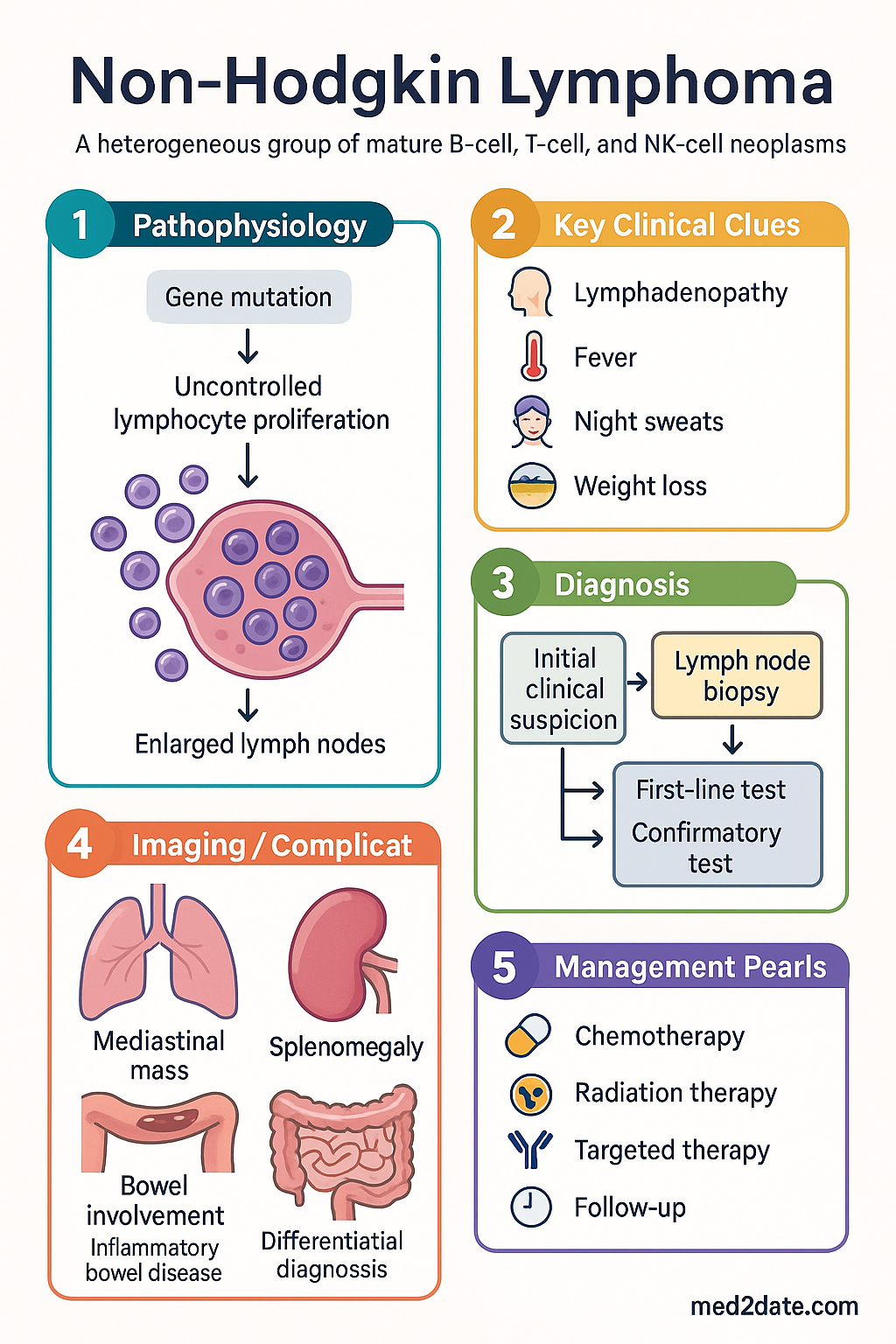
- Non-Hodgkin lymphoma (NHL) encompasses a heterogeneous group of mature B-cell, T-cell, and NK-cell neoplasms — aggressive subtypes (especially DLBCL) are far more common than indolent subtypes in Australia.
- Australia has one of the highest NHL incidence rates globally (~18 per 100 000 person-years); DLBCL and follicular lymphoma together account for >60 % of cases.
- The WHO Classification (5th edition, 2022) is the diagnostic standard; accurate subclassification by an expert haematopathologist is essential for treatment selection.
- Excisional lymph-node biopsy with immunophenotyping (flow cytometry, immunohistochemistry) and molecular studies (FISH for MYC, BCL2, BCL6) is the gold standard — fine-needle aspiration alone is insufficient.
- PET-CT is the preferred staging modality for FDG-avid aggressive lymphomas (DLBCL, Hodgkin); CT chest/abdomen/pelvis remains acceptable for indolent subtypes.
- The Lugano Classification (modified Ann Arbor) stages NHL I–IV with PET-CT; bone-marrow biopsy is no longer routinely required in FDG-avid lymphomas staged by PET-CT.
- R-CHOP-21 (rituximab, cyclophosphamide, doxorubicin, vincristine, prednisolone) × 6 cycles is the first-line standard for DLBCL; CNS-IPI score guides CNS prophylaxis decisions.
- High-grade (double-/triple-hit) lymphomas harbouring MYC plus BCL2 and/or BCL6 rearrangements require intensified regimens such as dose-adjusted R-EPOCH.
- Indolent follicular lymphoma (Grade 1–2) is managed with watch-and-writ for low-tumour-burden disease; immunochemotherapy (BR or R-CHOP) is first-line for symptomatic or high-burden disease.
- Relapsed/refractory aggressive NHL may benefit from CAR T-cell therapy (tisagenlecleucel, axicabtagene ciloleucel) — available at designated Australian centres via the Life Saving Drugs Programme.
- Consolidation radiotherapy is indicated for early-stage DLBCL (limited-field after R-CHOP) and for residual bulky disease post-chemotherapy.
- Survival surveillance includes clinical review, LDH, and CT at 3–6-month intervals for 2 years, then 6–12-monthly to 5 years; PET-CT for routine surveillance is not recommended outside clinical concern.
- Aboriginal and Torres Strait Islander peoples have a higher proportion of aggressive NHL subtypes and later-stage presentation; culturally safe pathways and remote-access specialist consultation are essential.
🎧 Audio Brief
Introduction & Australian Epidemiology
Non-Hodgkin lymphoma (NHL) is a heterogeneous group of mature B-cell, T-cell, and natural-killer (NK)-cell malignancies arising from lymphoid tissue. The spectrum ranges from indolent entities such as follicular lymphoma and marginal-zone lymphoma, which may be managed with observation alone for years, to highly aggressive forms including diffuse large B-cell lymphoma (DLBCL) and Burkitt lymphoma, which require urgent systemic therapy.
Australia has one of the highest age-standardised incidence rates of NHL worldwide, estimated at approximately 18 per 100 000 person-years. In 2024, an estimated 7 000 new cases of NHL were diagnosed nationally, with a median age at diagnosis of ~67 years and a male-to-female ratio of approximately 1.4 : 1. NHL represents approximately 4 % of all new cancer diagnoses in Australia and is the sixth most common cancer overall.
DLBCL is the single most common subtype, accounting for 30–40 % of all NHL cases in Australian registries, followed by follicular lymphoma (~25 %), marginal-zone lymphoma (~8 %), mantle-cell lymphoma (~6 %), and peripheral T-cell lymphoma (~5 %). The relative 5-year survival for all NHL subtypes combined is approximately 74 %, although this varies markedly by histology — approaching 90 % for localised follicular lymphoma but falling below 50 % for advanced-stage peripheral T-cell lymphoma not otherwise specified (PTCL-NOS).
Recognised risk factors in the Australian context include immunosuppression (HIV, post-transplant, iatrogenic), autoimmune disease (Sjögren syndrome, coeliac disease, rheumatoid arthritis), chronic hepatitis C (particularly splenic marginal-zone lymphoma), Helicobacter pylori (gastric MALT lymphoma), and increasing age. Epstein–Barr virus (EBV) is associated with specific entities including post-transplant lymphoproliferative disorder (PTLD) and EBV-positive DLBCL not otherwise specified.
Classification (B vs T Cell, Grade)
Accurate subclassification of NHL is critical because prognosis and treatment differ substantially between entities. The WHO Classification of Haematolymphoid Tumours (5th edition, 2022) is the international diagnostic standard and is used by all Australian haematopathology laboratories.
Mature B-Cell Neoplasms (>85 % of NHL in Australia)
| Subtype | Behaviour | Key Features | Approximate % of NHL |
|---|---|---|---|
| Diffuse large B-cell lymphoma (DLBCL), NOS | Aggressive | Most common NHL; curable with R-CHOP; cell-of-origin (GCB vs ABC) prognostically relevant | 30–40 % |
| Follicular lymphoma (FL) | Indolent | Grade 1–2 indolent, Grade 3B treated as DLBCL; t(14;18) BCL2 rearrangement; CD10+, BCL2+ | ~25 % |
| Marginal-zone lymphoma (MZL) | Indolent | Extranodal (MALT), nodal, splenic; H. pylori eradication cures gastric MALT in ~80 % | ~8 % |
| Mantle-cell lymphoma (MCL) | Aggressive (rarely indolent) | t(11;14) CCND1-IGH; SOX11+; typically older males; intensive vs de-escalated approaches | ~6 % |
| Burkitt lymphoma | Highly aggressive | MYC translocation t(8;14); "starry sky" histology; very high proliferation; dose-intensive chemo | ~2 % |
| High-grade B-cell lymphoma with MYC and BCL2 and/or BCL6 rearrangements ("double-hit" / "triple-hit") | Highly aggressive | Treated with dose-adjusted R-EPOCH rather than R-CHOP; poor prognosis if MYC + BCL2 only | ~3–5 % of DLBCL |
Mature T-Cell and NK-Cell Neoplasms (~10–15 % of NHL)
| Subtype | Behaviour | Key Features | Approximate % of NHL |
|---|---|---|---|
| Peripheral T-cell lymphoma, NOS | Aggressive | Heterogeneous; CHOP-based therapy; poor 5-year OS (~30 %); no single standard regimen | ~3 % |
| Angioimmunoblastic T-cell lymphoma | Aggressive | Systemic symptoms, polyclonal hypergammaglobulinaemia; EBV+; CHOP or CHOEP-based | ~1–2 % |
| Anaplastic large-cell lymphoma (ALCL) | Aggressive | ALK+ (better prognosis) vs ALK−; CD30+; brentuximab vedotin active | ~2 % |
| Extranodal NK/T-cell lymphoma, nasal type | Highly aggressive | EBV-driven; midline destructive lesions; SMILE protocol; no anthracycline (P-glycoprotein) | ~1 % |
| Cutaneous T-cell lymphoma (mycosis fungoides / Sézary syndrome) | Indolent → aggressive | Skin-directed therapy early; systemic for advanced; novel agents (mogamulizumab) | ~3 % |
Grading — Indolent vs Aggressive
Clinical Features & Staging
Presenting Features
NHL may present with painless peripheral lymphadenopathy, extranodal disease, or constitutional ("B") symptoms. The mode of presentation varies by subtype.
- Lymphadenopathy: Painless, rubbery, non-tender lymph node enlargement — cervical, axillary, inguinal, or mediastinal. Rapidly growing nodes suggest aggressive histology.
- B symptoms: Unexplained fever >38 °C, drenching night sweats, unintentional weight loss >10 % of body weight within 6 months. Present in ~30–40 % of aggressive NHL and confer adverse prognostic significance.
- Extranodal disease: Occurs in ~40 % of NHL at presentation — most commonly GI tract, bone marrow, skin, Waldeyer ring, CNS, bone, and testis.
- Mediastinal mass: May cause SVC obstruction (dyspnoea, facial swelling, plethora) — requires urgent investigation and treatment.
- Bone marrow infiltration: Cytopenias, fatigue, or incidental finding on staging biopsy.
- Gastric NHL: Epigastric pain, dyspepsia, or GI bleeding — H. pylori-associated MALT lymphoma may be cured with antibiotics alone.
- CNS involvement: Headache, cranial nerve palsies, altered mental status — consider in testicular, breast, kidney, or epidural lymphoma; high LDH; IPI ≥3.
Staging — Lugano Classification (Modified Ann Arbor)
| Stage | Definition | 5-Year OS (DLBCL, approximate) |
|---|---|---|
| I | Single lymph-node region or single extranodal site (IE) | ~90 % |
| II | ≥2 nodal regions on same side of diaphragm | ~80 % |
| III | Nodes on both sides of diaphragm | ~65 % |
| IV | Diffuse extranodal involvement (e.g. bone marrow, liver, lung) | ~50–55 % |
Suffixes: A = no B symptoms; B = B symptoms present; E = contiguous extranodal extension; Bulky = mass ≥10 cm (or ≥⅓ thoracic diameter for mediastinal).
International Prognostic Index (IPI) — Aggressive NHL
The IPI remains the standard prognostic tool for DLBCL. Each factor scores 1 point: age >60 years, LDH >upper limit of normal, ECOG performance status ≥2, Ann Arbor stage III–IV, >1 extranodal site.
Investigations (Biopsy, Immunophenotype)
Essential Investigations
Subtype-Specific Diagnostic Considerations
- Gastric MALT lymphoma: EGD with multiple biopsies; H. pylori testing (histology, urease test, stool Ag); t(11;18) if available (predicts antibiotic resistance).
- DLBCL: Cell-of-origin by Hans algorithm (CD10, BCL6, MUM1) — GCB vs non-GCB/ABC; MYC IHC ≥40 % triggers FISH for MYC rearrangement.
- Follicular lymphoma: Grade 1–2 vs 3A vs 3B (3B managed as DLBCL); FLIPI score.
- Mantle-cell lymphoma: Cyclin D1+ or t(11;14); SOX11 for indolent variant identification; TP53 mutation testing guides intensity.
Management (R-CHOP, Radiotherapy, Surveillance)
First-Line Therapy — Aggressive NHL (DLBCL)
R-CHOP-21 remains the standard first-line regimen for DLBCL. Six cycles are recommended for advanced-stage (II–IV) disease; 3–4 cycles plus involved-field radiotherapy (IFRT) is an acceptable alternative for non-bulky stage I–II disease.
DA-R-EPOCH — Intensified Alternative
Dose-adjusted R-EPOCH (rituximab, etoposide, prednisolone, vincristine, cyclophosphamide, doxorubicin — continuous infusion over 96 h) is preferred for:
- Double-hit or triple-hit lymphomas (MYC + BCL2 and/or BCL6 rearranged)
- MYC-rearranged DLBCL without additional hits
- Primary mediastinal B-cell lymphoma (PMBCL)
- Some CNS lymphoma protocols
DA-R-EPOCH is given for 6 cycles with G-CSF support. It requires inpatient or ambulatory chemotherapy infusion facilities.
Indolent NHL — Follicular Lymphoma
When treatment is indicated (symptomatic, high tumour burden, cytopenias, organ compromise, rapid progression):
- First-line: Bendamustine + rituximab (BR) × 6 cycles or R-CHOP × 6 cycles. BR is generally preferred for its favourable toxicity profile in older adults.
- Rituximab maintenance: 375 mg/m² IV every 2 months for 2 years following immunochemotherapy — improves PFS.
- Rituximab monotherapy: 375 mg/m² IV weekly × 4 for those not fit for combination chemotherapy.
Gastric MALT Lymphoma
- H. pylori eradication therapy (PPI + clarithromycin + amoxicillin [or metronidazole if penicillin-allergic] for 14 days) is first-line for all H. pylori-positive gastric MALT lymphoma, regardless of stage.
- Complete remission is achieved in ~80 % of stage IE cases.
- Confirm eradication with urea breath test at ≥4 weeks post-treatment.
- Refractory disease: involved-field radiotherapy (24–30 Gy) or rituximab-based systemic therapy.
Mantle-Cell Lymphoma
- Fit patients (age ≤65, adequate organ function): R-DHAP or R-CHOP/R-DHAP alternating, followed by autologous stem-cell transplant (ASCT) consolidation.
- Older / less fit patients: BR (bendamustine + rituximab) × 6 cycles; rituximab maintenance thereafter.
- Indolent MCL (SOX11−, low Ki-67, non-nodal): Observation may be appropriate.
- Relapsed/refractory: BTK inhibitors — ibrutinib (Imbruvica®), zanubrutinib (Brukinsa®), acalabrutinib (Calquence®). PBS Authority Required.
Radiotherapy
- Early-stage DLBCL (I–II non-bulky): Involved-site radiotherapy (ISRT) 30–36 Gy after abbreviated R-CHOP (3–4 cycles).
- Residual bulky disease: Consolidation ISRT 30–40 Gy after 6 cycles R-CHOP.
- Indolent NHL (localised): ISRT 24–30 Gy as definitive therapy — may provide long-term disease control.
- Palliative: 8 Gy in 1 fraction or 20 Gy in 5–10 fractions for symptomatic localised disease.
Relapsed / Refractory NHL
- Chemosensitive relapse (DLBCL): Salvage chemotherapy (R-ICE, R-DHAP, or R-GDP) followed by ASCT if fit and chemosensitive.
- Indolent NHL relapse: Rituximab re-treatment; PI3K inhibitor (copanlisib — PBS Authority); lenalidomide + rituximab (R²); or radiotherapy for limited sites.
- T-cell lymphoma relapse: Belinostat (Beleodaq®); pralatrexate (Folotyn®); mogamulizumab (for CTCL); or clinical trial.
CNS Prophylaxis
The CNS-IPI score identifies patients at higher risk of CNS relapse (kidney/adrenal involvement, >1 extranodal site, stage III–IV, LDH >ULN, ECOG >1, age >60). Patients with CNS-IPI 4–6 ("high risk") should be considered for CNS-directed prophylaxis:
- Intrathecal methotrexate 12–15 mg (PBS General Benefit) × 4–6 doses during R-CHOP, OR
- Systemic high-dose methotrexate 3 g/m² IV every cycle (preferred for testicular, breast, or kidney lymphoma).
Survival Surveillance
Post-treatment surveillance aims to detect relapse early and manage long-term toxicity. Routine surveillance PET-CT is not recommended outside clinical suspicion due to high false-positive rates.
- End-of-treatment PET-CT (Deauville score 1–3 = complete metabolic response; 4–5 = consider biopsy before assuming residual disease).
- Echocardiogram at 1 year post-anthracycline, then as clinically indicated.
- Fertility counselling should be documented prior to treatment initiation in all patients of reproductive age.
Special Populations
Aboriginal and Torres Strait Islander Health Considerations
Aboriginal and Torres Strait Islander Australians experience disparities in lymphoma outcomes, including later-stage presentation, higher proportion of aggressive subtypes, and barriers to timely specialist access. Culturally safe care and partnership with Aboriginal Community Controlled Health Organisations (ACCHOs) are essential.
📚 References
- 1. Alaggio R, Amador C, Anagnostopoulos I, et al. The 5th edition of the World Health Organization Classification of Haematolymphoid Tumours: Lymphoid Neoplasms. Leukemia. 2022;36(7):1720–1748. doi:10.1038/s41375-022-01620-2
- 2. Cheson BD, Fisher RI, Barrington SF, et al. Recommendations for initial evaluation, staging, and response assessment of Hodgkin and non-Hodgkin lymphoma: the Lugano classification. J Clin Oncol. 2014;32(27):3059–3068. doi:10.1200/JCO.2013.54.8800
- 3. Coiffier B, Lepage E, Brière J, et al. CHOP chemotherapy plus rituximab compared with CHOP alone in elderly patients with diffuse large-B-cell lymphoma. N Engl J Med. 2002;346(4):235–242. doi:10.1056/NEJM200201243460401
- 4. Sehn LH, Berry B, Chhanabhai M, et al. The revised International Prognostic Index (R-IPI) is a better predictor of outcome than the standard IPI for patients with diffuse large B-cell lymphoma treated with R-CHOP. Blood. 2007;109(5):1857–1861. doi:10.1182/blood-2006-08-038257
- 5. Wilson WH, Dunleavy K, Pittaluga S, et al. Phase II study of dose-adjusted EPOCH and rituximab in untreated diffuse large B-cell lymphoma with analysis of germinal center and post-germinal center biomarkers. J Clin Oncol. 2008;26(16):2717–2724. doi:10.1200/JCO.2007.13.1391
- 6. Peyrade F, Jardin F, Thieblemont C, et al. Attenuated immunochemotherapy regimen (R-mini-CHOP) in elderly patients older than 80 years with diffuse large B-cell lymphoma: a multicentre, single-arm, phase 2 trial. Lancet Oncol. 2011;12(5):460–468. doi:10.1016/S1470-2045(11)70069-9
- 7. Schuster SJ, Bishop MR, Tam CS, et al. Tisagenlecleucel in adult relapsed or refractory diffuse large B-cell lymphoma. N Engl J Med. 2019;380(1):45–56. doi:10.1056/NEJMoa1804980
- 8. Australian Institute of Health and Welfare (AIHW). Cancer data in Australia. Canberra: AIHW; 2024. Available from: https://www.aihw.gov.au/reports/cancer/cancer-data-in-australia
- 9. Rummel MJ, Niederle N, Maschmeyer G, et al. Bendamustine plus rituximab versus CHOP plus rituximab as first-line treatment for patients with indolent and mantle-cell lymphomas: an open-label, multicentre, randomised, phase 3 non-inferiority trial. Lancet. 2013;381(9873):1203–1210. doi:10.1016/S0140-6736(12)61763-2
- 10. Abramson JS, Palomba ML, Gordon LI, et al. Lisocabtagene maraleucel for patients with relapsed or refractory large B-cell lymphomas (TRANSCEND NHL 001): a multicentre seamless design study. Lancet. 2020;396(10254):839–852. doi:10.1016/S0140-6736(20)31366-4
- 11. El-Galaly TC, Villa D, Gormsen LC, et al. FDG-PET/CT in the routine management of patients with diffuse large B-cell lymphoma — a Danish population-based study. Ann Oncol. 2018;29(4):995–1001. doi:10.1093/annonc/mdy035
- 12. Australian Cancer Network Management Guidelines Working Party. Clinical practice guidelines for the management of non-Hodgkin lymphoma. Cancer Council Australia. Sydney: Cancer Council Australia; 2005 (with updates).
- 13. Schmitz R, Wright GW, Huang DW, et al. Genetics and pathogenesis of diffuse large B-cell lymphoma. N Engl J Med. 2018;378(15):1396–1407. doi:10.1056/NEJMoa1801445
- 14. Zucca E, Bertoni F. The spectrum of MALT lymphoma at different sites: biological and therapeutic relevance. Blood. 2016;127(17):2082–2092. doi:10.1182/blood-2015-12-624304