📋 Key Information Summary
- Haematological malignancies — leukaemias, lymphomas, and myeloma — are among the most chemotherapy-sensitive cancers, with many regimens offering curative or long-term disease control.
- CHOP (cyclophosphamide, doxorubicin, vincristine, prednisolone) ± rituximab (R-CHOP) is the standard first-line regimen for aggressive B-cell non-Hodgkin lymphoma (NHL).
- ABVD (doxorubicin, bleomycin, vinblastine, dacarbazine) remains first-line for Hodgkin lymphoma; bleomycin pulmonary toxicity requires baseline and serial pulmonary function monitoring.
- 7+3 induction (cytarabine 7 days + anthracycline 3 days) is the backbone for acute myeloid leukaemia (AML) intensive remission induction; azacitidine-based regimens are standard for unfit patients.
- FCR (fludarabine, cyclophosphamide, rituximab) is effective for fit, younger patients with chronic lymphocytic leukaemia (CLL), though venetoclax-based therapies are increasingly first-line.
- Anthracyclines (doxorubicin, idarubicin) carry cumulative cardiotoxicity risk; echocardiography is mandatory before treatment and at cumulative doses ≥300 mg/m² doxorubicin equivalent.
- Alkylating agents (cyclophosphamide, bendamustine, busulfan) cause myelosuppression, gonadal toxicity, and secondary malignancy risk; fertility preservation must be discussed pre-treatment.
- Tumour lysis syndrome (TLS) prophylaxis with rasburicase and aggressive hydration is critical for high-burden lymphomas and AML induction — assess risk with the Cairo–Bishop criteria.
- Neutropenic fever (febrile neutropenia) is a medical emergency; empirical IV antibiotics (piperacillin-tazobactam) must be administered within 60 minutes of presentation per ASCQHC standards.
- Aboriginal and Torres Strait Islander peoples have higher incidence and mortality from lymphoma and leukaemia with later diagnosis; culturally safe, community-based supportive care improves outcomes.
- All chemotherapy regimens must be prescribed using electronic prescribing with double-check verification; oral chemotherapy requires documented patient education and adherence monitoring.
- Pregnancy and fertility considerations are paramount — alkylating agents are teratogenic; referral for sperm or oocyte cryopreservation should occur before the first cycle.
🎧 Audio Brief
Introduction & Australian Epidemiology
Haematological malignancies encompass a diverse group of cancers arising from blood, bone marrow, lymph nodes, and lymphoid tissues. In Australia, approximately 17,000 new cases of blood cancer are diagnosed annually, making haematological malignancies the third most common cancer group and the second leading cause of cancer-related death. Lymphoma, leukaemia, and myeloma collectively account for over 6,500 deaths per year.
Treatment with systemic chemotherapy remains the cornerstone of management for most haematological malignancies. Unlike many solid organ cancers, haematological malignancies are often highly chemosensitive, and cure or durable remission is achievable with appropriate multi-agent regimens. Specific combinations — such as CHOP for aggressive lymphoma, ABVD for Hodgkin lymphoma, 7+3 for acute myeloid leukaemia, and FCR for chronic lymphocytic leukaemia — have been refined over decades and remain central to Australian treatment protocols.
The Australian burden of haematological malignancies is notable for several features: a rising incidence of diffuse large B-cell lymphoma in older adults, a significant gap in outcomes for Aboriginal and Torres Strait Islander peoples, and increasing adoption of targeted therapies and immunotherapies that are supplementing — though not yet replacing — cytotoxic chemotherapy. All chemotherapy must be delivered within accredited facilities meeting NSQHS Standards and under the supervision of a credentialed haematologist or medical oncologist.
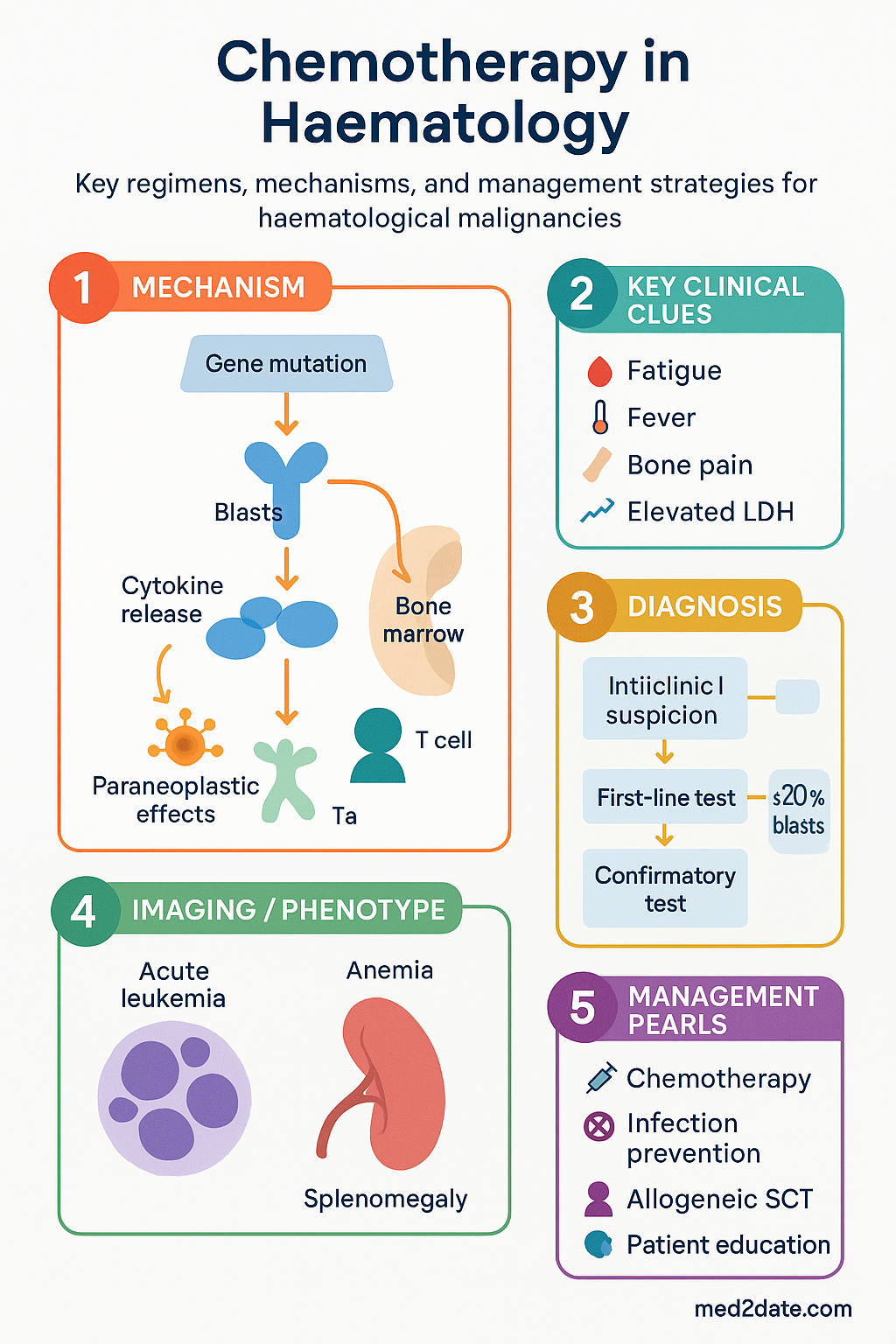
Principles of Haematological Chemotherapy
Haematological chemotherapy is guided by several foundational principles that distinguish it from solid tumour oncology:
- Curative intent: Many regimens (e.g. ABVD for Hodgkin lymphoma, 7+3 for AML) are administered with curative intent, requiring optimal dose intensity and adherence to schedule.
- Combination therapy: Multi-agent regimens exploit non-overlapping toxicities and different mechanisms of action to overcome resistance. Single-agent chemotherapy is rarely appropriate for first-line haematological malignancies.
- Cycle-based dosing: Regimens are delivered in defined cycles (typically 21- or 28-day intervals), allowing bone marrow recovery between administrations.
- Dose modification protocols: Standardised dose-reduction and escalation criteria exist for renal impairment (e.g. cytarabine), hepatic dysfunction, and haematological toxicity.
- Response assessment: Interim and end-of-treatment imaging (PET-CT for lymphoma) and bone marrow biopsy (for leukaemia/myeloma) guide decisions regarding treatment continuation, consolidation, or intensification.
- Supportive care integration: Antiemetics, growth factor support (G-CSF), tumour lysis prophylaxis, infection prophylaxis, and psychosocial support are integral components of every regimen.
Phases of Haematological Chemotherapy
| Phase | Purpose | Examples |
|---|---|---|
| Induction | Achieve complete remission / maximum tumour reduction | 7+3 (AML), CHOP ×6 (NHL), VTD (myeloma) |
| Consolidation | Eradicate residual disease; reduce relapse risk | High-dose cytarabine (AML), autologous SCT (lymphoma, myeloma) |
| Maintenance | Prolong remission in incurable or high-risk disease | Lenalidomide (myeloma), rituximab (FL), azacitidine (MDS) |
| Salvage | Re-induction after relapse or refractory disease | R-ICE, R-DHAP (lymphoma), FLAG-Ida (AML) |
Key Drug Mechanisms
Understanding the mechanisms of action of core cytotoxic agents is essential for anticipating toxicities, managing drug interactions, and selecting appropriate regimens.
Anthracyclines
Anthracyclines are among the most active agents in haematological oncology. They intercalate into DNA, inhibit topoisomerase II, generate free radicals, and cause direct DNA strand breaks. They are essential components of CHOP, ABVD, and 7+3 regimens.
Alkylating Agents
Alkylating agents form covalent bonds with DNA, causing cross-links that prevent replication. They are active across the cell cycle (non-phase-specific) and form the backbone of many haematological regimens.
Antimetabolites
Chemotherapy Regimens
The following regimens represent the most commonly used chemotherapy protocols in Australian haematology practice. All doses and schedules should be verified against institutional protocols and current PBS listings.
CHOP / R-CHOP — Aggressive B-Cell Non-Hodgkin Lymphoma
R-CHOP-21 (rituximab, cyclophosphamide, doxorubicin, vincristine, prednisolone) administered every 21 days for 6–8 cycles is the standard first-line treatment for diffuse large B-cell lymphoma (DLBCL) and other aggressive B-cell NHL.
| Drug | Dose | Route | Day(s) |
|---|---|---|---|
| Rituximab | 375 mg/m² | IV infusion | 1 |
| Cyclophosphamide | 750 mg/m² | IV | 1 |
| Doxorubicin | 50 mg/m² | IV | 1 |
| Vincristine | 1.4 mg/m² (max 2 mg) | IV | 1 |
| Prednisolone | 100 mg | PO | 1–5 |
ABVD — Hodgkin Lymphoma
ABVD (doxorubicin, bleomycin, vinblastine, dacarbazine) administered every 28 days for 2–6 cycles (with interim PET-adapted de-escalation per RATHL study) is first-line for classical Hodgkin lymphoma.
| Drug | Dose | Route | Day(s) |
|---|---|---|---|
| Doxorubicin | 25 mg/m² | IV | 1 & 15 |
| Bleomycin | 10 units/m² | IV | 1 & 15 |
| Vinblastine | 6 mg/m² | IV | 1 & 15 |
| Dacarbazine | 375 mg/m² | IV | 1 & 15 |
7+3 — Acute Myeloid Leukaemia (AML) Induction
The 7+3 regimen is the standard intensive remission induction for AML in patients fit enough for intensive chemotherapy (typically <70 years with good performance status).
| Drug | Dose | Route | Duration |
|---|---|---|---|
| Cytarabine | 100 mg/m²/day continuous IV infusion | CIVI | 7 days (Days 1–7) |
| Idarubicin | 12 mg/m²/day IV | IV push | 3 days (Days 1–3) |
Alternatives for unfit/elderly patients: Azacitidine (75 mg/m² SC/IV daily ×7 days per 28-day cycle — PBS Authority Required) ± venetoclax; low-dose cytarabine; or best supportive care with hydroxyurea for cytoreduction.
FCR — Chronic Lymphocytic Leukaemia (CLL)
FCR (fludarabine, cyclophosphamide, rituximab) is an intensive regimen for fit patients with CLL, particularly those with mutated IGHV and del(13q) who may achieve very long remissions. Increasingly, venetoclax-based combinations (VenR, VenO) are preferred as first-line due to superior tolerability and efficacy.
| Drug | Dose | Route | Day(s) |
|---|---|---|---|
| Fludarabine | 25 mg/m² | IV | 1–3 |
| Cyclophosphamide | 250 mg/m² | IV | 1–3 |
| Rituximab | 375 mg/m² (Cycle 1); 500 mg/m² (Cycles 2–6) | IV | 1 |
Repeat every 28 days for 6 cycles. All blood products must be irradiated. Pneumocystis jirovecii prophylaxis (trimethoprim-sulfamethoxazole DS three times weekly) and antiviral prophylaxis (valaciclovir 500 mg daily) are mandatory.
Regimen Comparison Overview
| Regimen | Indication | Cycles | Intent | Key Risk |
|---|---|---|---|---|
| R-CHOP | DLBCL, aggressive B-NHL | 6–8 × 21 days | Curative | Cardiotoxicity, neuropathy |
| ABVD | Classical Hodgkin lymphoma | 2–6 × 28 days | Curative | Pulmonary fibrosis (bleomycin) |
| 7+3 | AML induction | 1 (+ consolidation) | Curative | Prolonged aplasia, infection |
| FCR | CLL (fit patients) | 6 × 28 days | Long-term control | Immunosuppression, secondary MDS/AML |
Toxicity Management & Supportive Care
Effective management of chemotherapy toxicities is essential for maintaining dose intensity, preventing life-threatening complications, and preserving quality of life.
Febrile Neutropenia
Tumour Lysis Syndrome (TLS) Prophylaxis
TLS risk assessment (Cairo–Bishop criteria) must be performed before commencing chemotherapy for high-burden haematological malignancies. TLS is most common in AML induction, high-grade lymphomas (especially Burkitt), and ALL.
Antiemetic Protocols
Haematological regimens vary in emetogenic risk. R-CHOP and 7+3 are moderately to highly emetogenic; ABVD is moderately emetogenic.
| Emetogenic Risk | Antiemetic Regimen | Duration |
|---|---|---|
| High (7+3, HyperCVAD) | Aprepitant 125 mg PO Day 1 + 80 mg Days 2–3; dexamethasone 12 mg PO/IV Days 1–4; ondansetron 8 mg IV/PO BD Days 1–4 | Days 1–4 per cycle |
| Moderate (R-CHOP, ABVD) | Ondansetron 8 mg IV/PO BD Day 1; dexamethasone 8 mg PO Days 1–3 (given with prednisolone in CHOP) | Days 1–3 |
| Breakthrough | Levomepromazine 6.25 mg PO/SC PRN; lorazepam 0.5–1 mg SL for anticipatory nausea | As needed |
Growth Factor Support (G-CSF)
Granulocyte colony-stimulating factor (G-CSF) is used for primary prophylaxis when the anticipated risk of febrile neutropenia is ≥20%, or for secondary prophylaxis after a prior febrile neutropenia episode.
Other Supportive Care Measures
- Infection prophylaxis: Trimethoprim-sulfamethoxazole (PO 480 mg BD three times weekly) for Pneumocystis prophylaxis in patients receiving purine analogues, high-dose corticosteroids, or prolonged neutropenia. Valaciclovir 500 mg daily for HSV/VZV prophylaxis with fludarabine or alemtuzumab.
- Fertility preservation: Counsel all patients of reproductive age before commencing alkylating agents. Refer to a fertility specialist for sperm cryopreservation (males) or oocyte/embryo cryopreservation (females). Ganirelix/ GnRH agonist co-administration may reduce gonadotoxicity in females.
- Mucositis management: Maintain oral hygiene with chlorhexidine 0.2% mouthwash. Morphine patient-controlled analgesia for severe mucositis. Cryotherapy during short-infusion melphalan reduces mucositis severity.
- Venous thromboembolism (VTE) prophylaxis: Thalidomide and lenalidomide carry high VTE risk — mandatory thromboprophylaxis with aspirin (low risk) or LMWH (high risk) per IMWG guidelines.
Special Populations
Aboriginal and Torres Strait Islander Health Considerations
📚 References
- 1. Cancer Council Australia. Blood cancers in Australia: Incidence, mortality and survival. Sydney: Cancer Council Australia; 2023.
- 2. Australian Institute of Health and Welfare (AIHW). Cancer in Australia 2023: Blood cancers. Canberra: AIHW; 2023.
- 3. Coiffier B, Lepage E, Brière J, et al. CHOP chemotherapy plus rituximab compared with CHOP alone in elderly patients with diffuse large-B-cell lymphoma. N Engl J Med. 2002;346(4):235–242.
- 4. Johnson PWM, Sydes MR, Hancock BW, et al. Consolidation radiotherapy in patients with advanced Hodgkin lymphoma with complete response after chemotherapy: the RATHL trial. Lancet Oncol. 2016;17(9):1223–1231.
- 5. Döhner H, Estey E, Grimwade D, et al. Diagnosis and management of AML in adults: 2017 ELN recommendations from an international expert panel. Blood. 2017;129(4):424–447.
- 6. Eichhorst B, Fink AM, Bahlo J, et al. First-line chemoimmunotherapy with bendamustine and rituximab versus fludarabine, cyclophosphamide, and rituximab in patients with advanced chronic lymphocytic leukaemia (CLL10): an international, open-label, randomised, phase 3, non-inferiority trial. Lancet Oncol. 2016;17(7):928–942.
- 7. National Comprehensive Cancer Network (NCCN). Clinical Practice Guidelines in Oncology: B-Cell Lymphomas, Version 5.2024. Fort Washington, PA: NCCN; 2024.
- 8. Cancer Council Australia. Clinical Practice Guidelines for the Prevention, Diagnosis and Management of Lymphoma. Sydney: Cancer Council Australia; 2023.
- 9. Australian Commission on Safety and Quality in Health Care (ACSQHC). National Safety and Quality Health Service Standards. 2nd ed. Sydney: ACSQHC; 2021.
- 10. Klastersky J, de Naurois J, Rolston K, et al. Management of febrile neutropaemia: ESMO Clinical Practice Guidelines. Ann Oncol. 2016;27(suppl 5):v111–v118.
- 11. Cairo MS, Bishop M. Tumour lysis syndrome: new therapeutic strategies and classification. Br J Haematol. 2004;127(1):3–11.
- 12. Cancer Australia. A national cancer data strategy for Australia. Surry Hills, NSW: Cancer Australia; 2023.
- 13. Australian Institute of Health and Welfare (AIHW). Aboriginal and Torres Strait Islander health performance framework 2023: summary report. Canberra: AIHW; 2023.
- 14. Au WY, Couban SI, Bhatt VR, et al. Secondary malignancies after haematopoietic cell transplantation. Lancet Oncol. 2019;20(9):e503–e514.