📋 Key Information Summary
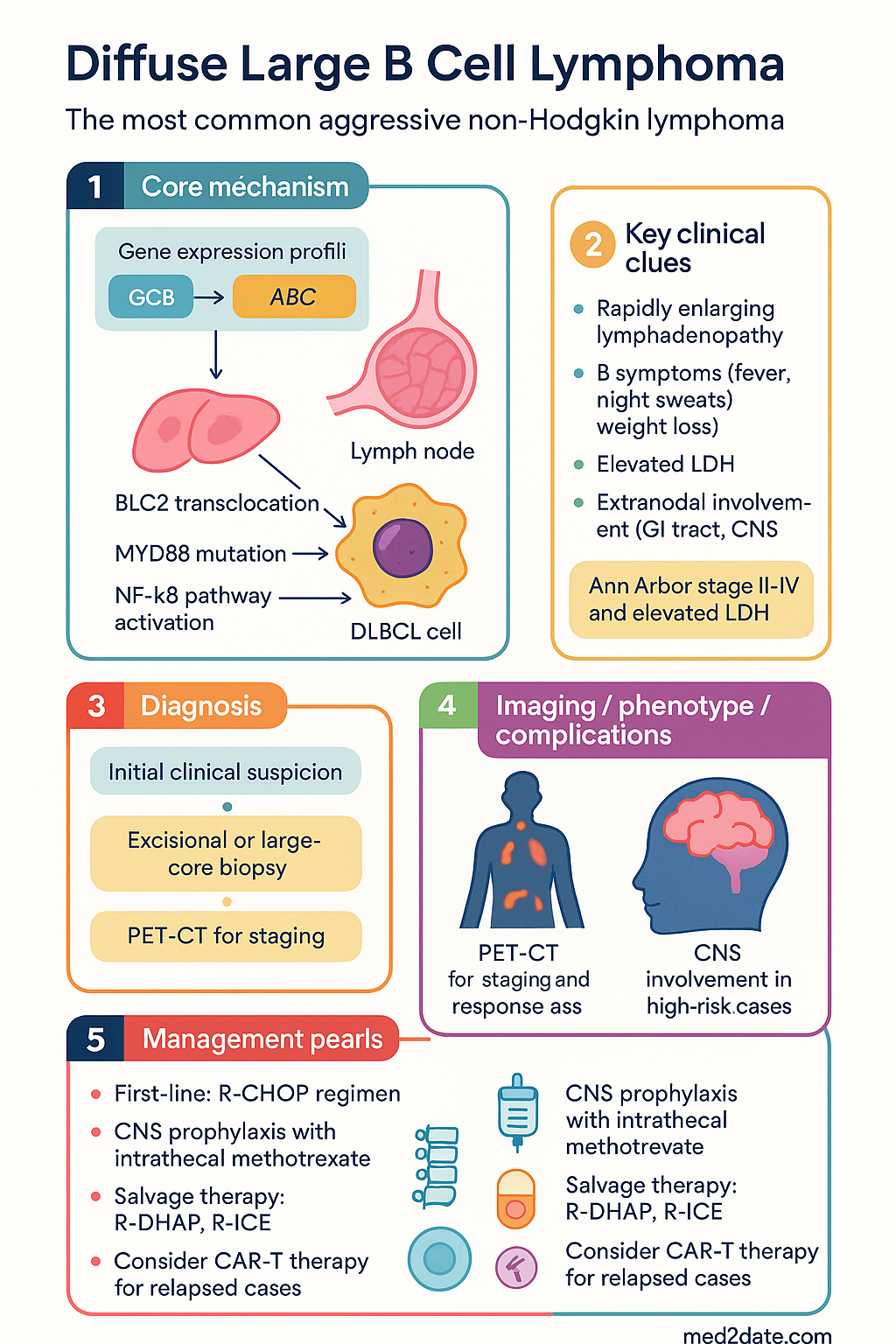
- Diffuse Large B Cell Lymphoma (DLBCL) is the most common aggressive non-Hodgkin lymphoma, accounting for approximately 30–40% of all NHL diagnoses in Australia.
- Front-line treatment is R-CHOP (rituximab, cyclophosphamide, doxorubicin, vincristine, prednisolone) × 6 cycles, achieving durable remission in ~60% of patients.
- Gene expression profiling classifies DLBCL into germinal-centre B-cell (GCB) and activated B-cell (ABC) subtypes — ABC has inferior outcomes with R-CHOP alone.
- The International Prognostic Index (IPI) remains the standard risk-stratification tool; age >60, Ann Arbor stage III–IV, elevated LDH, ECOG ≥2, and ≥2 extranodal sites drive risk.
- PET-CT is mandatory for staging (Lugano 2014 criteria) and interim/end-of-treatment response assessment using Deauville 5-point scale.
- Excisional or large-core biopsy is essential — fine-needle aspiration is inadequate for histological subtyping and molecular testing.
- Primary refractory or relapsed DLBCL is managed with platinum-based salvage chemotherapy (R-DHAP, R-ICE, or R-GDP) followed by autologous stem cell transplant (ASCT) in chemosensitive patients.
- Chimeric antigen receptor T-cell (CAR-T) therapy (tisagenlecleucel or axicabtagene ciloleucel) is available at designated Australian centres for relapsed/refractory disease post-2 salvage lines.
- Central nervous system prophylaxis with intrathecal methotrexate is indicated for high-risk sites (testicular, breast, paraspinal) and patients with CNS-IPI ≥4.
- Aboriginal and Torres Strait Islander peoples have higher rates of advanced-stage presentation and reduced access to specialist haematology services in remote areas.
- Cardiotoxicity screening (echocardiography, troponin) is essential prior to anthracycline-containing regimens, particularly in patients aged >65 or with cardiovascular risk factors.
- Positron emission tomography — computed tomography (PET-CT) is funded under Medicare for staging and response assessment of aggressive lymphomas.
🎧 Audio Brief
Introduction & Australian Epidemiology
Diffuse Large B Cell Lymphoma (DLBCL) is the most common aggressive non-Hodgkin lymphoma (NHL) worldwide and in Australia, representing approximately 30–40% of all new NHL diagnoses. In Australia, there are an estimated 1,400–1,800 new cases of DLBCL per year, with an age-standardised incidence rate of approximately 5.5 per 100,000 population. The median age at diagnosis is 65–70 years, although the disease can present at any age.
DLBCL is characterised by rapid growth and aggressive clinical behaviour, but it is potentially curable with appropriate chemotherapy. The introduction of the anti-CD20 monoclonal antibody rituximab to standard CHOP chemotherapy (cyclophosphamide, doxorubicin, vincristine, prednisolone) — forming the R-CHOP regimen — has significantly improved outcomes. Approximately 60–65% of patients achieve durable remission with first-line R-CHOP, representing a true cure in the majority.
Despite this, 30–40% of patients will either fail to achieve remission (primary refractory disease) or relapse after initial response. Outcomes for these patients remain poor, with fewer than 20% achieving long-term survival with conventional salvage therapy and autologous stem cell transplant (ASCT). Novel therapies, including CAR-T cell therapy, bispecific antibodies, and targeted agents, are transforming the treatment landscape for relapsed/refractory disease.
Understanding the molecular heterogeneity of DLBCL — particularly the distinction between germinal-centre B-cell (GCB) and activated B-cell (ABC) subtypes — is increasingly important for risk stratification and emerging precision medicine approaches.
Pathogenesis & Molecular Subtypes
Cell of Origin Classification
Gene expression profiling (GEP) using microarray technology classifies DLBCL into two principal molecular subtypes based on the putative cell of origin:
| Feature | GCB Subtype | ABC Subtype |
|---|---|---|
| Proportion of DLBCL | ~45–50% | ~35–40% |
| Cell of origin | Germinal-centre B lymphocyte | Post-germinal-centre plasmablast |
| Key genetic features | BCL2 translocation t(14;18), BCL6 translocation, EZH2 mutation, PTEN deletion | MYD88 L265P, CD79B mutation, CARD11 mutation, trisomy 3, NF-κB pathway activation |
| R-CHOP 5-year OS | ~70–75% | ~45–55% |
| Emerging targets | EZH2 inhibitors (tazemetostat), BTK inhibitors in select cases | BTK inhibitors (ibrutinib), lenalidomide, NF-κB pathway inhibitors |
| Immunohistochemical surrogate | Hans algorithm: CD10+ or CD10−/BCL6+/MUM1− | Hans algorithm: CD10−/BCL6− or CD10−/BCL6+/MUM1+ |
Immunohistochemical Surrogate (Hans Algorithm)
In routine Australian pathology practice, gene expression profiling is not universally available. The Hans immunohistochemical (IHC) algorithm serves as a validated surrogate, using CD10, BCL6, and MUM1/IRF4 staining to classify cases as GCB or non-GCB (used as a proxy for ABC). Concordance between IHC and GEP is approximately 80%.
Double-Hit and Triple-Hit Lymphomas
Double-Expresser Lymphomas
Cases demonstrating concurrent overexpression of MYC (≥40%) and BCL2 (≥50%) by immunohistochemistry without underlying translocations are termed "double-expresser" lymphomas. These represent approximately 20–30% of DLBCL, are enriched in ABC subtype, and have inferior outcomes with R-CHOP. Clinical trials evaluating DA-EPOCH-R and targeted agents in this population are ongoing.
Clinical Features & Staging
Presentation
DLBCL typically presents with rapidly enlarging lymphadenopathy, often with B symptoms (fever >38°C, drenching night sweats, unintentional weight loss >10% over 6 months). Extranodal involvement occurs in approximately 30–40% of cases and may be the sole presenting site.
| Clinical Feature | Frequency | Notes |
|---|---|---|
| Peripheral lymphadenopathy | ~70% | Rapidly enlarging, often painless, cervical most common |
| B symptoms | ~30–40% | Associated with advanced stage and higher IPI |
| Elevated LDH | ~55% | Reflects tumour bulk and proliferation rate |
| Extranodal disease | ~30–40% | GI tract, bone, testis, breast, CNS, skin |
| Bulky disease (≥7.5 cm) | ~25% | May influence consolidation radiotherapy decisions |
| CNS involvement at diagnosis | ~2–5% | Parenchymal or leptomeningeal; high mortality |
Ann Arbor Staging (Lugano Modification 2014)
International Prognostic Index (IPI)
The IPI remains the standard prognostic tool for DLBCL in clinical practice. Each factor scores 1 point:
- Age >60 years
- Serum LDH above normal
- ECOG performance status ≥2
- Ann Arbor stage III or IV
- ≥2 extranodal sites of disease
| IPI Score | Risk Group | 5-Year OS (R-CHOP era) |
|---|---|---|
| 0–1 | Low | ~90% |
| 2 | Low-intermediate | ~80% |
| 3 | High-intermediate | ~60% |
| 4–5 | High | ~40–50% |
Revised IPI (R-IPI) and NCCN-IPI
The Revised IPI (R-IPI) reclassifies patients into three groups (very good, good, poor) and may better discriminate outcomes in the rituximab era. The NCCN-IPI incorporates additional granularity in LDH ratio and extranodal site definitions, further refining high-risk identification.
Investigations
Histopathological Diagnosis
The diagnostic work-up of suspected DLBCL requires:
CNS-IPI Score
The CNS-IPI identifies patients at high risk of CNS relapse. One point each for: age >60, LDH elevated, ECOG >1, stage III/IV, extranodal site >1, kidney and/or adrenal involvement. Score 4–6 = high risk (12–15% 2-year CNS relapse); consider CNS prophylaxis.
Management
First-Line Treatment: R-CHOP-21
R-CHOP-21 (rituximab plus cyclophosphamide, doxorubicin, vincristine, and prednisolone administered every 21 days) remains the standard first-line regimen for DLBCL in Australia. The regimen is given for 6 cycles in stage I–II non-bulky disease and 6–8 cycles in advanced-stage disease, with consolidation radiotherapy considered for residual bulky sites.
Treatment by Stage
CNS Prophylaxis
Intrathecal methotrexate (12–15 mg per injection, weekly × 4–6 doses) is indicated for patients with high CNS-IPI (4–6), testicular DLBCL, breast DLBCL, or other high-risk extranodal sites. Some centres utilise systemic high-dose methotrexate (3 g/m² × 2–4 doses) as an alternative to intrathecal therapy, particularly for parenchymal CNS risk.
Salvage Therapy for Relapsed/Refractory DLBCL
Patients with primary refractory disease or relapse after R-CHOP should be evaluated for salvage chemotherapy and autologous stem cell transplant (ASCT) if chemosensitive and fit for transplant. Eligibility should be assessed at a transplant-capable centre.
Autologous Stem Cell Transplant (ASCT)
ASCT remains the standard consolidation for patients with chemosensitive relapsed DLBCL (partial or complete metabolic response to salvage therapy), as established by the PARMA trial. BEAM (carmustine, etoposide, cytarabine, melphalan) is the most widely used conditioning regimen in Australia. ASCT is performed at designated transplant centres across major Australian cities (Royal Adelaide Hospital, Peter MacCallum Cancer Centre, Westmead Hospital, Royal Brisbane and Women's Hospital, etc.).
CAR-T Cell Therapy
Novel and Emerging Agents
Several agents are in late-phase clinical trials or have received TGA registration for specific DLBCL subpopulations:
- Polatuzumab vedotin (anti-CD79b antibody-drug conjugate) — TGA-approved in combination with bendamustine + rituximab for relapsed/refractory DLBCL. PBS-listed (Authority Required).
- Tafasitamab (anti-CD19 antibody) + lenalidomide — approved for relapsed/refractory DLBCL ineligible for ASCT. Available via special access schemes in Australia.
- Bispecific antibodies (glofitamab, epcoritamab, mosunetuzumab) — anti-CD20 × CD3 T-cell engagers showing promising response rates in heavily pre-treated DLBCL. Glofitamab TGA-approved; PBS listing under review.
- Selitrectinib (LOXO-305) and pirtobrutinib — non-covalent BTK inhibitors under investigation for ABC-DLBCL.
Monitoring
During Treatment
End of Treatment
Post-Treatment Surveillance
Routine surveillance after confirmed complete response (CR) follows institutional protocols, generally:
- Clinical review every 3 months for years 1–2, every 6 months for years 3–5, then annually
- FBC, LDH, renal and liver function at each visit
- CT only if clinically indicated — routine CT surveillance is not recommended by Lugano 2014 or NCCN guidelines as most relapses present symptomatically or with LDH elevation
- Thyroid function testing if prior neck radiotherapy
- Psychosocial support, fertility counselling (pre-treatment), and survivorship care plan
Special Populations
Aboriginal and Torres Strait Islander Health Considerations
📚 References
- 1. Sehn LH, Donaldson J, Chhanabhai M, et al. Introduction of combined CHOP plus rituximab therapy dramatically improved outcome of diffuse large B-cell lymphoma in British Columbia. J Clin Oncol. 2005;23(22):5027–5033.
- 2. Coiffier B, Lepage E, Brière J, et al. CHOP chemotherapy plus rituximab compared with CHOP alone in elderly patients with diffuse large-B-cell lymphoma. N Engl J Med. 2002;346(4):235–242.
- 3. Alizadeh AA, Eisen MB, Davis RE, et al. Distinct types of diffuse large B-cell lymphoma identified by gene expression profiling. Nature. 2000;403(6769):503–511.
- 4. Hans CP, Weisenburger DD, Greiner TC, et al. Confirmation of the molecular classification of diffuse large B-cell lymphoma by immunohistochemistry using a tissue microarray. Blood. 2004;103(1):275–282.
- 5. Cheson BD, Fisher RI, Barrington SF, et al. Recommendations for initial evaluation, staging, and response assessment of Hodgkin and non-Hodgkin lymphoma: the Lugano classification. J Clin Oncol. 2014;32(27):3059–3068.
- 6. International Non-Hodgkin's Lymphoma Prognostic Factors Project. A predictive model for aggressive non-Hodgkin's lymphoma. N Engl J Med. 1993;329(14):987–994.
- 7. Schmitz R, Wright GW, Huang DW, et al. Genetics and pathogenesis of diffuse large B-cell lymphoma. N Engl J Med. 2018;378(15):1396–1407.
- 8. Philip T, Guglielmi C, Hagenbeek A, et al. Autologous bone marrow transplantation as compared with salvage chemotherapy in relapses of chemotherapy-sensitive non-Hodgkin's lymphoma. N Engl J Med. 1995;333(23):1540–1545.
- 9. Neelapu SS, Locke FL, Bartlett NL, et al. Axicabtagene ciloleucel CAR T-cell therapy in refractory large B-cell lymphoma. N Engl J Med. 2017;377(26):2531–2544.
- 10. Schuster SJ, Bishop MR, Tam CS, et al. Tisagenlecleucel in adult relapsed or refractory diffuse large B-cell lymphoma. N Engl J Med. 2019;380(1):45–56.
- 11. Pfreundschuh M, Trümper L, Österborg A, et al. CHOP-like chemotherapy plus rituximab versus CHOP-like chemotherapy alone in young patients with good-prognosis diffuse large-B-cell lymphoma: a randomised controlled trial by the MabThera International Trial (MInT) Group. Lancet Oncol. 2006;7(5):379–391.
- 12. Australian Institute of Health and Welfare (AIHW). Cancer data in Australia. Canberra: AIHW; 2024. Available from: https://www.aihw.gov.au/reports/cancer/cancer-data-in-australia
- 13. Australasian Leukaemia & Lymphoma Group (ALLG). ALLG clinical trial network. Available from: https://www.allg.org.au
- 14. Pfreundschuh M, Kuhnt E, Trümper L, et al. CHOP-like chemotherapy with or without rituximab in young patients with good-prognosis diffuse large-B-cell lymphoma: 6-year results of an open-label randomised study of the MabThera International Trial (MInT) Group. Lancet Oncol. 2011;12(11):1013–1022.
- 15. Tilly H, Gomes da Silva M, Vitolo U, et al. Diffuse large B-cell lymphoma (DLBCL): ESMO Clinical Practice Guidelines for diagnosis, treatment and follow-up. Ann Oncol. 2015;26(suppl 5):v116–v125.