📋 Key Information Summary
- Blood product transfusion is a life-saving therapy but carries significant risks; it must be based on clear clinical indications and patient-specific thresholds.
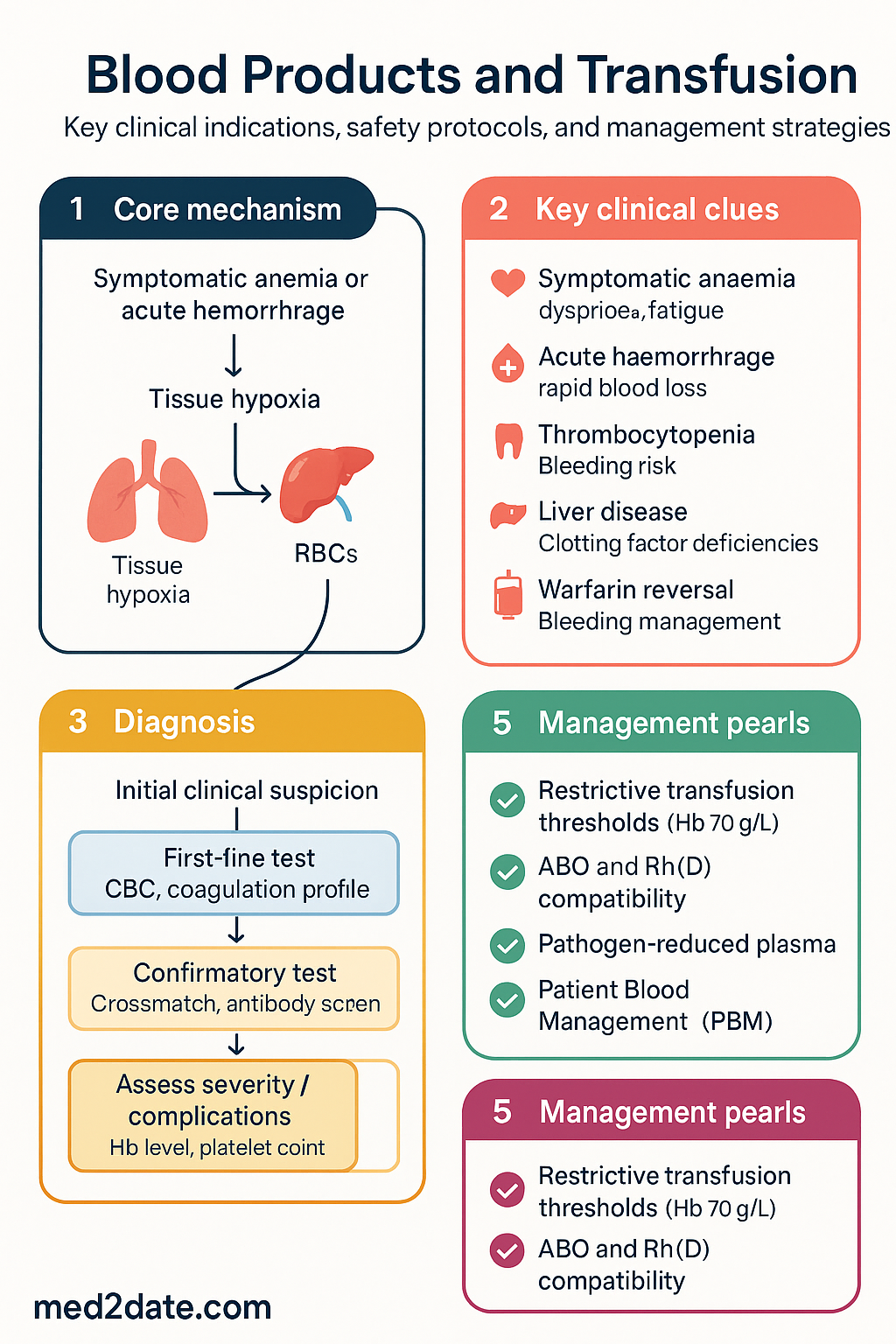
- Red cell transfusion is primarily indicated for symptomatic anaemia or acute haemorrhage, with restrictive thresholds (e.g., Hb <70 g/L in stable patients) generally preferred.
- Platelet transfusions are for prophylaxis or treatment of bleeding in thrombocytopenia or platelet dysfunction, with thresholds varying by clinical scenario.
- Fresh Frozen Plasma (FFP) is for multiple clotting factor deficiencies (e.g., liver disease, DIC) or warfarin reversal; it is not a volume expander.
- Cryoprecipitate is a concentrated source of fibrinogen, factor VIII, and von Willebrand factor; it is indicated for hypofibrinogenaemia.
- ABO and Rh(D) compatibility is mandatory for red cells; crossmatch testing prevents haemolytic reactions.
- All transfusions must be prescribed on a National Blood Authority (NBA) Patient Blood Management (PBM) form and administered via a validated identity check process.
- Acute transfusion reactions range from mild febrile to life-threatening anaphylaxis or Transfusion-Related Acute Lung Injury (TRALI).
- Patient Blood Management (PBM) is the standard of care, focusing on optimising erythropoiesis, minimising blood loss, and harnessing tolerance to anaemia.
- Aboriginal and Torres Strait Islander peoples may have higher transfusion needs and face barriers to timely access; culturally safe care is essential.
- Special considerations apply for pregnant patients, paediatric patients, the elderly, and those with renal, hepatic, or immunocompromised states.
- All transfusion events must be documented and reported to the blood bank, with any adverse events reported to the Therapeutic Goods Administration (TGA).
🎧 Audio Brief
Introduction & Australian Epidemiology
Blood product transfusion is a core therapeutic intervention in modern medicine, involving the administration of red cell concentrates, platelets, fresh frozen plasma (FFP), and cryoprecipitate. Each component has specific indications, compatibility requirements, and associated risks. In Australia, transfusion medicine is governed by stringent national frameworks to ensure safety, efficacy, and optimal resource utilisation.
The National Blood Authority (NBA) oversees Australia's blood supply, implementing the National Blood Agreement and the National Patient Blood Management (PBM) Guidelines. In 2021-22, approximately 1.6 million units of red cells, 200,000 doses of platelets, and 80,000 litres of plasma components were issued nationally. Despite this, inappropriate transfusion remains a concern, driving the nationwide adoption of PBM to minimise unnecessary exposure.
Australian clinical practice is guided by the Australian & New Zealand Society of Blood Transfusion (ANZSBT) guidelines and the National Safety and Quality Health Service (NSQHS) Standards, specifically Standard 7: Blood and Blood Products. Adherence to these standards ensures a systematic approach to patient identification, compatibility testing, administration, and monitoring for adverse events.
Red Cell Transfusion & Indications
Red cell concentrates are the most commonly transfused blood component, used to restore oxygen-carrying capacity. The decision to transfuse must balance the benefits against the risks of circulatory overload, alloimmunisation, and infection.
Key Indications
- Acute Symptomatic Anaemia: When haemoglobin (Hb) is <70 g/L with symptoms such as dyspnoea, fatigue, or cardiac failure.
- Acute Haemorrhage: To replace lost red cell mass, often in conjunction with other components and haemostatic agents.
- Chronic Anaemia: When other treatments (iron, B12, erythropoietin) are insufficient or contraindicated, and symptoms persist.
- Surgical Support: For patients unable to tolerate anaemia during major surgery or with a high anticipated blood loss.
Platelets, FFP & Cryoprecipitate
Platelet Transfusion
Platelets are indicated for the prophylaxis or treatment of bleeding in patients with thrombocytopenia or platelet dysfunction.
- Prophylactic Transfusion: For stable, non-bleeding patients with platelet count <10 x 10⁹/L.
- Before Invasive Procedures: Target >50 x 10⁹/L for most procedures, >100 x 10⁹/L for neurosurgery or eye surgery.
- Active Bleeding: Regardless of count, especially if platelet dysfunction is suspected (e.g., antiplatelet therapy, uraemia).
Fresh Frozen Plasma (FFP)
FFP contains all coagulation factors. It is indicated for bleeding or high bleeding risk with multiple factor deficiencies, not as a volume expander.
- Bleeding with Coagulopathy: Especially in liver disease, DIC, or massive transfusion.
- Warfarin Reversal: When Prothrombinex-VF is unavailable or for urgent reversal in major bleeding.
- Single Factor Deficiency: Only when specific factor concentrates are unavailable.
Cryoprecipitate
Cryoprecipitate is a plasma derivative rich in fibrinogen, factor VIII, factor XIII, and von Willebrand factor.
- Hypofibrinogenaemia: When fibrinogen is <1.0 g/L with bleeding or high risk.
- Uraemic Bleeding: To improve platelet function when dialysis and desmopressin are insufficient.
Compatibility Testing (ABO & Crossmatch)
Compatibility testing is a critical safety process to prevent haemolytic transfusion reactions. It involves ABO/Rh grouping, antibody screening, and crossmatching.
Process Overview
Special Considerations
- O Negative Red Cells: Used for emergencies of unknown blood group. Must be switched to group-specific once group is known to preserve supply.
- Massive Haemorrhage Protocol: Immediate release of uncrossmatched group O red cells and group AB FFP.
- Antibody-Positive Patients: Require antigen-negative blood, extending crossmatch time.
| Component | ABO Compatibility Requirement | Rh(D) Consideration |
|---|---|---|
| Red Cells | Must be ABO identical or compatible (recipient has no antibodies to donor ABO antigens). | D-negative patients, especially women of childbearing potential, should receive D-negative red cells. |
| Platelets | Ideally ABO identical. Can be ABO incompatible if titres are low; may reduce increment. | RhD matching not required but recommended for D-negative patients to prevent anti-D formation. |
| FFP / Cryo | Must be ABO identical or group AB (contains no anti-A or anti-B antibodies). | Not relevant for plasma components. |
Transfusion Thresholds & Complications
Evidence-Based Transfusion Thresholds
Complications of Transfusion
Complications are categorised as acute (during or within 24 hours) or delayed.
| Reaction Type | Key Features | Immediate Management |
|---|---|---|
| Febrile Non-Haemolytic | Temperature rise ≥1°C, rigors, headache. Most common reaction. | Stop transfusion. Paracetamol. Exclude haemolytic reaction. |
| Allergic / Anaphylaxis | Urticaria, flushing, angioedema, hypotension, bronchospasm. | Stop transfusion. Adrenaline IM for anaphylaxis. Supportive care. |
| Acute Haemolytic | Fever, rigors, flank pain, hypotension, dark urine. Usually ABO error. | Stop transfusion. Support BP. Maintain urine output. Treat DIC. |
| TRALI | Acute respiratory distress, hypoxia, bilateral pulmonary oedema within 6 hours. | Stop transfusion. Oxygen. Often requires ventilatory support. Supportive care. |
| TACO | Respiratory distress, hypertension, peripheral oedema. Overload risk in cardiac/renal patients. | Stop transfusion. Sit patient upright. Oxygen. Diuretics (e.g., frusemide IV). |
Special Populations
Pregnancy
Paediatrics
Immunocompromised
Renal Impairment
🪃 Aboriginal and Torres Strait Islander Health
Aboriginal and Torres Strait Islander peoples experience a higher burden of conditions that may require transfusion, including chronic kidney disease, anaemia of chronic disease, and complications from rheumatic heart disease. Access to timely and culturally safe transfusion services is critical.
📚 References
- 1. National Blood Authority. National Patient Blood Management Guidelines. Canberra: NBA; 2023.
- 2. Australian & New Zealand Society of Blood Transfusion (ANZSBT). Guidelines for the Administration of Blood Products. 3rd ed. Sydney: ANZSBT; 2022.
- 3. Australian Commission on Safety and Quality in Health Care (ACSQHC). National Safety and Quality Health Service Standards. 2nd ed. Sydney: ACSQHC; 2021.
- 4. National Blood Authority. Australian Haemovigilance Report 2021-22. Canberra: NBA; 2023.
- 5. Carson JL, Guyatt G, Heddle NM, et al. Clinical Practice Guidelines From the AABB: Red Blood Cell Transfusion Thresholds and Storage. JAMA. 2016;316(19):2025-2035.
- 6. Estcourt LJ, Birchall J, Allard S, et al. Guidelines for the use of platelet transfusions. Br J Haematol. 2017;176(3):365-394.
- 7. Australian Red Cross Lifeblood. Blood Component Information. Melbourne: Lifeblood; 2024.
- 8. Royal College of Pathologists of Australasia (RCPA). Quality Assurance Program (QAP) Transfusion Medicine. Sydney: RCPA; 2023.
- 9. Australian Institute of Health and Welfare (AIHW). Blood and blood products—summary. Canberra: AIHW; 2023.
- 10. Kaufman RM, Djulbegovic B, Gernsheimer T, et al. Platelet transfusion: a clinical practice guideline from the AABB. Ann Intern Med. 2015;162(3):205-213.
- 11. National Health and Medical Research Council (NHMRC). Australian Guidelines for the Prevention of Infection in Healthcare. Canberra: NHMRC; 2019.