📋 Key Information Summary
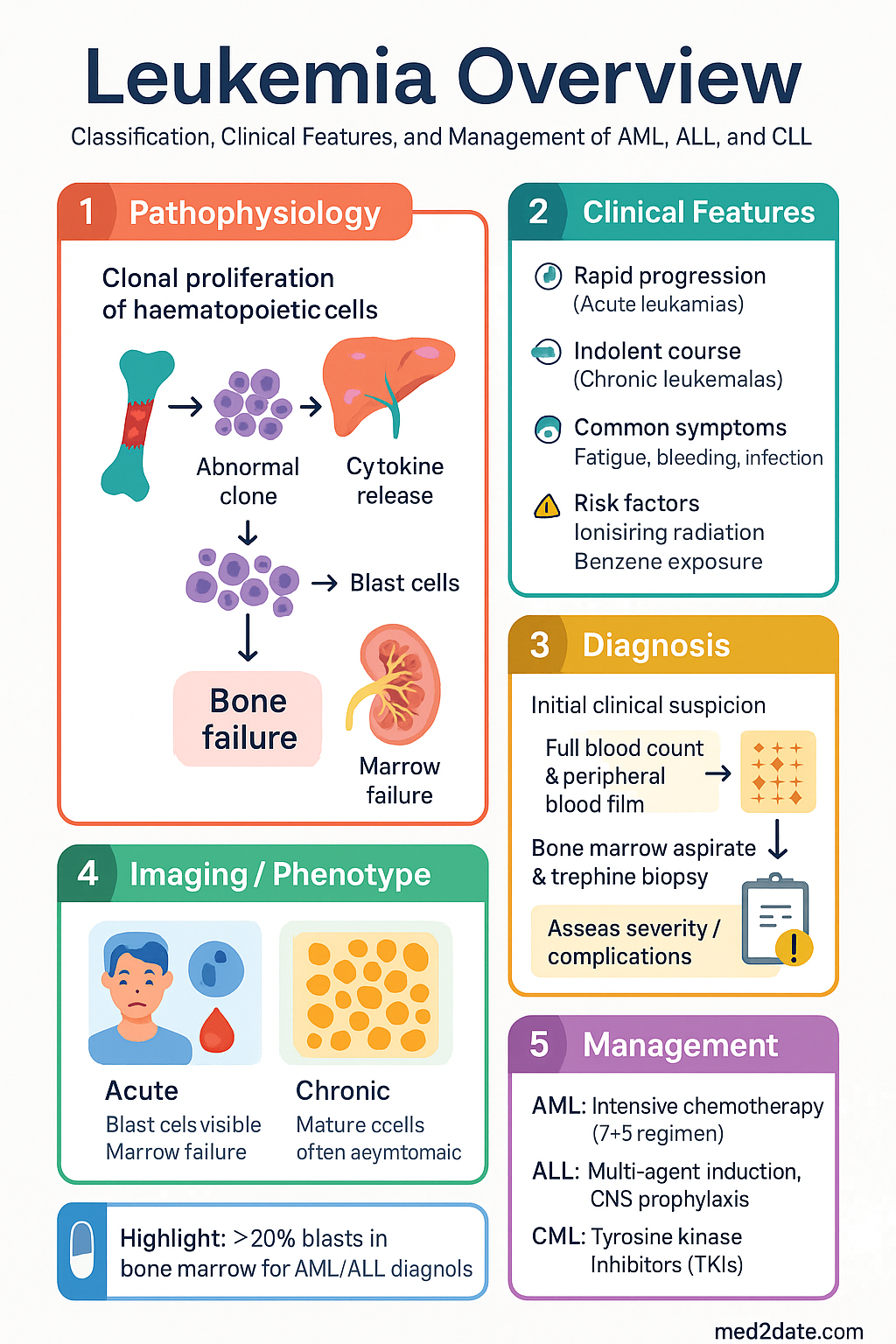
- Leukaemia is a clonal malignancy of haematopoietic cells classified by lineage (myeloid vs lymphoid) and acuity (acute vs chronic)
- Acute leukaemias (AML, ALL) present with rapidly progressive cytopenias due to bone marrow failure; chronic leukaemias (CML, CLL) are often indolent and discovered incidentally
- AML is the most common acute leukaemia in adults (median age 68 years); ALL predominates in children aged 2–5 years
- CML is characterised by the Philadelphia chromosome t(9;22) BCR-ABL1 and responds to tyrosine kinase inhibitors (TKIs)
- CLL is the most common leukaemia in Western adults (median age 72 years) and many patients require observation only at diagnosis
- Full blood count with peripheral blood film is the essential first investigation — blast cells suggest acute leukaemia; left shift and basophilia suggest CML
- Bone marrow aspirate and trephine biopsy with immunophenotyping, cytogenetics, and molecular studies are required for definitive diagnosis and risk stratification
- Acute leukaemia presenting with hyperleukocytosis (>100 × 10⁹/L) is an oncological emergency requiring urgent leukapheresis and rasburicase
- Treatment of AML centres on intensive induction chemotherapy (7+3 regimen) in fit patients; hypomethylating agents for those unfit for intensive therapy
- ALL treatment involves multi-agent induction, CNS prophylaxis, consolidation, and maintenance; paediatric-inspired regimens improve outcomes in adults up to age 40
- CML treatment is with TKIs (imatinib first-line on PBS); deep molecular response may allow treatment-free remission trials
- CLL management ranges from watch-and-wait for early-stage disease to targeted agents (BTK inhibitors, venetoclax combinations) for symptomatic disease
- Allogeneic haematopoietic stem cell transplant remains curative for high-risk AML, relapsed ALL, and accelerated/blast-phase CML
- Aboriginal and Torres Strait Islander Australians experience higher leukaemia incidence and poorer outcomes; culturally safe care and equitable access to transplant are critical
🎧 Audio Brief
Introduction & Australian Epidemiology
Leukaemia encompasses a heterogeneous group of haematological malignancies arising from the clonal proliferation of haematopoietic cells in the bone marrow. Classification is determined by both the cell lineage affected (myeloid or lymphoid) and the tempo of disease (acute or chronic). The four principal subtypes — acute myeloid leukaemia (AML), acute lymphoblastic leukaemia (ALL), chronic myeloid leukaemia (CML), and chronic lymphocytic leukaemia (CLL) — differ markedly in their epidemiology, clinical presentation, molecular pathogenesis, and therapeutic approach.
In Australia, leukaemia accounts for approximately 4,500 new cancer diagnoses annually, representing roughly 3% of all cancers. AML is the most common acute leukaemia in adults with an age-standardised incidence of approximately 3.5 per 100,000, predominantly affecting individuals over 60 years of age. ALL has a bimodal distribution with a peak incidence in children aged 2–5 years (approximately 3.8 per 100,000) and a second smaller peak in adults over 60 years. CML has an incidence of approximately 1.6 per 100,000 with a median age at diagnosis of 55–60 years. CLL is the most prevalent leukaemia in Western countries, with an Australian incidence of approximately 5.5 per 100,000 in individuals over 70 years and a male predominance of approximately 1.7:1.
Risk factors include ionising radiation, benzene exposure, prior chemotherapy (particularly alkylating agents and topoisomerase II inhibitors), myelodysplastic syndromes, Down syndrome (increased AML/ALL risk), and certain hereditary conditions (Li-Fraumeni syndrome, Fanconi anaemia). Unlike many solid tumours, leukaemia rarely forms a discrete mass; instead, the malignant clone infiltrates the bone marrow, displaces normal haematopoiesis, and often spills into the peripheral blood.
Classification & Comparison
The World Health Organization (WHO) 5th edition classification (2022) and the International Consensus Classification (ICC) 2022 provide the current frameworks for leukaemia subtyping. Both systems integrate morphology, immunophenotyping, cytogenetics, and molecular genetics to define biologically and clinically meaningful entities.
| Feature | AML | ALL | CML | CLL |
|---|---|---|---|---|
| Lineage | Myeloid | B-lymphoid (75%) or T-lymphoid (25%) | Myeloid (multipotent stem cell) | B-lymphoid |
| Acuity | Acute — rapid progression | Acute — rapid progression | Chronic (can transform) | Chronic — indolent |
| Median age at diagnosis | 68 years | 17 years (bimodal) | 55–60 years | 72 years |
| Australian incidence | ~1,100/year | ~400/year | ~330/year | ~1,500/year |
| Key molecular hallmark | Heterogeneous (FLT3, NPM1, TP53, RUNX1) | Philadelphia chromosome (25% adults), hyperdiploidy, ETV6-RUNX1 | BCR-ABL1 t(9;22) | del(13q), del(11q), del(17p), TP53 mutation |
| Blast threshold | ≥20% BM blasts (WHO); ≥10% with defining genetic abnormality | ≥20% BM or peripheral blood lymphoblasts | <10% in chronic phase | Small mature lymphocytes; blasts not increased |
| Philadelphia chromosome | ~2–3% of cases (treated as Ph+ AML) | ~25% adults, ~3% paediatric | ~95% — defining feature | Rare |
| Curative potential | Yes (intensive chemo ± HSCT) | Yes (85–90% paediatric; 40–50% adult) | Functional cure (TKI ± TFR) | Generally no (exception: allo-HSCT) |
WHO 5th Edition Classification of AML (Selected Entities)
The WHO 2022 classification separates AML into defined genetic entities and an "NOS" category. The following are clinically significant groupings relevant to Australian practice:
| Category | Key Abnormalities | Prognosis |
|---|---|---|
| AML with t(8;21) RUNX1-RUNX1T1 | Core-binding factor | Favourable |
| AML with inv(16) CBFB-MYH11 | Core-binding factor | Favourable |
| APL with PML-RARA | t(15;17) | Favourable (with ATRA + ATO) |
| AML with NPM1 mutation | NPM1 | Favourable (if no FLT3-ITD high ratio) |
| AML with FLT3-ITD | FLT3 internal tandem duplication | Adverse (improved with midostaurin/gilteritinib) |
| AML with TP53 mutation / complex karyotype | TP53, ≥3 cytogenetic abnormalities | Adverse |
| AML with KMT2A rearrangement | 11q23 rearrangements | Adverse |
| AML, NOS (≥20% blasts) | No defining genetic abnormality | Variable by cytogenetics |
Acute vs Chronic Leukaemia Features
The distinction between acute and chronic leukaemia is fundamental to clinical assessment, urgency of investigation, and therapeutic decision-making. Acute leukaemias are characterised by the rapid accumulation of immature blast cells in the bone marrow, leading to marrow failure, while chronic leukaemias involve the accumulation of more mature-appearing cells with an indolent clinical course, though transformation to an aggressive phase is possible.
Clinical Presentation Comparison
| Feature | Acute (AML/ALL) | Chronic (CML/CLL) |
|---|---|---|
| Onset | Days to weeks | Weeks to years |
| Symptoms at diagnosis | Usually symptomatic | Often asymptomatic |
| WCC at presentation | Variable — low, normal, or very high | Usually elevated |
| Blast cells on film | Present (≥20% in marrow) | Absent (chronic phase) |
| Cytopenias | Prominent (anaemia, thrombocytopenia, neutropenia) | Mild or absent initially |
| Hepatosplenomegaly | Variable | Common (CML splenomegaly; CLL lymphadenopathy) |
| Gum hypertrophy | AML with monocytic differentiation | Not typical |
| Skin infiltration | AML (leukaemia cutis) | Rare |
| CNS involvement | ALL more common (cranial nerve palsies) | Rare |
| Transformation risk | N/A — already acute | CML → blast crisis; CLL → Richter transformation |
Investigations (FBC, Bone Marrow Biopsy)
Initial Investigation Pathway
Investigation Details by Leukaemia Type
Diagnostic Criteria Summary
| Leukaemia | WHO Diagnostic Criteria (Simplified) |
|---|---|
| AML | ≥20% myeloid blasts in bone marrow or peripheral blood (exception: APL and AML with defining genetic abnormalities are diagnosed irrespective of blast count) |
| ALL | ≥20% lymphoblasts in bone marrow or peripheral blood with immunophenotypic confirmation of B- or T-lymphoid lineage |
| CML | Philadelphia chromosome t(9;22) BCR-ABL1 by cytogenetics, FISH, or PCR. Chronic phase: <10% blasts. Accelerated phase: 10–19% blasts or specific features. Blast phase: ≥20% blasts or extramedullary blast proliferation |
| CLL | Monoclonal B-lymphocyte count ≥5 × 10⁹/L sustained for ≥3 months with characteristic immunophenotype (CD5+, CD19+, CD23+, CD200+). Small lymphocytic lymphoma (SLL) is the tissue-based equivalent. |
Treatment Principles & Prognosis
Treatment of leukaemia is highly subtype-specific and increasingly guided by molecular risk stratification. General principles apply across all subtypes: confirm diagnosis with adequate tissue, perform comprehensive risk assessment before commencing therapy, and ensure treatment occurs at centres with specialist haematology, blood bank, and supportive care infrastructure.
Acute Myeloid Leukaemia (AML)
Intensive Induction — "7+3" Regimen
Venetoclax Combinations for Unfit/Unsuitable Patients
Acute Lymphoblastic Leukaemia (ALL)
ALL treatment is among the most complex of all cancer regimens, comprising induction, consolidation/intensification, CNS prophylaxis, and maintenance phases over 2–3 years. Paediatric-inspired regimens (e.g., COG-based protocols) have demonstrated superior outcomes compared to adult-type regimens in adolescents and young adults (AYA) aged 15–40 years.
Chronic Myeloid Leukaemia (CML)
CML management has been revolutionised by tyrosine kinase inhibitors targeting BCR-ABL1. Imatinib (Glivec®) is the standard first-line agent, available as a PBS General Benefit. Second-generation TKIs (dasatinib, nilotinib) are used for suboptimal response or intolerance. Treatment-free remission (TFR) is a goal for patients achieving deep molecular response (DMR) sustained for ≥2 years.
Chronic Lymphocytic Leukaemia (CLL)
CLL management has shifted from chemoimmunotherapy to targeted agents. The approach is determined by disease stage (Rai/Binet), molecular risk factors (IGHV mutation status, TP53/del17p), comorbidities, and patient preference. Watchful wait is appropriate for asymptomatic early-stage disease.
Prognosis Summary
Allogeneic Haematopoietic Stem Cell Transplant
Allogeneic HSCT remains a potentially curative option for high-risk and relapsed leukaemia. Indications include:
- AML in first complete remission with intermediate or adverse ELN 2022 risk (in patients medically fit for transplant)
- ALL in first complete remission with high-risk features (Ph+, MLL rearrangement, hypodiploidy, poor MRD response)
- CML in accelerated or blast phase, or with TKI resistance/failure
- Relapsed/refractory acute leukaemias achieving second remission
Australian transplant centres are located in all major capital cities (e.g., Royal Adelaide Hospital, Westmead Hospital Sydney, Royal Melbourne Hospital, Peter MacCallum Cancer Centre). Donor options include matched sibling, matched unrelated (ABMDR/international registry), haploidentical family donor, and cord blood. Transplant-related mortality ranges from 15–30% depending on conditioning intensity, patient age, and comorbidities.
Special Populations
Aboriginal and Torres Strait Islander Health Considerations
📚 References
- 1. Khoury JD, Solary E, Abla O, et al. The 5th edition of the World Health Organization Classification of Haematolymphoid Tumours: Myeloid and Histiocytic/Dendritic Neoplasms. Leukemia. 2022;36(7):1703–1719.
- 2. Arber DA, Orazi A, Hasserjian RP, et al. International Consensus Classification of myeloid neoplasms and acute leukemias: integrating morphologic, clinical, and genomic data. Blood. 2022;140(11):1200–1228.
- 3. Döhner H, Wei AH, Appelbaum FR, et al. Diagnosis and management of AML in adults: 2022 recommendations from an international expert panel on behalf of the ELN. Blood. 2022;140(12):1345–1377.
- 4. Australian Institute of Health and Welfare. Cancer data in Australia. Canberra: AIHW; 2023. Available from: https://www.aihw.gov.au/reports/cancer/cancer-data-in-australia
- 5. Cancer Council Australia. Leukaemia — Understanding Blood Cancer. Sydney: Cancer Council Australia; 2023.
- 6. National Health and Medical Research Council. Clinical Practice Guidelines for the Management of Acute Myeloid Leukaemia. Canberra: NHMRC; 2021.
- 7. Hallek M, Cheson BD, Catovsky D, et al. iwCLL guidelines for diagnosis, indications for treatment, response assessment, and supportive management of CLL. Blood. 2018;131(25):2745–2760.
- 8. Hochhaus A, Baccarani M, Silver RT, et al. European LeukemiaNet 2020 recommendations for treating chronic myeloid leukemia. Leukemia. 2020;34(4):966–984.
- 9. DeAngelo DJ, Stevenson KE, Dahlberg SE, et al. Long-term outcome of a pediatric-inspired regimen used for adults aged 18–50 years with newly diagnosed acute lymphoblastic leukemia. Leukemia. 2019;33(4):1070–1081.
- 10. DiNardo CD, Jonas BA, Pullarkat V, et al. Azacitidine and venetoclax in previously untreated acute myeloid leukemia. N Engl J Med. 2020;383(7):617–629.
- 11. Australian Government Department of Health. Pharmaceutical Benefits Scheme — Leukaemia Medications. Canberra: PBS; 2024. Available from: https://www.pbs.gov.au
- 12. ">Conyers R, De Abreu Lourenço R, Galis F, et al. Cancer incidence and survival for Aboriginal Australians in New South Wales and Victoria. Aust N Z J Public Health. 2023;47(2):100030.
- 13. Australian Commission on Safety and Quality in Health Care. National Safety and Quality Health Service Standards. 2nd ed. Sydney: ACSQHC; 2021.
- 14. ">ANZCHOG (Australian and New Zealand Children's Haematology/Oncology Group). Clinical trial protocols for paediatric ALL and AML. Melbourne: ANZCHOG; 2024.
- 15. Eichhorst B, Niemann CU, Kater AP, et al. First-line venetoclax combinations in chronic lymphocytic leukemia. N Engl J Med. 2023;388(19):1739–1754.