📋 Key Information Summary
- Acute lymphoblastic leukaemia (ALL) is the most common cancer in children aged 1–14 years, with a peak incidence at 2–5 years; ~80% of cases are B-ALL and ~15% T-ALL.
- Adult ALL is rarer (median age ~35–40 years) with inferior outcomes compared to paediatric disease; Philadelphia chromosome-positive (Ph+) ALL increases with age.
- CNS involvement (CNS leukaemia) is present at diagnosis in 5–10% of paediatric and ~5% of adult cases; prophylactic intrathecal (IT) therapy is mandatory in all risk groups.
- Diagnosis requires ≥20% bone-marrow lymphoblasts (WHO 2022 threshold), confirmed by morphology, immunophenotyping (flow cytometry), cytogenetics and molecular studies including BCR::ABL1, KMT2A rearrangements and IKZF1 deletions.
- Induction therapy achieves morphological remission (M1, <5% blasts) in >95% of paediatric and ~85–90% of adult patients using multi-agent vincristine + corticosteroid + L-asparaginase ± anthracycline backbones.
- Minimal residual disease (MRD) by flow cytometry or qPCR at end of induction (Day 28–35) is the single strongest prognostic factor and drives risk-stratified post-remission therapy.
- Ph+ ALL requires a tyrosine-kinase inhibitor (TKI — dasatinib or ponatinib) from day 1 of induction combined with chemotherapy or blinatumomab.
- Paediatric-inspired protocols (e.g., COG/DFCI hybrids adapted for Australia) produce superior survival in adolescents and young adults (AYA, 15–39 years) compared with adult regimens.
- Blinatumomab (CD3/CD19 BiTE) is PBS-listed for relapsed/refractory B-ALL (≥18 years, prior ≥1 therapy) and now used in first-line Ph+ ALL and high-risk MRD-positive settings.
- Allogeneic haematopoietic stem-cell transplant (allo-HSCT) is indicated in high-risk groups — Ph+ ALL in first remission, persistent MRD positivity after consolidation, early T-precursor (ETP) ALL with adverse features, and all second or subsequent remissions.
- Mediastinal masses in T-ALL carry a risk of superior vena cava (SVC) syndrome and airway compromise — anaesthetic and procedural planning is mandatory before general anaesthesia.
- Tumour lysis syndrome (TLS) prophylaxis with rasburicase (PBS Authority) or allopurinol plus aggressive IV hydration is essential from the time of diagnosis in all high-burden patients.
- Aboriginal and Torres Strait Islander children experience higher ALL incidence but lower event-free survival, driven by later presentation, treatment toxicity, and remote-care barriers — culturally safe, centralised management is critical.
- L-asparaginase–associated thrombosis and pancreatitis require pre-emptive antithrombin monitoring and patient/family education regarding abdominal pain during treatment.
- Five-year overall survival exceeds 90% in standard-risk paediatric ALL but remains <50% in relapsed adult ALL; treatment at an accredited paediatric or adult haematology centre is mandatory.
🎧 Audio Brief
Introduction & Australian Epidemiology
Acute lymphoblastic leukaemia (ALL) is a haematological malignancy characterised by clonal proliferation and accumulation of immature lymphoid cells (lymphoblasts) in the bone marrow, blood and extramedullary sites. It is the most common cancer diagnosed in children, accounting for approximately 25% of all paediatric malignancies, and is also recognised as a significant disease in adolescents, young adults and older adults.
In Australia, ALL accounts for approximately 300–350 new diagnoses per year. The age-specific incidence is highest in children aged 2–5 years (approximately 5 per 100,000 per year), declining through adolescence and adulthood to approximately 1–1.5 per 100,000 in adults over 50 years of age. There is a slight male preponderance (male:female ratio ~1.2:1), which is more pronounced in T-ALL.
Paediatric ALL represents one of the great success stories of modern oncology, with five-year overall survival exceeding 90% in contemporary Australian and international cooperative-group trials. This achievement reflects successive protocol refinements in risk stratification, central nervous system-directed therapy, treatment intensity modulation, and the use of minimal residual disease (MRD) monitoring to guide therapeutic decisions.
Outcomes in adult ALL remain less favourable, with five-year overall survival of approximately 40–50% in patients aged 25–60 years and <20% in those over 60 years. The adoption of paediatric-inspired regimens in adolescents and young adults (AYA, defined as 15–39 years in Australia) has narrowed this gap, with Australian centres increasingly using hybrid DFCI/COG-style protocols in this age group.
In Aboriginal and Torres Strait Islander populations, limited registry data suggest an equal or higher incidence of ALL in children, but significantly worse event-free and overall survival — a disparity driven by later presentation, greater treatment-related toxicity, and barriers to accessing tertiary paediatric oncology centres. National collaborative efforts through the Children's Oncology Group, ANZCHOG and state-based services aim to reduce this gap.
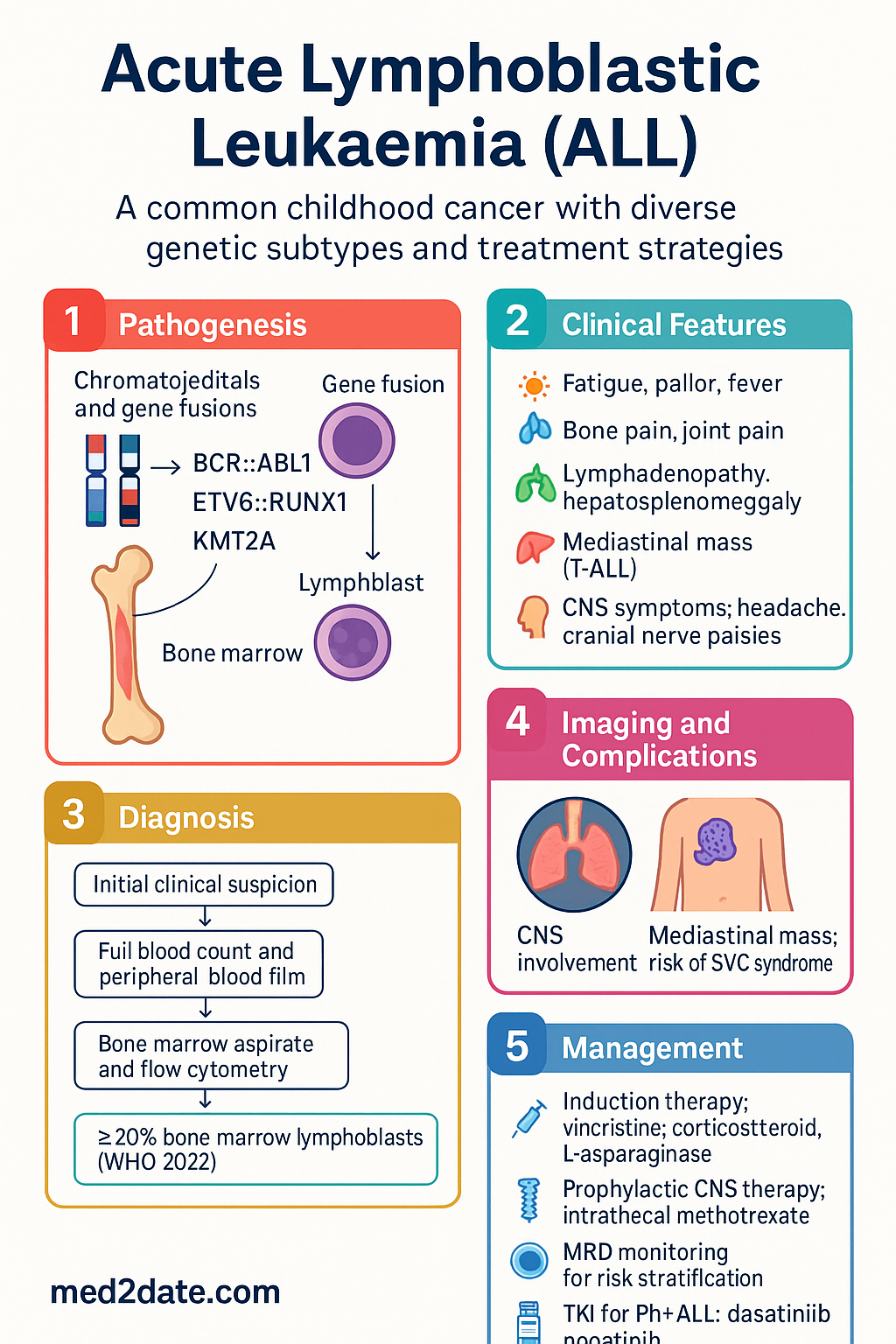
Pathogenesis & Classification (B vs T)
Pathogenesis
ALL arises from the malignant transformation of lymphoid progenitor cells (lymphoblasts) within the bone marrow. The leukaemic transformation involves sequential acquisition of genetic abnormalities — including chromosomal translocations, gene fusions, aneuploidy, and cooperating somatic mutations — that arrest normal lymphoid differentiation, confer a survival and proliferative advantage, and permit immune evasion. Most ALL-initiating lesions arise in utero, as evidenced by the detection of leukaemia-associated fusion genes (e.g., TCF3::PBX1, ETV6::RUNX1) in neonatal Guthrie spots of children who later develop ALL.
The bone-marrow microenvironment plays a critical role: lymphoblasts disrupt normal haematopoiesis, leading to cytopenias (anaemia, thrombocytopenia, neutropenia), and can infiltrate extramedullary sanctuary sites — most importantly the central nervous system (CNS) and testes — where they may be shielded from systemic chemotherapy.
WHO 2022 / ICC 2022 Classification
The current World Health Organization (WHO) 2022 and International Consensus Classification (ICC) 2022 frameworks classify ALL primarily by lineage and defining genetic lesion rather than blast percentage alone. A bone-marrow blast count of ≥20% remains the standard threshold for diagnosis, though certain genetic subtypes (e.g., BCR::ABL1 ALL) are considered acute leukaemia regardless of blast count.
B-Lymphoblastic Leukaemia/Lymphoma (B-ALL) — ~80% of paediatric, ~75% of adult ALL
| Subtype | Genetic Alteration | Frequency (Paediatric) | Prognosis |
|---|---|---|---|
| Hyperdiploid (>50 chromosomes) | Trisomies of chromosomes 4, 10, 17 (favourable); +21 | ~25–30% | Favourable |
| ETV6::RUNX1 (t(12;21)) | ETV6–RUNX1 fusion | ~20–25% | Favourable |
| BCR::ABL1 (Ph+) (t(9;22)) | BCR::ABL1 p190 (usually) | ~3% paediatric; ~25% adult | Historically poor → improved with TKI |
| KMT2A-rearranged (t(v;11q23)) | KMT2A::AFF1 (t(4;11)) most common in infant ALL | ~2% overall; ~75% of infant ALL | Unfavourable (especially infant <6 months) |
| TCF3::PBX1 (t(1;19)) | TCF3–PBX1 fusion | ~5–6% | Intermediate (with modern therapy) |
| IKZF1 deletion / iAMP21 | IKZF1del, RUNX1 amplification | ~15% (IKZF1del); ~2% (iAMP21) | Unfavourable — intensified therapy |
| Ph-like ALL | ABL-class fusions, JAK-STAT, CRLF2 rearrangements | ~10–15% | Unfavourable — TKI / JAK inhibitor trials |
| B-ALL NOS (B-other) | No recurrent defining abnormality | ~10–15% | Heterogeneous — MRD-driven |
T-Lymphoblastic Leukaemia/Lymphoma (T-ALL) — ~15% of paediatric, ~25% of adult ALL
| Subtype | Genetic Alteration | Key Features |
|---|---|---|
| Early T-cell precursor (ETP) ALL | Mutations in FLT3, NRAS/KRAS, DNMT3A, IKZF1, RUNX1, IL7R, JAK1/3, BCL11B, GATA3 | Immunophenotype: CD1a⁻, CD8⁻, CD5 weak/neg, myeloid/stem-cell markers; historically poor prognosis, improved with intensified therapy |
| Near ETP / intermediate ETP | Overlapping features | Variable prognosis |
| TAL/LMO rearranged | TAL1, TAL2, LMO1, LMO2 deletions/duplications | More common in older children/adults; intermediate prognosis |
| TLX1/TLX3 rearranged | HOXA activation | Prothymocyte stage; variable outcomes |
| NKX2-1 / HOXA activated | NUP214::ABL1, SET::NUP214 | Potential TKI sensitivity |
Immunophenotyping Markers
| Lineage | Positive Markers | Negative Markers |
|---|---|---|
| B-ALL (common) | CD19, CD79a, CD22, CD10 (cALLa), TdT, HLA-DR | sIg⁻, cIg⁻ (usually), MPO⁻, CD3⁻ |
| Pro-B ALL | CD19, CD79a, CD22, TdT, HLA-DR | CD10⁻, sIg⁻ |
| Pre-B ALL | CD19, CD10, cIgμ+, TdT | sIg⁻ |
| T-ALL | cytoplasmic CD3 (cCD3), CD7, CD5, CD2, TdT | CD19⁻, CD10⁻/weak |
| ETP-ALL | cCD3+, CD7+, CD5 weak/neg, CD1a⁻, CD8⁻, myeloid markers (CD13, CD33, CD11b, CD65), CD34 | CD1a⁻, CD8⁻ |
A lineage switch from ALL to AML (or vice versa) at relapse is rare but well described, particularly in KMT2A-rearranged disease. Repeat immunophenotyping at relapse is mandatory.
Clinical Features & CNS Involvement
Presenting Features
The clinical presentation of ALL reflects the consequences of bone-marrow failure (replacement by blasts) and extramedullary infiltration. Onset is typically subacute over weeks, although fulminant presentations with severe pancytopenia, TLS or respiratory compromise from a mediastinal mass occur.
| System | Features | Mechanism |
|---|---|---|
| General | Fatigue, pallor, lethargy, fever (with or without infection), weight loss, night sweats | Anaemia, cytokine release, marrow infiltration |
| Haematological | Anaemia, thrombocytopenia (petechiae, purpura, epistaxis, gum bleeding), neutropenia (recurrent/severe infections) | Marrow failure — blast replacement of normal haematopoiesis |
| Musculoskeletal | Bone pain (especially lower limbs, back), joint pain, refusal to walk (young children), limp | Periosteal infiltration, marrow expansion, leukaemic arthritis |
| Lymphatic | Generalised lymphadenopathy, hepatomegaly, splenomegaly | Extramedullary infiltration |
| Mediastinal (T-ALL) | Dyspnoea, orthopnoea, cough, SVC syndrome (facial/upper-limb oedthora, plethora, venous distension), stridor | Anterior mediastinal mass — present in ~60–70% of T-ALL, rare in B-ALL |
| CNS | Headache, vomiting, cranial nerve palsies (especially CN VII), visual changes, seizures, altered consciousness | Leukaemic meningitis, intracranial mass, cranial nerve infiltration |
| Testicular | Painless testicular enlargement (unilateral or bilateral) | Leukaemic infiltration — sanctuary site |
| Renal | Renal enlargement, loin pain, hypertension, acute kidney injury | Leukaemic infiltration, TLS, urate nephropathy |
CNS Involvement
The central nervous system is a major sanctuary site in ALL. CNS leukaemia is defined by the presence of lymphoblasts in the cerebrospinal fluid (CSF) and/or clinical signs of CNS infiltration.
CNS Status Classification (Children's Oncology Group)
| CNS Status | Criteria |
|---|---|
| CNS-1 | No blasts in CSF (regardless of WBC count) |
| CNS-2 | WBC <5/μL in CSF with blasts present on cytospin |
| CNS-3 | WBC ≥5/μL in CSF with blasts present — overt CNS leukaemia; OR cranial nerve palsy; OR intracranial mass on imaging |
| TLP+ | Traumatic lumbar puncture (≥10 RBC/μL) with blasts present — regarded as CNS-3 equivalent if ≥10 blasts, or CNS-2 equivalent if <10 blasts |
CNS involvement at diagnosis is present in approximately 5–10% of paediatric and ~3–5% of adult ALL. Traumatic lumbar puncture (TLP) at diagnosis — seen in ~10–15% of children — is associated with inferior outcomes, particularly when blasts are introduced into the CSF. Prophylactic intrathecal therapy (IT methotrexate ± hydrocortisone) is given at every lumbar puncture to prevent sanctuary-site relapse.
Testicular Involvement
Testicular infiltration occurs in ~2% of boys at diagnosis (more common in T-ALL and high-risk disease) and was historically a major site of relapse. With modern intensive therapy and maintenance, isolated testicular relapse is now rare. Testicular examination should be performed at every clinical review; ultrasound is indicated for any abnormality.
Investigations & Diagnosis
Initial Workup
Diagnostic Criteria Summary
- ≥20% bone-marrow lymphoblasts with a lymphoid immunophenotype (WHO 2022 threshold).
- Exceptions: BCR::ABL1, KMT2A rearrangements, hypodiploidy, iAMP21 — diagnosed as ALL regardless of blast count.
- Lineage assignment by flow cytometry: B-ALL (CD19+, CD79a+, CD22+); T-ALL (cCD3+, CD7+).
- Morphology: L1 (small, regular blasts — common in paediatric), L2 (larger, irregular — more common in adult), L3 (Burkitt — now classified separately).
Management (Induction, Consolidation, Maintenance)
Overview of Treatment Phases
ALL therapy follows a sequential, risk-stratified multi-phase approach. Australian paediatric centres participate in ANZCHOG-coordinated trials aligned with COG or BFM-style protocols. Adult centres increasingly adopt paediatric-inspired regimens (e.g., DFCI-adapted) for patients up to age 40–45 years, with modified hyper-CVAD or CALGB-type regimens for older adults.
Phase 1: Remission Induction
The induction backbone differs by age group and protocol but generally comprises:
Phase 2: Consolidation / Intensification
Post-remission therapy consists of multiple consolidation blocks, typically given as inpatient cycles over 6–12 months. The composition is risk-stratified based on MRD at end of induction, cytogenetic/molecular risk group, and CNS status.
Key Consolidation Components
Risk Stratification Driving Consolidation Intensity
Phase 3: Maintenance Therapy
Maintenance is a defining feature of ALL treatment and distinguishes it from AML therapy. Continuous low-dose oral chemotherapy sustains long-term remission.
Maintenance includes monthly vincristine IV pulses and 5-day dexamethasone pulses every 4–8 weeks (protocol-dependent). Intrathecal methotrexate continues at defined intervals (typically every 8–12 weeks) during maintenance. Total treatment duration is approximately 2–2.5 years for girls and 3 years for boys (longer in boys due to historical excess of testicular relapses with shorter maintenance).
Targeted & Immunotherapy Agents
Allogeneic Haematopoietic Stem-Cell Transplant (Allo-HSCT)
Allo-HSCT remains the most effective post-remission therapy for high-risk ALL, offering a graft-versus-leukaemia (GvL) effect that chemotherapy alone cannot replicate. Australian transplant centres (e.g., RCH Melbourne, SCH Sydney, RAH Adelaide, QCH Brisbane, PMH Perth, RHH Hobart via interstate arrangement) perform approximately 50–70 ALL-related transplants annually.
- Ph+ ALL (particularly in adults — increasingly replaced by TKI + blinatumomab chemo-free regimens, but HSCT still standard in many protocols)
- KMT2A-rearranged ALL in infants (<1 year at diagnosis)
- Hypodiploid ALL (<44 chromosomes)
- End-induction MRD ≥1% (or MRD ≥0.01% after consolidation in some protocols)
- Induction failure (M2/M3 marrow at end of induction)
- Early T-cell precursor (ETP) ALL with high MRD after consolidation
- All second or subsequent remissions
CNS-Directed Therapy — Intrathecal Protocol Summary
| Phase | IT Therapy | Frequency |
|---|---|---|
| Induction | IT methotrexate (age-based dose: <1 y: 8 mg; 1–2 y: 10 mg; 2–3 y: 12 mg; ≥3 y: 12–15 mg) + hydrocortisone 15 mg (triple IT with cytarabine in CNS-3) | Day 1 (or at diagnostic LP), Day 8, Day 15 (CNS-2/3: Day 22 also) |
| Consolidation | IT methotrexate ± hydrocortisone | Every 4–8 weeks per protocol; CNS-3: intensified schedule |
| Maintenance | IT methotrexate | Every 8–12 weeks throughout maintenance (total ~16–26 IT doses over treatment) |
| CNS-3 at diagnosis | Triple IT (MTX + Ara-C + hydrocortisone) twice weekly until clear, then intensified schedule. Cranial irradiation 12–18 Gy (after age 2–3 years) + IT therapy. | Intensified |
Relapsed / Refractory ALL
Relapse in ALL can occur in the bone marrow, CNS, testes, or extramedullary sites. Bone-marrow relapse carries the worst prognosis, particularly if occurring during maintenance or <18 months from diagnosis.
- Re-induction chemotherapy with agents not used in frontline therapy or with novel agents (blinatumomab, inotuzumab, nelarabine).
- MRD assessment after re-induction to guide transplant decision.
- Allo-HSCT in second remission for all eligible patients — the only curative option after relapse.
- CAR-T cell therapy (tisagenlecleucel / brexucabtagene) — available through clinical trials and compassionate-access programmes at select Australian centres (Peter Mac, Westmead, RCH). PBS listing pending.
- Consider palliative care referral for patients not transplant-eligible with multiply-relapsed disease.
Monitoring
During Active Treatment
| Parameter | Frequency | Purpose |
|---|---|---|
| FBC with differential | Before each phase; weekly during maintenance (more often if myelosuppressive blocks) | Dose adjustment of 6-MP/MTX; infection risk; engraftment post-HSCT |
| MRD (flow cytometry / qPCR) | End of induction (Day 28–35); end of consolidation block 1; pre-transplant; any clinical concern | Risk stratification; early relapse detection; transplant decision |
| Serum asparaginase activity (ASAL) | 7 and 14 days after each PEG-asparaginase dose | Detect silent inactivation; ensure therapeutic levels (≥0.1 IU/mL) |
| LFTs, amylase, lipase | Before each PEG-asp dose; weekly during consolidation blocks | L-asparaginase hepatotoxicity and pancreatitis detection |
| Coagulation (fibrinogen, ATIII, PT/APTT) | Before each asparaginase dose; clinical suspicion of thrombosis | Thrombosis prophylaxis — cryoprecipitate for hypofibrinogenemia; ATIII concentrate if <60% |
| Serum methotrexate levels | 24, 42, 48 h post-start of HD-MTX infusion | Guide leucovorin rescue; detect delayed clearance (renal dose adjustment) |
| Echocardiogram / MUGA | Baseline; after cumulative anthracycline 150–200 mg/m²; annually if post-HSCT | Anthracycline cardiotoxicity surveillance — LVEF <50% requires cardiology review and possible anthracycline modification |
| TPMT / NUDT15 genotype | Before first 6-MP dose | Pharmacogenomics — dose reduction or alternative for poor metabolisers |
| Lumbar puncture / CNS imaging | Each IT therapy timepoint; new neurological symptoms | CNS status reassessment; early detection of CNS relapse |
| Infectious monitoring (blood cultures, CMV/EBV PCR post-HSCT) | As clinically indicated; post-HSCT: weekly viral PCRs | Febrile neutropenia management; post-HSCT viral reactivation |
Long-Term / Survivorship Follow-Up
ALL survivors require lifelong surveillance for late effects of treatment. Australian follow-up guidelines (adapted from COG LTFU and ANZCHOG recommendations) include:
- Cardiac function: echocardiogram every 1–5 years depending on cumulative anthracycline dose (lifelong if >250 mg/m²).
- Endocrine: thyroid function (especially post-cranial irradiation), growth hormone monitoring in paediatric patients, pubertal assessment.
- Neurocognitive: formal neuropsychological testing after CNS-directed therapy (IT chemotherapy, cranial irradiation), especially if learning difficulties emerge at school.
- Fertility: pre-treatment counselling for all post-pubertal patients; sperm/ovarian tissue cryopreservation where appropriate; gonadotropin monitoring post-therapy.
- Secondary malignancy: radiation-related solid tumours (thyroid, brain, breast — especially in childhood irradiation survivors); alkylator-related MDS/AML.
- Psychosocial: mental health screening, survivorship care plan, education/vocational support, transition from paediatric to adult services.
Special Populations
Aboriginal and Torres Strait Islander Health Considerations
Aboriginal and Torres Strait Islander children experience an equal or higher incidence of ALL compared with non-Indigenous Australian children, yet registry data consistently demonstrate significantly worse event-free and overall survival. These disparities are multifactorial and require targeted, culturally safe interventions at every stage of the patient journey.
📚 References
- 1. Hunger SP, Mullighan CG. Acute lymphoblastic leukemia in children. N Engl J Med. 2015;373(16):1541-1552. doi:10.1056/NEJMra1400972
- 2. Inaba H, Greaves M, Mullighan CG. Acute lymphoblastic leukaemia. Lancet. 2013;381(9881):1943-1955. doi:10.1016/S0140-6736(12)62187-4
- 3. Alaggio R, Amador C, Anagnostopoulos I, et al. The 5th edition of the World Health Organization classification of haematolymphoid tumours: lymphoid neoplasms. Leukemia. 2022;36(7):1720-1748. doi:10.1038/s41375-022-01620-2
- 4. Roberts KG, Li Y, Payne-Turner D, et al. Targetable kinase-activating lesions in Ph-like acute lymphoblastic leukemia. N Engl J Med. 2014;371(11):1005-1015. doi:10.1056/NEJMoa1403088
- 5. Jeha S, Pei D, Choi J, et al. Improved CNS control of childhood acute lymphoblastic leukemia without cranial irradiation: St Jude Total Therapy Study 16. J Clin Oncol. 2019;37(35):3377-3391. doi:10.1200/JCO.19.01692
- 6. Vora A, Andreano A, Pui CH, et al. Influence of cranial radiotherapy on outcome in children with acute lymphoblastic leukemia treated with contemporary therapy. J Clin Oncol. 2016;34(9):919-926. doi:10.1200/JCO.2015.64.7229
- 7. Stock W, Luger SM, Advani AS, et al. A pediatric regimen for older adolescents and young adults with acute lymphoblastic leukemia: results of CALGB 10403. Blood. 2019;133(14):1548-1559. doi:10.1182/blood-2018-10-881961
- 8. Rijneveld AW, van der Holt B, Daenen SMGJ, et al. Intensified chemotherapy inspired by a pediatric regimen combined with allogeneic transplantation in adult patients with acute lymphoblastic leukemia up to the age of 40. Leukemia. 2011;25(11):1697-1703. doi:10.1038/leu.2011.142
- 9. Foà R, Bassan R, Vitale A, et al. Dasatinib-blinatumomab for Ph-positive acute lymphoblastic leukemia in adults. N Engl J Med. 2020;383(17):1613-1623. doi:10.1056/NEJMoa2016272
- 10. Kantarjian H, Stein A, Gökbuget N, et al. Blinatumomab versus chemotherapy for advanced acute lymphoblastic leukemia. N Engl J Med. 2017;376(9):836-847. doi:10.1056/NEJMoa1609783
- 11. Kantarjian HM, DeAngelo DJ, Stelljes M, et al. Inotuzumab ozogamicin versus standard therapy for acute lymphoblastic leukemia. N Engl J Med. 2016;375(8):740-753. doi:10.1056/NEJMoa1509277
- 12. Australian Institute of Health and Welfare. Cancer data in Australia. Canberra: AIHW; 2024. Available from: https://www.aihw.gov.au/reports/cancer/cancer-data-in-australia
- 13. Australian Institute of Health and Welfare. Aboriginal and Torres Strait Islander health performance framework 2020 — summary report. Canberra: AIHW; 2020.
- 14. Cancer Australia. Optimal care pathway for Aboriginal and Torres Strait Islander people with cancer. Surry Hills, NSW: Cancer Australia; 2022.
- 15. Royal Australasian College of Physicians (RACP). Paediatric haematology/oncology training curriculum. Sydney: RACP; 2023.
- 16. Australian Commission on Safety and Quality in Health Care (ACSQHC). National Safety and Quality Health Service Standards. 2nd ed. Sydney: ACSQHC; 2021.