📋 Key Information Summary
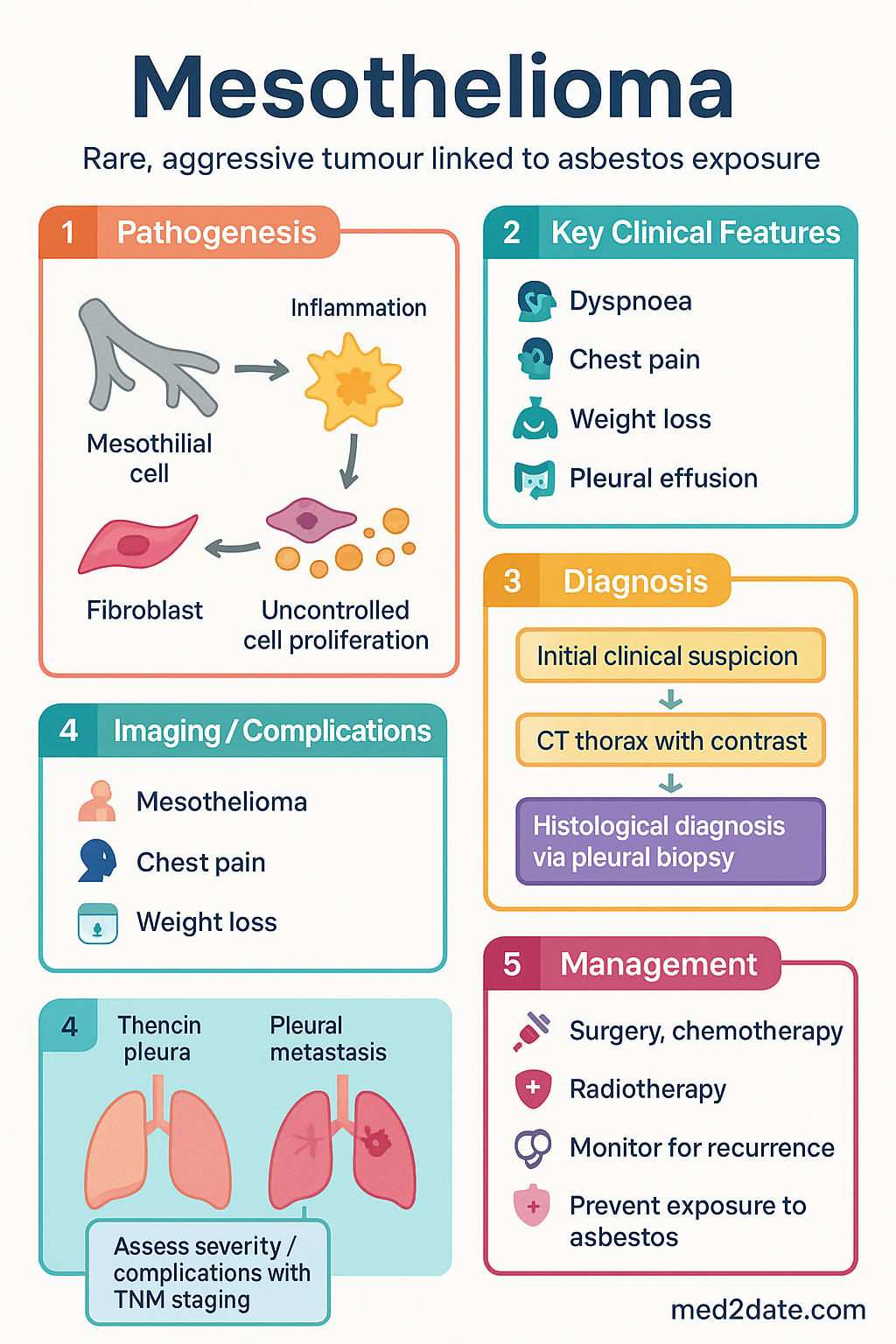
- Malignant mesothelioma is a rare, aggressive tumour arising from mesothelial surfaces; pleural mesothelioma accounts for approximately 90% of cases
- Australia has one of the highest per-capita incidences globally due to extensive historical asbestos mining and industrial use, with peak diagnoses expected to continue into the late 2020s
- Virtually all cases are linked to asbestos exposure (crocidolite > amosite > chrysotile); latency period is typically 20–50 years, and no level of exposure is considered safe
- Three histological subtypes — epithelioid (best prognosis), sarcomatoid (worst), and biphasic (mixed) — direct treatment approach and prognosis
- Common presenting features include unilateral pleural effusion, progressive dyspnoea, and dull chest pain; constitutional symptoms (fatigue, weight loss, night sweats) are late
- CT thorax with contrast is the primary imaging modality; PET-CT assists staging and detects extrathoracic disease
- Histological diagnosis requires adequate tissue (pleural biopsy preferred); immunohistochemistry (calretinin, WT-1, CK5/6 positive; TTF-1, CEA negative) differentiates from adenocarcinoma
- The TNM-based IMIG staging system guides treatment; resectable disease (Stage I–III epithelioid) is managed with intention-to-cure via multimodal therapy
- First-line systemic therapy: platinum-based doublet (cisplatin + pemetrexed) ± bevacizumab; immunotherapy (nivolumab + ipilimumab) is PBS-listed for unresectable disease
- Surgical options include extrapleural pneumonectomy (EPP) and pleurectomy/decortication (P/D); P/D is increasingly preferred due to lower perioperative mortality
- Early palliative care integration is essential; talc pleurodesis or indwelling pleural catheter manage recurrent effusions
- Aboriginal and Torres Strait Islander communities may face delayed diagnosis due to limited specialist access in remote regions; culturally safe pathways and state compensation schemes require awareness
- All Australian states operate asbestos-related disease compensation schemes (dust disease authorities); clinicians have a legal duty to notify
Introduction & Australian Epidemiology
Malignant mesothelioma is a rare but devastating malignancy arising from the mesothelial lining of the pleura, peritoneum, pericardium, or tunica vaginalis. Pleural mesothelioma accounts for approximately 90% of all cases and is the focus of this guideline. The disease is characterised by aggressive local invasion, rapid progression, and a historically poor prognosis, with median overall survival ranging from 12 to 21 months depending on histological subtype and stage.
Australia holds the unenviable distinction of having one of the highest per-capita rates of malignant mesothelioma in the world. This is directly attributable to the extensive use and mining of asbestos — particularly crocidolite (blue asbestos) — throughout the 20th century. The Wittenoom mine in Western Australia was the largest crocidolite mine in the Southern Hemisphere and its legacy continues to drive new diagnoses. National incidence peaked around 700–800 cases per year in the late 2010s and has remained elevated; the Australian Mesothelioma Registry (AMR) recorded 699 new cases in 2022. Forecasts suggest a gradual decline through the late 2020s, though cases linked to home renovation and building-demolition exposure continue to emerge.
Key Australian epidemiological features include:
- Male predominance (approximately 85%), reflecting historical occupational patterns
- Median age at diagnosis: 72–75 years
- Latency period: typically 20–50 years from first exposure
- Emerging cohort of younger patients (40–60 years) exposed during home renovations of pre-1990 dwellings
- All states and territories have mandatory notification to their respective dust disease authorities
Epidemiology & Asbestos Exposure
Asbestos fibre types and risk
| Fibre Type | Colour | Relative Risk | Australian Context |
|---|---|---|---|
| Crocidolite | Blue | Highest — approximately 500× general population | Mined at Wittenoom, WA (1937–1966); widely used in cement products and insulation |
| Amosite | Brown | Very high | Imported for thermal insulation and fireproofing |
| Chrysotile | White | Lower but significant | Most commonly used type; found in cement sheeting, brake pads, gaskets |
Exposure pathways
- Occupational: Mining, milling, construction, shipbuilding, boiler-making, lagging, railway carriage repair, automotive brake maintenance
- Para-occupational: Household contacts laundering work clothes; children playing near worksites
- Environmental: Residents near mine sites (Wittenoom), naturally occurring asbestos deposits, disturbance of asbestos-containing materials during renovation or demolition
- Recreational: DIY home renovation of pre-1990 properties — a growing exposure cohort in Australia
Other risk factors
- Erionite: A fibrous zeolite mineral with mesotheliomagenic properties; rare in Australia
- Germline BAP1 mutations: Carriers have a significantly elevated lifetime risk of mesothelioma, uveal melanoma, and renal cell carcinoma; present in 1–5% of sporadic cases
- Simian virus 40 (SV40): Detected in some mesothelioma specimens; aetiological role remains debated
- Therapeutic radiation: Historical mantle-field radiotherapy for Hodgkin lymphoma is an established risk factor
Compensation & notification
In Australia, malignant mesothelioma is a notifiable dust disease. Each state and territory operates a Dust Diseases Board or Authority responsible for assessing and providing compensation. Clinicians diagnosing mesothelioma should:
- Refer the patient to the relevant state dust diseases authority (e.g., icare Dust Diseases Authority NSW, WorkSafe Victoria, Queensland DDT)
- Complete a Dust Disease Notification Form
- Advise the patient to seek legal advice regarding potential common-law claims in addition to statutory benefits
Pathology & Clinical Features
Histological classification
Immunohistochemistry panel
Accurate differentiation from metastatic adenocarcinoma or primary lung adenocarcinoma requires a standardised IHC panel:
| Marker | Mesothelioma | Adenocarcinoma |
|---|---|---|
| Calretinin | Positive (nuclear + cytoplasmic) | Negative / focal |
| WT-1 | Positive (nuclear) | Negative |
| CK5/6 | Positive | Negative / focal |
| D2-40 (podoplanin) | Positive (membranous) | Negative |
| TTF-1 | Negative | Positive (75–85%) |
| CEA | Negative | Positive |
| Ber-EP4 (EpCAM) | Negative / weak | Positive |
Clinical presentation
- Pleural effusion: Most common initial finding — typically unilateral, exudative, and often haemorrhagic
- Progressive dyspnoea: Due to effusion, pleural thickening, or restrictive physiology
- Chest wall pain: Dull, constant, often localised to the site of tumour; may indicate chest wall invasion
- Fatigue & weight loss: Constitutional symptoms in advanced disease
- Finger clubbing: Present in ~30% of cases at diagnosis
- Contralateral or peritoneal spread: Late manifestation; peritoneal mesothelioma presents with ascites and abdominal distension
Investigations & Staging
Baseline investigations
Staging — IMIG/AJCC 8th Edition TNM
| Stage | TNM | Description | Treatment Approach |
|---|---|---|---|
| IA | T1a N0 M0 | Tumour limited to ipsilateral parietal pleura | Surgery ± adjuvant therapy |
| IB | T1b N0 M0 | Tumour on ipsilateral visceral pleura | Surgery ± adjuvant therapy |
| II | T2 N0 M0 | Confluent visceral pleural tumour, involvement of diaphragmatic muscle, or lung parenchymal invasion | Multimodal — neoadjuvant chemo then surgery |
| IIIA | T3 N0 M0 | Solitary focus of chest wall invasion, mediastinal fat, non-transmural pericardial involvement | Multimodal if operable; chemo if borderline |
| IIIB | T1–3 N1–2 M0 or T4 Any N M0 | Nodal disease or extensive local invasion (chest wall, transdiaphragmatic, contralateral pleura) | Systemic therapy (chemo ± immunotherapy) |
| IV | Any T Any N M1 | Distant metastases (contralateral lung, peritoneum, bone, liver) | Systemic therapy; palliative care |
Management (Chemotherapy, Surgery & Palliative)
Systemic therapy — First-line
Immunotherapy — Unresectable disease
Second-line and subsequent therapy
- Vinorelbine: 60 mg/m² PO weekly (or 25 mg/m² IV weekly) — modest activity; PBS-listed. Consider when progression after platinum/pemetrexed and immunotherapy
- Gemcitabine: 1000 mg/m² IV on Days 1, 8, 15 every 28 days — alternative second-line option
- Re-challenge with pemetrexed: If PFS >6 months after first-line pemetrexed, re-challenge may be considered
- Clinical trials: Patients should be referred for clinical trial consideration at every treatment decision point. Australian sites for mesothelioma trials include Peter MacCallum Cancer Centre, Chris O'Brien Lifehouse, and Linear Clinical Research
Surgical management
Surgery is a key component of multimodal treatment for patients with resectable disease (Stage I–III epithelioid). Decisions must be made in a specialist MDT and at a centre with high-volume mesothelioma surgical expertise.
- Removal of visceral and parietal pleura with preservation of the lung
- Lower perioperative mortality (1–4%) vs EPP
- Better post-operative quality of life and pulmonary function
- Increasingly preferred approach at major Australian centres
- Indicated: epithelioid histology, adequate PFTs (FEV₁ >60%, DLCO >50%), ECOG 0–1
- En bloc removal of lung, pleura, ipsilateral diaphragm, and pericardium
- Higher perioperative mortality (5–10%)
- Reserved for highly selected patients at expert centres
- Requires reconstruction of diaphragm and pericardium with synthetic mesh
- The MARS trial (2011) did not show a survival benefit for EPP over non-surgical management
Radiotherapy
- Prophylactic irradiation to intervention tracts (PIT): Historically used to prevent port-site metastases after VATS. The SMART and PIT-PRO trials showed no clear benefit; practice is declining in Australia
- Hemithoracic adjuvant radiotherapy: IMRT after EPP may reduce local recurrence; limited evidence for adjuvant RT after P/D
- Palliative radiotherapy: Effective for chest wall pain, superior vena cava obstruction, or painful bone metastases. Typical regimen: 20 Gy in 5 fractions or 30 Gy in 10 fractions
Pleural effusion management
Multimodal treatment pathways
Special Populations
Monitoring & Follow-up
During active treatment
| Assessment | Frequency | Details |
|---|---|---|
| CT thorax + abdomen | Every 2–3 cycles (q6–9 weeks) | RECIST or modified RECIST for mesothelioma (measurement at level of diaphragm) |
| Bloods: FBC, LFTs, renal function | Before each cycle | Dose adjustments per protocol; watch for nephrotoxicity (cisplatin), hepatotoxicity (immunotherapy) |
| TFTs | Every cycle (immunotherapy) | Thyroiditis/hypothyroidism in 10–20% on nivolumab/ipilimumab |
| Symptom assessment (ECOG) | Every visit | Dyspnoea, pain, cough, weight, appetite |
| SMRP (if elevated at baseline) | Every 2 cycles | Rising levels may indicate progression before radiological change |
Post-treatment surveillance
- Clinical review every 6–8 weeks for 2 years, then every 3 months
- CT thorax + abdomen every 3–4 months for 2 years, then every 6 months
- Assess quality of life at each visit using validated tools (EORTC QLQ-C30 + LC13)
- Ongoing palliative care and psychosocial support
Aboriginal and Torres Strait Islander Health Considerations
While mesothelioma incidence data specific to Aboriginal and Torres Strait Islander peoples are limited, several barriers to care are well recognised and must be actively addressed:
📚 References
- 1. Baas P, Fennell D, Kerr KM, et al. Malignant pleural mesothelioma: ESMO Clinical Practice Guidelines for diagnosis, treatment and follow-up. Ann Oncol. 2015;26(suppl 5):v31–v39.
- 2. Kindler HL, Ismaila N, Armato SG 3rd, et al. Treatment of Malignant Pleural Mesothelioma: American Society of Clinical Oncology Clinical Practice Guideline. J Clin Oncol. 2018;36(13):1343–1373.
- 3. Zalcman G, Mazieres J, Margery J, et al. Bevacizumab for newly diagnosed pleural mesothelioma in the Mesothelioma Avastin Cisplatin Pemetrexed Study (MAPS): a randomised, controlled, open-label, phase 3 trial. Lancet. 2016;387(10026):1405–1414.
- 4. Baas P, Scherpereel A, Nowak AK, et al. First-line nivolumab plus ipilimumab in unresectable malignant pleural mesothelioma (CheckMate 743): a multicentre, randomised, open-label, phase 3 trial. Lancet. 2021;397(10272):375–386.
- 5. Treasure T, Lang-Lazdunski L, Waller D, et al. Extra-pleural pneumonectomy versus no extra-pleural pneumonectomy for patients with malignant pleural mesothelioma: clinical outcomes of the Mesothelioma and Radical Surgery (MARS) randomised feasibility study. Lancet Oncol. 2011;12(8):763–772.
- 6. Australian Institute of Health and Welfare (AIHW). Mesothelioma in Australia 2023. Canberra: AIHW; 2023. Available from: www.aihw.gov.au.
- 7. Muscat JE, Wynder EL. Cigarette smoking, asbestos exposure, and malignant mesothelioma. Cancer Res. 1991;51(9):2263–2267.
- 8. Rusch VW, Giroux D, Kennedy C, et al. Initial analysis of the International Association for the Study of Lung Cancer Mesothelioma Database. J Thorac Oncol. 2012;7(11):1631–1639.
- 9. Yap TA, Aerts JG, Popat S, Fennell DA. Novel insights into mesothelioma biology and implications for therapy. Nat Rev Cancer. 2017;17(8):475–488.
- 10. Cancer Council Australia. Clinical Practice Guidelines for the Management of Mesothelioma. Sydney: Cancer Council Australia; 2022. Available from: wiki.cancer.org.au.
- 11. Woolhouse I, Bishop L, Darlison L, et al. British Thoracic Society Guideline for the investigation and management of malignant pleural mesothelioma. Thorax. 2018;73(suppl 1):i1–i30.
- 12. National Health and Medical Research Council (NHMRC). Asbestos: Information on Australia's ban and management. Canberra: NHMRC; 2021. Available from: www.nhmrc.gov.au.