📋 Key Information Summary
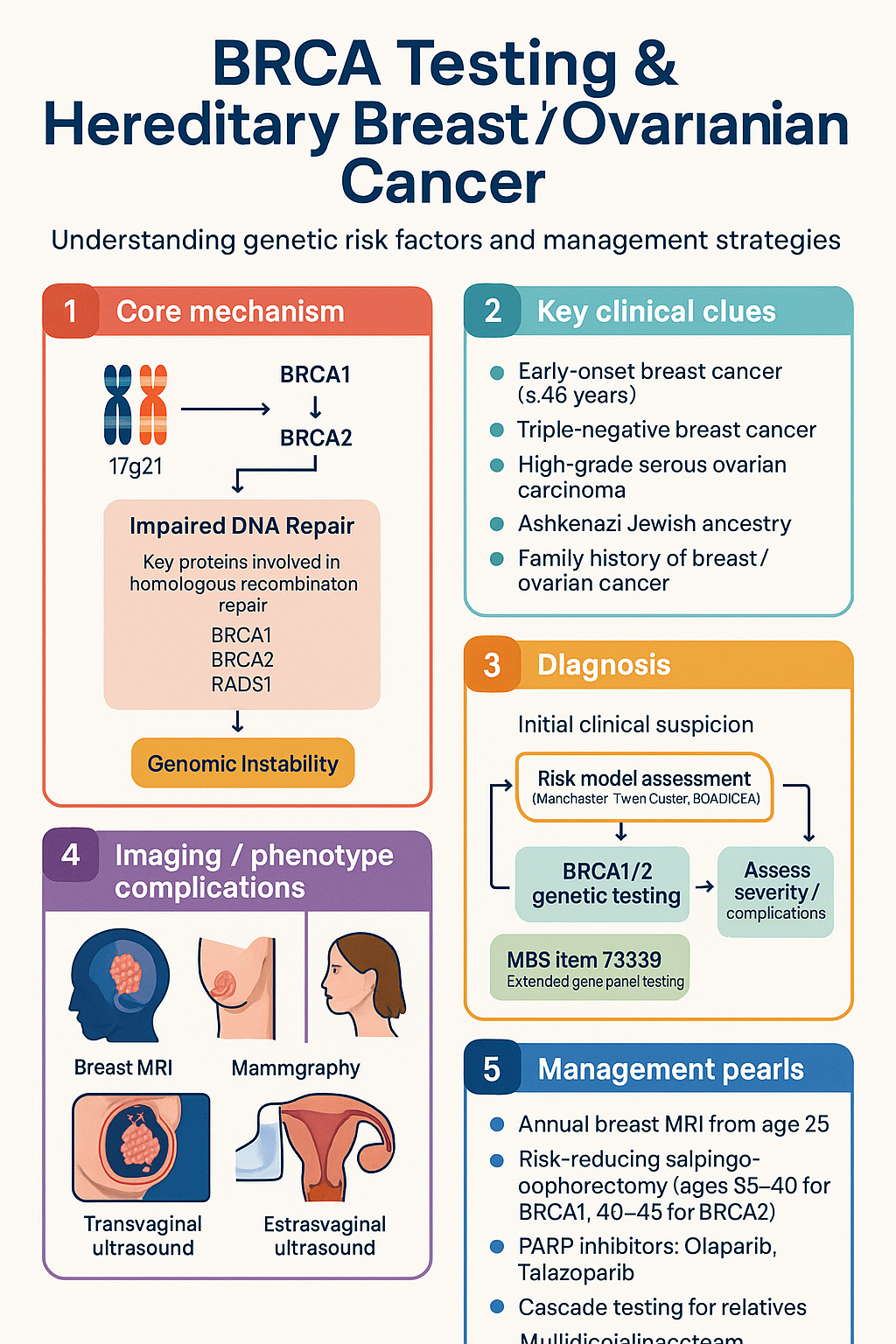
- Pathogenic variants in BRCA1 and BRCA2 are the most significant hereditary risk factors for breast and ovarian cancer, conferring cumulative lifetime risks of 60–72% (breast) and 11–44% (ovarian) by age 80.
- BRCA1 mutations predispose to triple-negative breast cancer (TNBC) and high-grade serous ovarian carcinoma (HGSOC) with earlier onset, while BRCA2 mutations carry a higher lifetime risk of breast cancer but later onset and more oestrogen-receptor–positive tumours.
- Testing is indicated for individuals with ≥10% prior probability of carrying a pathogenic BRCA variant using validated risk models (Manchester, Tyrer-Cuzick, BOADICEA), or who meet MBS criteria for Medicare-funded testing.
- MBS item 73339 (extended gene panel testing) is available without charge for eligible patients meeting clinical criteria; pre- and post-test genetic counselling is mandatory.
- Enhanced surveillance for BRCA carriers includes annual breast MRI from age 25–30 alternating with mammography from age 30–35, and 6-monthly transvaginal ultrasound and CA-125 from age 35.
- Risk-reducing bilateral salpingo-oophorectomy (RR-BSO) reduces ovarian cancer mortality by ~80% and is recommended between ages 35–40 (BRCA1) and 40–45 (BRCA2); risk-reducing bilateral mastectomy (RRM) reduces breast cancer risk by >90%.
- Olaparib (Lynparza®) and talazoparib (Talzenna®) are PBS-listed PARP inhibitors for germline BRCA-mutated HER2-negative metastatic breast cancer and maintenance therapy in platinum-sensitive recurrent ovarian cancer.
- Cascade testing of first- and second-degree relatives is the most cost-effective public health strategy; a positive index result should prompt referral of relatives to a clinical genetics service.
- BRCA mutations also confer elevated risk of prostate cancer (BRCA2: 2–6×) and pancreatic cancer; male carriers should be considered for enhanced prostate-specific antigen (PSA) screening from age 40.
- Aboriginal and Torres Strait Islander peoples have lower access to genetic services and cascade testing; culturally safe pathways and remote telehealth genetic counselling should be prioritised.
- All management decisions in BRCA carriers should be made within a multidisciplinary team (MDT) including medical oncology, surgical oncology, gynaecology, clinical genetics, psychology, and genetic counselling.
- Psychological support and informed consent are critical — irreversible decisions such as prophylactic surgery require careful discussion of benefits, harms, body image, fertility, and menopausal implications.
Introduction & Australian Epidemiology
Pathogenic variants in the BRCA1 (chromosome 17q21) and BRCA2 (chromosome 13q12.3) tumour suppressor genes are the most clinically significant inherited predispositions to breast and ovarian cancer. These genes encode proteins essential for homologous recombination repair of double-strand DNA breaks; their inactivation leads to genomic instability and oncogenesis — a phenotype exploited therapeutically by PARP inhibitors.
In Australia, approximately 1 in 300–400 individuals carry a pathogenic BRCA1 or BRCA2 variant, with higher carrier frequencies in certain founder populations. The Australian Institute of Health and Welfare (AIHW) estimates that hereditary breast and ovarian cancer syndrome (HBOC) accounts for 5–10% of all breast cancers and 15–20% of epithelial ovarian cancers diagnosed nationally each year.
The landscape of BRCA testing in Australia has changed markedly since the introduction of Medicare-funded panel-based germline testing (MBS item 73339) in November 2020, removing the previous financial barrier of approximately AUD ,000–,800 per test. This has led to a significant increase in testing rates, earlier identification of carriers, and expanded access to risk-reducing interventions and targeted therapies including olaparib and talazoparib on the Pharmaceutical Benefits Scheme (PBS).
This guideline provides a comprehensive overview of BRCA1/2 testing, cancer risk estimation, evidence-based surveillance protocols, risk-reducing surgical strategies, and the role of PARP inhibitor therapy in the Australian clinical context.
BRCA1 vs BRCA2 Differences
Although both BRCA1 and BRCA2 encode tumour suppressor proteins involved in homologous recombination DNA repair, the two genes differ in their chromosomal location, protein structure, associated cancer spectra, and phenotypic expression. Understanding these differences is essential for risk stratification, screening scheduling, and surgical timing.
| Feature | BRCA1 | BRCA2 |
|---|---|---|
| Chromosomal location | 17q21 | 13q12.3 |
| Protein function | RING domain (E3 ubiquitin ligase activity); HR repair; cell-cycle checkpoint | Binds RAD51; HR repair; stabilises stalled replication forks |
| Breast cancer lifetime risk (to age 80) | 72% (95% CI 65–79%) | 69% (95% CI 61–77%) |
| Ovarian cancer lifetime risk (to age 80) | 44% (95% CI 36–53%) | 17% (95% CI 11–25%) |
| Peak breast cancer incidence age | 40–49 years | 50–59 years |
| Breast cancer histology | Predominantly triple-negative (basal-like, ER−/PR−/HER2−); high grade | More oestrogen-receptor positive (ER+); mixed histology including lobular |
| Ovarian cancer histology | High-grade serous carcinoma (HGSOC); may arise from fallopian tube | High-grade serous; also mucinous and low-grade subtypes |
| Contralateral breast cancer (20-year risk) | 40–62% | 26–52% |
| Male breast cancer risk | ~1–2% | 6–8% |
| Prostate cancer risk | Slightly elevated (~2×) | Significantly elevated (2–6×); aggressive disease |
| Pancreatic cancer risk | Minimal increased risk | 2–4× increased risk (cumulative ~5–7%) |
| Melanoma | No established association | Possible modest increase |
| Recommended RRSO age | 35–40 years | 40–45 years |
| PARP inhibitor sensitivity | High (synthetic lethality) | High (synthetic lethality) |
Penetrance Modifiers
The penetrance of BRCA1/2 mutations is not uniform. Known modifiers include:
- Family history: Individuals from families with multiple early-onset breast cancers have higher estimated penetrance than those from families with fewer affected members.
- Specific variant location: Variants clustered in the Ovarian Cancer Cluster Region (OCCR) of BRCA2 (exon 11, codons 3059–6629) confer a higher ovarian-to-breast cancer ratio.
- Polygenic risk scores: Common low-penetrance alleles (e.g., SNPs identified through genome-wide association studies) can modify BRCA-associated risk 2–3 fold in either direction.
- Reproductive factors: Parity, oral contraceptive use, and oophorectomy history modify penetrance (oral contraceptives reduce ovarian cancer risk but may modestly increase breast cancer risk in carriers).
Indications for Testing
BRCA1/2 testing should be offered to individuals who have a ≥10% prior probability of carrying a pathogenic germline variant, or who meet the Medicare Benefits Schedule (MBS) eligibility criteria for funded testing. Testing should always be performed in the context of pre-test genetic counselling provided by an accredited genetic counsellor or clinical geneticist.
MBS Eligibility Criteria (Item 73339)
Medicare-funded extended gene panel testing (including BRCA1, BRCA2, and other hereditary cancer genes) is available for patients who meet any of the following criteria:
- Personal history of breast cancer diagnosed at age ≤45 years
- Personal history of breast cancer diagnosed at age ≤50 with additional features (bilateral, triple-negative, Ashkenazi Jewish ancestry, male breast cancer, or two or more first/second-degree relatives with breast or ovarian cancer)
- Personal history of high-grade serous/fallopian tube/peritoneal carcinoma at any age
- Personal history of triple-negative breast cancer diagnosed at age ≤60
- Personal history of male breast cancer at any age
- A first- or second-degree relative with a known pathogenic variant in a high-risk gene
- Two or more first- or second-degree relatives on the same side of the family with breast cancer (at least one diagnosed ≤50) or ovarian cancer at any age
- Ashkenazi Jewish ancestry with any personal or family history of breast or ovarian cancer
- Personal history of pancreatic cancer with a family history of breast, ovarian, or pancreatic cancer
Risk Assessment Models
Several validated models can estimate the prior probability of carrying a BRCA mutation and guide referral for testing:
| Model | Inputs | Strengths | Limitations |
|---|---|---|---|
| Manchester Scoring System | Cancer types, ages at diagnosis, family structure | Simple to use; good discrimination; widely used in Australia | May underestimate risk in small families |
| Tyrer-Cuzick (IBIS) v8 | Family history, hormonal factors, BMI, breast density, benign breast disease | Comprehensive; includes non-genetic risk factors; integrates with MRI screening decisions | Complex; requires detailed data |
| BOADICEA v5 | Family history, polygenic risk score, tumour pathology (ER/PR/HER2) | Incorporates polygenic risk; gene-specific estimates; well-validated | Requires specialist software (CanRisk) |
| BRCAPRO | Bayesian model using family pedigree data | Strong statistical basis; well-calibrated | Sensitive to incomplete family data |
Testing Process
BRCA testing in Australia follows a structured pathway:
- Referral: GP or specialist refers to an accredited clinical genetics service or familial cancer centre (FCC).
- Pre-test counselling: Genetic counsellor assesses family history, discusses implications of testing (psychological, insurance, familial), and obtains informed consent.
- Sample collection: Peripheral blood or saliva sample sent to an accredited laboratory (e.g., Peter MacCallum Cancer Centre, Melbourne Genomics, Genetic Health Queensland).
- Result and post-test counselling: Typically 2–4 weeks. A positive result triggers discussion of risk management, cascade testing of relatives, and referral to relevant MDTs.
- Variant reclassification: Variants of uncertain significance (VUS) are not clinically actionable; families are recalled if a VUS is reclassified to pathogenic or likely pathogenic.
Cancer Risks & Screening Protocols
BRCA1 and BRCA2 carriers face substantially elevated lifetime risks of breast, ovarian, fallopian tube, peritoneal, and other cancers. Risk-estimation, adapted surveillance, and early detection are central pillars of management.
Cumulative Cancer Risks by Age 80
| Cancer Site | BRCA1 Lifetime Risk | BRCA2 Lifetime Risk | General Population |
|---|---|---|---|
| Female breast cancer | 65–72% | 61–69% | ~12.5% |
| Contralateral breast cancer (20-yr post-dx) | 40–62% | 26–52% | ~5–10% |
| Ovarian/fallopian tube/peritoneal | 39–44% | 11–17% | ~1.2% |
| Male breast cancer | 1–2% | 6–8% | 0.1% |
| Prostate cancer | Slightly elevated | 20–30% (aggressive) | ~12% lifetime |
| Pancreatic cancer | 1–2% | 5–7% | ~1.5% |
Breast Cancer Screening — BRCA1/2 Carriers
Standard population mammographic screening (BreastScreen Australia, biennial from age 50) is insufficient for BRCA carriers. Enhanced protocols are recommended by Cancer Australia and the Royal Australian College of Radiologists (RACR):
Monthly self-examination; clinical breast examination (CBE) every 6–12 months by a healthcare provider. MRI not routinely recommended before age 25 unless a family member was diagnosed under 25.
Ovarian Cancer Screening — BRCA1/2 Carriers
No screening modality has been proven to reduce ovarian cancer mortality. Nonetheless, surveillance is offered to carriers who decline or defer risk-reducing salpingo-oophorectomy:
- Transvaginal ultrasound (TVUS): Every 6–12 months from age 30–35 (BRCA1) or 35–40 (BRCA2). Sensitivity for early-stage disease remains limited.
- Serum CA-125: Every 6 months in conjunction with TVUS. Reference change value (RCV) methodology improves sensitivity over absolute thresholds. Elevated levels warrant urgent gynaecological-oncology referral.
- Risk of Ovarian Cancer Algorithm (ROCA): Uses serial CA-125 measurements to detect trends; not widely available in routine Australian practice but has been studied in the UK UKFOCSS and GOG-0199 trials.
Other Cancer Screening
- Prostate cancer (male BRCA2 carriers): PSA-based screening from age 40, every 1–2 years; consider MRI prostate for elevated PSA. Refer Cancer Council Australia and Prostate Cancer Foundation of Australia guidelines.
- Pancreatic cancer (BRCA2): No established screening protocol in Australia; consider endoscopic ultrasound (EUS) and/or MRI/MRCP annually from age 50 if combined with a family history of pancreatic cancer (refer to international CAPS consortium criteria).
- Skin cancer: Standard Australian surveillance (regular skin checks) — BRCA2 carriers may have modestly increased melanoma risk.
Risk-Reducing Interventions (Surgery & PARP Inhibitors)
Risk-reducing surgery and targeted pharmacological therapy form the cornerstone of cancer prevention and treatment in BRCA1/2 carriers. All decisions should be individualised within a multidisciplinary team framework, incorporating patient preference, reproductive plans, menopausal status, and psychological readiness.
Risk-Reducing Bilateral Salpingo-Oophorectomy (RR-BSO)
| Parameter | BRCA1 | BRCA2 |
|---|---|---|
| Recommended age for RR-BSO | 35–40 years | 40–45 years |
| Surgical approach | Laparoscopic (preferred); complete removal of ovaries, fallopian tubes, and fimbriae; thorough peritoneal washings for cytology | |
| Pathological assessment | SEE-FIM protocol (Sectioning and Extensively Examining the Fimbriated end) — serial sectioning of fimbriae at 2 mm intervals to detect occult serous tubal intraepithelial carcinoma (STIC) | |
| Breast cancer risk reduction | ~50% reduction in premenopausal carriers | ~50% reduction in premenopausal carriers |
| Residual peritoneal cancer risk | ~1–4% lifetime (primary peritoneal carcinoma) | ~1–4% lifetime |
| Consequences | Immediate surgical menopause; increased cardiovascular, bone, and cognitive risk; vasomotor symptoms. Discuss HRT (oestrogen-only if hysterectomy performed; combined if uterus retained) — generally considered safe for short-term use if no breast cancer history. | |
Opportunistic Salpingectomy (OS) with Delayed Oophorectomy
Emerging evidence from the TUBA study (Netherlands) and the SOROCk trial supports bilateral salpingectomy alone at age 35–40 with delayed oophorectomy at natural menopause age (~50) as an option for BRCA carriers who wish to avoid premature surgical menopause. This approach is not yet standard of care in Australia and should be discussed within an MDT with acknowledgement of limited long-term oncological outcome data.
Risk-Reducing Mastectomy (RRM)
Risk-reducing mastectomy (bilateral or contralateral) reduces breast cancer risk by >90% in BRCA carriers and is associated with a significant reduction in breast cancer-specific mortality. However, it is an irreversible, body-altering procedure and requires thorough multidisciplinary discussion.
PARP Inhibitors
Poly(ADP-ribose) polymerase (PARP) inhibitors exploit the concept of synthetic lethality: BRCA-deficient cells cannot repair DNA double-strand breaks by homologous recombination, and PARP inhibition further impairs single-strand break repair, leading to cell death. Two PARP inhibitors are PBS-listed in Australia:
PBS Authority Criteria — PARP Inhibitors
PBS-subsidised olaparib and talazoparib require Authority approval and are available when:
- A germline pathogenic BRCA1 or BRCA2 mutation has been confirmed by a validated test in a NATA/RCPA-accredited laboratory.
- For breast cancer: the patient has HER2-negative locally advanced or metastatic disease and has received prior chemotherapy (including an anthracycline and taxane, unless contraindicated).
- For ovarian cancer: olaparib maintenance following complete or partial response to platinum-based chemotherapy for recurrent HGSOC.
- The prescribing specialist has authority from Services Australia (Department of Human Services).
Other Targeted Therapies
- Platinum-based chemotherapy: BRCA-mutated tumours (particularly ovarian and TNBC) are exquisitely sensitive to platinum agents (carboplatin, cisplatin). Carboplatin is the backbone of first-line and relapsed ovarian cancer therapy.
- Immunotherapy: BRCA1-associated TNBC often has high tumour-infiltrating lymphocyte (TIL) counts and PD-L1 expression, making these tumours candidates for checkpoint inhibitors (e.g., pembrolizumab + chemotherapy in triple-negative breast cancer — PBS-listed).
- Antibody-drug conjugates: Sacituzumab govitecan (Trodelvy®) is TGA-approved and PBS-listed for metastatic TNBC, relevant for BRCA1-mutated disease.
Special Populations
Aboriginal and Torres Strait Islander Health Considerations
Aboriginal and Torres Strait Islander peoples face significant disparities in access to genetic testing, cancer screening, and risk-reducing interventions for hereditary breast and ovarian cancer. These inequities contribute to later-stage diagnoses and poorer outcomes.
Key Disparities
Recommendations for Clinicians
- Actively enquire about family cancer history in ATSI patients and refer for genetic counselling if criteria are met — do not assume disinterest or inability to access services.
- Engage Aboriginal Health Workers (AHWs) and Aboriginal Medical Services (AMS) in the referral, counselling, and follow-up process.
- Use telehealth for pre- and post-test genetic counselling where in-person attendance is impractical; ensure culturally appropriate materials are provided.
- Support navigation services to assist ATSI patients in accessing surgery, imaging, and PBS-listed PARP inhibitors.
- Advocate for increased funding for hereditary cancer services in rural and remote Australia, including subsidised travel for RRSO and enhanced screening.
📚 References
- 1. Kuchenbaecker KB, Hopper JL, Barnes DR, et al. Risks of breast, ovarian, and contralateral breast cancer for BRCA1 and BRCA2 mutation carriers. JAMA. 2017;317(23):2402–2416.
- 2. Cancer Australia. Clinical practice guidelines for the management of breast cancer. Surry Hills, NSW: Cancer Australia; 2024. Available from: cancer.gov.au.
- 3. Domchek SM, Friebel TM, Singer CF, et al. Association of risk-reducing surgery in BRCA1 or BRCA2 mutation carriers with cancer risk and mortality. JAMA. 2010;304(9):967–975.
- 4. Robson M, Im SA, Senkus E, et al. Olaparib for metastatic breast cancer in patients with a germline BRCA mutation. N Engl J Med. 2017;377(6):523–533.
- 5. Litton JK, Rugo HS, Ettl J, et al. Talazoparib in patients with advanced breast cancer and a germline BRCA mutation. N Engl J Med. 2018;379(8):753–763.
- 6. National Health and Medical Research Council (NHMRC). Additional decision-making principles for the management of Aboriginal and Torres Strait Islander peoples. Canberra: NHMRC; 2020.
- 7. Australian Institute of Health and Welfare (AIHW). Cancer in Australia 2024. Cancer series no. 140. Canberra: AIHW; 2024.
- 8. Rebbeck TR, Friebel T, Lynch HT, et al. Bilateral prophylactic mastectomy reduces breast cancer risk in BRCA1 and BRCA2 mutation carriers: the PROSE Study Group. J Clin Oncol. 2004;22(6):1055–1062.
- 9. Australian Government Department of Health. Medicare Benefits Schedule — Item 73339 (Extended genomic testing). Canberra: Services Australia; 2024.
- 10. Jacobs IJ, Menon U, Ryan A, et al. Ovarian cancer screening and mortality in the UK Collaborative Trial of Ovarian Cancer Screening (UKCTOCS): a randomised controlled trial. Lancet. 2016;387(10022):945–956.
- 11. Eccles DM, Mitchell G, Monteiro ANA, et al. BRCA1 and BRCA2 genetic testing — pitfalls and recommendations for managing variants of uncertain clinical significance. Ann Oncol. 2015;26(10):2057–2065.
- 12. Tischkowitz M, Huang S, Banerjee S, et al. Small-cell carcinoma of the ovary, hypercalcemic type — genetics, genomics, and the road ahead. Gynecol Oncol. 2020;159(3):581–587.
- 13. National Comprehensive Cancer Network (NCCN). Genetic/Familial High-Risk Assessment: Breast, Ovarian, and Pancreatic — Version 2.2024. Plymouth Meeting, PA: NCCN; 2024.
- 14. Steuten L, Pyle L, Engel N, et al. Cost-effectiveness of PARP inhibitors in germline BRCA-mutated metastatic breast cancer: a systematic review. Pharmacoeconomics. 2022;40(7):657–672.