📋 Key Information Summary
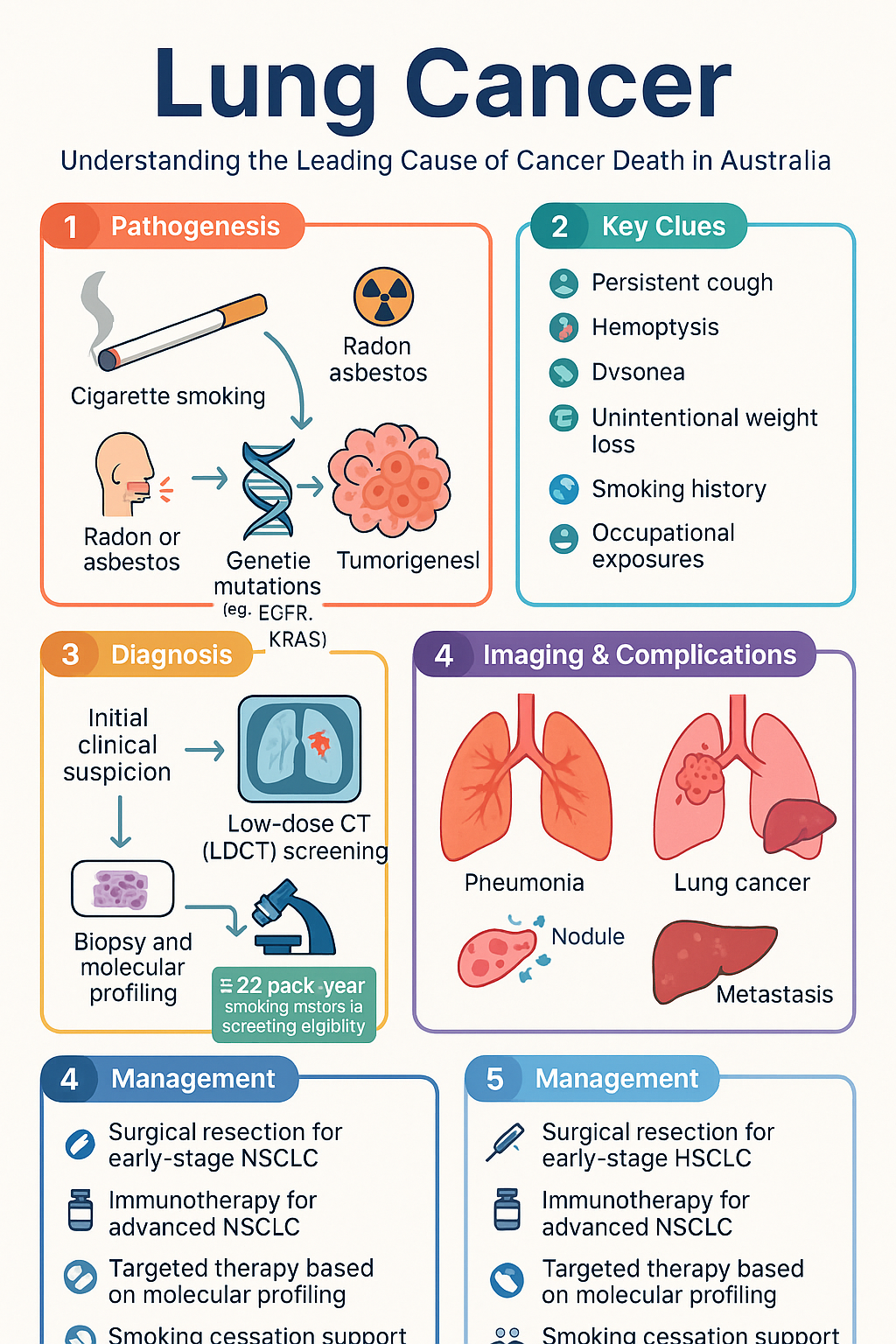
- Lung cancer is the leading cause of cancer death in Australia — approximately 13,500 new diagnoses and 8,700 deaths annually; 5-year survival remains around 22% overall.
- Non-small cell lung cancer (NSCLC) accounts for ~80% of cases; small cell lung cancer (SCLC) accounts for ~20% and behaves as a systemic disease from diagnosis.
- Cigarette smoking is the dominant risk factor (80–90% of cases); risk persists for ≥15 years after cessation. Non-smoking risk factors include radon, asbestos, air pollution, and occupational exposures.
- Low-dose CT (LDCT) screening is recommended annually for high-risk Australians aged 50–80 with ≥20 pack-year history who currently smoke or quit within 15 years (supported by the International Early Lung Cancer Action Program and NELSON trial data).
- All advanced NSCLC (stage IV) adenocarcinoma must undergo comprehensive molecular profiling — at minimum EGFR, ALK, ROS1, BRAF V600E, KRAS G12C, MET exon 14, RET, NTRK, and PD-L1 expression — to guide therapy selection.
- Immunotherapy (pembrolizumab, nivolumab ± ipilimumab, atezolizumab) has transformed first-line treatment of advanced NSCLC without actionable driver mutations; used alone or combined with platinum-doublet chemotherapy.
- Targeted therapies in NSCLC include osimertinib (EGFR), alectinib/lorlatinib (ALK), sotorasib/adagrasib (KRAS G12C), selpercatinib (RET), entrectinib/larotrectinib (NTRK), and tepotinib/capmatinib (MET exon 14).
- SCLC treatment remains platinum-etoposide based; the addition of atezolizumab or durvalumab to first-line chemotherapy has improved survival in extensive-stage disease.
- Surgical resection (lobectomy + mediastinal lymph node dissection) offers the best chance of cure for stage I–II NSCLC; sublobar resection may be appropriate for peripheral tumours ≤2 cm.
- Adjuvant osimertinib is now standard of care for completely resected stage II–IIIA NSCLC with sensitising EGFR mutations, based on the ADAURA trial.
- Adjuvant pembrolizumab or atezolizumab is indicated for PD-L1 ≥1% stage II–IIIA NSCLC after complete resection and adjuvant chemotherapy.
- NSCLC with actionable driver mutations generally receives targeted therapy as first-line rather than immunotherapy alone; immunotherapy combinations are reserved for non-driver or post-targeted-therapy progression.
- All patients should be discussed at a multidisciplinary team (MDT) meeting; palliative care integration is recommended from diagnosis for advanced disease.
- Aboriginal and Torres Strait Islander Australians have higher lung cancer incidence, later-stage presentation, and lower survival; culturally safe services and proactive smoking cessation support are essential.
Introduction & Australian Epidemiology
Lung cancer remains the most lethal malignancy worldwide and in Australia, accounting for more cancer deaths than colorectal, breast, and prostate cancers combined. The disease is broadly classified into two major groups: non-small cell lung cancer (NSCLC), comprising approximately 80% of cases, and small cell lung cancer (SCLC), comprising approximately 20%. Within NSCLC, adenocarcinoma is the most common histological subtype (40–50%), followed by squamous cell carcinoma (25–30%) and large cell carcinoma (<5%).
In Australia, the Australian Institute of Health and Welfare (AIHW) estimates approximately 13,500 new lung cancer cases were diagnosed in 2023, with age-standardised incidence rates of around 45 per 100,000 in males and 35 per 100,000 in females. The incidence in females has been gradually rising, reflecting historical smoking patterns. Lung cancer causes approximately 8,700 deaths per year, making it the leading cause of cancer death in both sexes.
Five-year survival has improved modestly over the past two decades, from approximately 13% (diagnoses 2008–2012) to 22% (diagnoses 2016–2020), largely driven by advances in targeted therapies, immunotherapy, and improved surgical techniques. However, prognosis remains poor for patients diagnosed at advanced stages.
The therapeutic landscape has been revolutionised by molecular profiling, which is now mandatory in all advanced non-squamous NSCLC and increasingly in squamous NSCLC. Actionable driver mutations — including EGFR, ALK, ROS1, BRAF V600E, KRAS G12C, MET exon 14, RET, and NTRK — are found in approximately 30–40% of adenocarcinomas, each with corresponding targeted therapies that offer superior outcomes to conventional chemotherapy.
In SCLC, the addition of immune checkpoint inhibitors (atezolizumab or durvalumab) to platinum-etoposide chemotherapy has established a new standard of care for extensive-stage disease, marking the first meaningful survival improvement in over 30 years.
Epidemiology & Risk Factors
Incidence in Australia
| Metric | Value | Notes |
|---|---|---|
| New cases (2023 est.) | ~13,500 | 5th most common cancer overall |
| Deaths (2023 est.) | ~8,700 | Leading cause of cancer death |
| 5-year survival | ~22% | Improving; stage-dependent |
| Median age at diagnosis | 71 years | ~85% diagnosed age ≥55 |
| Male : Female ratio | 1.2 : 1 | Gap narrowing over time |
Modifiable Risk Factors
- Tobacco smoking: Relative risk 15–30× for current smokers vs never-smokers; 50 pack-years is the typical threshold used in screening eligibility.
- Second-hand smoke: 20–30% increased risk among non-smokers with significant exposure.
- Occupational exposures: Asbestos (synergistic with smoking — multiplicative risk), crystalline silica, chromium, nickel, arsenic, diesel exhaust, polycyclic aromatic hydrocarbons.
- Radon: Second leading cause of lung cancer; estimated 2–10% of Australian lung cancers linked to residential radon exposure.
- Air pollution: Particulate matter (PM₂.₅) classified as Group 1 carcinogen; contributes to approximately 1–2% of cases.
- Cannabis smoking: Emerging evidence of association, though confounded by concurrent tobacco use in many studies.
Non-Modifiable Risk Factors
- Age: Median 71 years; incidence rises sharply after age 50.
- Family history: First-degree relative with lung cancer increases risk 1.5–2× independent of smoking.
- Pre-existing lung disease: COPD (1.5–2× risk independent of smoking), pulmonary fibrosis (particularly idiopathic pulmonary fibrosis).
- Genetic susceptibility: GWAS-identified susceptibility loci; rare germline mutations (EGFR T790M, BRCA2).
- Never-smoker lung cancer: Approximately 10–15% of lung cancers occur in never-smokers; more common in women and Asian populations; enriched for EGFR mutations and ALK rearrangements.
Screening — Low-Dose CT (LDCT)
Eligibility criteria (Cancer Australia recommendation):
- Age 50–80 years
- Current smoker or former smoker who quit within the past 15 years
- ≥20 pack-year smoking history
- No current symptoms suggestive of lung cancer
- Annual LDCT with structured nodule management per Lung-RADS
Pathology — NSCLC vs SCLC
Histological Classification
| Feature | NSCLC (~80%) | SCLC (~20%) |
|---|---|---|
| Subtypes | Adenocarcinoma (40–50%), Squamous cell (25–30%), Large cell (<5%), Large cell neuroendocrine (2–3%) | Classic small cell, combined small cell (with NSCLC elements) |
| Location | Peripheral (adenocarcinoma) or central (squamous); any lobe | Almost exclusively central; hilar/mediastinal |
| Smoking association | Strong (all subtypes); adenocarcinoma most common in never-smokers | Very strong (>95% smokers); rare in never-smokers |
| Growth rate | Moderate; variable doubling time | Very rapid; short doubling time (30–60 days) |
| Driver mutations | Common (EGFR 15%, ALK 5%, ROS1 1–2%, KRAS G12C 13%, BRAF 2%, MET 3%, RET 1–2%, NTRK <1%) | Rare; TP53 and RB1 universal inactivation; NOTCH pathway alteration |
| PDL1 expression | Variable (0 to >50%); adenocarcinoma generally higher | Usually low; less predictive of immunotherapy benefit |
| Paraneoplastic | Hypercalcaemia (squamous — PTHrP), hypertrophic pulmonary osteoarthropathy | SIADH (15%), ectopic ACTH (Cushing syndrome — 2–5%), Lambert-Eaton myasthenic syndrome, cerebellar degeneration |
| Prognosis (all stages) | 5-year survival ~25% | 5-year survival ~7% |
Adenocarcinoma Sub-classification (IASLC)
The 2021 WHO Classification and IASLC grading system stratify adenocarcinoma by predominant pattern:
- Grade 1 (Lepidic): Well-differentiated; best prognosis; lepidic predominant.
- Grade 2 (Acinar/Papillary): Intermediate prognosis.
- Grade 3 (Solid/Micropapillary/Complex glandular): Poorly differentiated; worst prognosis; highest recurrence rates.
Squamous Cell Carcinoma
Central location, strong association with smoking, keratinisation and intercellular bridges on histology. Molecular profiling less commonly yields actionable targets (FGFR1 amplification, PIK3CA mutations may be targetable in trials). PD-L1 expression is variable.
Small Cell Lung Cancer
Histologically characterised by small cells with scant cytoplasm, nuclear moulding, crush artefact, and very high mitotic rate. Immunohistochemistry positive for synaptophysin, chromogranin A, and TTF-1. Ki-67 proliferation index typically >70%.
Immunohistochemistry Panel
- NSCLC — Adenocarcinoma: TTF-1+, Napsin A+, CK7+, CK20−, p40−
- NSCLC — Squamous: p40+, p63+, CK5/6+, CK7−, TTF-1−
- SCLC: Synaptophysin+, Chromogranin A+, CD56+, TTF-1+, Ki-67 >70%
Staging & Investigations
Initial Investigations
TNM Staging — NSCLC (AJCC 8th Edition)
| Stage | TNM | Description | 5-Year Survival |
|---|---|---|---|
| IA1 | T1a(mi) N0 M0 | Minimally invasive adenocarcinoma ≤3 cm, lepidic predominant, invasion ≤5 mm | 92% |
| IA2 | T1a N0 M0 | Tumour ≤1 cm | 83% |
| IA3 | T1b N0 M0 | Tumour >1 cm but ≤2 cm | 77% |
| IB | T1c N0 M0 | Tumour >2 cm but ≤3 cm | 68% |
| IIA | T2a N0 M0 | Tumour >3 cm but ≤4 cm, or involves main bronchus, visceral pleura, or causes atelectasis | 60% |
| IIB | T2b N0 / T1-2 N1 M0 | Tumour >4 cm but ≤5 cm; or ipsilateral peribronchial/hilar node (N1) | 53% |
| IIIA | T1-2 N2 M0 / T3 N1 M0 | Ipsilateral mediastinal/subcarinal node (N2) | 36% |
| IIIB | T1-2 N3 M0 / T3-4 N2 M0 | Contralateral mediastinal/supraclavicular (N3) | 26% |
| IIIC | T3-4 N3 M0 | Locally advanced, unresectable | 13% |
| IVA | Any T Any N M1a/M1b | M1a: contralateral lung/pleural/pericardial; M1b: single extrathoracic site | 10% |
| IVB | Any T Any N M1c | Multiple extrathoracic metastases | <5% |
SCLC Staging — Veterans Administration Lung Study Group (VALSG)
- Limited stage (LS-SCLC): Disease confined to one hemithorax and regional nodes that can be encompassed within a tolerable radiation field (~30–40% at presentation).
- Extensive stage (ES-SCLC): Disease beyond a single radiation field; includes contralateral lung, distant metastases, malignant pleural/pericardial effusion (~60–70% at presentation).
Surgical Fitness Assessment
For patients being considered for curative-intent resection, the following must be assessed at MDT:
- ECOG performance status 0–1 (ideally)
- FEV₁ >80% predicted, or ppoFEV₁ >40% predicted
- DLCO >40% predicted (ppoDLCO >40%)
- VO₂ max >15 mL/kg/min (if borderline PFTs)
- Cardiopulmonary exercise testing for borderline cases
- No uncontrolled comorbidities (recent MI, uncontrolled heart failure, severe pulmonary hypertension)
Treatment
1. Surgical Resection — NSCLC Stage I–II
Surgery remains the cornerstone of curative-intent treatment for early-stage NSCLC.
Resection Options
2. Neoadjuvant & Adjuvant Therapy — NSCLC
Adjuvant Chemotherapy
Cisplatin-based adjuvant chemotherapy is recommended for completely resected stage II–IIIA NSCLC (and select stage IB tumours >4 cm). The standard regimen:
Adjuvant Targeted Therapy
Neoadjuvant Chemo-immunotherapy
3. Chemotherapy — Advanced / Metastatic NSCLC
First-Line — Non-Squamous NSCLC (without actionable drivers)
First-Line — Squamous NSCLC (without actionable drivers)
Immunotherapy Monotherapy — PD-L1 ≥50%
4. Targeted Therapy — Actionable Driver Mutations (NSCLC)
5. Immunotherapy — SCLC
Extensive-Stage SCLC — First-Line
Limited-Stage SCLC
Concurrent chemoradiation remains standard: platinum-etoposide × 4 cycles with thoracic radiotherapy (45 Gy BID or 60–66 Gy daily) commencing by cycle 2. Prophylactic cranial irradiation (PCI, 25 Gy in 10 fractions) is recommended for patients with response (CR/PR). MRI surveillance is an alternative to PCI based on ongoing studies (e.g., MAVERICK).
6. Locally Advanced NSCLC — Stage III (Unresectable)
7. Later-Line Options & Resistance Mechanisms
- Post-osimertinib progression (EGFR+): Platinum-pemetrexed chemotherapy ± pembrolizumab; consider amivantamab (EGFR/MET bispecific) + lazertinib (EGFR TKI) per MARIPOSA-2. Clinical trial enrolment strongly encouraged.
- Post-alectinib progression (ALK+): Lorlatinib preferred (if not used 1st-line); brigatinib or ceritinib as alternatives.
- Post-immunotherapy progression: Docetaxel ± ramucirumab (REVEL trial: OS HR 0.86). Pemetrexed for non-squamous histology if not previously used.
- Post-SCLC progression: Topotecan (oral or IV) or lurbinectedin (if available). Paclitaxel, docetaxel, or irinotecan as alternatives.
8. Molecular Resistance Pathways
| Primary Driver | Resistance Mechanism | Therapeutic Implication |
|---|---|---|
| EGFR sensitising | EGFR T790M (~50%) | Osimertinib (3rd gen TKI) |
| EGFR sensitising | MET amplification (~15–20%) | Osimertinib + savolitinib/tepotinib (trial) |
| EGFR sensitising | Small cell transformation (~5–15%) | Treat as SCLC — platinum-etoposide |
| ALK rearrangement | Compound ALK mutations (G1202R) | Lorlatinib (3rd gen TKI) |
| KRAS G12C | MET, NRAS, BRAF activation | Combination trials; chemotherapy |
9. Immune-Related Adverse Events (irAEs)
Monitoring & Follow-Up
Post-Surgical Surveillance (NSCLC Stage I–II)
On-Treatment Monitoring (Advanced Disease)
- Response assessment: CT chest/abdomen every 2–3 cycles (6–9 weeks); PET-CT not routinely used for on-treatment response.
- Immunotherapy: Hyperprogression may occur — CT at 6–8 weeks first assessment. Pseudoprogression occurs in 2–10%; confirm with biopsy or continued imaging if clinically stable.
- Targeted therapy: Monitor for drug-specific toxicities (e.g., LFTs for alectinib, lipids for lorlatinib, QTc for osimertinib, renal function for sunitinib).
- Brain MRI: Baseline and every 3–6 months for ALK+ and EGFR+ (high CNS tropism); otherwise at clinical suspicion.
- Bone protection: Denosumab or zoledronic acid for symptomatic bone metastases (PBS Authority).
Special Populations
Aboriginal and Torres Strait Islander Health Considerations
Quick Reference — First-Line Regimens by Molecular Subgroup
Palliative & Supportive Care
- Referral: All patients with advanced lung cancer should be offered palliative care referral at diagnosis, not just at end of life.
- Symptom management: Dyspnoea (opioids, fan therapy, pulmonary rehab), pain (WHO analgesic ladder), cough (codeine, benzonatate), fatigue, anorexia, depression/anxiety.
- Endobronchial interventions: Endobronchial stenting, cryotherapy, argon plasma coagulation for obstructing tumours.
- Pleural effusion: Therapeutic thoracentesis, indwelling pleural catheter (IPC), pleurodesis (talc poudrage preferred).
- Brain metastases: Stereotactic radiosurgery (SRS) for oligometastatic (1–4 lesions); whole brain radiotherapy (WBRT) for multiple lesions (with hippocampal avoidance and memantine if possible).
- SVC obstruction: Urgent stenting ± radiotherapy. Chemotherapy if chemosensitive histology (SCLC).
- Advance care planning: Goals of care documentation; resuscitation preferences; nominated substitute decision-maker.
📚 References
- 1. Cancer Australia. Lung cancer in Australia: national statistics. Surry Hills, NSW: Cancer Australia; 2023. Available from: https://www.canceraustralia.gov.au
- 2. Australian Institute of Health and Welfare. Cancer data in Australia. Canberra: AIHW; 2023. Cat. no. CAN 144.
- 3. Goldstraw P, Chansky K, Crowley J, et al. The IASLC Lung Cancer Staging Project: proposals for revision of the TNM stage groupings in the forthcoming (eighth) edition of the TNM Classification for lung cancer. J Thorac Oncol. 2016;11(1):39–51.
- 4. Soria JC, Ohe Y, Vansteenkiste J, et al. Osimertinib in untreated EGFR-mutated advanced non–small-cell lung cancer. N Engl J Med. 2018;378(2):113–125. (FLAURA)
- 5. Wu YL, Tsuboi M, He J, et al. Osimertinib in resected EGFR-mutated non–small-cell lung cancer. N Engl J Med. 2020;383(18):1711–1723. (ADAURA)
- 6. Peters S, Camidge DR, Shaw AT, et al. Alectinib versus crizotinib in untreated ALK-positive non–small-cell lung cancer. N Engl J Med. 2017;377(9):829–838. (ALEX)
- 7. Shaw AT, Bauer TM, de Marinis F, et al. First-line lorlatinib or crizotinib in advanced ALK-positive lung cancer. N Engl J Med. 2020;383(21):2018–2029. (CROWN)
- 8. Gandhi L, Rodríguez-Abreu D, Gadgeel S, et al. Pembrolizumab plus chemotherapy in metastatic non–small-cell lung cancer. N Engl J Med. 2018;378(22):2078–2092. (KEYNOTE-189)
- 9. Paz-Ares L, Luft A, Vicente D, et al. Pembrolizumab plus chemotherapy for squamous non–small-cell lung cancer. N Engl J Med. 2018;379(21):2040–2051. (KEYNOTE-407)
- 10. Antonia SJ, Villegas A, Daniel D, et al. Durvalumab after chemoradiotherapy in stage III non–small-cell lung cancer. N Engl J Med. 2017;377(20):1919–1929. (PACIFIC)
- 11. Horn L, Mansfield AS, Szczęsna A, et al. First-line atezolizumab plus chemotherapy in extensive-stage small-cell lung cancer. N Engl J Med. 2018;379(23):2220–2229. (IMpower133)
- 12. Paz-Ares L, Dvorkin M, Chen Y, et al. Durvalumab plus platinum-etoposide versus platinum-etoposide in first-line treatment of extensive-stage small-cell lung cancer (CASPIAN). Lancet. 2019;394(10212):1929–1939.
- 13. Forde PM, Spicer J, Lu S, et al. Neoadjuvant nivolumab plus chemotherapy in resectable lung cancer. N Engl J Med. 2022;386(21):1973–1985. (CheckMate 816)
- 14. Felip E, Altorki N, Zhou C, et al. Adjuvant atezolizumab after adjuvant chemotherapy in resected stage IB–IIIA non-small-cell lung cancer (IMpower010). Lancet. 2021;398(10308):1344–1357.
- 15. Temel JS, Greer JA, Muzikansky A, et al. Early palliative care for patients with metastatic non–small-cell lung cancer. N Engl J Med. 2010;363(8):733–742.
- 16. National Health and Medical Research Council. Clinical practice guidelines for the prevention, diagnosis and management of lung cancer. Canberra: NHMRC; 2023.
- 17. Cancer Australia. Investigation of symptoms of lung cancer: a guide for general practitioners. Surry Hills, NSW: Cancer Australia; 2020.
- 18. Department of Health and Aged Care. National Lung Cancer Screening Programme — Consultation Paper. Canberra: Australian Government; 2023.