📋 Key Information Summary
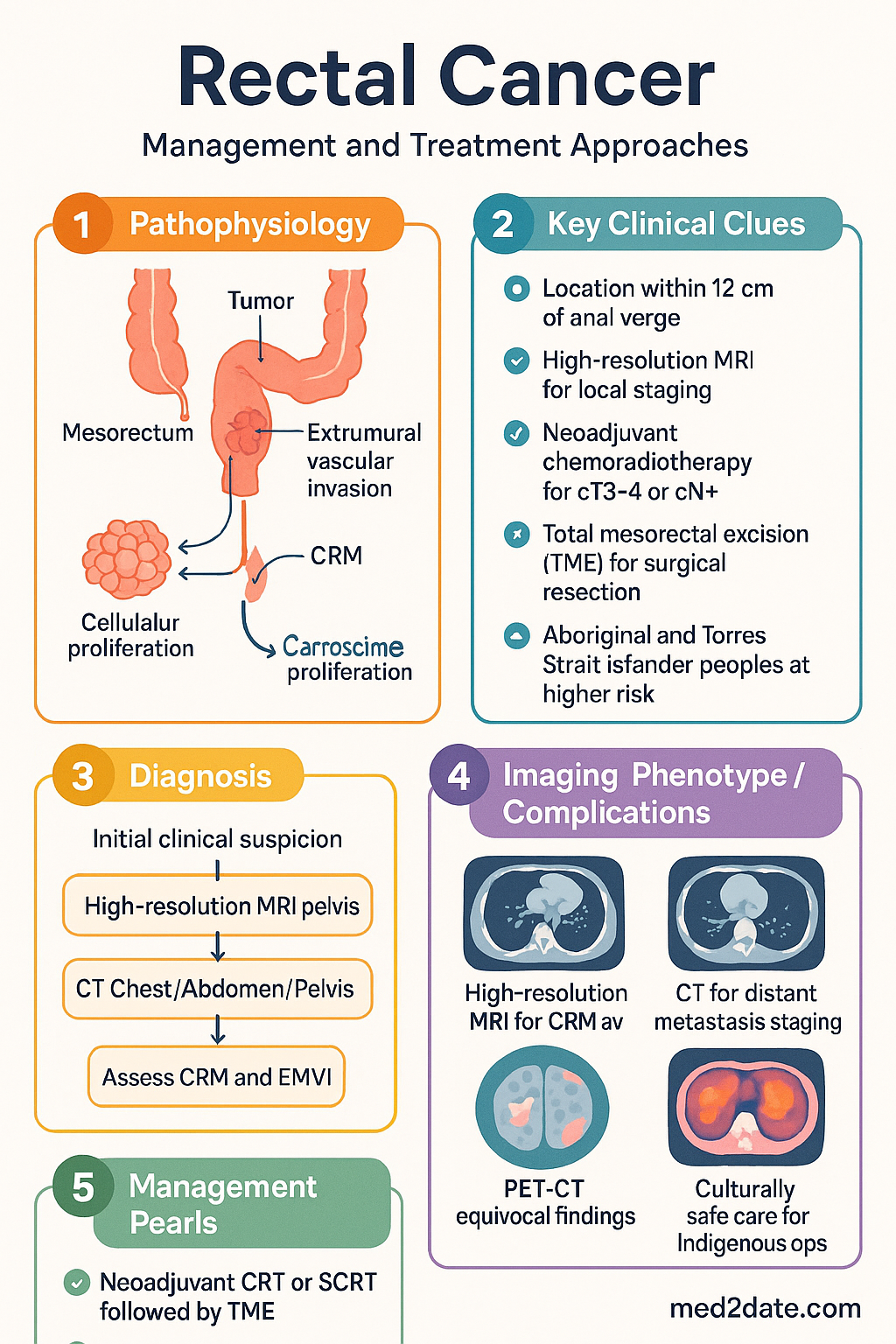
- Rectal cancer management is defined by its location within 12 cm of the anal verge on rigid sigmoidoscopy.
- High-resolution MRI pelvis is the gold standard for local staging (T-stage, N-status, circumferential resection margin (CRM), extramural vascular invasion (EMVI)).
- For locally advanced rectal cancer (cT3-4 or cN+), the standard of care is neoadjuvant chemoradiotherapy (CRT) or short-course radiotherapy (SCRT) followed by total mesorectal excision (TME).
- The primary surgical goal is a negative CRM (>1 mm), achieved through meticulous TME.
- The choice between abdominoperineal resection (APR) and sphincter-preserving low anterior resection (LAR) depends on tumour distance from the anal sphincter complex.
- Post-operative (adjuvant) chemotherapy is controversial but may be considered for high-risk stage II and stage III disease, particularly if neoadjuvant therapy was not given.
- Intensive surveillance for 5 years post-curative resection includes regular colonoscopy, CT imaging, and serum CEA monitoring.
- Total neoadjuvant therapy (TNT), where all chemo and radiotherapy is delivered pre-operatively, is increasingly used to improve compliance and tumour response.
- Management of rectal cancer requires a multidisciplinary team (MDT) approach involving colorectal surgery, radiation oncology, medical oncology, radiology, and pathology.
- Aboriginal and Torres Strait Islander peoples have a higher incidence and mortality from colorectal cancer; culturally safe care and equitable access to MDT and treatment are critical.
Introduction & Australian Epidemiology
Rectal cancer is a distinct clinical entity from colon cancer due to its anatomical location within the rigid confines of the bony pelvis and its proximity to the anal sphincter complex. These factors significantly influence staging, treatment sequencing, surgical technique, and functional outcomes. Management requires specific expertise and a coordinated multidisciplinary team (MDT) approach.
In Australia, colorectal cancer is the second most common cause of cancer-related death. Approximately 30% of colorectal cancers are located in the rectum. The age-standardised incidence rate is around 44 per 100,000 people. While overall survival has improved, disparities persist, particularly for Aboriginal and Torres Strait Islander peoples and those in remote areas. The cornerstone of curative treatment is surgical resection, often combined with radiotherapy and chemotherapy in a sequence tailored to the stage of disease at presentation.
Anatomy & Staging
The rectum is defined as the large bowel segment commencing at the rectosigmoid junction (approximately 12-15 cm from the anal verge) and ending at the anorectal ring. It is divided into thirds: lower (0-5 cm), middle (5-10 cm), and upper (10-12 cm) rectum. The mesorectum, a package of fat containing lymph nodes and vessels surrounding the rectum, is the key surgical plane.
TNM Staging (8th Edition)
| T Stage | Definition |
|---|---|
| T1 | Tumour invades submucosa |
| T2 | Tumour invades muscularis propria |
| T3 | Tumour invades through muscularis propria into pericolorectal tissues |
| T4 | Tumour directly invades other organs or structures and/or perforates visceral peritoneum |
Key Staging Investigations
Neoadjuvant Chemoradiotherapy
Neoadjuvant therapy is administered for locally advanced rectal cancer (LARC) defined as cT3-4 or cN+ disease, with the goals of downstaging the tumour, increasing the chance of a clear CRM (R0 resection), improving sphincter preservation rates, and reducing local recurrence.
Standard Regimens
Radiotherapy Schedules
Surgical Approaches (TME & APR)
Surgery remains the definitive curative treatment. The standard operation is a total mesorectal excision (TME), which involves sharp dissection in the avascular plane between the mesorectal fascia and the parietal pelvic fascia, removing the rectum and its intact mesorectum.
Indication: Tumours in the mid/upper rectum or low rectum where a 1-2 cm distal margin is achievable and the sphincter complex is not involved.
Procedure: Removal of the tumour-bearing rectum with restoration of bowel continuity via a colorectal or coloanal anastomosis. A temporary defunctioning ileostomy is often created to protect a low anastomosis.
Indication: Very low rectal cancers invading the anal sphincter complex or levator ani muscles, where a negative distal margin cannot be achieved with LAR.
Procedure: Removal of the rectum, anal canal, and sphincter complex, resulting in a permanent end-colostomy. A more cylindrical specimen is now advocated to reduce margin positivity.
Adjuvant Therapy & Surveillance
Adjuvant (Post-operative) Chemotherapy
The role of adjuvant chemotherapy after neoadjuvant CRT and TME is controversial. Current Australian practice, guided by MDT discussion, generally considers it for:
- Patients who did not receive neoadjuvant therapy (e.g., early-stage tumours upstaged post-operatively).
- Patients with high-risk features on surgical pathology (e.g., positive lymph nodes, poor differentiation, EMVI, perforation) particularly if pre-operative treatment was suboptimal.
Common regimens are based on fluoropyrimidines ± oxaliplatin (e.g., CAPOX, FOLFOX) for 3-6 months.
Post-Treatment Surveillance
Intensive follow-up for 5 years is recommended to detect potentially curable recurrences.
Every 3-6 months: Clinical review, serum CEA. Annual: CT Chest/Abdomen/Pelvis.
At ~12 months post-resection: First surveillance colonoscopy.
Every 6-12 months: Clinical review, CEA. As indicated: CT imaging. Colonoscopy repeated at 3-5 years, then per national bowel cancer screening guidelines.
MBS Items: CEA (item 66518), CT scan (item 56809).
Special Populations
Aboriginal and Torres Strait Islander Health Considerations
Aboriginal and Torres Strait Islander peoples experience a higher incidence of colorectal cancer, are more likely to be diagnosed at an advanced stage, and have lower survival rates compared to non-Indigenous Australians. Contributing factors are complex and multifaceted.
📚 References
- 1. Cancer Council Australia Colorectal Cancer Guidelines Working Party. Clinical practice guidelines for the management of colorectal cancer. Sydney: Cancer Council Australia; 2017 (updated 2021).
- 2. Australian Institute of Health and Welfare (AIHW). Cancer data in Australia. Canberra: AIHW; 2023.
- 3. National Comprehensive Cancer Network (NCCN). NCCN Clinical Practice Guidelines in Oncology: Rectal Cancer. Version 2.2024.
- 4. Glynne-Jones R, Wyrwicz L, Tiret E, et al. Rectal cancer: ESMO Clinical Practice Guidelines for diagnosis, treatment and follow-up. Ann Oncol. 2017;28(suppl_4):iv22-iv40.
- 5. Royal Australasian College of Surgeons (RACS). Guidelines for the management of colorectal cancer. Melbourne: RACS; 2017.
- 6. Australian Government Department of Health. The Pharmaceutical Benefits Scheme (PBS). Available at: www.pbs.gov.au.
- 7. Australian Government Department of Health. Medical Benefits Schedule (MBS). Available at: www.mbsonline.gov.au.
- 8. Smith FM, Cresswell K, Myint AS, et al. Is "watch and wait" a safe strategy for rectal cancer after neoadjuvant chemoradiotherapy? ANZ J Surg. 2021;91(12):2623-2628.
- 9. Australian Commission on Safety and Quality in Health Care (ACSQHC). National Safety and Quality Health Service Standards. 2nd ed. Sydney: ACSQHC; 2017.
- 10. Condon JR, Garling G, Cunningham J, et al. Cancer disparities in Indigenous Australians: a review. Cancer Epidemiol. 2014;38(4):353-361.
- 11. Bahadoer RR, Dijkstra EA, van Etten B, et al. Short-course radiotherapy followed by chemotherapy before total mesorectal excision (TME) versus preoperative chemoradiotherapy, TME, and optional adjuvant chemotherapy in locally advanced rectal cancer (RAPIDO): a randomised, open-label, phase 3 trial. Lancet Oncol. 2021;22(1):29-42.
- 12. Fleshman J, Branda ME, Sargent DJ, et al. Disease-free survival versus overall survival as a primary endpoint for rectal cancer trials: analysis of data from the National Surgical Adjuvant Breast and Bowel Project. J Clin Oncol. 2017;35(33):3771-3778.