📋 Key Information Summary
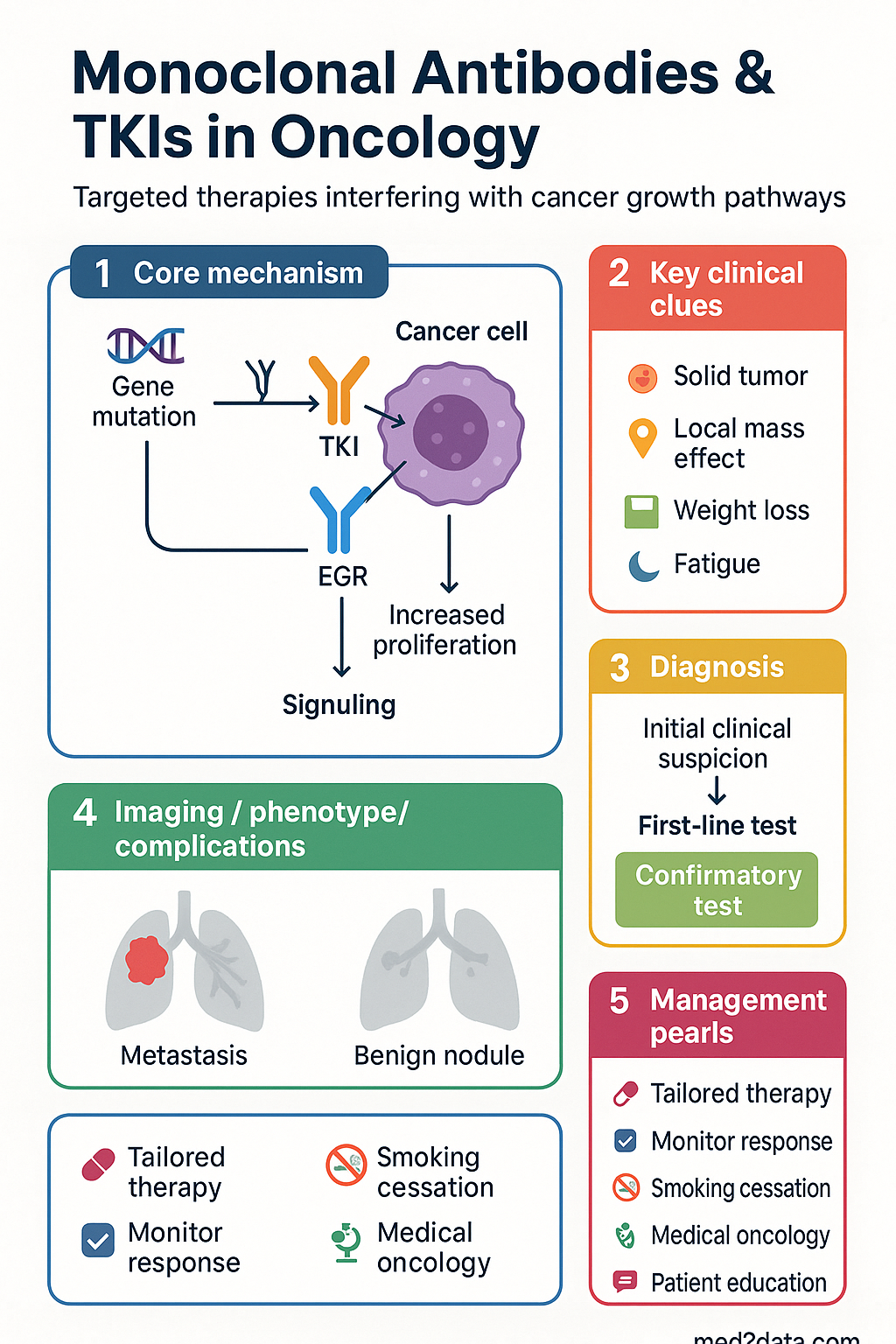
- Monoclonal antibodies (mAbs) and tyrosine kinase inhibitors (TKIs) are targeted cancer therapies that interfere with specific molecular pathways driving tumour growth and survival.
- mAbs are large-molecule glycoproteins binding extracellular targets (e.g., HER2, EGFR, VEGF); TKIs are small-molecule inhibitors acting intracellularly on kinase domains.
- Anti-EGFR agents (cetuximab, panitumumab) are indicated in RAS wild-type metastatic colorectal cancer; KRAS/NRAS mutation testing (MBS item 71553) is mandatory before initiation.
- Anti-HER2 therapy (trastuzumab, pertuzumab, T-DM1) is standard in HER2-positive breast and gastric cancers; IHC and FISH testing is required to confirm HER2 status (score 3+ or amplified).
- Anti-VEGF therapy (bevacizumab) inhibits angiogenesis and is used in colorectal, ovarian, renal, and non-small cell lung cancers.
- Imatinib revolutionised CML treatment, achieving complete cytogenetic response in >80% of chronic-phase patients; BCR-ABL1 quantitative PCR monitoring is essential.
- Erlotinib is an EGFR TKI indicated in EGFR-mutated advanced NSCLC; EGFR mutation testing (exon 19 deletion, L858R) guides therapy selection.
- Resistance mechanisms include gatekeeper mutations (T315I in CML, T790M in NSCLC), bypass signalling, and efflux pump overexpression.
- Common side effects across classes include skin toxicity (acneiform rash, paronychia), diarrhoea, hepatotoxicity, infusion reactions, and QT prolongation.
- Cardiotoxicity screening is mandatory for anti-HER2 therapy; left ventricular ejection fraction (LVEF) assessment every 3 months during trastuzumab.
- All targeted therapies require PBS Authority approval in Australia; companion diagnostic testing must be performed at NATA-accredited laboratories.
- Aboriginal and Torres Strait Islander patients face lower rates of molecular testing access and higher barriers to specialist oncology services, particularly in remote and very remote areas.
- Multidisciplinary team (MDT) discussion is required before initiation of any targeted therapy in accordance with Cancer Australia guidelines.
Introduction & Australian Epidemiology
Monoclonal antibodies (mAbs) and tyrosine kinase inhibitors (TKIs) represent a paradigm shift in oncology, moving from non-specific cytotoxic chemotherapy to precision-targeted therapies directed against specific molecular alterations within tumour cells. These agents interfere with critical signalling pathways governing cell proliferation, survival, angiogenesis, and immune evasion.
In Australia, targeted therapies are now integral to the management of multiple solid and haematological malignancies. The Pharmaceutical Benefits Scheme (PBS) currently subsidises numerous mAbs and TKIs across approved indications, and their use is guided by companion diagnostic testing mandated under MBS item numbers.
Australian Cancer Burden & Relevance
According to the Australian Institute of Health and Welfare (AIHW), an estimated 162,000 new cancer cases were diagnosed in Australia in 2023. The malignancies most amenable to targeted therapy with mAbs and TKIs include:
| Cancer Type | Approx. New Cases/Year (AU) | Key Targetable Alteration | Primary Targeted Agent |
|---|---|---|---|
| Colorectal | 15,500 | RAS wild-type (exon 2/3/4) | Cetuximab, panitumumab, bevacizumab |
| Breast (HER2+) | 3,200 (≈20% of breast) | HER2 amplification | Trastuzumab, pertuzumab, T-DM1 |
| Non-small cell lung | 12,700 | EGFR mutation (10–15%) | Erlotinib, osimertinib |
| Chronic myeloid leukaemia | 330 | BCR-ABL1 fusion | Imatinib |
| Renal cell | 4,200 | VEGF/VEGFR pathway | Bevacizumab, sunitinib |
| Melanoma | 17,800 | BRAF V600E (≈50%) | Vemurafenib, dabrafenib |
Classes of Targeted Therapy
Targeted therapies in oncology are broadly classified by molecular size, site of action, and mechanism. Understanding these classes is essential for rational drug selection, resistance anticipation, and toxicity management.
Monoclonal Antibodies (mAbs)
Monoclonal antibodies are large glycoprotein molecules (≈150 kDa) produced via recombinant DNA technology. They bind extracellular targets with high specificity and are administered intravenously or subcutaneously. Their mechanisms include:
- Receptor blockade: Competitive inhibition of ligand binding (e.g., cetuximab blocks EGF binding to EGFR).
- Signal transduction inhibition: Prevention of receptor dimerisation and downstream signalling (e.g., trastuzumab inhibits HER2 homo- and heterodimerisation).
- Antibody-dependent cellular cytotoxicity (ADCC): Fc region recruits natural killer cells to destroy tumour cells.
- Complement-dependent cytotoxicity (CDC): Activation of the classical complement cascade.
- Angiogenesis inhibition: Neutralisation of VEGF ligand preventing new blood vessel formation (e.g., bevacizumab).
- Immune checkpoint modulation: Blockade of PD-1/PD-L1 or CTLA-4 (e.g., pembrolizumab, nivolumab — outside scope of this article but relevant to immuno-oncology).
Antibody-Drug Conjugates (ADCs)
ADCs combine the targeting specificity of mAbs with the cytotoxic potency of small-molecule chemotherapy. The antibody component delivers the payload selectively to antigen-expressing tumour cells, reducing systemic toxicity. Key examples include:
- Trastuzumab emtansine (T-DM1, Kadcyla®): Anti-HER2 antibody conjugated to the microtubule inhibitor DM1. Indicated in HER2-positive metastatic breast cancer after prior trastuzumab and taxane therapy. PBS Authority Required.
- Trastuzumab deruxtecan (T-DXd, Enhertu®): Anti-HER2 antibody conjugated to topoisomerase I inhibitor. Approved in Australia for HER2-positive and HER2-low metastatic breast cancer.
- Ado-trastuzumab: ADC technology is expanding rapidly into other targets (TROP-2, Nectin-4, HER3).
Tyrosine Kinase Inhibitors (TKIs)
TKIs are small-molecule compounds (typically 400–900 Da) that penetrate the cell membrane and competitively inhibit the ATP-binding site of intracellular tyrosine kinases. Unlike mAbs, they are administered orally. Classification by generation:
| Generation | Examples | Primary Target | Key Advantage |
|---|---|---|---|
| 1st generation | Imatinib, erlotinib, gefitinib | BCR-ABL1, EGFR | Foundational efficacy; long-term safety data |
| 2nd generation | Dasatinib, nilotinib, afatinib | BCR-ABL1 (mutant), EGFR/HER2 | Broader mutant coverage; improved potency |
| 3rd generation | Osimertinib, ponatinib | T790M EGFR, T315I BCR-ABL1 | Activity against gatekeeper mutations |
Key Pharmacological Differences: mAbs vs TKIs
| Property | Monoclonal Antibodies | Tyrosine Kinase Inhibitors |
|---|---|---|
| Molecular size | ≈150 kDa (large) | 400–900 Da (small) |
| Route | IV infusion or SC injection | Oral tablet |
| Target location | Extracellular / cell surface | Intracellular |
| Half-life | Long (days to weeks) | Short to moderate (hours) |
| Metabolism | Proteolytic degradation (reticuloendothelial) | Hepatic CYP3A4 (major), CYP1A2, CYP2D6 |
| Immunogenicity | Yes — human anti-drug antibodies (HADA) | Minimal |
| Infusion reactions | Common (1–10%) | Rare |
Anti-EGFR, Anti-HER2 & Anti-VEGF Agents
Anti-EGFR Monoclonal Antibodies
Epidermal growth factor receptor (EGFR/HER1/ErbB1) is a transmembrane receptor tyrosine kinase overexpressed in many epithelial malignancies. Anti-EGFR mAbs bind the extracellular domain, preventing ligand activation and downstream RAS-MAPK and PI3K-AKT signalling.
Anti-HER2 Therapy
Human epidermal growth factor receptor 2 (HER2/ERBB2) is amplified in approximately 15–20% of breast cancers and 15–20% of gastric/gastro-oesophageal junction (GOJ) cancers. HER2 status must be confirmed by immunohistochemistry (IHC) and fluorescence in situ hybridisation (FISH) at a NATA-accredited laboratory prior to therapy.
| IHC Score | FISH Result | HER2 Status | Eligibility for Anti-HER2 |
|---|---|---|---|
| 0 or 1+ | Negative | HER2-negative | Not eligible (standard chemo/IO) |
| 2+ | Equivocal → confirm by FISH | Pending FISH | Await FISH result |
| 3+ | Positive (or not required) | HER2-positive | Eligible for anti-HER2 therapy |
| 1+ or 2+ | Negative | HER2-low | T-DXd eligible (2nd-line mBC) |
Anti-VEGF Therapy
Vascular endothelial growth factor (VEGF) is the principal mediator of tumour angiogenesis. By promoting new blood vessel formation, VEGF supports tumour growth beyond 1–2 mm³. Anti-VEGF agents starve tumours of oxygen and nutrients.
Tyrosine Kinase Inhibitors — Imatinib & Erlotinib
Imatinib — The Paradigm of Precision Oncology
Imatinib mesylate (Gleevec®, Glivec®) is a first-generation TKI that competitively inhibits the ATP-binding site of the BCR-ABL1 fusion oncoprotein, as well as c-KIT (CD117) and PDGFRα. Its introduction in 2001 transformed chronic myeloid leukaemia (CML) from a fatal disease to one with >90% 5-year survival in chronic phase.
BCR-ABL1 Monitoring in CML
Response monitoring with quantitative reverse transcription PCR (qRT-PCR) for BCR-ABL1 transcript levels is the cornerstone of CML management. The International Scale (IS) is used to standardise results across laboratories.
| Timepoint | Optimal Response (IS) | Warning | Failure — Consider TKI Switch |
|---|---|---|---|
| 3 months | BCR-ABL1 ≤10% | >10% | >10% (assess compliance, mutation testing) |
| 6 months | BCR-ABL1 ≤1% | 1–10% | >10% |
| 12 months | Major molecular response (MMR): ≤0.1% | 0.1–1% | >1%; loss of CHR or CCyR |
| Any time | Stable MMR or deeper | Rising BCR-ABL1 >0.1% after MMR | Loss of MMR; new mutations on ABL kinase domain sequencing |
Erlotinib — EGFR TKI in NSCLC
Erlotinib (Tarceva®) is a first-generation reversible EGFR TKI that binds the intracellular ATP-binding domain of EGFR, blocking autophosphorylation and downstream RAS-MAPK and PI3K-AKT signalling. It is indicated in EGFR-mutation-positive advanced NSCLC.
Comparison: Imatinib vs Erlotinib
| Feature | Imatinib | Erlotinib |
|---|---|---|
| Primary target | BCR-ABL1, c-KIT, PDGFRα | EGFR (HER1/ErbB1) |
| Indication | Ph+ CML, GIST | EGFR-mutated NSCLC |
| Dose | 400 mg PO daily | 150 mg PO daily (fasting) |
| Monitoring | BCR-ABL1 qRT-PCR; FBC; LFTs | CT chest q6–12 weeks; LFTs; clinical ILD assessment |
| Signature toxicity | Oedema, myalgia | Acneiform rash, ILD |
| Renal adjustment | Required (eGFR <40) | Not required |
| Smoking interaction | Minimal | Major — ↓ plasma levels ~60% |
Indications, Resistance & Side Effects
Approved Indications Summary
| Agent | Cancer Type | Biomarker Requirement | Line of Therapy |
|---|---|---|---|
| Cetuximab | mCRC, HNSCC | RAS wild-type (mCRC) | 1st or 2nd line (mCRC); 1st line (HNSCC) |
| Panitumumab | mCRC | RAS wild-type | 1st or 2nd line |
| Trastuzumab | Breast, gastric/GOJ | HER2-positive (IHC 3+ or FISH+) | Adjuvant, neoadjuvant, metastatic |
| Pertuzumab | Breast | HER2-positive | Neoadjuvant, 1st-line metastatic |
| T-DM1 | Breast | HER2-positive | 2nd-line metastatic; adjuvant (residual disease) |
| Bevacizumab | CRC, NSCLC, ovarian, renal | None (non-biomarker selected) | 1st/2nd line (varies by tumour) |
| Imatinib | CML, GIST | Ph+/BCR-ABL1+ (CML); c-KIT/PDGFRα+ (GIST) | 1st line |
| Erlotinib | NSCLC | EGFR mutation (exon 19 del or L858R) | 1st line (mutation+); 2nd/3rd line (limited) |
Mechanisms of Resistance
Acquired resistance is the principal limitation of targeted therapies. Resistance mechanisms can be broadly classified as on-target (target-dependent) or off-target (bypass/alternative pathway) and inform subsequent therapy selection.
Anti-EGFR Resistance (Cetuximab/Panitumumab)
- Primary (de novo) resistance: Occult RAS mutations below standard testing sensitivity; BRAF V600E mutation; HER2 amplification; PIK3CA mutation; PTEN loss.
- Acquired resistance: Emergence of RAS-mutant clones detectable on liquid biopsy (ctDNA); EGFR extracellular domain mutations (S492R preventing cetuximab binding); MET amplification; HER2 amplification.
- Clinical approach: Re-biopsy or liquid biopsy at progression; if acquired RAS mutation, consider rechallenge after clonal decay (anti-EGFR holiday ≥4 months).
Anti-HER2 Resistance
- On-target: Truncated HER2 (p95-HER2) lacking extracellular trastuzumab binding domain; HER2 mutations (not amplification — e.g., L755S).
- Bypass: PIK3CA mutation (≈30% of HER2+ BC at diagnosis); PTEN loss; upregulation of IGF-1R, HER3, or MET signalling.
- Clinical approach: Continue anti-HER2 backbone; switch from trastuzumab to T-DM1 (which does not require extracellular binding for internalisation) or T-DXd; add CDK4/6 inhibitor or PI3K inhibitor in clinical trial settings.
BCR-ABL1 Resistance (Imatinib)
- Point mutations in ABL kinase domain: >100 mutations described; most common: T315I (gatekeeper — resistant to imatinib, dasatinib, nilotinib; sensitive to ponatinib); E255K/V; Y253H; G250E.
- Amplification: BCR-ABL1 gene amplification causing overproduction of the target.
- Clinical approach: On imatinib failure, perform ABL kinase domain mutation analysis; switch to 2nd generation (dasatinib, nilotinib) or 3rd generation (ponatinib for T315I) TKI. Allogeneic transplant remains an option in advanced phases.
EGFR TKI Resistance (Erlotinib/Gefitinib)
- T790M gatekeeper mutation: Present in 50–60% of acquired resistance; increases EGFR affinity for ATP relative to 1st-generation TKIs. Treat with osimertinib (3rd-generation TKI active against T790M).
- MET amplification: 5–20% of cases; bypass signalling via ERBB3. Treat with MET inhibitors (capmatinib, tepotinib) or clinical trials.
- Small cell lung cancer (SCLC) transformation: 5–15%; histological transformation to SCLC with retained EGFR mutation. Treat with SCLC-standard platinum-etoposide chemotherapy.
- Clinical approach: Repeat biopsy (tissue or ctDNA) at progression to identify mechanism and guide next-line therapy.
Comprehensive Side Effect Management
Key Side Effects by Agent
| Side Effect | Cetuximab | Trastuzumab | Bevacizumab | Imatinib | Erlotinib |
|---|---|---|---|---|---|
| Acneiform rash | ✓✓✓ | — | — | ✓ | ✓✓✓ |
| Diarrhoea | ✓✓ | — | ✓ | ✓✓ | ✓✓ |
| Hypomagnesaemia | ✓✓✓ | — | — | — | — |
| Cardiotoxicity | — | ✓✓✓ | — | — | — |
| Hypertension | — | — | ✓✓✓ | — | — |
| GI perforation | — | — | ✓✓ | — | — |
| Oedema | — | — | — | ✓✓✓ | — |
| Myalgia/cramps | — | — | — | ✓✓✓ | — |
| ILD | — | — | — | — | ✓✓ |
| Infusion reaction | ✓✓✓ | ✓✓ | ✓ | N/A (oral) | N/A (oral) |
| Cytopenias | — | — | — | ✓✓ | — |
Molecular Testing & Companion Diagnostics
Appropriate molecular testing is the prerequisite for targeted therapy. All companion diagnostic testing must be performed at NATA-accredited laboratories. The following MBS item numbers are relevant:
Monitoring During Targeted Therapy
Structured monitoring is essential for efficacy assessment, early detection of resistance, and toxicity management.
Anti-EGFR Monitoring (Cetuximab/Panitumumab)
- Serum magnesium fortnightly (mandatory — hypomagnesaemia develops in 20–50%); supplement as needed.
- Serum calcium and potassium fortnightly.
- Skin assessment each visit — grade acneiform rash (CTCAE v5.0).
- CT chest/abdomen/pelvis q8–12 weeks for response assessment.
- ctDNA RAS mutation monitoring at progression (if previously RAS wild-type).
Anti-HER2 Monitoring (Trastuzumab/Pertuzumab)
- LVEF by ECHO or MUGA scan at baseline, q3 months during therapy, and 6 months post-completion.
- Hold trastuzumab if LVEF <45%, or 45–49% with ≥10% absolute decline from baseline.
- FBC and LFTs prior to each cycle.
- CT imaging q9–12 weeks for metastatic disease.
Imatinib Monitoring (CML)
Erlotinib Monitoring (NSCLC)
- CT chest/abdomen/pelvis q6–12 weeks for response.
- LFTs at baseline and q4–6 weeks (hepatotoxicity monitoring).
- Clinical assessment for ILD symptoms (new dyspnoea, cough, fever) each visit — low threshold for CT chest.
- Skin toxicity management — prophylactic minocycline 100 mg PO daily from initiation.
- ctDNA EGFR mutation testing at progression (T790M, C797S).
Special Populations
Aboriginal and Torres Strait Islander Health Considerations
Aboriginal and Torres Strait Islander peoples experience significant disparities in cancer outcomes, with a 1.4× higher cancer mortality rate compared to non-Indigenous Australians (AIHW 2023). These disparities are driven by later stage at diagnosis, reduced access to optimal treatment including targeted therapies, and systemic barriers to specialist care.
Quick Reference — Treatment Selection
📚 References
- 1. Cancer Council Australia. National Cancer Control Indicators: Cancer Incidence and Mortality in Australia. Sydney: Cancer Council Australia; 2024. Available from: cancerdata.gov.au
- 2. Australian Institute of Health and Welfare (AIHW). Cancer in Australia 2023. Cat. no. CAN 144. Canberra: AIHW; 2023.
- 3. Douillard JY, Oliner KS, Siena S, et al. Panitumumab–FOLFOX4 treatment and RAS mutations in colorectal cancer. N Engl J Med. 2013;369(11):1023–1034.
- 4. Heinemann V, von Weikersthal LF, Decker T, et al. FOLFIRI plus cetuximab versus FOLFIRI plus bevacizumab as first-line treatment for patients with metastatic colorectal cancer (FIRE-3): a randomised, open-label, phase 3 trial. Lancet Oncol. 2014;15(10):1065–1075.
- 5. Slamon D, Eiermann W, Robert N, et al. Adjuvant trastuzumab in HER2-positive breast cancer. N Engl J Med. 2011;365(14):1273–1283.
- 6. Swain SM, Baselga J, Kim SB, et al. Pertuzumab, trastuzumab, and docetaxel in HER2-positive metastatic breast cancer (CLEOPATRA): overall survival results from a double-blind randomised placebo-controlled phase 3 study. Lancet Oncol. 2013;14(6):461–471.
- 7. von Minckwitz G, Huang CS, Mano MS, et al. Trastuzumab emtansine for residual invasive HER2-positive breast cancer (KATHERINE). N Engl J Med. 2019;380(7):617–628.
- 8. O'Brien SG, Guilhot F, Larson RA, et al. Imatinib compared with interferon and low-dose cytarabine for newly diagnosed chronic-phase chronic myeloid leukemia (IRIS). N Engl J Med. 2003;348(11):994–1004.
- 9. Hochhaus A, Baccarani M, Silver RT, et al. European LeukemiaNet 2020 recommendations for treating chronic myeloid leukemia. Leukemia. 2020;34(4):966–984.
- 10. Rosell R, Carcereny E, Gervais R, et al. Erlotinib versus standard chemotherapy as first-line treatment for European patients with advanced EGFR mutation-positive non-small-cell lung cancer (EURTAC): a multicentre, open-label, randomised phase 3 trial. Lancet Oncol. 2012;13(3):239–246.
- 11. Ramalingam SS, Vansteenkiste J, Planchard D, et al. Overall survival with osimertinib in untreated, EGFR-mutated advanced NSCLC (FLAURA). N Engl J Med. 2020;382(1):41–50.
- 12. Hurwitz H, Fehrenbacher L, Novotny W, et al. Bevacizumab plus irinotecan, fluorouracil, and leucovorin for metastatic colorectal cancer (AVF2107g). N Engl J Med. 2004;350(23):2335–2342.
- 13. Cancer Australia. National Aboriginal and Torres Strait Islander Cancer Framework. Surry Hills, NSW: Cancer Australia; 2015.
- 14. Cancer Australia. Optimal Care Pathway for Aboriginal and Torres Strait Islander People with Cancer. 2nd edition. Surry Hills, NSW: Cancer Australia; 2024.
- 15. Pharmaceutical Benefits Scheme (PBS). Australian Government Department of Health and Aged Care. Available from: pbs.gov.au. Accessed 2024.
- 16. Australian Commission on Safety and Quality in Health Care (ACSQHC). National Safety and Quality Health Service Standards. 2nd edition. Sydney: ACSQHC; 2021.