📋 Key Information Summary
- Human leukocyte antigen (HLA) matching at HLA-A, HLA-B, and HLA-DR loci reduces rejection risk; a six-antigen (0-mismatch) match confers the best long-term graft survival in renal transplantation.
- HLA typing is performed by molecular (PCR-SSO/NGS) methods in Australian transplant centres; crossmatching uses complement-dependent cytotoxicity (CDC) and flow cytometry.
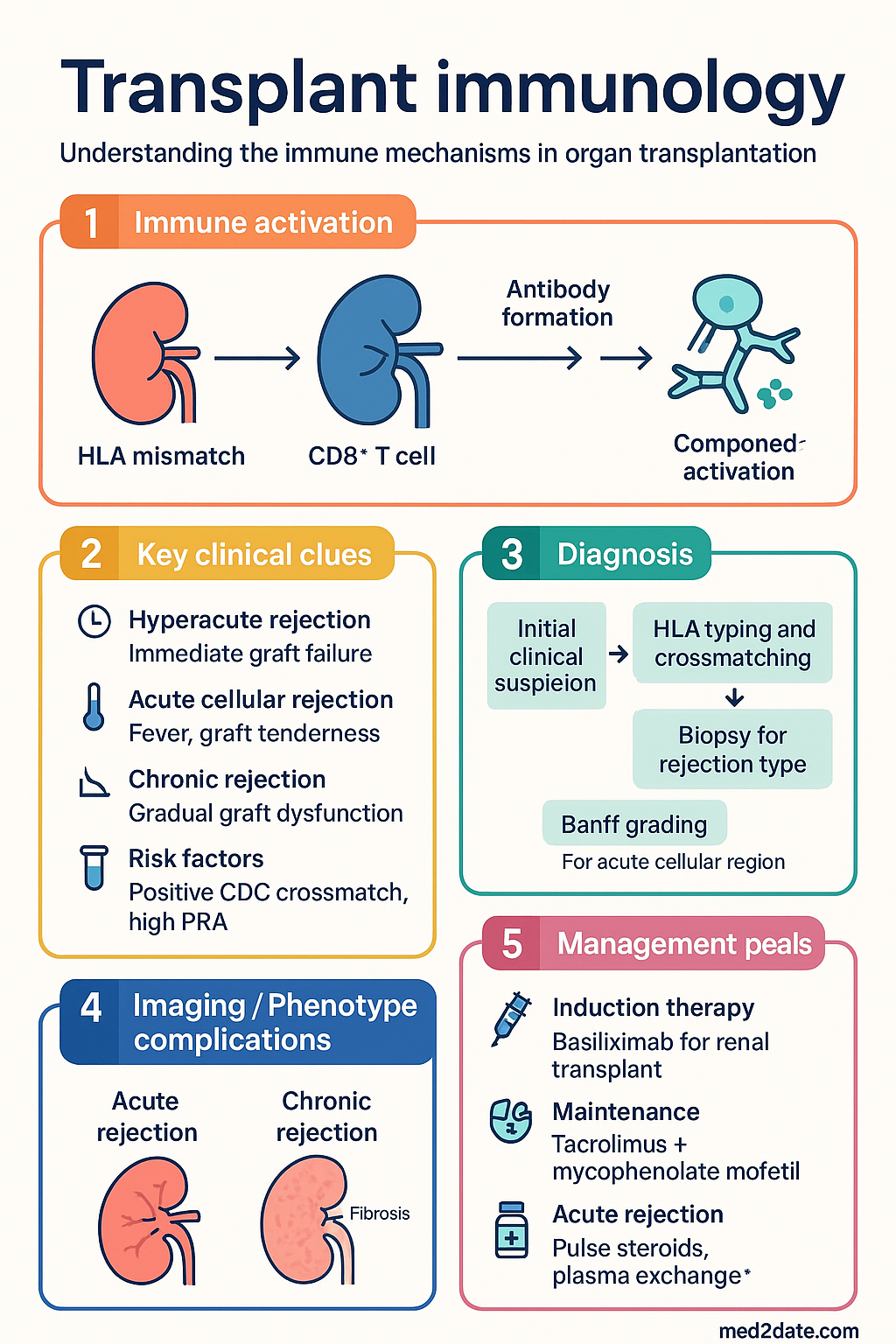
- Hyperacute rejection occurs within minutes to hours due to pre-formed anti-donor antibodies (anti-HLA or ABO); it is irreversible and mandates immediate graft removal.
- Acute cellular rejection (ACR) typically occurs within days to 6 months post-transplant; diagnosed by biopsy (Banff grading); treated with pulsed IV methylprednisolone.
- Acute antibody-mediated rejection (AMR) is driven by donor-specific antibodies (DSA); treated with plasma exchange, IV immunoglobulin (IVIG), and rituximab.
- Chronic allograft dysfunction manifests months to years post-transplant; involves interstitial fibrosis, tubular atrophy (IF/TA), and transplant glomerulopathy.
- Graft-vs-host disease (GVHD) is a risk after allogeneic haematopoietic stem cell transplantation (HSCT); skin, liver, and gut are the primary target organs.
- First-line maintenance immunosuppression in solid-organ transplantation is a calcineurin inhibitor (tacrolimus) + mycophenolate mofetil ± corticosteroids.
- Tacrolimus trough targets: kidney 5–8 ng/mL (maintenance), liver 5–10 ng/mL, heart 8–12 ng/mL; therapeutic drug monitoring (TDM) is mandatory.
- Induction therapy with basiliximab (anti-CD25) is PBS-listed for renal transplant; anti-thymocyte globulin (ATG) is used for high-immunological-risk recipients.
- Australia performed 1,482 organ transplants in 2023 (AIHW); organ donation rates remain below international benchmarks, increasing reliance on marginal and extended-criteria donors.
- Aboriginal and Torres Strait Islander peoples have higher rates of end-stage kidney disease but lower access to transplant waitlists — equity strategies are essential.
Introduction & Australian Epidemiology
Transplant immunology encompasses the immunological mechanisms governing the acceptance or rejection of transplanted organs, tissues, and cells. The field integrates histocompatibility science, innate and adaptive immune biology, and pharmacological immunosuppression to achieve durable graft function while minimising infection and malignancy risk.
In Australia, organ transplantation is coordinated through the Organ and Tissue Authority (OTA) and Donate Life, with clinical activity concentrated in designated transplant centres across each state and territory. In 2023, Australia recorded 1,482 organ transplant procedures from 503 deceased donors, alongside living-donor programmes (principally renal and liver). Despite national reforms, the deceased organ donation rate of approximately 22 donors per million population (dpmp) remains below leading nations such as Spain (49 dpmp) and the United States (45 dpmp).
Kidney transplantation is the most common procedure (~1,000/year), followed by liver (~250), lung (~200), heart (~150), and pancreas/islet (~50). Allogeneic haematopoietic stem cell transplantation (HSCT) adds approximately 700 procedures annually for malignant and non-malignant haematological conditions. Long-term graft survival has improved markedly over the past two decades, with 5-year deceased-donor kidney graft survival now exceeding 85%, attributable to refined HLA matching, improved immunosuppression, and protocol biopsy surveillance.
Key challenges in the Australian context include geographic barriers to transplantation for rural and remote populations, inequitable access for Aboriginal and Torres Strait Islander peoples, increasing donor age and comorbidity (expanded-criteria donors), and the lifelong burden of immunosuppression-related complications including infection, cardiovascular disease, diabetes, and post-transplant malignancy.
MHC / HLA Matching
The human major histocompatibility complex (MHC), termed the human leukocyte antigen (HLA) system, is located on chromosome 6p21.3 and encodes the most polymorphic genes in the human genome. HLA matching between donor and recipient is a cornerstone of pre-transplant immunological assessment and directly influences graft survival, particularly in renal transplantation.
HLA Classes and Transplant Relevance
| Feature | Class I (HLA-A, -B, -C) | Class II (HLA-DR, -DQ, -DP) |
|---|---|---|
| Expression | All nucleated cells | Antigen-presenting cells (B cells, macrophages, dendritic cells); upregulated on endothelium during inflammation |
| Present to | CD8⁺ cytotoxic T cells | CD4⁺ helper T cells |
| Transplant matching loci | HLA-A, HLA-B | HLA-DR |
| Rejection role | Direct allorecognition; CD8-mediated cytotoxicity | Indirect allorecognition; antibody production via T-helper cell activation |
| Allelic diversity (>25,000 alleles total) | >7,000 (HLA-A), >8,000 (HLA-B) | >2,700 (HLA-DRB1) |
Australian Typing and Crossmatching Practice
HLA typing in Australia is performed by National Association of Testing Authorities (NATA)-accredited histocompatibility laboratories, typically using molecular methods:
- Low-resolution typing: PCR-sequence-specific priming (PCR-SSP) or sequence-specific oligonucleotide probing (PCR-SSO) — identifies HLA antigen-level (2-digit) specificity.
- High-resolution typing: Next-generation sequencing (NGS) — identifies allele-level (4–8 digit) specificity; increasingly used for waitlisted patients and living donors to detect permissible mismatches and avoid immunogenic alleles.
- Crossmatch testing: Complement-dependent cytotoxicity (CDC) crossmatch (historical standard) and flow cytometry crossmatch (more sensitive). A positive CDC crossmatch is an absolute contraindication to transplantation in most circumstances due to hyperacute rejection risk.
- Virtual crossmatch: Using single-antigen bead (SAB) Luminex assays to characterise the recipient's anti-HLA antibody profile (specificity, MFI titre) — allows prospective crossmatching without a physical sample from the donor when donor HLA type is known.
Matching and Graft Survival
The Australian Kidney Exchange Programme (AKX) facilitates incompatible living-donor pairs and maximises HLA matching. Data from ANZDATA demonstrate the following 5-year deceased-donor kidney graft survival by HLA mismatch:
- 0-mismatch (000): ~92%
- 1–3 mismatches: ~87%
- 4–6 mismatches: ~82%
While perfect matching confers the best outcomes, the extreme polymorphism of HLA means that <15% of deceased-donor transplants in Australia achieve a 0-mismatch. Sensitised recipients (panel reactive antibody [PRA] >80%) face prolonged wait times and are prioritised through the national matching algorithms.
Rejection Types
Allograft rejection is classified by temporal onset, immunological mechanism, and histopathological pattern. Accurate classification guides treatment intensity and prognosis.
Hyperacute Rejection
Hyperacute rejection is a medical emergency characterised by immediate graft thrombosis due to pre-formed circulating antibodies binding to donor endothelium. Risk factors include positive CDC crossmatch, ABO incompatibility (unless a desensitisation protocol is in place), and high-titre anti-endothelial cell antibodies. The affected organ becomes dusky, mottled, and non-functional within minutes of reperfusion. Treatment is immediate graft nephrectomy (kidney) or explantation. Prevention relies on rigorous pre-transplant crossmatch and ABO verification — a sentinel event if missed (NSQHS Standard 7).
Acute Cellular Rejection (ACR)
ACR is mediated primarily by recipient CD4⁺ and CD8⁺ T cells recognising donor HLA antigens via direct (intact donor MHC on passenger leucocytes) and indirect (recipient APC presenting processed donor peptides) pathways. It is the most common form of acute rejection, occurring in 10–20% of renal transplants within the first year despite modern immunosuppression.
Banff classification (kidney, updated 2019):
| Grade | Interstitial Inflammation (i) | Tubulitis (t) | Endothelialitis (v) |
|---|---|---|---|
| Borderline (suspicious) | i0 or i1 | t1, t2, or t3 | v0 |
| IA | i2 or i3 | t2 | v0 |
| IB | i2 or i3 | t3 | v0 |
| IIA | Any i | Any t | v1 (mild-moderate) |
| IIB | Any i | Any t | v2 (severe) |
| III | Any i | Any t | v2 + arterial transmural or fibrinoid change |
Acute Antibody-Mediated Rejection (AMR)
AMR requires three criteria (Banff 2017): (1) histological evidence of acute tissue injury (microvascular inflammation [g+ptc ≥2], thrombotic microangiopathy, or acute tubular injury); (2) evidence of current/recent antibody interaction with endothelium (C4d positivity in peritubular capillaries or molecular evidence of endothelial injury); (3) presence of donor-specific antibodies (DSA). AMR accounts for 20–30% of acute rejection episodes and is more common in sensitised recipients and ABO-incompatible transplants.
Chronic Rejection
Chronic allograft nephropathy (CAN) — now termed interstitial fibrosis/tubular atrophy (IF/TA) of unknown aetiology — is a clinicopathological entity characterised by progressive decline in graft function, proteinuria, and histological changes including interstitial fibrosis (ci), tubular atrophy (ct), transplant glomerulopathy (cg), and arteriolar hyalinosis (ah). Chronic AMR, defined by transplant glomerulopathy + DSA + C4d, is a major driver of late graft loss. Non-immune contributors include calcineurin inhibitor (CNI) nephrotoxicity, hypertension, recurrent native kidney disease, polyomavirus (BK) nephropathy, and chronic ischaemia.
Graft-versus-Host Disease (GVHD)
GVHD occurs when immunocompetent donor T lymphocytes recognise recipient tissues as foreign and mount an immune attack. It is principally a complication of allogeneic haematopoietic stem cell transplantation (HSCT), but can also occur following solid-organ transplantation (particularly liver and small bowel), blood product transfusion (transfusion-associated GVHD), and haploidentical procedures without adequate T-cell depletion.
Acute GVHD
Acute GVHD typically manifests within 100 days of HSCT and involves a three-step process: (1) tissue damage from conditioning chemoradiotherapy releasing pro-inflammatory cytokines (TNF-α, IL-1); (2) donor T-cell activation by recipient APCs; (3) effector cell-mediated target organ apoptosis. The primary targets are skin, liver, and gastrointestinal tract.
| Organ | Stage 1 | Stage 2 | Stage 3 | Stage 4 |
|---|---|---|---|---|
| Skin (% BSA rash) | <25% | 25–50% | >50% | Generalised erythroderma with bullae/desquamation |
| Liver (bilirubin, µmol/L) | 34–51 | 51–102 | 102–255 | >255 |
| Gut (diarrhoea volume, mL/day) | 500–1000 | 1000–1500 | >1500 | >1500 ± pain/ileus |
Chronic GVHD
Chronic GVHD (>100 days post-HSCT) is the leading cause of non-relapse mortality and morbidity in long-term HSCT survivors. It resembles autoimmune connective tissue disease with scleroderma-like skin changes, sicca syndrome, bronchiolitis obliterans syndrome (BOS), and hepatic dysfunction. The NIH 2014 consensus classifies chronic GVHD as classic chronic, overlap syndrome (with acute features), or late acute.
GVHD Prophylaxis and Treatment — Australian Practice
Immunosuppression Protocols
Modern immunosuppression in solid-organ transplantation follows a three-phase model: induction (peri-operative intensive therapy), maintenance (lifelong combination therapy), and rescue (treatment of acute rejection episodes). The goal is to balance adequate immune suppression to prevent rejection against the risks of infection, malignancy, metabolic complications, and drug toxicity.
Induction Therapy
Maintenance Immunosuppression — Standard Triple Therapy
The standard maintenance regimen in Australian renal, liver, and heart transplantation is a calcineurin inhibitor (CNI) + an antiproliferative agent + corticosteroids:
mTOR Inhibitor-Based Regimens
Rejection Rescue Protocols
| Rejection Type | First-Line Treatment | Second-Line |
|---|---|---|
| Mild ACR (Banff IA–IB) | IV methylprednisolone 500 mg daily × 3 days | rATG 1.5 mg/kg IV × 5–7 days if steroid-resistant |
| Moderate-severe ACR (Banff IIA–III) | IV methylprednisolone 500 mg–1 g daily × 3 days + consider rATG | rATG if not already given; optimise maintenance immunosuppression |
| Acute AMR | Plasma exchange × 3–6 sessions + IVIG 2 g/kg (total) + pulse methylprednisolone | Rituximab 375 mg/m² IV × 1; bortezomib (off-label); eculizumab (limited PBS availability) |
| Chronic AMR | Optimise CNI/MMF; DSA monitoring; treat non-immune factors (BP, proteinuria) | Plasma exchange + IVIG (limited evidence); belatacept conversion (if CNI intolerant, not PBS-listed) |
Investigations
Special Populations
Aboriginal and Torres Strait Islander Health Considerations
Aboriginal and Torres Strait Islander peoples experience disproportionately high rates of end-stage kidney disease (ESKD) — approximately 7 times the rate of non-Indigenous Australians — driven by higher prevalence of type 2 diabetes, hypertension, and socioeconomic disadvantage. Despite this, Indigenous Australians are underrepresented on transplant waitlists and have lower rates of living-donor transplantation.
Monitoring
Post-transplant monitoring integrates graft function surveillance, immunosuppression drug levels, infection screening, and metabolic complication prevention. The frequency and intensity of monitoring is highest in the first 3 months and gradually reduces over the first year.
📚 References
- 1. Loupy A, Haas M, Roufosse C, et al. The Banff 2019 Kidney Meeting Report: Banff classification of antibody-mediated rejection and chronic active T cell-mediated rejection. Am J Transplant. 2020;20(4):806–819.
- 2. Transplantation Society of Australia and New Zealand (TSANZ). Clinical guidelines for organ transplantation from deceased donors. Version 2.0. 2021. Available from: https://www.tsanz.com.au
- 3. Australian Institute of Health and Welfare (AIHW). Australia's organ and tissue donation and transplantation annual report 2023. Canberra: AIHW; 2024.
- 4. Australian and New Zealand Dialysis and Transplant Registry (ANZDATA). ANZDATA 46th annual report 2023. Adelaide: ANZDATA; 2023. Available from: https://www.anzdata.org.au
- 5. Kidney Disease: Improving Global Outcomes (KDIGO). KDIGO 2024 Clinical Practice Guideline for the evaluation and management of chronic kidney disease. Kidney Int Suppl. 2024;14(1):1–163.
- 6. Jagasia MH, Greinix HT, Arora M, et al. National Institutes of Health Consensus Development Project on Criteria for Clinical Trials in Chronic Graft-versus-Host Disease: I. The 2014 Diagnosis and Staging Working Group report. Biol Blood Marrow Transplant. 2015;21(3):389–401.
- 7. Clayton PA, McDonald SP, Chadban SJ. Steroids and recurrent IgA nephropathy after kidney transplantation. J Am Soc Nephrol. 2011;22(6):1171–1179.
- 8. Australian Commission on Safety and Quality in Health Care (ACSQHC). National Safety and Quality Health Service Standards. 2nd ed. Sydney: ACSQHC; 2021.
- 9. Webster AC, Lee VW, Chapman JR, Craig JC. Target of rapamycin inhibitors (sirolimus and everolimus) for primary immunosuppression of kidney transplant recipients: a systematic review and meta-analysis of randomized trials. Transplantation. 2006;81(9):1234–1248.
- 10. Hoy WE, Mathews JD, McCredie DA, et al. The multidimensional nature of renal disease: rates and associations of albuminuria in an Australian Aboriginal community. Kidney Int. 1998;54(4):1296–1304.
- 11. Grace JA, Angus PW. Rational prescribing of immunosuppressive drugs in liver transplantation. Aust Prescr. 2019;42(4):118–123.
- 12. Australian Society of Clinical Immunology and Allergy (ASCIA). Guidelines for the management of transplant immunology. 2023. Available from: https://www.allergy.org.au