📋 Key Information Summary
- T cell deficiency impairs cell-mediated immunity, predisposing to opportunistic infections by intracellular pathogens, fungi, and certain viruses
- Primary causes include severe combined immunodeficiency (SCID), DiGeorge syndrome (22q11.2 deletion), and combined variable immunodeficiency (CVID)
- Secondary causes are dominated by HIV/AIDS, corticosteroid therapy, post-transplant immunosuppression, and chemotherapy
- Absolute CD4+ T cell count is the principal marker of T cell competence; <200 cells/μL defines severe deficiency in HIV
- Presenting infections include Pneumocystis jirovecii pneumonia (PCP), mucocutaneous candidiasis, CMV disease, and mycobacterial infections
- Investigation pathway: full blood count with lymphocyte subsets, flow cytometry, HIV serology, and functional T cell assays
- Newborn screening for SCID using T cell receptor excision circles (TRECs) is performed in all Australian states via Guthrie cards
- PCP prophylaxis with trimethoprim–sulfamethoxazole is indicated when CD4 <200 cells/μL in HIV and in other severely immunosuppressed patients
- Live vaccines (MMR, varicella, BCG, oral polio, Yellow Fever) are generally contraindicated in significant T cell deficiency
- Antiretroviral therapy (ART) is the cornerstone of management for HIV-related T cell deficiency; early initiation improves outcomes
- Haematopoietic stem cell transplantation (HSCT) is curative for SCID and other severe primary immunodeficiencies
- Aboriginal and Torres Strait Islander peoples have disproportionately higher HIV and TB rates, requiring culturally safe screening and management
- Immunology and infectious diseases referral is recommended for all patients with confirmed primary T cell deficiency
Introduction & Australian Epidemiology
T cell deficiency impairs cell-mediated immunity, the arm of the adaptive immune system responsible for defence against intracellular pathogens, fungi, and certain viruses. Deficiency may be primary (genetic/congenital) or secondary (acquired), and the clinical severity ranges from mild susceptibility to infections in partial deficiency to life-threatening opportunistic disease in severe deficiency.
In Australia, secondary T cell deficiency — particularly HIV/AIDS and iatrogenic immunosuppression — accounts for the vast majority of cases encountered in clinical practice. As of 2023, approximately 29,460 people were living with HIV in Australia, with an estimated 90% diagnosed, 91% of those on antiretroviral therapy, and 97% of those virally suppressed (Kirby Institute, 2023). Despite these strong national outcomes, late diagnosis remains a concern, with approximately one-third of new diagnoses presenting with a CD4 count <350 cells/μL.
Primary immunodeficiencies (PIDs) affecting T cells are rare but important. Severe combined immunodeficiency (SCID) affects approximately 1 in 50,000–70,000 live births. Since 2018, newborn screening for SCID via T cell receptor excision circles (TRECs) on Guthrie cards has been progressively implemented across Australian states and territories, enabling early detection and life-saving intervention.
DiGeorge syndrome (22q11.2 deletion syndrome) affects approximately 1 in 4,000 live births and may present with a spectrum of T cell impairment ranging from complete absence (complete DiGeorge) to mild lymphopenia that improves with age (partial DiGeorge).
Iatrogenic T cell suppression — from corticosteroids, calcineurin inhibitors, anti-thymocyte globulin, rituximab, and various chemotherapeutic agents — is increasingly encountered as transplant medicine, oncology, and rheumatology therapeutic programmes expand in Australia.
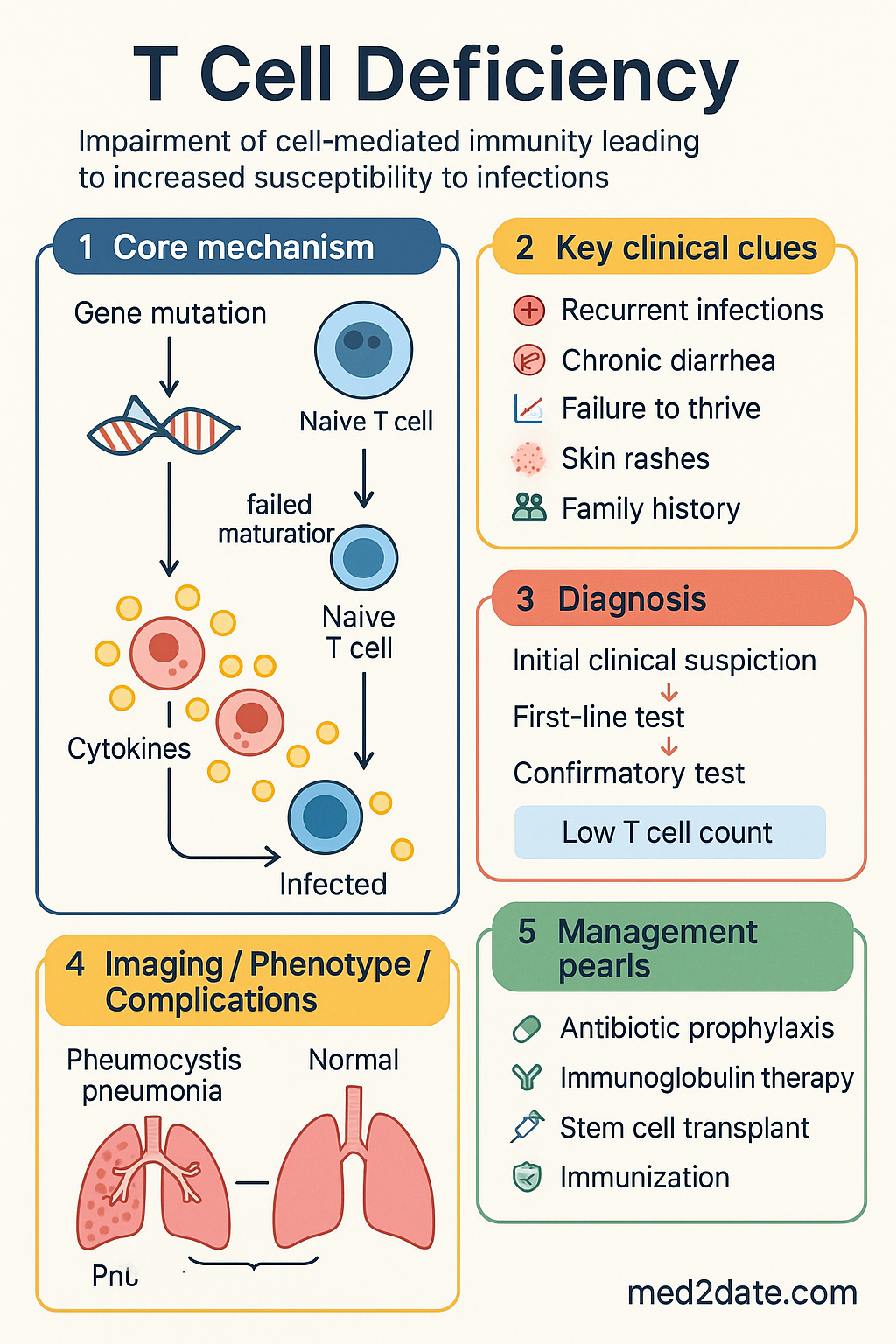
Causes & Classification
T cell deficiency is classified broadly as primary (inherited/congenital) or secondary (acquired). The classification guides investigation, prognosis, and management strategy.
Primary T Cell Deficiency
| Condition | Genetic Basis | Inheritance | Key Features |
|---|---|---|---|
| Severe Combined Immunodeficiency (SCID) | IL2RG, JAK3, RAG1/2, ADA, IL7Rα, CD3δ/ε/ζ, Artemis mutations | X-linked or AR | Absent T cells (±B/NK cells); presents in infancy with failure to thrive, opportunistic infections; universally fatal without HSCT |
| DiGeorge Syndrome (22q11.2 deletion) | 22q11.2 microdeletion | De novo (90%) or AD | Thymic hypoplasia/aplasia; spectrum from complete absence of T cells (complete DiGeorge) to mild lymphopenia; associated cardiac anomalies, hypocalcaemia, facial dysmorphism |
| Combined Variable Immunodeficiency (CVID) | Heterogeneous; ICOS, TACI, BAFFR, CD19 | Usually sporadic; AR/AD forms | Hypogammaglobulinaemia with impaired T cell function; typically presents in 2nd–4th decade; recurrent sinopulmonary infections, autoimmunity |
| Wiskott–Aldrich Syndrome | WAS gene (Xp11.22) | X-linked | Eczema, thrombocytopenia, combined immunodeficiency; progressive T cell decline |
| Ataxia Telangiectasia | ATM gene | AR | Progressive cerebellar ataxia, telangiectasia, combined immunodeficiency, cancer predisposition |
| Hyper-IgM Syndromes | CD40LG, CD40, AID, UNG | X-linked or AR | Defective class-switch recombination; low IgG/IgA with elevated IgM; susceptibility to Pneumocystis, Cryptosporidium |
| DOCK8 Deficiency | DOCK8 | AR | Severe eczema, recurrent viral skin infections, combined immunodeficiency, elevated IgE |
Secondary (Acquired) T Cell Deficiency
| Cause | Mechanism | Clinical Context |
|---|---|---|
| HIV infection | CD4+ T cell destruction by HIV; immune activation and exhaustion | Most common cause of T cell deficiency in Australia; ~29,460 people living with HIV (2023) |
| Corticosteroids | T cell apoptosis, reduced IL-2 production, lymphocyte redistribution | Risk increases with doses >20 mg/day prednisolone equivalent for >2 weeks |
| Calcineurin inhibitors | Block IL-2 transcription (cyclosporin, tacrolimus) | Solid organ and stem cell transplant recipients |
| Anti-thymocyte globulin (ATG) | T cell depletion via antibody-mediated cytotoxicity | Induction therapy in transplantation; aplastic anaemia treatment |
| Chemotherapy | Cytotoxic to rapidly dividing lymphocytes | Fludarabine, cladribine, alemtuzumab particularly lymphodepletive |
| Biologics (rituximab, anti-TNFα) | B cell depletion (indirect T cell dysfunction); TNF blockade impairs granuloma formation | Rheumatoid arthritis, IBD, lymphoma, vasculitis |
| Malnutrition | Thymic atrophy, reduced lymphopoiesis | Protein-energy malnutrition, anorexia nervosa, critical illness |
| Malignancy | T cell lymphoma, thymoma, bone marrow infiltration | Direct tumour effect on thymus or lymphoid tissue |
| Chronic viral infections (CMV, EBV) | T cell exhaustion and immune senescence | Post-transplant, chronic immunosuppression |
Clinical Features
The clinical presentation of T cell deficiency varies with the severity of T cell impairment and whether associated B cell or antibody deficiency is present. Patients with predominantly T cell dysfunction are susceptible to a characteristic spectrum of infections, while those with combined defects present with broader infectious and non-infectious manifestations.
Infectious Presentations by T Cell Count
Pathogen-Specific Susceptibilities
| Pathogen Category | Specific Organisms | Clinical Syndromes |
|---|---|---|
| Fungi | Candida spp., Cryptococcus neoformans, Histoplasma capsulatum, Coccidioides spp. | Oropharyngeal/oesophageal candidiasis, cryptococcal meningitis, disseminated histoplasmosis |
| Opportunistic protozoa | Toxoplasma gondii, Cryptosporidium spp., Microsporidium spp. | Cerebral toxoplasmosis, chronic diarrhoea, cholangiopathy |
| Viruses | CMV, HSV, VZV, EBV, JC virus, HHV-8 | CMV retinitis/colitis, severe mucocutaneous HSV, disseminated VZV, PML, Kaposi sarcoma |
| Mycobacteria | M. tuberculosis, M. avium complex (MAC) | Disseminated TB, MAC bacteraemia, chronic pulmonary disease |
| Bacteria | Pneumocystis jirovecii (classified as fungus), Listeria monocytogenes, Nocardia spp., Salmonella spp. | PCP pneumonia, listeria meningitis/bacteraemia, nocardiosis, recurrent salmonella bacteraemia |
Non-Infectious Features
- Failure to thrive (infants with SCID or DiGeorge)
- Chronic diarrhoea and malabsorption
- Autoimmune phenomena — particularly in CVID, IPEX, and DiGeorge syndrome
- Eczematous dermatitis — DOCK8 deficiency, Wiskott–Aldrich syndrome
- Malignancy — lymphoma (EBV-associated), Kaposi sarcoma (HHV-8)
- Graft-versus-host disease — in SCID following non-irradiated blood transfusion (transfusion-associated GVHD)
- Congenital anomalies — cardiac defects, hypocalcaemia, facial dysmorphism (DiGeorge)
Investigations
Investigation of T cell deficiency follows a stepwise approach from basic blood tests to specialised functional and genetic studies. The depth of investigation is guided by clinical suspicion of primary versus secondary deficiency.
Initial Screening Tests
Specialised / Confirmatory Investigations
Age-Adjusted Normal Lymphocyte Counts
| Age | Total Lymphocytes (cells/μL) | CD3+ T cells (cells/μL) | CD4+ T cells (cells/μL) |
|---|---|---|---|
| Birth | 2,000–11,000 | 1,500–6,000 | 1,000–4,000 |
| 2–6 months | 2,500–16,500 | 2,000–10,000 | 1,400–7,000 |
| 1–2 years | 2,000–10,000 | 1,500–7,000 | 1,000–5,000 |
| 6–12 years | 1,500–6,000 | 1,000–3,500 | 600–2,500 |
| Adult | 1,000–4,800 | 700–2,100 | 400–1,500 |
Management
Management of T cell deficiency encompasses treatment of underlying causes, opportunistic infection prophylaxis and treatment, immune reconstitution, vaccination modifications, and specialist referral. The approach differs substantially between primary and secondary deficiency.
Antimicrobial Prophylaxis
Prophylaxis is targeted to the CD4 count and the specific pathogen risks. The following regimens align with Australian Therapeutic Guidelines and national HIV management guidelines.
Antiretroviral Therapy (HIV-Related T Cell Deficiency)
ART is the cornerstone of immune reconstitution in HIV. Current Australian guidelines recommend initiation of ART in all people diagnosed with HIV, regardless of CD4 count (ASHM, 2024). Preferred first-line regimens for treatment-naïve adults include:
Curative Therapies for Primary T Cell Deficiency
Vaccination Considerations
- MMR (measles, mumps, rubella) — except in asymptomatic HIV with CD4 ≥200
- Varicella (unless CD4 ≥200 and asymptomatic HIV)
- BCG (Bacillus Calmette–Guérin)
- Oral polio (Sabin) — use IPV (inactivated) instead
- Yellow Fever
- Rotavirus
- Oral typhoid (Ty21a)
Household contacts should receive influenza vaccination annually and ensure up-to-date MMR, varicella, and pertussis vaccination to create a cocoon of protection. COVID-19 vaccination (mRNA-based, not live) is recommended and safe in T cell-deficient patients.
Immunoglobulin Replacement
If T cell deficiency is accompanied by hypogammaglobulinaemia or impaired antibody production (e.g., CVID, hyper-IgM syndromes), immunoglobulin replacement therapy (IgRT) is indicated:
- IVIg: 400–600 mg/kg every 3–4 weeks (PBS Authority Required)
- SCIg: 100–200 mg/kg per week subcutaneous infusion (home-based programme available via immunology departments)
MBS item 13705 covers IVIg administration in hospital settings; MBS item 13711 for SCIg home administration training.
Special Populations
Aboriginal and Torres Strait Islander peoples experience a disproportionate burden of infections that are exacerbated by T cell deficiency. Culturally safe, trauma-informed care is essential in all clinical encounters.
📚 References
- 1. Kirby Institute. HIV, viral hepatitis and sexually transmissible infections in Australia: Annual surveillance report 2023. Sydney: UNSW Sydney; 2023.
- 2. Australasian Society for HIV, Viral Hepatitis and Sexual Health Medicine (ASHM). Antiretroviral guidelines: Australian commentary on the US DHHS guidelines for the use of antiretroviral agents in adults and adolescents with HIV. ASHM; 2024.
- 3. National Health and Medical Research Council (NHMRC). Australian immunisation handbook. Australian Government Department of Health; 2024. Available from: immunisationhandbook.health.gov.au.
- 4. Bousfiha A, Moundir A, Tangye SG, et al. The 2022 Update of IUIS Phenotypical Classification for Human Inborn Errors of Immunity. J Clin Immunol. 2022;42(7):1508–1520.
- 5. Kwan A, Abraham RS, Currier R, et al. Newborn screening for severe combined immunodeficiency in 11 screening programs in the United States. JAMA. 2014;312(7):729–738.
- 6. Australian Institute of Health and Welfare (AIHW). HIV, viral hepatitis and sexually transmissible infections in Australia: Annual surveillance report. Canberra: AIHW; 2023.
- 7. RHDAustralia (a programme of Menzies School of Health Research). NT Tuberculosis Procedures Manual. Darwin: NT Department of Health; 2022.
- 8. Lucas M, Hughes WJ, Kwan A, et al. Newborn screening for severe combined immunodeficiency: what are we waiting for? Ann Allergy Asthma Immunol. 2023;130(4):427–433.
- 9. Shearer WT, Rosenblatt HM, Gelman RS, et al. Lymphocyte subsets in healthy children from birth through 18 years of age: the Pediatric AIDS Clinical Trials Group P1009 study. J Allergy Clin Immunol. 2003;112(5):973–980.
- 10. Parker SK, Harding JL. Newborn screening for SCID: what comes next? Immunol Allergy Clin North Am. 2020;40(3):497–512.
- 11. Australasian Society of Clinical Immunology and Allergy (ASCIA). Primary immunodeficiency diseases: position statements and guidelines. ASCIA; 2024. Available from: allergy.org.au.
- 12. Department of Health and Aged Care, Australian Government. National Aboriginal and Torres Strait Islander Health Plan 2021–2031. Canberra: Commonwealth of Australia; 2021.